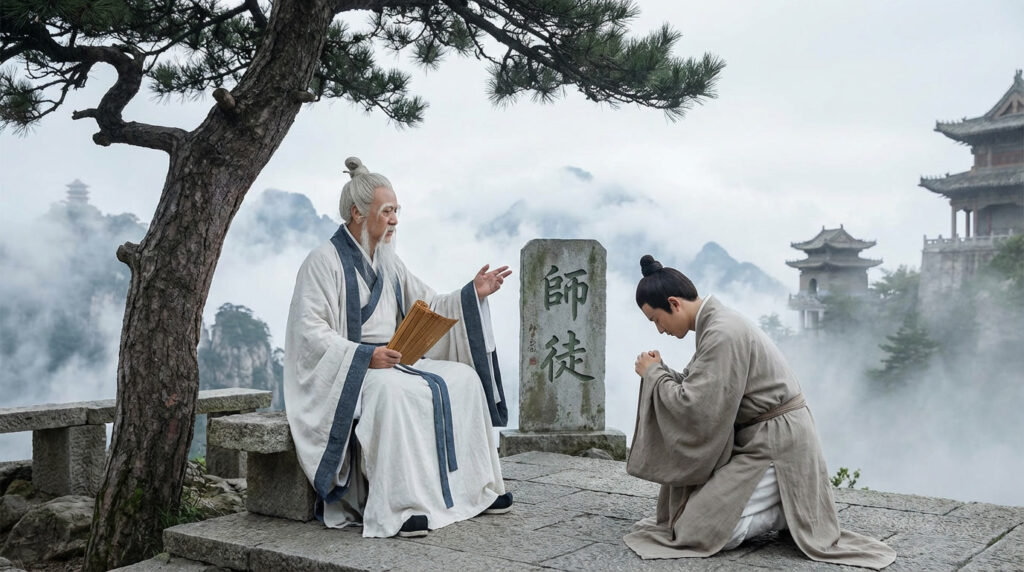
Master & Disciple Hierarchy
Respect • Responsibility • Teaching Lineage • Martial Family Structure
Shifu / Shizun / Shixiong / Shimei
The Master–Disciple relationship is one of the most iconic foundations in wuxia, xianxia, and classical Chinese storytelling.
It’s how skills are transmitted, how values are passed down, and how characters form their deepest bonds — for better or worse.
But Western audiences often misunderstand this dynamic. It’s not “teacher and student.” It’s not “mentor and apprentice.” It’s an entire cultural hierarchy, with rules, obligations, boundaries, and emotional weight.
Let’s break it down clearly.
What the Master–Disciple Hierarchy Is
At its core, the hierarchy is a:
“Martial family built on respect, duty, and lineage.”
It includes:
- A Master (Shifu 师父 / Shizun 师傅 depending on context)
- Senior Disciples (Shixiong 师兄, Shijie 师姐)
- Junior Disciples (Shidi 师弟, Shimei 师妹)
- Sect Elders or Grandmasters (Shizu 师祖, Shigong 师公)
This system forms:
- a chain of authority
- a chain of responsibility
- a chain of inheritance (skills, manuals, positions)
- a chain of loyalty
It’s a structure that blends:
family + military hierarchy + school lineage.
Characters don’t just join a sect. They join a family with rules.
❌ What the Hierarchy Is NOT
This is where Western adaptations get messy.
✔ Not a casual teacher–student relationship
You don’t just “sign up” for classes.
✔ Not equal
There is always someone above and below.
✔ Not temporary
It’s a lifelong relationship unless formally severed.
✔ Not a modern dojo
No belts, no paid memberships, no rotating teachers.
✔ Not a democracy
The seniority system decides order, roles, and privileges.
The hierarchy has real consequences — socially, morally, and emotionally.
How the Hierarchy Works (Story Logic)
Inside a sect or martial school:
The Shifu / Shizun (Master)
embodies authority
holds responsibility for disciples’ actions
sets the rules
chooses who inherits core techniques
decides punishments and rewards
protects the disciples as if they were their own children
Senior Disciples
mentor younger ones
regulate discipline
act as extensions of the Master
pass down foundational skills
represent the sect in public
Junior Disciples
obey seniors
follow the rules
train harder than anyone
uphold the school’s name
inherit culture, not just skills
Grandmaster / Sect Head
passes down legacy
holds the highest authority
decides internal politics and direction
Hierarchy = order, duty, and transmission of knowledge.
Master–Disciple in Combat & Conflict
The hierarchy shapes:
who steps forward in a fight
who protects whom
who negotiates
who takes blame
how revenge arcs get justified
who inherits dangerous knowledge
why betrayals matter
If a disciple breaks rules, the Shifu takes responsibility. If a Shifu is insulted, disciples MUST react. If a senior disciple is harmed, juniors respond as family.
This hierarchy creates emotional stakes.
Hierarchy Terms (Easy Guide)
Shifu / Shizun (师父 / 师傅) — Master
Authority figure & martial parent.
Shixiong (师兄) — Senior Martial Brother
Older male disciple in rank.
Shijie (师姐) — Senior Martial Sister
Older female disciple in rank.
Shidi (师弟) — Junior Martial Brother
Younger male disciple.
Shimei (师妹) — Junior Martial Sister
Younger female disciple.
Shishu (师叔) — Martial Uncle
Your master’s martial brothers.
Shibo (师伯) — Martial Elder Uncle
Senior generation of your master.
Shizu (师祖) — Grandmaster
Your master’s master.
It’s a full family tree — just martial.
Why Western Sources Get It Wrong
Two reasons:
1. Translations collapsed everything into “master” or “teacher.”
Nuance vanished.
2. Hollywood framed mentors as lone wolves.
But in Chinese tradition, mentorship = family + duty + lineage.
The whole emotional framework was lost in translation.
Hierarchy in CVM Sekai
In CVM Sekai stories, the Master–Disciple system follows three core rules:
✔ Hierarchy = identity
Characters define themselves by where they stand in the lineage.
✔ Respect flows upward; responsibility flows downward
Seniors guide juniors.
Juniors honor seniors.
Everyone is a family.
✔ Breaking hierarchy has consequences
Emotional, cultural, relational, and sometimes supernatural (if tied to cultivation).
This system becomes the emotional skeleton of your martial worlds.
Common Variations in Fiction (Fiction-Friendly)
Strict Hierarchy
Everything is formal. Seniority decides all.
Loose Hierarchy
Master treats disciples more like friends or found family.
Corrupted Hierarchy
Master abuses authority. Power imbalance becomes a plot driver.
Rebel Disciple Arc
Disciple challenges or rejects the system. Important for identity arcs.
Lost Lineage / Last Disciple Trope
The only survivor carries the entire legacy. These variations appear constantly in Wuxia and Xianxia.
Final Takeaway
The Master–Disciple hierarchy is:
lineage
responsibility
cultural identity
respect
inheritance
emotional structure
the martial world’s “family system”
It is one of the most meaningful — and most misunderstood — elements of wuxia and cultivation storytelling. Once you understand it, character relationships become richer, deeper, and far more dramatic.