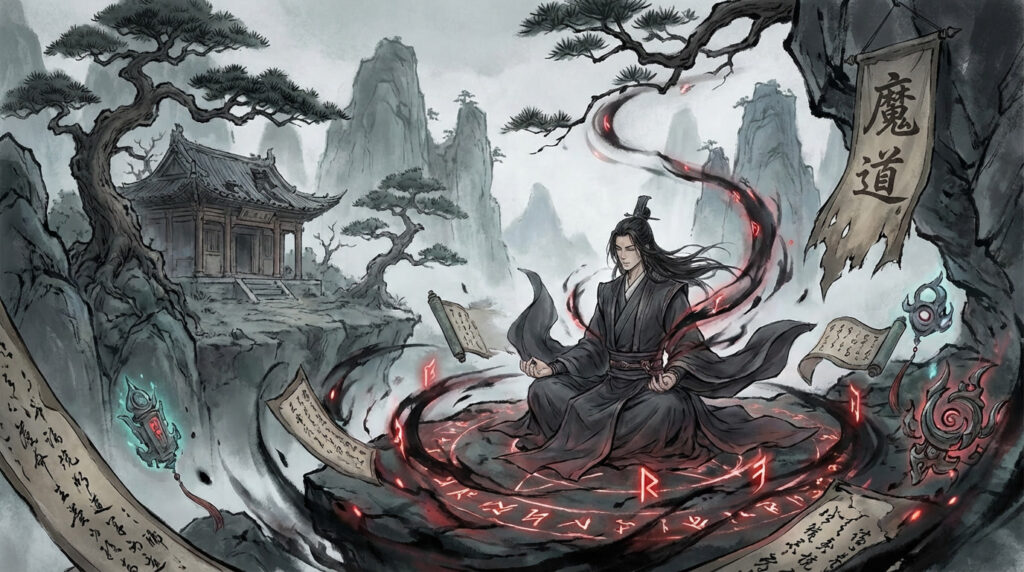
Demonic Cultivation (魔道 / 邪道)
Corrupted Power • Forbidden Methods • The Path of Desire and Chaos
Demonic Cultivation (魔修) is one of the most dramatic, misunderstood concepts in Xianxia. People assume it means “evil magic,” “black qi,” or “turning into a demon,” but that’s not the truth.
Demonic Cultivation is a path, not a race. A philosophy, not a species. A choice, not a curse.
It’s the story of people who pursue power through methods that warp their mind, body, and Dao.
Let’s break it down the right way.
What Demonic Cultivation Actually Is
At its core, Demonic Cultivation (魔修 / 魔道) is:
“A cultivation path fueled by desire, obsession, corruption, or taboo methods.”
It is defined by:
impure or corrupted qi
twisted Dao philosophy
breaking moral or natural laws
using forbidden methods
power gained at the cost of stability or humanity
rejecting balance for extremes
Demonic cultivators are not always evil — but they are always dangerous.
❌ What Demonic Cultivation Is NOT
People online mix this up constantly, so let’s separate fact from trope:
✔ Not the same as being a demon
A human can be Demonic Cultivators 魔修.
A demon can also be righteous.
✔ Not inherently cruel
Some demonic cultivators live by strict personal codes.
✔ Not always “dark magic”
The visual aesthetic varies — it’s the method that defines Demonic Cultivation 魔修, not the color scheme.
✔ Not a separate energy type
They still use qi — but corrupted, twisted, or forced.
✔ Not a free power-up
Demonic cultivation always comes with costs.
How Demonic Cultivation Works (Xianxia Logic)
Demonic cultivation twists:
1. Dao (道)
The cultivator’s path becomes warped by desire, vengeance, obsession, or cruelty.
2. Qi (气)
Energy is taken violently or unnaturally, causing instability.
3. Body (体)
Physical structure changes under stress, techniques, or corruption.
4. Heart (心)
Emotional center becomes vulnerable to deviation and collapse.
5. Mind / Spirit (神)
Hallucinations, paranoia, obsession — the mind fractures under the burden.
Demonic cultivation is powerful… but never stable.
Common Demonic Methods (Fiction-Friendly)
Absorption Techniques (吞噬术)
Stealing qi from others.
Blood Cultivation (血修)
Using blood as a medium for power.
Corpse Cultivation (尸修)
Raising or manipulating corpses or corpse qi.
Desire Cultivation (欲修)
Using emotions, indulgence, or lust for breakthroughs.
Pain / Torture Cultivation
Inflicting or receiving pain to force progress.
Contracting Evil Spirits
Borrowing power that corrupts over time.
All these methods have two things in common:
They shortcut natural growth.
They damage the cultivator psychologically or spiritually.
Why Someone Chooses the Demonic Path
Demonic cultivators often come from:
betrayal
trauma
desire for revenge
desperation
loss of purpose
ideological rebellion
inability to follow orthodox methods
Demon cultivator 魔修 characters are rarely born evil. Their story is usually about pain + choices + consequences.
Demonic Cultivators in Combat
They are:
explosive
unpredictable
brutally efficient
emotionally unstable
sometimes brilliant, sometimes feral
Their fighting style blends:
corrupted qi attacks
blood or shadow techniques
self-sacrificing power boosts
ruthless efficiency
But they burn out quickly. Stability is not their strength.
Demonic vs Righteous Cultivation
A key distinction in xianxia:
Righteous Path (正道)
harmony
balance
moral rules
sustainable cultivation
emotional stability
Demonic Path (魔道)
shortcuts
extremes
taboo, corruption
rapid growth with side effects
unstable Dao Heart
Both paths produce powerful cultivators — but only one leads to long-term stability.
Demonic Cultivation vs Devil Path (魔族 / 魔界)
Important distinction:
Demonic Cultivation (魔修 / 魔道)
Humans (or other beings) who choose a corrupted method.
Devil Path / Demon Race (魔族)
A literal species or realm. Different origin, different culture.
They are NOT the same. Western translations often merge them incorrectly.
Why Western Sources Get Demonic Cultivation Wrong
1. “Villain = demonic” simplified everything
Flattened nuance into cartoon evil.
2. Anime/manga used visual shorthand (purple = bad)
Color ≠ cultivation path.
3. Game adaptations turned it into a class choice
Removed the cultural and emotional depth.
4. Bad translations merged Demonic Cultivation 魔修 with Demonic Path 魔族
Two unrelated concepts became one.
Demonic Cultivation in CVM Sekai
In CVM Sekai:
✔ Demonic cultivation = psychological + spiritual corruption
The focus is emotional instability, not gore.
✔ Power gained always has narrative consequences
No free growth.
✔ The Demonic Path is cinematic, dramatic, dangerous
Not aesthetic-only.
✔ Demonic cultivators can be tragic, loyal, or complex
Morality is layered, not binary.
✔ The corrupted path reflects character flaws
Obsession → downfall
Anger → collapse
Trauma → instability
Ambition → recklessness
Every Demonic Cultivation 魔修 arc reveals a deeper emotional truth.
Common Demonic Cultivator Tropes (CVM-Friendly)
The tragic antihero
The vengeance-consumed genius
The desperate survivor
The corrupted prodigy
The forbidden-technique inheritor
The reluctant demonic cultivator
The redemption arc
The irreversible fall
You can use these in CVM Sekai without copying any existing franchises.
Final Takeaway
Demonic Cultivation (魔修 / 魔道) is:
a corrupted path
a philosophy of extremes
a distortion of Dao
dangerous, powerful, unstable
emotionally driven
morally complex
a narrative mirror of a character’s deepest flaws
It is not “evil magic.” It is the resonance of desire, pain, and power pushed too far.