
The Jade Emperor (玉皇大帝), Ruler of the Heavenly Court and Immortal Realm
Sovereign of Heaven, Earth and the Underworld
The Celestial Boss Who Pretends Everything Is Under Control
The Jade Emperor is the cosmic CEO who definitely should not be the CEO. He sits on a golden dragon throne the size of a small country, wears enough embroidered silk to fund three kingdoms, and hopes this convinces everyone that he is not panicking. Spoiler alert. He is always panicking. He rules Heaven, Earth and the Underworld, but he still cannot rule over the immortals who treat the Heavenly Court like a drama competition with unlimited budget.
He tries to project ancient wisdom but honestly he looks like someone who inherited his job through divine nepotism. The universe was barely formed when he became the boss, and he has been confused ever since. Every time a problem happens he lifts his chin, pretends to be composed, and then whispers, “Go find Tai Bai” because he knows exactly who the actual competent adult is.
He is the monarch who holds council meetings that everyone ignores. He writes decrees that half the gods misinterpret and the other half forget to read. The dragons do not listen to him. The star officials do not listen to him. Sun Wu Kong definitely does not listen to him. Honestly the Jade Emperor is lucky if even one department meets its quarterly celestial goals.
The Jade Emperor has a whole army of heavenly generals but somehow still ends up sending one old diplomat with a calm smile to handle disasters. He talks a big game about order and balance while the Peach Garden is empty, the Eight Immortals are drinking again, and Monkey is running across Heaven like it is a playground. The Jade Emperor has seen rebellion, cosmic theft and large scale monkey violence but he still believes that maybe today will be peaceful if no one touches anything.
In summary, he is the world’s oldest middle manager. He rules the heavens with the quiet desperation of a man who is trying to keep a straight face while everything collapses behind him. The Jade Emperor deserves respect, but he also deserves an auditor and a vacation. Maybe if the immortals let him rest for ten minutes the universe would not constantly shift into chaos. Until then he will sit on his glowing throne and pretend it is all part of the plan.
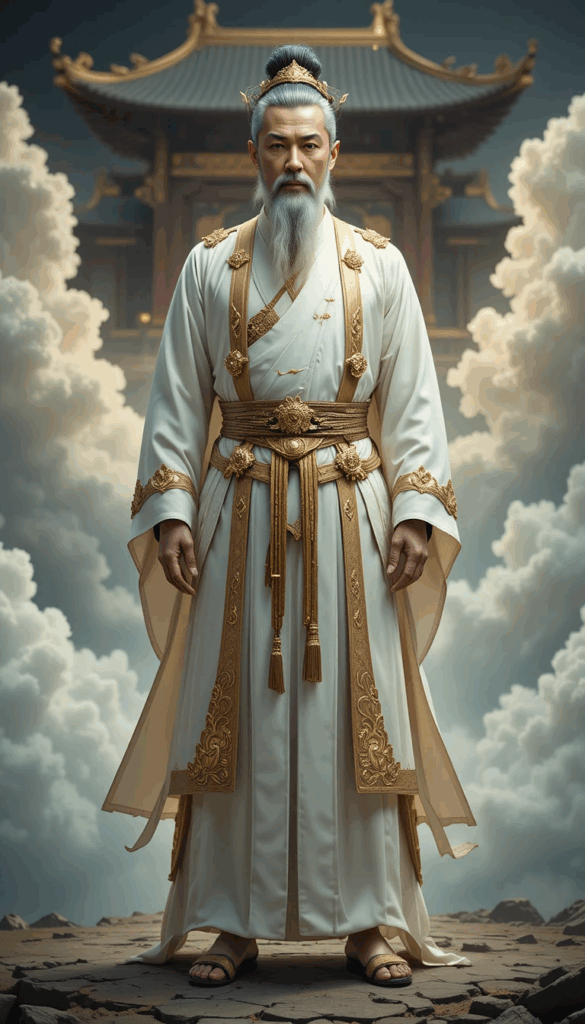
The Jade Emperor stands with the calm patience of a man who has given up on being surprised. His eyes say he has seen too much, his posture says he refuses to bend, and his soul quietly wonders why immortals keep making his job harder. He looks regal, powerful and absolutely done with everyone.
Character At-a-Glance Details
- Name: The Jade Emperor (玉皇大帝)
- First Name: Jade
- Family Name: Emperor
- Nickname/Title:
- Supreme Heavenly Boss
- Cosmic CEO Who Pretends Everything Is Fine
- Ancient Manager of Universal Problems
- Age: Ancient. Older than the paperwork he forces everyone else to complete.
- Height: Tall enough to look down on immortals who disappoint him, which is most of them.
- Build: Regal and deceptively calm. Physically sturdy enough to sit through centuries of celestial meetings.
- Appearance Snapshot: Golden crown, white and gold robes, permanent expression of dignified exhaustion. Looks majestic even when internally screaming.
- Background: Appointed ruler of all realms since before anyone remembers. Possibly promoted by cosmic nepotism. Possibly promoted because no one else wanted the job.
- Affiliation: The Heavenly Court. Every single department. Every single problem.
- Career/Profession: Sovereign of Heaven, Earth and the Underworld. Full time manager of immortals who do not read instructions.
- Moral Alignment: Lawful Overwhelmed.
- Location: The Celestial Palace. Usually on the throne. Occasionally hiding behind the throne when Sun Wu Kong visits.
- Status: Eternal ruler. Permanently stressed. Still pretending everything is under control.
- Combat Classification: Celestial Commander Who Never Actually Fights
- Primary Weapon: His authority, which everyone ignores until it is too late
- Secondary Weapon: Delegation, usually to Tai Bai Jin Xing
- Fighting Style/Tactics: Standing very still and letting his generals pretend they have a plan
- Areas of Expertise: Cosmic administration, throne sitting, dramatic pauses
- Unique Ability/Talent: The power to look calm while spiritually deceased
- Story World: Ascendant Skies
- Book: Journey to the West
- Series: Classical Translations
- Story Role: The ancient ruler who tries to appear in control while chaos happens behind him
- Functional Role in Group: The supervisor who signs the forms but someone else does the real work
Character Summary
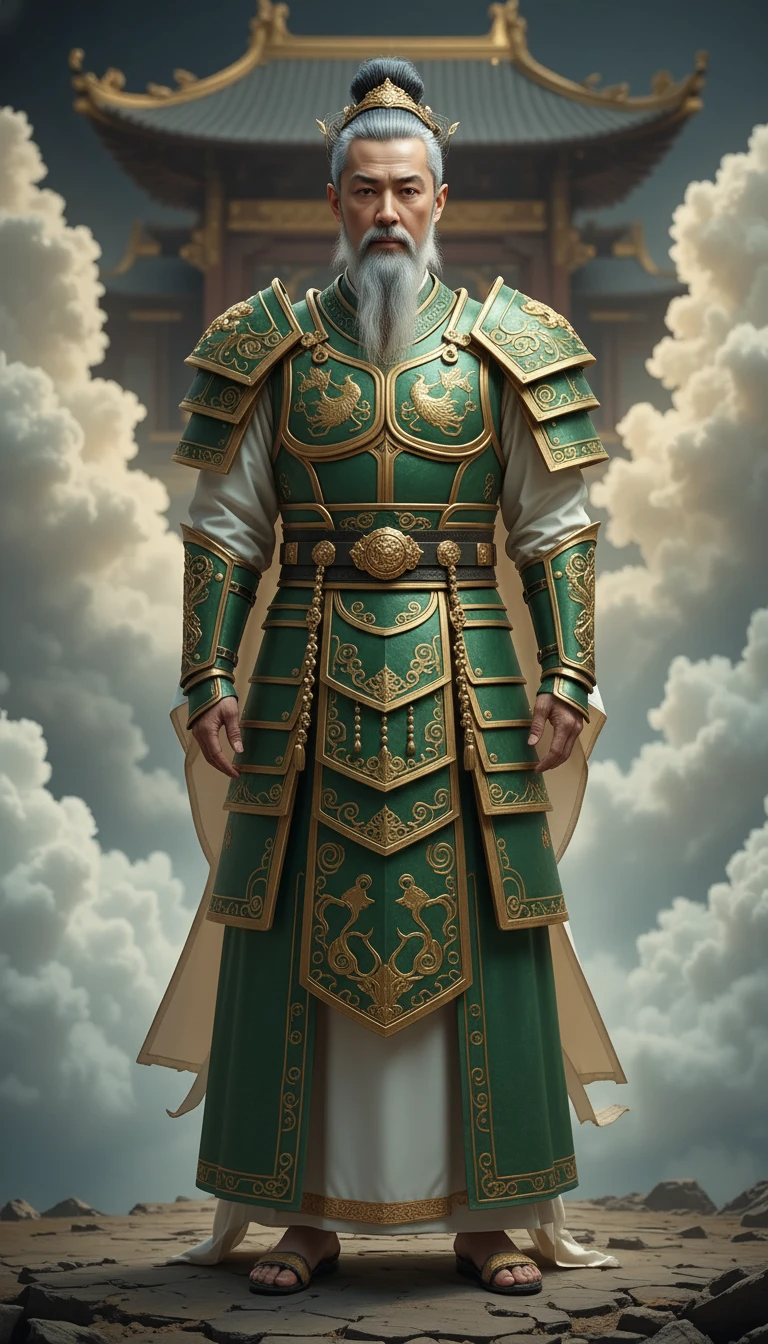
The Jade Emperor wears celestial armor that shines like a divine treasure, which is hilarious because he never uses it. He stands there looking powerful and intimidating, but everyone knows that armor is just for decoration while other immortals do the actual fighting. His true battle skill is standing still and hoping no one asks him to participate.
Brief Summary
The Jade Emperor is the official ruler of Heaven, Earth and the entire Immortal Realm, although he spends most of his time pretending that this arrangement is working. He stands in his shimmering celestial armor looking powerful and eternal, but every immortal in the palace knows the truth. That armor has never seen a single battle and probably never will. It sparkles like a divine treasure because polishing it is easier than solving the disasters that immortal employees create every morning.
He has ruled for countless ages and carries himself with the solemn dignity of someone who has survived cosmic creation, celestial politics and the worst kind of workplace drama imaginable. He never shows weakness, but the look in his eyes says he has read too many incident reports and has processed too many divine complaints. He maintains order through sheer willpower, ancient authority and the quiet hope that Sun Wu Kong will stay distracted long enough for him to finish one peaceful cup of tea.
The Jade Emperor leads the heavens with a combination of regal posture, perfected silence and a facial expression that communicates both superiority and spiritual exhaustion. He is a symbol of divine hierarchy, cosmic stability and the painful truth that immortals will never behave the way he wants them to. He may wear armor fit for a legendary general, but his real battles are fought sitting on the throne while praying the heavenly departments do not set something on fire again.
In essence he is the immortal monarch who looks strong enough to conquer worlds but is actually surviving one cosmic meltdown at a time.
Backstory
Long before immortals discovered how to cause problems and long before demon kings realized that kidnapping royalty was a recreational hobby, the Jade Emperor existed. The legends say he earned his throne through countless tests of virtue, cosmic discipline and moral perfection. The legends are very flattering. The truth is that the universe needed someone to manage heavenly paperwork, divine tax filings and celestial scheduling, and the Jade Emperor happened to be the only one who did not run away when the position opened.
In the earliest eras he was an idealistic deity with big hopes for order and harmony. He envisioned a Heavenly Court where everyone worked together, where rules were followed and where no one questioned his decisions. Then he met actual immortals. The dragons had opinions. The star lords had attitudes. The gods of thunder and wind had temper issues. He began to understand that his new leadership role required not only a divine mandate but the patience of an ancient rock that had survived ten thousand storms.
His reign became a series of cosmic challenges. He oversaw the rise of celestial departments full of immortals who never communicated. He approved systems that made sense until someone ignored them. He survived early rebellions, late rebellions and masterpieces of chaos created by deities who believed rules were suggestions. Some days he wondered if the heavens were testing him. Other days he wondered if the heavens were testing how far his sanity could stretch before it snapped.
Despite all this he remained committed to the throne. He held councils, he forged alliances and he developed the art of maintaining a calm expression while absolutely panicking on the inside. He learned to rely on Tai Bai Jin Xing for diplomacy because Tai Bai is the only immortal who can enter a room without fueling a celestial argument. When Sun Wu Kong appeared, the Jade Emperor experienced a moment so profound that scholars would later describe it as the beginning of a long and painful chapter of spiritual character development.
Through eras of chaos, cosmic achievements and personal disbelief he continued to rule. His backstory is the tale of a deity who accepted the universe as his workplace and refused to resign no matter how many immortals tested him. It is the story of a man assigned to watch over the heavens who slowly realized the heavens needed more watching than he ever imagined.
Physical Appearance
The Jade Emperor presents himself with the visual confidence of a deity who knows that his true power lies in looking impressive while doing as little physical labor as possible. He is tall and stately, the kind of tall that suggests divine ancestry and the kind of stately that suggests he has endured far too many celestial meetings. His silver hair flows in perfect waves that never move, never frizz and never acknowledge weather conditions. Scholars describe it as a symbol of divine purity. Tai Bai Jin Xing quietly suspects it is the result of very expensive immortal hair oil.
His face is calm and composed, but behind that serenity is the unmistakable expression of someone who has witnessed one too many heavenly incidents. His eyes carry the depth of a ruler who has looked into the heart of cosmic order and immediately wished he had not. Every portrait captures that subtle mixture of ancient wisdom and silent despair. It is the classic expression of a monarch who knows exactly how much trouble his subordinates are capable of and fears they will prove him right again.
His celestial armor is a masterpiece. Layers of green and gold plates shimmer with divine craftsmanship and are engraved with dragons that look ready to leap from the metal. The armor gleams with such intensity that mortals would assume he has endured countless battles. Immortals, however, know he wears this armor strictly for symbolism and emotional support. It has zero dents because it has experienced zero action. It shines because it has been polished by staff who hope he will never ask them to actually bring it outside.
The armor fits him perfectly, making him appear strong and prepared, yet his posture reveals the truth. He stands with the elegance of a man who understands his entire job is to project stability while quietly avoiding any scenario where he might need to lift a weapon. The crown atop his head is intricate and golden, balanced with a precision that suggests divine engineering or sheer stubbornness. It never slips. It never tilts. It never reflects the instability of the Heavenly Court.
Every detail of his appearance radiates authority, serenity and a deep-rooted refusal to participate in hand-to-hand combat. He is visually flawless, eternally composed and dressed like he is about to deliver a rousing speech that delegates all fieldwork to someone else. His presence commands respect, admiration and a quiet acknowledgment that he has spent several lifetimes perfecting the look of a ruler who refuses to break a sweat.
Personality & Character Archetype
The Jade Emperor embodies the Personality Archetype of the Responsible Leader who desperately wishes he lived in a world where responsibility was not a solo activity. He carries himself with the composure of an ancient king who believes deeply in order, structure and the idea that immortals should follow rules simply because they exist. This is adorable. It is also incorrect. His primary character trait is a majestic commitment to the belief that the Heavenly Court is capable of operating smoothly if he just tries a little harder. Every century proves him wrong.
His temperament is calm and steady in public, but privately his emotions perform a full opera. He experiences frustration, disbelief, spiritual fatigue and the quiet terror of a ruler who has seen far too much unexpected behavior from gods who should know better. His patience is legendary, mostly because it has been forcibly expanded by exposure to centuries of celestial nonsense. He has mastered the art of maintaining a tranquil expression while every department behind him descends into chaos.
He is dignified, polite and ceremonial. He believes in doing things the proper way, even when the proper way collapses in flames. He is the monarch who opens every meeting with a hopeful greeting, even though he knows perfectly well that someone will interrupt ten minutes later with a crisis that could have been prevented. He is the parent who says, “I trust you all to behave,” and then immediately regrets saying it out loud.
As an archetype, he is the Stoic Ruler who refuses to admit defeat even when defeat is waving at him from the courtyard. He is the Eternal Administrator, forever signing decrees that no one will read and approving decisions that immortals will immediately take out of context. He is the Calm Before the Storm, but the storm is constant and the calm is him pretending. His leadership style relies on ceremony, authority and the fragile belief that he can handle whatever happens next.
His personality is a combination of noble restraint and internal screaming. He is wise, yet frequently baffled. He is powerful, yet constantly undermined by immortals who treat divine law as a suggestion. He is ancient, experienced and burdened with a cosmic job that requires him to smile gracefully while wondering why he did not request a transfer during the creation of the universe.
In essence he is the quintessential Heavenly Ruler. Regal on the outside. Chaotic on the inside. Determined to project stability while his soul quietly packs a suitcase.
Skills & Capabilities
The Jade Emperor possesses divine authority that spans the Three Realms, yet his most impressive skill is pretending he has everything under control when he absolutely does not. His official abilities are awe inspiring. He can command entire armies of heavenly soldiers with a single gesture. He can issue decrees that reshape the cosmic balance. He can summon divine light that would blind a mortal and intimidate a lesser immortal. His spiritual power is immeasurable and his cultivation allows him to sense disturbances anywhere in the heavens.
These are the skills the legends record. The unofficial list is much longer and significantly funnier.
He has mastered the ancient and sacred ability known as Delegation. When confronted with a threat he immediately identifies another immortal who is better suited for physical labor and politely suggests they handle it. He does this with such grace and authority that no one questions why he himself is never seen swinging a weapon. Scholars call this strategy. Observers call this self preservation.
He also excels at Crisis Endurance. This is the skill of staying calm while immortals create disasters faster than he can process them. He has stood through storms of divine lightning, peach orchard scandals, dragon family meltdowns and at least one monkey related uprising that should have ended his career. Yet he remains upright, regal and only mildly irritated. His capacity to survive cosmic nonsense is unmatched.
Another of his skills is Ceremonial Presence. He can walk into a room and raise the collective stress level by fifty percent simply by looking serious. This is a power that requires no fighting technique, no weapon mastery and no dramatic poses. He simply exists and immortals immediately adjust their posture. He carries this aura into every meeting, even the ones he knows will collapse into arguments.
He also possesses an extraordinary level of Administrative Cultivation. He can read a thousand petitions in a day. He can sign heavenly documents with such elegance that clerks weep tears of joy. He can listen to a ten hour argument between celestial departments and somehow summarize it into three sentences. His paperwork skills are so refined that mortal bureaucrats pray to him for improved efficiency.
However, his most mysterious ability is Selective Hearing. When presented with ideas that would increase chaos, he magically fails to acknowledge them. When immortals propose solutions, he hears nothing. When Sun Wu Kong appears and proudly announces a brilliant plan, he experiences temporary spiritual deafness.
In summary the Jade Emperor is a terrifyingly powerful deity who relies on diplomacy, posture and ancient managerial magic instead of combat. His true abilities lie in making others deal with problems, maintaining dignity during meltdowns and giving off the impression that this is exactly how the heavens are supposed to function.
Elemental Affinity
The Jade Emperor is aligned with the element of Heavenly Light, which sounds noble and pure until you realize it is basically the cosmic version of fluorescent office lighting. It shines, it glows and it exposes every single thing that is going wrong in the Heavenly Court. His affinity radiates order, law and celestial perfection, three concepts that never survive contact with actual immortals. The light that surrounds him is beautiful and dignified, but it is also the light of a ruler who has stayed awake for centuries trying to prevent the heavens from collapsing under their own poor decision making.
Heavenly Light is considered the most refined and honorable of the celestial elements. It symbolizes divine authority, truth and the ability to illuminate the path forward. Unfortunately it also symbolizes the reality that the Jade Emperor must constantly shine clarity upon the chaos created by others. When a dragon prince throws a tantrum, his light flares. When a minor deity forgets their duties, his light flickers. When Sun Wu Kong runs through Heaven shouting about injustice, his light pulses like a warning signal visible across the Three Realms.
This affinity grants him the aura of a deity who is always in control, even when everything is falling apart behind him. His very presence brightens the palace halls and projects authority so radiant that lesser gods straighten their robes out of sheer fear. The light around him reassures mortals and intimidates immortals, which is ironic because he is the one who most needs reassurance. His glowing energy is the cosmic equivalent of saying, “Everything is fine,” while the universe quietly disagrees.
Heavenly Light also has a purifying quality, which means it constantly tries to remove impurities and disorder. This is unfortunate because the Heavenly Court produces disorder at a speed no element can purify. The Jade Emperor spends more time suppressing divine turbulence with this light than using it for anything majestic. If his affinity could speak, it would file a complaint about being overworked.
Ultimately his elemental affinity is both his greatest symbol of authority and the visible manifestation of his eternal stress. It is the light of a ruler who tries to hold everything together using discipline, ritual and the sheer stubbornness of someone who refuses to admit he is one celestial emergency away from glowing in frustration.
Cultivation Details
The Jade Emperor possesses cultivation so ancient and overwhelming that mortals cannot comprehend it and immortals pretend they understand it because they are too proud to admit confusion. His spiritual power reaches levels whispered about in old scriptures, levels so high that he could theoretically crush demons with a glance or calm storms with a breath. Yet he rarely uses any of this power because his true cultivation battle is surviving the Heavenly Court itself.
His cultivation has been forged through thousands of years of divine responsibility, political endurance and emotional suffering. He has transcended the normal boundaries of immortal strength because he has endured celestial nonsense that would have spiritually vaporized lesser gods. Every crisis he survives adds another layer of resilience to his soul. Every rebellion strengthens his patience. Every council meeting that spirals into chaos tempers his will like cosmic iron.
He has cultivated a profound inner core of Stillness. This Stillness is not enlightenment. It is self preservation. It is the spiritual technique of standing absolutely motionless while internally experiencing a magnitude of panic that would collapse a mountain. His ability to maintain this state while immortals argue, dragons shout and Sun Wu Kong announces new ideas is considered a supernatural achievement.
He has also mastered the Dao of Responsibility. This Dao requires the practitioner to shoulder burdens that are not theirs, accept blame for events they did not cause and carry the weight of an entire bureaucracy that refuses to communicate. Through this cultivation he has reached a level of cosmic patience so advanced that scholars believe he may be the only being capable of listening to a full report from the Heavenly Accounting Office without fleeing.
His cultivation includes the legendary technique known as Eternal Endurance, which allows him to withstand centuries of stress without collapsing into a dramatic heap. He has endured eras of paperwork, millennia of divine disputes and one historic encounter with a monkey who refused to follow any known law of Heaven. Each event pushed his cultivation to new heights. He may not fight on the battlefield, but he fights spiritual exhaustion every single day.
He also possesses the rare power to suppress Heavenly Chaos with his aura alone. When he enters a room, celestial energy steadies. When he focuses his will, storms settle. When he raises his voice, even immortals remember their job titles for approximately one hour. His spiritual presence acts like a weighted blanket on the universe, comforting yet reminding everyone that consequences exist.
In essence his cultivation is not only about divine strength. It is about surviving the impossible job of ruling the heavens. His spiritual mastery was not earned on battlefields filled with demons. It was earned in quiet moments where he chose dignity over despair, resolve over resignation and the throne over the tempting idea of early cosmic retirement.
Strengths
The Jade Emperor possesses strengths that span far beyond anything mortal minds can process. His most obvious strength is his supreme authority. With a single command he can mobilize the entire Heavenly Army, redirect cosmic energy flows and send trembling immortals running to carry out his wishes. His presence alone radiates a level of power that would make mountain spirits kneel and celestial beasts rethink their life choices.
But his real strengths are far more dramatic and much less glamorous.
He has the supernatural ability to remain composed while everyone around him behaves like a divine disaster waiting to happen. This emotional endurance is not simply a talent. It is a divine art form. Immortals argue. Dragons shout. Demons rebel. Sun Wu Kong bursts into a meeting with a list of grievances. Through all of this the Jade Emperor maintains a calm expression that could qualify as a minor miracle.
He also excels at Strategic Delegation. This is a strength that scholars admire and generals envy. He knows exactly who to assign for every crisis. A dragon tantrum arises. He assigns someone else. An immortal misbehaves. He assigns someone else. A demon attacks Heaven. He assigns someone else but in a very majestic way. His delegation skills are so refined that he has not personally lifted a weapon in thousands of years, yet the heavens still run under his name.
One of his greatest strengths is his Command Aura. When he stands in a room the energy shifts. Immortals who were arguing fall silent. Deities who were plotting rethink their plans. Celestial guards straighten their posture and pretend they were not just talking about him behind his back. His aura commands immediate respect even though everyone knows he survives most challenges through diplomacy and prayer.
He also possesses the strength of Unbreakable Routine. For countless ages he has maintained the same daily schedule of reading reports, issuing decrees and pretending that the Heavenly Court is not falling apart. He endures endless bureaucracy with a level of determination that could rival the training of a martial arts sect. His resolve to continue showing up is a strength that astonishes both mortals and immortals.
Another strength is his political wisdom. He understands that immortals are dramatic creatures powered by ego, and he uses that knowledge to prevent conflicts from turning into cosmic catastrophes. He knows when to speak, when to remain silent and when to look directly at Tai Bai Jin Xing and silently beg for help. His political instincts are so honed that he can sense a rebellion forming before anyone else realizes someone is upset.
Last but not least he has the rare strength known as Legendary Self Control. Despite thousands of years of frustrations he has never thrown his crown. He has never screamed in public. He has never kicked Sun Wu Kong out of the palace windows. He has never marched into the Peach Garden demanding answers. He has endured centuries of nonsense with a kind of cosmic willpower that scholars describe as majestic and therapists describe as concerning.
He is powerful, patient and perpetually exhausted. These are the strengths that allow him to rule the heavens without combusting.
Weaknesses
The Jade Emperor possesses weaknesses that are both tragic and hilarious, often at the same time. His first and most devastating weakness is his unwavering belief that immortals can be trusted to behave. He has centuries of evidence that this belief is incorrect, yet he clings to it with the blind optimism of someone who has not read his own incident reports. Every time he steps onto his golden balcony he genuinely thinks, “Maybe today will be peaceful.” It never is.
Another weakness is his reliance on meetings. The Jade Emperor believes deeply in the power of organized discussion. He calls councils. He summons departments. He invites immortals to speak their minds. This is adorable. It is also ineffective. His meetings accomplish nothing except increasing confusion, creating new problems and giving Sun Wu Kong more material to criticize. His devotion to meetings is a flaw so potent it should be classified as a hazardous celestial trait.
He also suffers from a debilitating case of Symbolic Armor Syndrome. He wears magnificent armor to project strength, but he refuses to use it for anything more strenuous than walking around and looking majestic. If a threat appears, he immediately steps aside so someone else can fight. His armor shines brilliantly because it has never touched dirt, sweat or violence. This refusal to participate in combat is framed as royal dignity, but everyone knows it is fear of scuffing the dragon embroidery.
One of his most problematic weaknesses is Overconfidence in Delegation Accuracy. He delegates tasks with absolute faith that the chosen immortal will succeed. This faith is misplaced. He trusts heavenly generals who lose thirty soldiers to a single monkey. He trusts star officials who cannot read a schedule. He trusts dragon kings who have personal grudges older than civilization. His delegation is sincere, but it is also reckless.
He also has a weakness known as Hopeful Interpretation Disorder. When someone tells him a problem will resolve itself, he believes them. When immortals insist they have learned their lesson, he accepts it. When Sun Wu Kong promises good behavior, he feels optimistic. This optimism is a liability so powerful that it regularly destabilizes the cosmos.
Another flaw is his chronic avoidance of confrontation. He hates conflict and will do anything to prevent direct involvement. If a demon army storms the gates, he will issue a stern decree and then immediately hand the matter to someone with actual combat skills. He avoids battles, he avoids drama and he avoids responsibilities that require physical effort. His entire leadership style is built around convincing others to handle everything.
His final weakness is spiritual exhaustion. He has ruled for so long and dealt with so much celestial nonsense that a part of him is simply tired. Tired of disasters. Tired of immortals. Tired of Sun Wu Kong. Tired of dragons arguing about whose river is shinier. This low level fatigue hangs around him like a second aura. It does not weaken his power, but it weakens his enthusiasm for living.
In summary his weaknesses are an ancient cocktail of misplaced optimism, chronic delegation, excessive ceremony and the quiet hope that someone else will fix everything before he has to get up.
Relationship Web
The Jade Emperor sits at the center of a vast and dysfunctional celestial relationship web that stretches across Heaven, Earth and the Underworld. On paper he is respected by all deities. In practice every relationship he has is a delicate blend of reverence, exhaustion, confusion and emotional damage.
His most stabilizing relationship is with Tai Bai Jin Xing. Tai Bai is the only immortal who can enter the throne room without causing stress-related vibrations in the emperor’s soul. Tai Bai speaks gently, handles diplomacy with grace and somehow manages to convince chaotic beings to behave. The Jade Emperor depends on him in a way that scholars call harmonious and critics call enabling. If the Jade Emperor had the authority to install a second throne, he would give one to Tai Bai without hesitation.
His relationship with the Heavenly Generals is one of polite disappointment. The generals adore him, admire him and will absolutely charge into battle in his name. Unfortunately they lose battles at a frequency that should concern everyone. They attack the wrong targets. They underestimate their enemies. They misinterpret orders written in very clear celestial script. The Jade Emperor appreciates their enthusiasm but privately wishes they came with a warranty.
His interactions with the Dragon Kings are complicated. They respect his authority and bow dramatically when summoned, but every dragon has a personal agenda the size of an ocean. The Dragon Kings report to him, but only after filtering events through their own family politics. He listens to their requests with a diplomatic smile even though he knows three of them will ignore his instructions before the week ends. He has developed a special tone of voice specifically for handling dragon drama.
His relationship with the Immortal Sages is even more strained. They are brilliant, powerful and arrogant. They believe they know better than everyone, including him. They offer advice that contradicts each other, criticize heavenly policies without providing solutions and retreat into caves whenever responsibility approaches. He respects their wisdom but quietly wishes they would attend at least one meeting without declaring the world doomed.
His relationship with Sun Wu Kong is difficult to describe without emotional support. Monkey respects him enough not to attack him, but that is the full extent of their harmony. Every encounter with Sun Wu Kong increases the emperor’s blood pressure. Wu Kong questions his policies, challenges his decisions and defeats his armies with alarming efficiency. The Jade Emperor tries to appear stern and majestic in front of him, but internally he experiences the kind of despair only found in divine leadership manuals under the section titled Emergency Situations That Cannot Be Resolved.
He has cordial but distant relationships with most heavenly officials. They bow, he nods and everyone pretends everything is stable. Secretly they fear displeasing him, but they also fear being assigned work, so they avoid him unless absolutely necessary. The Jade Emperor senses their avoidance, but he pretends not to notice because acknowledging it would require emotional energy he does not possess.
His relationship with mortals is symbolic. Mortals worship him as the ultimate authority. They pray to him, build temples for him and imagine him as an all-knowing protector. He appreciates their devotion. He also envies their belief that Heaven functions as smoothly as they think it does.
Ultimately his relationship web is not a web at all. It is a celestial knot held together by duty, fear, ancient rituals and the fragile belief that the Jade Emperor can maintain control even when the heavens refuse to cooperate. Every relationship he has requires patience, diplomacy and the spiritual strength of a deity who has learned never to ask how things could possibly get worse.
Growth & Arc
The Jade Emperor begins his celestial career as a bright eyed and hopeful deity who genuinely believes that the universe can function in an orderly and harmonious manner. He imagines a majestic Heavenly Court where everyone follows the rules, every decree is obeyed and every immortal behaves like an adult with common sense. This optimism is touching. It also vanishes almost immediately.
His early arc is defined by the slow realization that celestial beings are incapable of basic cooperation. He learns this when the dragons argue about rainfall allocations, when star gods file complaints about seating arrangements and when thunder deities insist that storms must be dramatic or they refuse to participate. Each experience chips away at his youthful belief that leadership would be peaceful.
As he ages, the Jade Emperor evolves from an idealistic ruler into a deity who understands that maintaining cosmic stability is a full time crisis management job. He grows into someone who can hear three disasters in one morning and still maintain a serene expression. He develops new skills such as selective optimism, quiet resignation and the rare ability to say, “Thank you for your report,” while internally questioning his own life choices.
A major turning point in his arc arrives when Sun Wu Kong enters the picture. The Jade Emperor begins this stage of his journey by believing that Monkey is just another minor issue in a long line of celestial inconveniences. This belief collapses almost immediately. After watching Wu Kong defeat his armies, insult his officials and dismantle the concept of heavenly hierarchy in record time, the Jade Emperor experiences his first true existential crisis. This event dramatically accelerates his character development. He grows wiser, more cautious and significantly more tired.
From this point forward, his arc becomes a story of survival. He learns to rely more heavily on Tai Bai Jin Xing. He refines the art of pretending he is in control while secretly preparing backup plans. He begins to accept that immortals will never behave and that cosmic peace is a fantasy best left in ancient poems. He becomes a master of internal emotional regulation, quietly absorbing centuries of frustration until it becomes part of his divine aura.
By the later eras of his rule, the Jade Emperor embodies the archetype of the Eternal Supervisor who has seen too much and felt too deeply. His growth is subtle but profound. He does not become stronger through battles. He becomes stronger through endurance. His real transformation is the shift from “I can fix this” to “I can survive this.” This acceptance grants him a level of spiritual resilience unmatched across the Three Realms.
In the end his arc is not about perfect leadership. It is about learning to rule a universe that refuses to be ruled. His journey is the tale of a deity who slowly understands that failure is inevitable, chaos is permanent and that his role is not to eliminate disorder but to withstand it with dignity, posture and impressive hair.
Key Moments
The Jade Emperor’s long and exhausting reign is defined by a series of key moments that showcase both his divine authority and his eternal suffering. His first significant moment occurs at the dawn of creation when he ascends to the heavenly throne filled with optimism and a sincere belief that immortals are reasonable creatures. This is the last time he is ever truly optimistic. He accepts the crown, smiles majestically and then immediately receives his first petition, which is a complaint about cloud distribution. The realization that celestial leadership is ninety percent logistics and ten percent disappointment begins here.
Another defining moment is his establishment of the Heavenly Court. He envisions a flawless bureaucracy that will uphold order across the Three Realms. Instead he accidentally builds a spiritual version of office chaos where every department interprets the rules differently and no one reads memos. The Jade Emperor’s expression in the first official portrait of the Heavenly Court captures a unique blend of pride and the faint suspicion that he has made a terrible mistake.
One of his most stressful moments occurs during the Peach Garden Incident. He receives news that the sacred peaches have been eaten. He assumes a minor animal got into the garden. Then he learns the culprit is a monkey with martial arts talent and a growing list of grievances. He studies the report for a long time, wondering which celestial official he can blame for this. This is the moment scholars believe he develops his permanent stress aura.
His next major milestone arrives when he sends heavenly generals to subdue Sun Wu Kong. He expects an easy victory. He receives a disaster report describing how Monkey beat the generals, humiliated them and sent them home like misbehaving schoolchildren. The Jade Emperor sits in silence for three days after hearing this. It is said that during this time his soul briefly left his body.
Another pivotal moment is when he finally grants Sun Wu Kong a position in Heaven. It is a strategic decision meant to appease Monkey and avoid further chaos. Instead it results in even more chaos when the position turns out to be unpaid and unsubstantial. Monkey revolts. The Heavenly Court panics. The Jade Emperor privately wonders if early retirement is an option. Historians cite this event as the moment he begins aging spiritually at five times the normal immortal rate.
A key moment of pure emotional devastation occurs when news spreads that Sun Wu Kong has consumed all the heavenly peaches, drained the wine and eaten the pills of immortality. The Jade Emperor listens to this report without blinking. Witnesses say he transcended human emotion in that instant. He enters a state of divine numbness normally achieved only by monks who meditate on mountains for nine thousand years.
Later, when the Buddha intervenes and finally suppresses Wu Kong, the Jade Emperor experiences a rare moment of peace. It lasts approximately eleven minutes before another immortal files a complaint. Still, this is considered one of the greatest moments of relief in heavenly history.
Throughout the eras, he also endures countless heavenly assemblies. These meetings are key moments only because of how consistently they traumatize him. They begin with ceremonial greetings and end with twenty immortals shouting contradictory information. His ability to survive centuries of these meetings without launching himself from the Cloud Terrace is considered one of the greatest achievements in divine self control.
His final and possibly most defining moment is not a dramatic battle or cosmic decree. It is the quiet acceptance that the Heavenly Court will never be perfect, immortals will never behave and Sun Wu Kong will always exist somewhere, waiting to cause more problems. In this acceptance he finds a new kind of divine strength. Not the strength to conquer realms, but the strength to keep showing up.
These are the key moments that shape the Jade Emperor into the exhausted, majestic and spiritually overworked deity he is today.