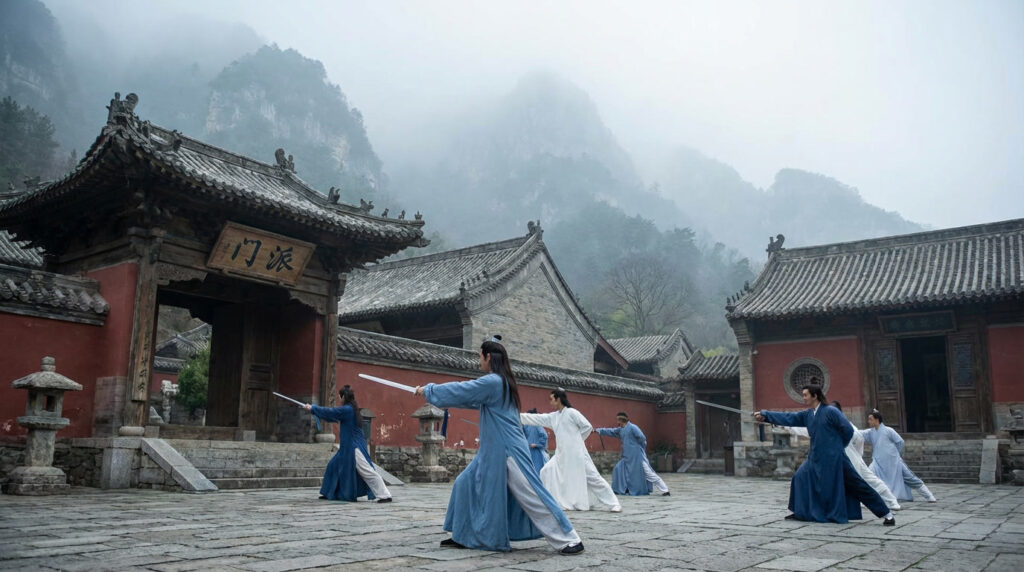
Sects (门派)
Martial Schools • Lineage • Tradition • Power Structures of the Wuxia World
Sects (门派) are some of the most iconic pillars of wuxia and cultivation storytelling.
They’re not clubs. They’re not schools. They’re not fandom houses you sort characters into.
A sect is an entire martial world within the world — built on lineage, philosophy, hierarchy, and tradition. This is where characters learn who they are, how they fight, and what they stand for.
Let’s break it down clearly and correctly.
What Sects (门派) Actually Are
A sect is a:
“Martial institution built on lineage, training, and shared philosophy.”
Every sect has:
a founding ancestor
a guiding philosophy (their Dao)
a school of martial arts (wugong)
rules, rituals, traditions
a Master or Head (Sect Leader)
senior and junior disciples
internal hierarchy and political structure
Sects provide:
identity
protection
training
community
belonging
power
responsibility
Characters don’t just join a sect. They join a legacy.
❌ What Sects Are NOT
Let’s clear up the common misconceptions:
✔ Not a dojo
Western dojo culture ≠ Chinese sect culture.
✔ Not a casual learning space
You can’t enroll, leave, and re-enroll. Once you join, you join the lineage.
✔ Not a democracy
Seniors outrank juniors.
Rules outrank feelings.
✔ Not merely a building
A sect is its people, philosophy, and lineage — not the location.
✔ Not Hogwarts
No “house sorting.” You join through acceptance, rituals, or testing.
How Sects Function (Wuxia Logic)
Inside a sect, everything runs on:
Seniority
Age, rank, and generation determine authority.
Lineage
Your martial genealogy defines your role.
Tradition
Techniques, rituals, and codes are passed down.
Hierarchy
Sect Leader
→ Elders
→ Peak Masters
→ Senior Disciples
→ Junior Disciples
→ Outer Disciples (in some sects)
Philosophy
Each sect has a core belief that shapes its culture.
Internal Politics
Where there are humans, there is drama. This is why sects create endless story possibilities.
Types of Sects (Fiction-Friendly)
Not all sects are alike. Common types include:
1. Martial Sects
Focused on physical wugong, discipline, and weapon mastery.
2. Daoist or Spiritual Sects
Focus on meditation, neigong, and inner refinement.
3. Sword Sects
One philosophy, one weapon, one identity: the sword.
4. Hidden or Reclusive Sects
Mysterious, powerful, often ancient, rarely seen.
5. Evil or Demonic Sects (魔教)
Not always “evil,” but opposing the main sect’s worldview.
6. Medical or Alchemy Sects
Healing, pills, herbs, spiritual medicine.
7. Scholarly or Ritual Sects
Philosophy, calligraphy, formation arts, strategy.
Each sect type has distinct personalities, methods, and hierarchies.
Sects in Combat & Conflict
Sects influence:
how battles are fought
which techniques disciples specialize in
who leads rescue missions
who takes responsibility
political alliances or rivalries
sect vs sect wars
generational feuds
forbidden techniques or secrets
When a disciple fights, they carry: their sect’s reputation, their master’s honor, and generations of legacy.
Sects vs Jianghu (Critical Distinction)
Many people confuse these — but they’re not the same.
Sects (门派)
- structured
- hierarchical
- lineage-based
- have rules and traditions
- formal training system
- internal politics
Jianghu (江湖)
- unstructured
- chaotic
- freelance
- wanderers, hunters, mercenaries, clans
- no formal hierarchy
- the martial world at large
Jianghu is the ocean. Sects are the islands.
Why Western Sources Get Sects Wrong
1. Translation issues
“School,” “clan,” “sect,” “house,” and “society” all got flattened.
2. Misunderstanding lineage culture
Western fiction rarely uses generational seniority as a core storytelling device.
3. Martial culture portrayed as “free training”
Chinese martial traditions emphasize hierarchy, not casual instruction.
4. Overlapping terms simplified
Sects, Clans, Peaks, and Branches got merged incorrectly.
Sects in CVM Sekai
In CVM Sekai worlds:
✔ Sects shape identity
Characters learn who they are through their sect’s philosophy.
✔ Each sect has its own Dao (core worldview)
This determines training, discipline, and punishment.
✔ Sects influence politics and world stability
Some protect balance, others disrupt it.
✔ Disciples represent the sect
Every action reflects the lineage.
✔ Sects are story engines
They create rivalry, loyalty, betrayal, ambition, redemption, and ascension arcs.
Common Sect Elements (CVM-Friendly)
Peaks / Halls / Branches
Different divisions within a sect focusing on specific disciplines.
Forbidden Manuals
Techniques only a few can learn.
Core vs Outer Disciples
Inner circle vs general members.
Inheritance Trials
Test to become a future Peak Master or Sect Leader.
Rules & Punishments
Ritualized, strict, emotional storytelling.
Final Takeaway
Sects (门派) are:
martial families
lineage institutions
philosophical communities
political powers
emotional homes
narrative engines
They define character identity, create world structure, and build the emotional stakes that make wuxia and cultivation stories unforgettable.