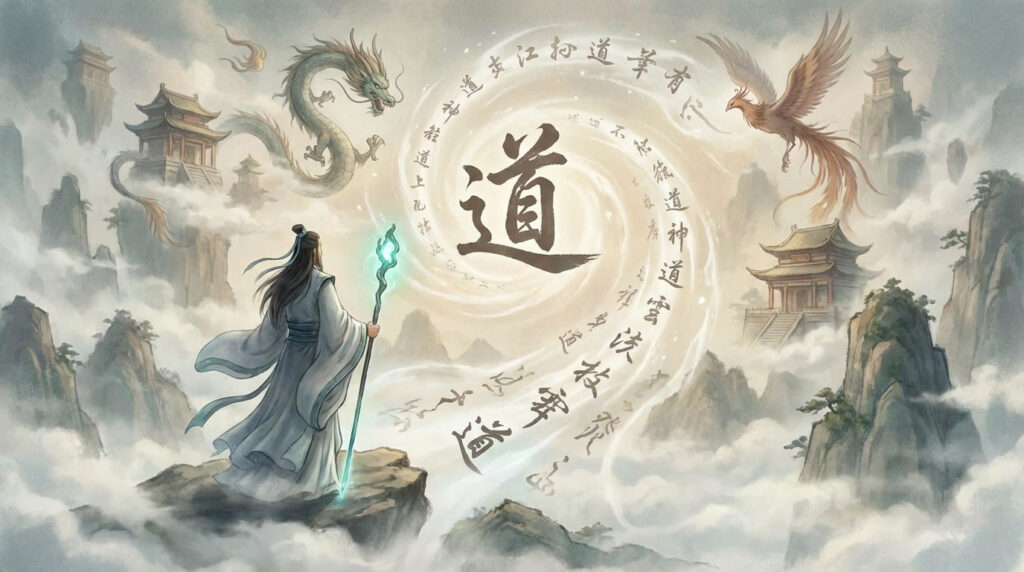
Dao (道)
The Path • The Way • The Guiding Principle Behind Everything
Dao (道) is one of the most important — and most misunderstood — concepts in Chinese storytelling, philosophy, and cultivation fiction.
People throw the word around casually (“follow your Dao,” “he broke his Dao,” “her Dao heart shattered”), but very few explanations online actually explain what it means in a storytelling context.
Dao is not a spell. Dao is not a power-up. Dao is not a flashy ability.
Dao is the core belief that shapes a character’s actions, choices, cultivation, and destiny.
Let’s break it down properly.
What Is Dao (道)?
Dao literally means:
“The Way.” —or— “The path a person follows.”
In storytelling, Dao refers to:
a character’s guiding philosophy
their internal compass
the truth they choose to live by
their purpose
their core value system
the path they refuse to abandon under pressure
Dao is the why behind everything a character does. It shapes worldview, morality, training style, reactions, mistakes, and even breakthroughs.
A strong Dao gives characters:
clear identity
emotional stability
inner alignment
resilience in conflict
the ability to grow under pressure
Dao = the inner road a character refuses to betray.
❌ What Dao Is NOT
This is where most English explanations fall apart.
✔ Dao is NOT magic
It doesn’t shoot lasers. It doesn’t create special effects.
✔ Dao is NOT cultivation
Cultivation may follow Dao, but Dao is the belief, not the power system.
✔ Dao is NOT a technique
There is no “Dao punch.” (If someone wrote that… they’re lying.)
✔ Dao is NOT religion
Dao has philosophical roots, not doctrinal ones.
✔ Dao is NOT the same as “attitude”
Attitude changes. Dao anchors.
Dao is not a superpower — Dao is the core principle that power grows from.
How Dao Works (Story Logic)
In classical Chinese storytelling, a person’s Dao is expressed through:
their choices
their discipline
their values
their reasoning
their reaction to crisis
their interpretation of the world
A character’s Dao shapes:
which techniques they choose
which paths they reject
what they sacrifice
what breaks them
what they protect
how they achieve breakthroughs
A person’s Dao will always reveal:
what they believe
what they fear
what they cannot accept
what they refuse to compromise
Dao = identity under pressure.
Dao in Cultivation Stories
In cultivation fiction, Dao often influences:
the direction of cultivation
the stability of breakthroughs
heart demons
inner turmoil
moment of clarity
destiny and ascension
interpersonal conflict
A weak Dao leads to:
emotional collapse
corrupted cultivation
instability
heart deviation
inability to advance
A strong Dao creates:
power alignment
character growth
emotional safety
higher potential
Dao isn’t the power. Dao defines how the power is used.
Dao vs Dao Heart (道心)
Dao (道):
The path. The core principle. The worldview.
Dao Heart (道心):
The emotional strength to stay on that path.
Dao Heart is:
willpower
mental clarity
resilience
emotional grounding
If Dao is the road, Dao Heart is the ability to stay on it during a storm.
They are connected, but not interchangeable.
Why Western Sources Get Dao Wrong
Lorem ipsum dolor sit amet, consectetur adipiscing elit. Ut elit tellus, luctus nec ullamcorper mattis, pulvinar dapibus leo.
1. Bad translations
Many early subs used “truth,” “morality,” “principle,” and “cultivation path” interchangeably.
They are not the same.
2. Dao gets mixed with magic systems
People assumed Dao = spellbook.
No.
3. Philosophical terms were flattened
English didn’t have a neat equivalent for Dao, so translators simplified it into concepts that lost nuance.
Your page fixes that.
Dao in CVM Sekai
In CVM Sekai:
✔ Dao = emotional clarity + guiding principle
Every character has one, even if they don’t know it yet.
✔ Dao shapes breakthroughs
Characters who betray their Dao stall or regress.
✔ Dao reveals personality
Two characters with identical abilities will fight differently depending on their Dao.
✔ Dao controls narrative identity
The stronger a character’s Dao, the clearer their arc becomes.
✔ No one “steals” or “copies” Dao
Dao is uniquely tied to personal philosophy and lived experience.
Dao is story structure disguised as character psychology.
Types of Dao (Fiction-Friendly)
Stories often emphasize different categories:
Heavenly Dao (天道)
Cosmic order. Universal rules. Fate-level stuff.
Personal Dao (心道)
A character’s unique guiding belief.
Path Dao (道法)
The specific philosophy that shapes one’s abilities.
Moral Dao (义道)
Justice, honor, protection, compassion.
Desire Dao (欲道)
Ambition, longing, pursuit.
Balance Dao (和道)
Harmony, stillness, emotional clarity.
You can mix these depending on the world.
Final Takeaway
Dao (道) is:
the path
the principle
the belief
the identity
the worldview
the story’s emotional backbone
It is one of the most powerful storytelling tools in Chinese-inspired fiction — misunderstood online, but unforgettable once you learn the real meaning.