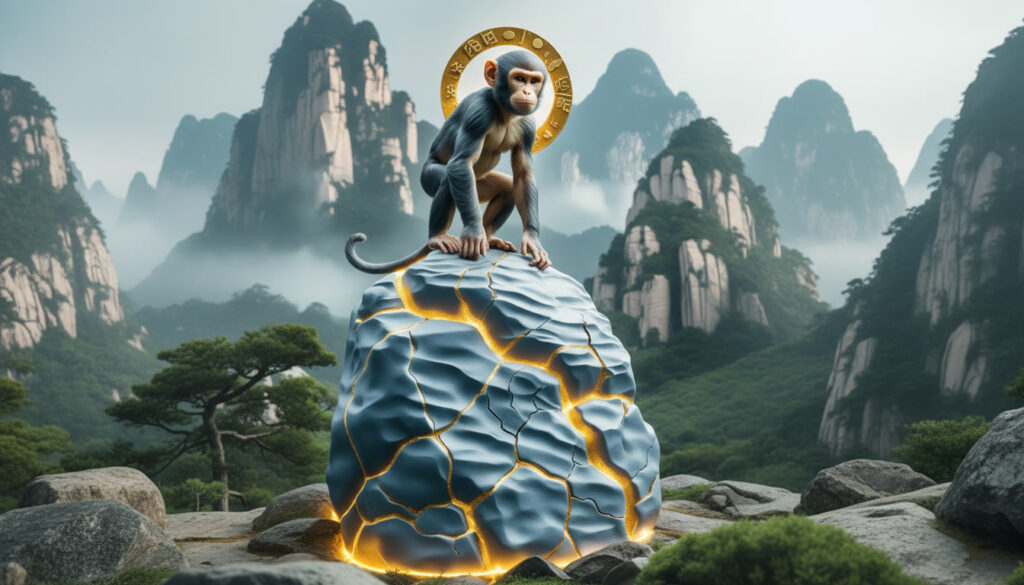
Before the world had form, heaven and earth were not yet separated. Light and shadow mixed together in a vast, silent expanse. Over countless ages the clear essence rose upward to become the sky and the heavy essence sank downward to form the earth. As creation continued to unfold, mountains rose from the land, rivers carved their first paths, and life awakened in countless shapes.
Among the Four Great Continents, the story begins in Dongsheng Shenzhou, the Eastern Continent. Near the Eastern Sea lies a small kingdom called Aolai, and beside its shores stands the legendary Hua Guo Shan, Flower Fruit Mountain. Since the dawn of time this mountain has gathered the purest breath of heaven and earth, absorbing the radiance of sun and moon for thousands of years.
At the summit rests an immortal stone that has soaked in spiritual energy for ages. One day the stone splits open and releases a large stone egg. When the egg meets the wind it transforms into a stone monkey. This newborn monkey bows to the four directions and opens his eyes, sending out golden beams of light that shoot into the heavens. The light reaches the palace of the Jade Emperor, who sends his watchful generals Qianli Yan and Shunfeng Er to investigate. When they report that the light comes from a stone monkey born on Hua Guo Shan, the Jade Emperor brushes it aside as an ordinary phenomenon of the mortal world.
The stone monkey grows wild and free on the mountain. He drinks from streams, eats fruit, sleeps beneath cliffs, and plays alongside wolves, tigers, deer, macaques, and other forest creatures. Time passes without measure in the mountain wilderness.
One summer day the monkey troop gathers near a rushing waterfall. Curious about its source, they follow the stream upward until they reach a towering cascade. The troop cheers in excitement. They challenge one another to pass through the waterfall unharmed and discover where the water originates. Whoever succeeds will become king.
Only one monkey steps forward. The stone monkey closes his eyes, crouches, and leaps straight through the falling water. Behind the curtain he discovers a hidden world. A stone bridge made of iron plate leads into a wide cavern filled with stone beds, stone bowls, stone stoves, moss-covered walls, bamboo groves, and fresh mountain mist. At the center stands a carved stone tablet that reads:
Hua Guo Shan Fudi, Shui Lian Dong Dongtian
(The Blessed Land of Flower Fruit Mountain, the Cave Heaven of Water Curtain Cave.)
Filled with joy, the stone monkey rushes back to the troop and urges them to follow him. One by one the monkeys leap through the waterfall. Inside they explore the cavern, claim stone beds, admire the natural furnishings, and celebrate the discovery of a safe home where they can shelter from wind, rain, snow, and thunder.
Remembering their agreement, the troop bows to the stone monkey and declares him their king. From this day forward he is known as Mei Hou Wang, the Handsome Monkey King.
Under his leadership the monkeys enjoy a peaceful and carefree life. They gather flowers in spring, search for fruit in summer, dig up yams and chestnuts in autumn, and eat yellow essence roots in winter. The Handsome Monkey King lives in happiness for many centuries.
During a feast, however, worry suddenly enters his heart. He tells the troop that although they are free from earthly kings and wild beasts, they cannot escape the laws of aging and death. One day he will grow old, weaken, and fall under the authority of Yan Wang, the King of the Underworld.
The troop grows fearful until an elder monkey steps forward. He explains that only three kinds of beings escape death: Buddhas, immortals, and divine sages. These beings can be found somewhere in the human world, living in ancient mountains and hidden caves.
The Handsome Monkey King finds hope in this knowledge. He resolves to leave Hua Guo Shan the next morning. He will cross the sea, travel the world, and seek the teachings of immortality. The troop supports his decision and prepares a farewell feast. At dawn they build a simple raft for him. Carrying fruit for the journey, the Handsome Monkey King sails away from the mountain that raised him.
Thus begins his quest for the Dao, the path that will lead him to Pu Ti Zu Shi and eventually transform him into Sun Wu Kong, one of the most famous figures in all of Chinese literature.