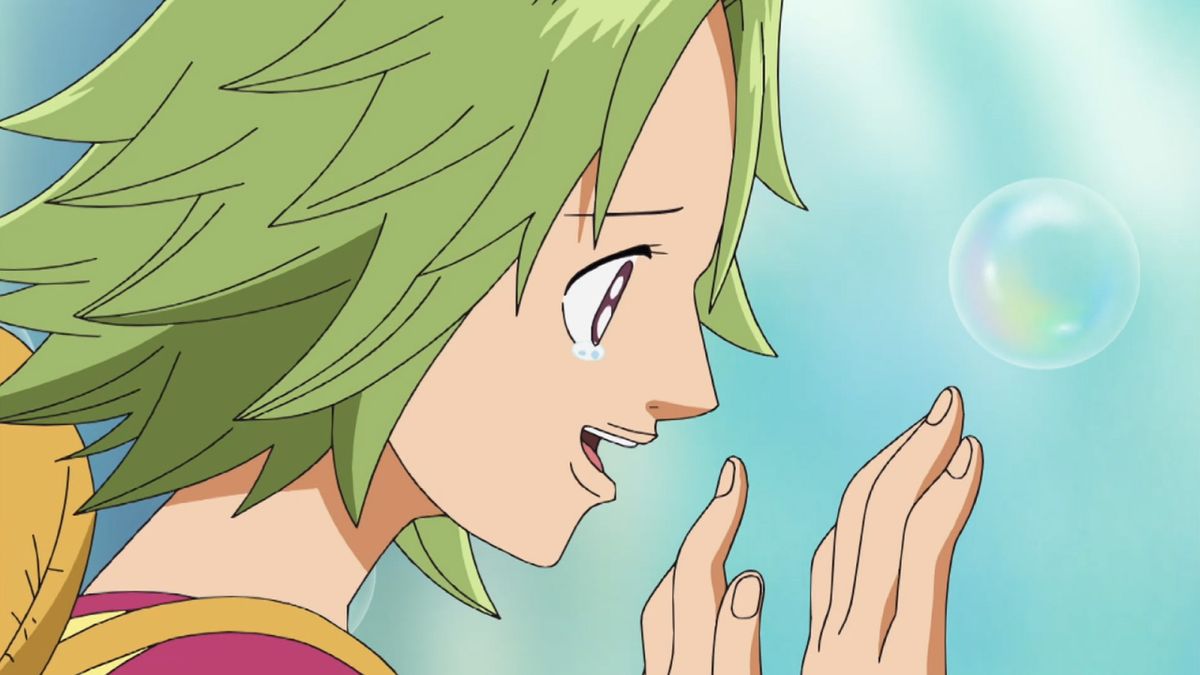
RaeRae Reacts · One Piece Episode 393
Camie Reaches Her Ferris Wheel Dream Before Peterman Steals Her Away
One Piece Episode 393 React follows Camie’s Sabaody Park joy, Bonney saving Zoro from Charlos, and Peterman exploiting the crowd to abduct a mermaid.
One Piece Episode 393 React: Camie finally rides the Sabaody Park Ferris wheel, Peterman tracks her through information sold by bounty hunters, and a day built around one joyful dream ends with a professional kidnapping.
What happened in Episode 393
Luffy’s group leaves Shakky’s bar to search for Rayleigh but gets distracted by Sabaody Park, where Camie fulfills her dream of riding the attractions. Peterman follows after learning that she is a mermaid. Elsewhere, Zoro crosses Saint Charlos, and Jewelry Bonney fakes Zoro’s death to prevent retaliation. Peterman abducts Camie during the distraction, and Chopper calls Sanji, who summons Duval’s renamed Rosy Life Riders.
RaeRae’s opening receipt
Camie gets one beautiful day at the park before a man turns her species into a price. The kidnapping hurts because the episode lets her joy breathe first. Peterman does not steal a plot token. He steals a person whose smallest dream was riding a Ferris wheel without somebody trying to own her.
Sabaody Park makes wonder accessible and safety conditional
The rides welcome visitors through bright color, bubbles, and public excitement. Camie can enter the attraction, but the market outside still marks her body as valuable merchandise.
Access to entertainment does not equal protection inside the surrounding society.
Camie’s dream is wonderfully ordinary
She wants a Ferris wheel ride, not power, treasure, or recognition. The modest wish reveals how exclusion can make ordinary pleasure feel legendary.
A person should not need heroic protection to spend one afternoon at an amusement park.
The crew joins her joy without mocking the scale
Luffy, Chopper, Brook, and Hatchan treat the park as worth the detour. Nobody tells Camie that Rayleigh’s search is too important for her dream.
Friendship makes room for delight even during urgent travel.
Searching for Rayleigh becomes comically ineffective
The group claims to be looking while rides keep winning their attention. The distraction fits Luffy and keeps the episode light long enough for danger to organize unseen.
Poor search discipline creates an opening Peterman understands.
Peterman weaponizes information gathered by others
Bounty hunters who saw Camie pass knowledge to a professional kidnapper. No single observer needs to seize her when information itself carries market value.
Surveillance becomes a supply chain.
Her identity becomes dangerous once strangers name the price
Camie did not change between the bar and park. Other people changed how they classified her after learning she was a mermaid.
Prejudice and profit can convert visibility into immediate threat.
Peterman uses disguise because violence works best near trust
A bear costume belongs naturally inside an amusement park. The disguise lets him approach without looking like the criminal threat Hatchan warned about.
Predators use the surrounding environment to make danger resemble ordinary fun.
The park crowd creates cover rather than community
Many people surround Camie, yet crowd density helps Peterman hide movement. Public space does not protect somebody when nobody recognizes the threat or accepts responsibility.
Safety requires attention, not merely witnesses.
Hatchan’s warnings were precise, not paranoid
He knows mermaids attract kidnappers on Sabaody. The worst outcome arrives while everyone is enjoying a place designed to lower vigilance.
Lived knowledge deserves respect before danger proves every warning correct.
Joy did not cause the kidnapping
Camie should not be blamed for wanting the park, and the crew should not conclude that vulnerable people must avoid every pleasure to remain safe. Peterman chose predation.
Responsibility stays with the kidnapper and the market rewarding him.
The abduction converts minutes into market movement
Professional kidnappers know where to transport a valuable captive, whom to contact, and how quickly an auction can absorb stolen bodies.
The system operates efficiently because trafficking is established business rather than hidden improvisation.
Chopper notices absence after the window closes
The group’s energy makes one missing person harder to detect immediately. Recognition arrives with panic because Sabaody’s scale offers countless directions.
Delay becomes dangerous when kidnappers already know the route.
The phone call spreads responsibility across the crew
Chopper contacts Sanji instead of trying to solve the crisis alone. Communication turns private panic into coordinated response.
A crew survives separation by sharing bad news quickly.
Sanji moves from guard duty into command
He receives the report aboard the Sunny and immediately identifies Duval’s flying riders as the fastest available search network.
Good crisis response uses nearby capacity rather than waiting for the ideal rescuer.
Duval’s new name signals an attempted new direction
The Flying Fish Riders become the Rosy Life Riders after Sanji changes Duval’s face and confidence. A rebrand alone cannot erase trafficking history.
Helping find Camie will provide actual evidence that conduct may be shifting.
Former enemies become useful through accountable action
Duval’s riders know Sabaody routes and can cover distance from the air. Sanji does not need to declare them morally clean before requesting help.
Present action can begin repair while judgment of the past remains intact.
Zoro meets Charlos with no patience for ritual
He does not understand why everybody kneels and refuses to perform reverence for a stranger acting above ordinary humanity.
His instinct is morally satisfying and strategically catastrophic.
Charlos fires because disobedience feels like injury
Zoro’s lack of submission enrages a man taught that inherited status guarantees control of public space. The gun turns bruised entitlement into lethal force.
Power treats equality as insult.
Zoro dodges and prepares the wrong necessary answer
He can avoid the bullet and strike the shooter. Under ordinary pirate rules, retaliation would make complete sense.
Sabaody’s system attaches an admiral to Charlos, so one justified sword stroke could endanger everyone nearby.
Jewelry Bonney intervenes through performance
She knocks Zoro aside and stages his death loudly enough for Charlos to believe the bullet succeeded. Her quick deception saves the swordsman while preventing government escalation.
Intelligence beats pride because she understands the rule Zoro never heard.
Bonney’s tears become tactical language
She performs grief because nobles expect common people to fear them and mourn helplessly. Matching that expectation lets her control what Charlos perceives.
Oppressed behavior can be imitated strategically to survive power.
Zoro resents rescue because he misreads the scale
He sees one weak shooter and one interfering stranger. Bonney sees Marine Headquarters behind the trigger.
Strength without context can become a liability at a political bottleneck.
The two storylines share predation protected by status
Peterman kidnaps Camie for profit while Charlos shoots people through inherited privilege. One operates through criminal markets and the other through official immunity.
Sabaody allows both systems to meet at the auction house.
Camie’s disappearance exposes the crew’s information gap
They know she is gone but not which kidnapper, route, buyer, or grove now holds her. Sabaody’s numbered map becomes useless without a lead.
The riders’ aerial network changes the search from panic into possible pursuit.
Pappag and Hatchan face a familiar nightmare
Both understand what happens when a mermaid reaches the slave market. Their fear contains knowledge the Straw Hats are only beginning to acquire.
Urgency grows from more than friendship; they know the destination awaiting her.
The Ferris wheel memory resists reducing Camie to a victim
The episode records her laughter and dream before captivity. That person remains present even when later scenes place her inside a tank.
Victimization describes what somebody did to her, not the whole person kidnapped.
Peterman depends on buyers more powerful than himself
He can abduct Camie because an auction will convert the crime into money and influential customers will legitimize the sale.
Predators at the street level thrive because respected people create demand.
The crew’s rescue clock starts before the auction announcement
Every transfer moves Camie farther from people who know where to search. Quick coordination matters because traffickers use speed to turn a missing person into anonymous inventory.
Delay serves the seller.
This remains an episode React
This page responds to Camie’s park dream, Peterman’s surveillance and abduction, Bonney saving Zoro from Charlos, and Sanji calling Duval. A complete Sabaody Review belongs on the arc-level record.
React classification keeps joy, danger, and the exact mechanics of kidnapping visible.
The official local still remains canonical
The Episode 393 still serves as featured image, hero, bounded-directory card, and social preview. One local attachment keeps visual recognition consistent.
Complete source, descriptive, accessibility, and filing metadata remain attached. No other record reuses the image.
RaeRae’s final receipt
Camie’s Ferris wheel ride matters because safety should include more than avoiding death. She deserves ordinary fun, public space, ridiculous snacks, and a day where being a mermaid changes which ride she wants rather than how much a trafficker expects to earn.
Peterman watches, waits, disguises himself, and sells access to her body into a market Sabaody already protects. The crew’s distraction does not cause his choice. Camie’s joy does not cause his choice. Demand, information, and a practiced kidnapping network make his choice profitable. Sanji responds by calling the fastest people nearby, including a former enemy whose flying riders can finally use their mobility to help rather than hunt. The park dream remains real. So does the rescue clock now chasing the auction.
Camie’s captors rely on disbelief and distraction
A cheerful public park encourages visitors to interpret costumes and unusual movement as entertainment. Peterman exploits that assumption so witnesses fail to recognize a crime unfolding beside them.
Predation becomes easier when the setting teaches everyone to suspend suspicion.
The crew’s scattered positions become a logistical problem
Some members guard the Sunny, Zoro remains lost, and Luffy’s group lacks a lead. Sanji must coordinate people across numbered groves while the auction deadline approaches.
Strength only becomes useful after everybody knows where to aim.
Duval’s riders can search vertically
Flying fish bypass crowded paths and cover multiple groves faster than runners. A gang technology once used for ambush becomes rescue infrastructure.
Tools gain moral direction from the purpose people choose.
Bonney protects more than Zoro
Stopping his sword prevents an admiral from arriving before Camie’s kidnapping is even known. Her intervention protects strangers, crews, and the island from escalation.
She receives no public credit because successful deception makes the crisis look as though nothing happened.
Zoro’s confusion demonstrates the danger of missing shared information
He left before hearing Hatchan explain the Celestial Dragons. The rest of the crew knows why submission is strategically necessary.
Separation turns one absent briefing into a near catastrophe.
Camie’s dream makes the rescue about returning a future
The goal is not merely extracting her from a tank. Rescue should return the possibility of rides, friendship, work, and travel without ownership defining every day.
Freedom has content beyond an unlocked door.
The episode keeps Camie central even while she disappears
Her absence reorganizes every group, call, and decision. The story remembers her personality through the park experience rather than discussing only sale value.
The missing person remains a person inside the search.
Peterman’s professionalism is an indictment of the market
He has methods, disguises, contacts, and buyers because kidnapping produces reliable income. Professional status means Sabaody has normalized enough demand to support specialization.
The problem extends beyond one villain’s bad impulse.
The search must preserve Camie’s agency after rescue
Friends can become so focused on retrieval that the rescued person gets treated like another object transferred between protectors. Camie’s freedom means returning decisions to her, not moving possession from kidnappers to allies.
The crew’s earlier friendship gives that distinction credibility.
The park records what predators interrupt
Camie completed a dream and shared happiness with friends. Peterman’s abduction does not retroactively make the day foolish.
The memory identifies the life rescue intends to restore beyond physical safety.
Sanji chooses usefulness over pride
Duval recently tried to kill him over a bounty poster. Sanji still calls because flying riders offer the best chance of finding Camie before sale.
Effective loyalty can require cooperation without sentimental reconciliation.
Sanji chooses usefulness over pride
Duval recently tried to kill him over a bounty poster. Sanji still calls because flying riders offer the best chance of finding Camie before sale.
The choice gives Duval a path toward evidence rather than promises. If his gang wants a rosy new life, helping recover the woman their old criminal world would sell provides the first credible receipt.
The rescue must return Camie’s decisions
Friends can become so focused on retrieval that the rescued person feels transferred between protectors. Freedom means returning choice to Camie, not moving possession from kidnappers to allies.
The crew already knows her as somebody with dreams and relationships beyond danger.
The call makes Camie’s absence everybody’s emergency
Chopper shares the news, Sanji finds transportation, and separated groups begin moving toward one purpose. A kidnapping designed to isolate one person meets a crew capable of spreading responsibility faster than fear.