RaeRae Reacts · One Piece Episode 394
Duval’s Riders Search Sabaody While Shakky Names the Auction System
One Piece Episode 394 React follows the aerial search for Camie as Sabaody’s discrimination and so-called employment office reveal an organized trafficking market.
One Piece Episode 394 React: Camie’s friends turn Sabaody upside down, Duval’s riders become an aerial search network, and the island’s history explains why a kidnapped mermaid can be sold in public.
What happened in Episode 394
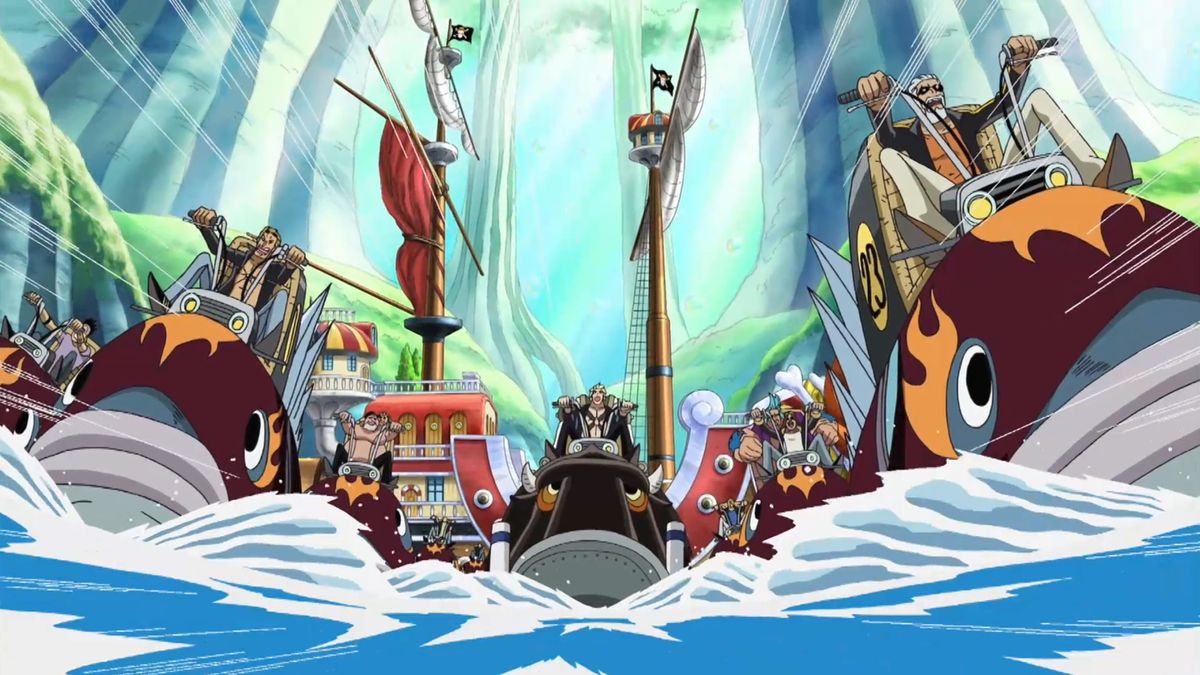
Sanji calls Duval, who gathers scattered Straw Hats and deploys every flying fish to identify Camie’s kidnappers. Shakky explains the long history of discrimination against fish-men and merfolk and the auction market hiding behind an employment-office name. The search narrows toward Grove 1 as kidnappers deliver Camie for sale and the crew races against registration and auction time.
RaeRae’s opening receipt
Camie vanished in a park full of people. Finding her requires the criminal network that recently attacked the Sunny, a bartender with better intelligence than the authorities, and flying fish covering an island built to move stolen bodies quickly. Sabaody has arranged law around the buyers.
Sanji turns worry into command work
He cannot kick a kidnapper nobody can locate. Calling Duval creates search capacity across dozens of groves.
Crisis leadership begins by identifying which available tool reaches the problem fastest.
Duval answers because changed allegiance needs action
His new face and renamed gang could remain a cosmetic joke. Helping Camie lets the riders work against the trafficking economy they once served.
Repair becomes credible through behavior that costs effort and risk.
The Rosy Life Riders know criminal routes
Former participation around Sabaody gives them contacts, visual knowledge, and a sense of how kidnappers transfer captives. That history is uncomfortable and useful.
People leaving harmful systems can help dismantle methods they understood from inside.
Flying fish change the scale of the search
Sabaody spreads across enormous numbered roots. A ground search would lose time at every bridge and crowd.
Aerial coverage makes separate areas visible while Camie moves toward a deadline.
Gathering the Straw Hats prevents fragmented rescue
Duval’s riders collect crew members scattered by shopping, exploration, and Zoro’s war against directions. Coordination concentrates strength around shared information.
A rescue fails when powerful allies arrive at different wrong places.
Shakky supplies history because urgency needs context
The crew wants a location, yet understanding why Camie was targeted predicts the likely destination. Mermaids carry extreme auction value inside an established racial hierarchy.
Context directs action rather than slowing action.
Discrimination survived formal recognition
Fish-men and merfolk entered relations with the World Government generations ago, but prejudice and trafficking continued. Official language did not change markets, habits, or beliefs automatically.
Law can announce equality while institutions tolerate daily contradiction.
The auction house hides behind employment language
Calling the operation a public employment office gives slavery a respectable sign. Euphemism protects customers from naming what they purchase.
Changing vocabulary without changing coercion launders violence through administration.
Camie’s body becomes a premium category
Traffickers assign price through rarity, species, gender, and customer fantasy. Every part of her identity gets stripped from personhood and reorganized as sales appeal.
A high price remains dehumanization rather than admiration.
Peterman sells access to violence
He does not plan to keep Camie. His role connects public surveillance to the auction’s inventory pipeline.
Middlemen help respectable buyers pretend distance from kidnapping.
Registration turns abduction into repeatable business
Clerks, handlers, cages, paperwork, and schedules process captives into lots. Bureaucracy lets a violent act recur efficiently.
Administrative order deepens cruelty by distributing responsibility until nobody claims the whole crime.
Hatchan and Pappag know what the tank means
Both have seen how mermaids are treated around human markets. Their panic grows from lived knowledge rather than abstract fear.
The crew must listen to people who understand danger from inside the targeted community.
Nami recognizes ownership language
Arlong treated her skill as property and controlled movement through threat. Camie’s sale operates through another institution, yet coercion carries a familiar shape.
Nami does not need identical experience to recognize captivity.
The search refuses to blame Camie for visibility
She entered public space and enjoyed a ride. The response is rescue, not a lecture about hiding better.
Freedom cannot require permanent self-erasure to accommodate predators.
Speed still needs accurate intelligence
Flying across every grove only helps after witnesses, rumors, and contacts narrow the route. Movement and knowledge must cooperate.
Fast action aimed at bad information wastes the very time the rescue lacks.
The numbered map becomes a trafficking map
The same grove system used for tourism and coating guides kidnappers toward auction facilities. Neutral infrastructure serves whoever controls routes.
Maps reveal place without deciding purpose.
The crew confronts an institution instead of one captor
Beating Peterman would punish the abduction but would not free Camie after transfer. The auction house now controls her body and schedule.
Rescue must follow the chain instead of stopping at the first criminal.
Camie’s registration overwrites identity quickly
She arrives as a friend, designer’s companion, dreamer, and guide. Auction paperwork reduces all of that to mermaid inventory.
The speed of reduction exposes a system practiced at ignoring testimony.
Rayleigh may share the building without sharing her captivity
The missing coater may have entered an auction scheme voluntarily, trusting his own power. Camie has no comparable control over the sale.
Physical proximity does not make their circumstances equivalent.
The deadline measures transfer of control
Once bidding ends, a powerful customer can move Camie behind private walls. Every minute before sale carries greater rescue value.
Urgency comes from narrowing access rather than dramatic counting alone.
Sanji’s concern belongs to collective loyalty
His behavior around women can become exhausting, but the mission mobilizes everybody because a friend was taken. Camie’s right to freedom does not depend on attraction.
The rescue belongs to the crew’s shared promise.
Duval’s riders begin earning the rosy name
A new label sounded like vanity after his face changed. Searching for Camie gives Rosy Life a direction centered on preserving somebody else’s future.
Names become meaningful after conduct catches up.
Shakky remains calm because panic wastes intelligence
She explains history, evaluates routes, and helps identify the destination without pretending the danger is small.
Calm can reflect competence rather than emotional distance.
Respectable demand drives the street crime
Kidnappers take risks because nobles and wealthy patrons will pay extraordinary sums. Removing one Peterman leaves another seller available while buyers remain protected.
The market begins in the auction seats as much as the park.
Prejudice and profit reinforce each other
Beliefs that mark fish-men and merfolk as lesser make captivity easier to excuse. Auction profits reward people for repeating those beliefs.
Ideology gives exploitation a story, and money gives the story endurance.
Former enemies enter one rescue formation
Nami, Hatchan, Duval, and the Straw Hats carry histories that once made cooperation impossible. Camie’s danger creates a shared present task.
Cooperation does not rewrite the past; cooperation tests what everybody chooses now.
The riders can provide restitution without becoming heroes
One rescue does not erase their earlier attacks or connection to kidnappers. Their help still matters because Camie needs every available route searched.
Accountability can recognize useful change without inflating change into sainthood.
The crew’s strength becomes accountable to Camie’s needs
Nobody gets to smash random groves and call destruction a search. Information determines where force can free her rather than frighten more vulnerable people.
Power works best when guided by the person-centered objective.
This remains an episode React
This page responds to Duval’s search network, Shakky’s history lesson, the auction euphemism, and Camie’s transfer toward Grove 1. A complete Sabaody Review belongs on the arc-level record.
React classification keeps the rescue mechanics and institutional context visible.
The official local still remains canonical
The Episode 394 still serves as featured image, hero, bounded-directory card, and social preview. One local attachment preserves recognition across every route.
Complete source, descriptive, accessibility, and filing metadata remain attached. No other record reuses the still.
RaeRae’s final receipt
Episode 394 makes the search bigger than finding one bad guy. Peterman already delivered Camie into a bureaucracy that knows how to register, display, price, and transfer people while calling the building an employment office. The respectable sign exists so buyers can enjoy the product without naming the kidnapping.
Sanji calls Duval because redemption needs transportation. The renamed riders know the routes because they once worked near the same ugliness. Shakky knows the history because prejudice did not vanish when formal law changed. Hatchan and Pappag know the clock because mermaids do not receive the luxury of assuming public systems will protect them. Every flying fish heads toward Grove 1 carrying a simple answer: Camie is a person, the auction is theft, and nobody gets to call a receipt consent.
The search creates responsibility for every witness
People saw a bear costume, a frightened mermaid, unusual transport, or hurried movement. Individually, each detail looked minor. Together, witness accounts can reconstruct the route.
Community safety depends on noticing when ordinary surroundings are being used to hide harm.
Duval’s gang knows which doors hide respectable criminals
Street-level offenders understand that the auction house depends on polished customers and protected owners. Their knowledge punctures the myth that crime only lives in lawless groves.
The largest profits wait behind the cleanest entrance.
Shakky refuses comforting history
She does not claim old legal reforms solved discrimination. She explains why prejudice endured through markets and daily treatment.
Honest history helps the crew recognize that rescuing Camie will not end the structure targeting her.
Hatchan’s urgency carries guilt and love
He wants to protect Camie while knowing his own past with Arlong complicates trust. The search gives him no time to center personal discomfort.
He directs every available connection toward her safety.
The flying formation converts spectacle into service
Earlier riders used altitude for bombs and intimidation. The same movement now gathers allies and tracks kidnappers.
Changed purpose becomes visible because the technology serves the vulnerable person rather than the gang leader’s pride.
The crew cannot rescue Camie anonymously
Entering the auction may expose pirate identities, challenge wealthy customers, and attract Marines. Saving her carries political consequences beyond one criminal fight.
Friendship means accepting risk without making the rescued person apologize for being valuable to predators.
Every delay strengthens the seller’s story
Once Camie appears on a program, buyers may assume paperwork proves legitimate ownership. Time lets administration overwrite the visible fact of abduction.
The rescue races against narrative capture as well as physical transfer.
The episode builds motion around one clear name
Dozens of riders, groves, calls, and historical facts could make the plot feel scattered. Camie remains the organizing center.
Every useful choice asks whether the action brings her closer to freedom.
The auction depends on targeted communities expecting no help
Traffickers work confidently because fish-men and merfolk have learned that authorities may ignore or worsen their danger. Isolation lowers the cost of kidnapping.
The Straw Hats and riders disrupt that expectation through collective pursuit.
The crew learns that rescue may require public disruption
The auction’s protected customers and legal cover make a quiet extraction increasingly unlikely. Every new fact moves the mission closer to confronting the institution directly.
Preparation helps anger reach the person who needs freedom.
Camie’s rarity never becomes the reason she deserves rescue
The market values her because mermaids are scarce among human buyers. Her friends value her because she is Camie.
Person-centered care rejects every price as a measure of worth.
The riders’ search creates a counter-network
Kidnappers rely on contacts, transport, and rapid information. Duval turns similar capabilities toward tracing the transfer.
Networks can become resistance when participants change whom their knowledge serves.
History explains the present without excusing anyone
Long prejudice makes Camie’s kidnapping predictable. Predictability does not make Peterman, auction staff, buyers, or officials less responsible.
Structural explanation should widen accountability rather than dissolve individual choices.
The auction thrives on victims being isolated
Traffickers expect fish-men and merfolk to lack allies able to challenge wealthy buyers. Camie’s friendships break that calculation.
Collective pursuit raises the cost of treating one person as easy inventory.
The search also tells Camie’s captors that disappearance will not become silence. Friends are tracking routes, questioning contacts, and moving across every grove. A market built on isolation now faces a visible network refusing to let one stolen person become anonymous stock.
The rescue network answers the market network
Peterman relied on watchers, transport, clerks, and buyers. Camie’s friends answer through callers, riders, witnesses, and local knowledge. Collective care must become organized because exploitation was already organized long before she entered the park.
Organized care must outrun organized harm
Camie’s rescue depends on friends coordinating with the same urgency traffickers use for profit. Calls, riders, history, and witness reports become a care system strong enough to challenge the auction pipeline.