RaeRae Reacts · One Piece Episode 392
Shakky Names the Eleven Supernovas Waiting at the New World’s Door
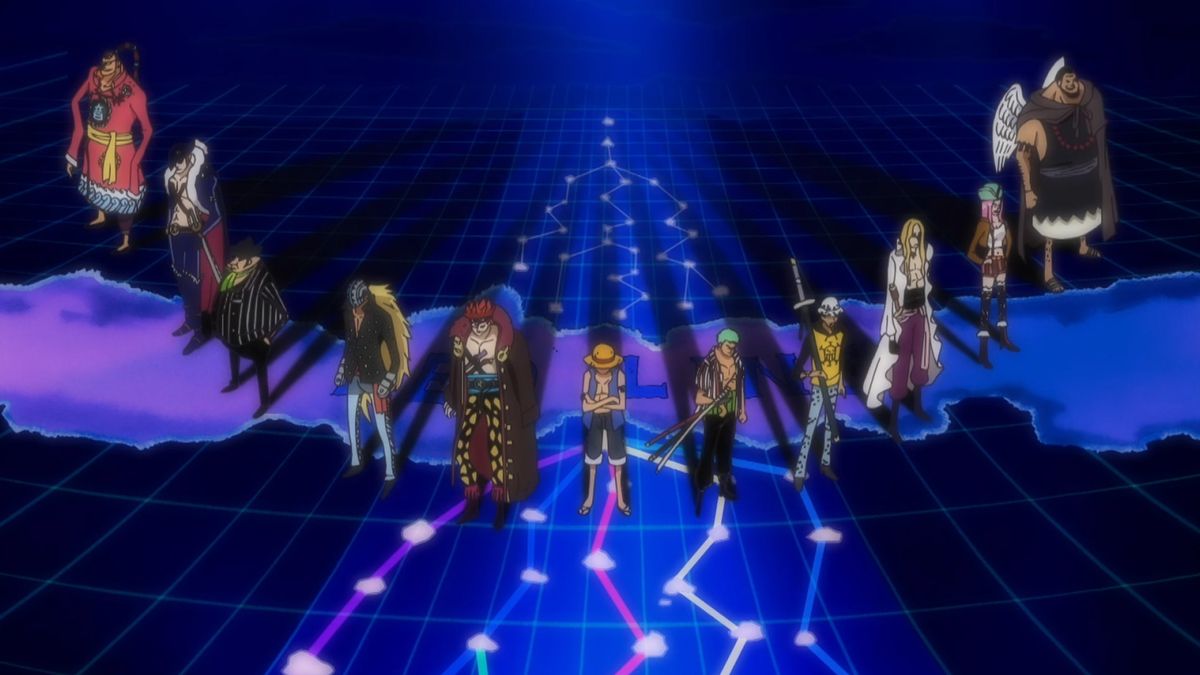
One Piece Episode 392 React follows Shakky explaining the eleven high-bounty rookies while Rayleigh remains missing and the Straw Hats enter Sabaody’s lawless groves.
One Piece Episode 392 React: Shakky introduces the eleven Supernovas, Rayleigh remains missing, and the Straw Hats learn that Sabaody has gathered an entire generation of rookie captains who reached the same dangerous threshold.
What happened in Episode 392
Luffy’s group defeats bounty hunters and reaches Shakky’s Rip-off Bar in the lawless groves. Shakky explains that coating mechanic Silvers Rayleigh has been absent for six months and may have sold himself into slavery for gambling money. She also identifies eleven rookie pirates with bounties above one hundred million berries, including Luffy and Zoro, who have converged on Sabaody before the New World.
RaeRae’s opening receipt
Luffy spent hundreds of episodes behaving like the Grand Line had produced one uniquely unmanageable rookie. Shakky opens the wider guest list. Eleven pirates have crossed the same threshold with enough bounty money attached to make the government sweat. The era has peers, rivals, and several people whose fashion choices deserve their own legal review.
The bounty hunters choose familiar prey and misread the room
Luffy’s group handles the attackers quickly because Sabaody danger comes in layers. Opportunists chase known rewards without understanding which rookie crews have already survived government islands and Warlords.
A posted number attracts people whose confidence exceeds their information.
The lawless groves do not mean power disappears
Government enforcement weakens in certain areas, but kidnappers, traffickers, bounty hunters, and strong pirate crews fill the gap. Absence of public law creates private rule rather than automatic freedom.
People with less force become more vulnerable when every dispute belongs to whoever can impose an answer.
Shakky’s bar announces honesty through the wrong name
A place called Rip-off Bar at least tells customers which kind of hospitality awaits. Shakky charges outrageous prices, gathers information, and remains calm around dangerous guests.
Her confidence suggests she understands the island’s real hierarchy better than most armed men outside.
Shakky reads Luffy before Luffy reads Shakky
She knows bounties, crews, routes, and reputations while the Straw Hats arrive asking for a missing craftsperson. Information gives her control of the conversation.
The crew’s strength cannot replace local intelligence.
Rayleigh becomes more mysterious through absence
The most important coater on the island has vanished for months. His disappearance does not sound like kidnapping because Shakky suggests he may have entered an auction scheme voluntarily to settle gambling trouble.
A missing person who can apparently manage his own danger is a different problem from an ordinary captive.
Selling oneself exposes the auction system’s absurd openness
Rayleigh can allegedly exploit a market designed to strip people of freedom. His confidence does not make the market less brutal for captives without his power.
One exceptional person gaming oppression should never become evidence that oppression is survivable by everyone.
The coater’s habits place the Sunny’s future inside uncertainty
The crew has found the correct contact network and still lacks the person needed. Technical requirements now depend on locating a gambler who refuses predictable schedules.
Adventure remains vulnerable to somebody else’s personal chaos.
Eleven Supernovas redefine Luffy’s generation
The term groups rookies whose bounties cross one hundred million before entering the New World. The threshold says the current era produced several crews capable of disrupting established power.
Luffy is exceptional without being alone.
Zoro’s inclusion matters because he is not a captain
Most names lead their own crews. Zoro reaches the bounty threshold as a subordinate who looks fully capable of commanding violence on his own.
His presence reflects both personal danger and the unusual strength concentrated beneath Luffy’s flag.
Eustass Kid holds the highest bounty for an ugly reason
Shakky explains that Kid’s number exceeds Luffy’s because he harms civilians. The ranking therefore measures government attention and reported threat, not moral worth or clean combat ability.
A larger bounty can represent cruelty rather than greater courage.
Luffy’s number carries institutional defiance
Enies Lobby, Warlord defeats, and repeated public disruption built his reputation. He attacks power that harms friends, even when the government labels resistance criminal.
Comparing raw numbers without reading the events behind them produces bad analysis.
Trafalgar Law enters through composure
Law’s calm presence contrasts with Luffy’s physical enthusiasm and Kid’s aggression. A rookie can threaten the established order without performing danger the same way.
Different leadership styles gather at one bottleneck.
Jewelry Bonney has already saved Zoro from himself
Her intervention with Charlos prevented a sword strike that would have summoned an admiral. She recognized consequence faster than Zoro recognized status.
Practical intelligence can look like theatrical deception when survival demands a quick performance.
Basil Hawkins treats danger as probability
His cards and calm calculations create a relationship to risk unlike Luffy’s instinct. Hawkins wants to know the chance before acting.
The contrast prepares a generation divided by how captains respond when the world refuses certainty.
Scratchmen Apoo turns provocation into spectacle
Apoo’s presence feels loud before his full abilities become clear. He observes, irritates, and seeks reaction as though conflict were another performance stage.
Sabaody collects personalities too large for one peaceful waiting room.
Urouge brings religion and physical force into one silhouette
The monk title, enormous body, and measured demeanor resist a simple pirate category. His crew has crossed the same Grand Line through a history the Straw Hats do not know.
Every bounty number hides an entire unseen voyage.
Capone Bege carries organized-crime discipline
His crew’s styling and hierarchy suggest a captain who treats piracy as structured family business. Order can serve criminal ambition as effectively as chaos.
The generation contains institutions in miniature, not only wandering adventurers.
X Drake complicates the line between pirates and government
A former Marine becomes a pirate captain with a major bounty. His career already proves official affiliation and personal allegiance can change.
Sabaody introduces biographies that will matter long after first impressions.
Scratchmen, Drake, Bonney, Hawkins, and Bege refuse one rookie mold
Their bodies, crews, methods, and temperaments differ sharply. Calling them a generation should not flatten those distinctions.
Shared timing creates comparison without creating sameness.
Killer joining Zoro as a non-captain matters
Kid’s masked fighter also crosses the bounty threshold. Two first mates appearing among captains shows how certain crews distribute strength beyond the person at the top.
A dangerous era produces dangerous partnerships.
The hundred-million threshold is partly a storytelling lens
Government records select who becomes publicly legible as a major rookie. Capable pirates beneath the line disappear from this particular list.
Classification helps viewers organize the field while remaining an imperfect measure.
Eleven converging at Sabaody proves geography organizes history
Different routes through Paradise eventually narrow toward the Red Line. Captains who never met across distant islands now share nearby groves.
A transit bottleneck turns separate adventures into a generational event.
The New World becomes a filter everybody can see
Reaching Sabaody earns no guarantee of passing onward. Coating, Marines, rivals, traffickers, and local power stand between arrival and descent.
The threshold celebrates survival while exposing how many crews may fail at the gate.
Shakky compares rookies without worshipping them
She has enough history and strength around her to treat large bounties as information rather than celebrity. Her calm prevents the introduction from becoming a breathless ranking show.
Perspective changes when the speaker has watched generations rise and disappear.
Rayleigh’s absence quietly outranks every rookie name
The crew came for coating, and no Supernova can provide the missing craft. Fame does not solve the actual route problem.
A specialist’s unavailable labor remains more immediately important than the island’s pirate leaderboard.
Luffy receives rivals without becoming competitive on command
He wants the One Piece but does not need to defeat every rookie merely because Shakky lists them. His attention follows friends, food, adventure, and immediate injustice.
Rivalry gains meaning through future choices rather than a narrator declaring a bracket.
Zoro may not understand the category around him
He is elsewhere getting lost while his name enters an elite list. That separation fits a swordsman more interested in his captain’s route and personal ambition than public ranking.
Reputation grows even when the subject misses the announcement.
The episode expands the world before tightening danger
Viewers receive a rush of names and designs, then the story returns to the missing Rayleigh and the crew’s search. Scale increases without losing the local objective.
Good setup makes the world larger while keeping action pointed forward.
The Supernovas are not a promise of moral alliance
Shared generation does not create shared ethics. Kid’s civilian violence already marks one divide, and each captain will respond differently to Marines, slavery, Emperors, and opportunity.
Peers can threaten the same order for incompatible reasons.
This remains an episode React
This page responds to Shakky’s bar, Rayleigh’s disappearance, the lawless groves, and the eleven Supernovas. A complete Sabaody Review belongs on the arc-level record.
React classification preserves the generational introduction without turning an episode page into a full-career encyclopedia.
The official local still remains canonical
The Episode 392 still serves as featured image, hero, bounded-directory card, and social preview. One local attachment keeps recognition consistent across every route.
Complete source, descriptive, accessibility, and filing metadata remain attached. No other record reuses the image.
RaeRae’s final receipt
Episode 392 takes Luffy out of the fantasy that only one reckless rookie reached the Red Line with a government headache attached. Ten other names share the threshold. Some protect people. Some harm civilians. Some calculate. Some perform. Two are not even captains, which tells everybody exactly how dangerous the crews around them have become.
Shakky does not confuse bounty with virtue, and neither should we. Kid’s higher number carries civilian blood. Luffy’s number carries open war against institutions protecting cruelty. The figures measure attention, not character. Meanwhile, the person the Straw Hats actually need has apparently been missing for six months because gambling and voluntary auction fraud sounded more interesting than staying home. Welcome to Sabaody. The rookies are famous, the coater is absent, and every route forward depends on reading more than a wanted poster.
Each bounty hides islands the audience never visited
The Straw Hats earned their numbers across stories viewers witnessed. The other captains arrive with unseen battles, losses, crimes, rescues, and crews who kept them alive.
The list creates curiosity because public totals cannot explain private routes.
Shakky’s information network is a form of power
She knows names, numbers, habits, and recent movement without leaving the bar. People carrying physical strength come to her for knowledge they cannot punch into existence.
Sabaody rewards anyone who can read traffic before traffic becomes conflict.
Rayleigh’s gambling story refuses respectable legend
A master coater absent for half a year could sound tragic or heroic. Shakky suggests a man who gets bored, gambles, and enters trouble with confidence that would kill ordinary people.
Future importance does not require polished personal habits.
The title calls them rivals before most have met
Competition for the One Piece connects the captains even when no formal rivalry exists yet. Their ambitions point toward the same symbolic prize and limited political space.
Rivalry begins as structural pressure before becoming personal.
Kid and Law provide immediate contrasts around Luffy
Kid’s reputation emphasizes civilian casualties. Law’s calm makes intention difficult to read. Luffy sits between them as a captain whose chaos often follows a clear line around friends and domination.
Three dangerous men can reject authority without sharing a moral center.
The generation label will outlive this first gathering
Governments and newspapers need a name for simultaneous disruption. Naming can clarify history while also turning complicated crews into a single phenomenon.
Public language creates expectations each pirate may later resist.
The crew learns scale without surrendering identity
Ten peers do not make Luffy smaller. Their arrival confirms that the era contains enough pressure to challenge more than one established power at a time.
Individual dreams become part of a broader historical movement without losing personal stakes.
The list expands the voyage without replacing the crew at its center. Each captain adds another possible future, alliance, collision, or warning. Luffy remains Luffy because comparison cannot decide which dream deserves the sea.
The generation label remains a beginning
Shakky gives the crew a map of names rather than completed judgments. Every captain will reveal character through alliances, betrayals, risks, and the people protected or harmed along the route.
A bounty opens the file. Conduct writes the record.
The names create a map for future accountability
Every Supernova now enters the story with a public reputation that later behavior can confirm, complicate, or expose. Shakky gives viewers enough information to remember the first claim without pretending a bounty closes the judgment.