RaeRae Reacts · One Piece Episode 391
An Exploding Slave Collar Exposes the Celestial Dragons’ Rule Over Sabaody
One Piece Episode 391 React follows Devil Dias begging for freedom before Saint Shalria shows how law protects Celestial Dragon cruelty.
One Piece Episode 391 React: bubble-bike fun collides with a runaway slave’s exploding collar, and the Celestial Dragons enter Sabaody as proof that law can protect cruelty instead of stopping cruelty.
What happened in Episode 391
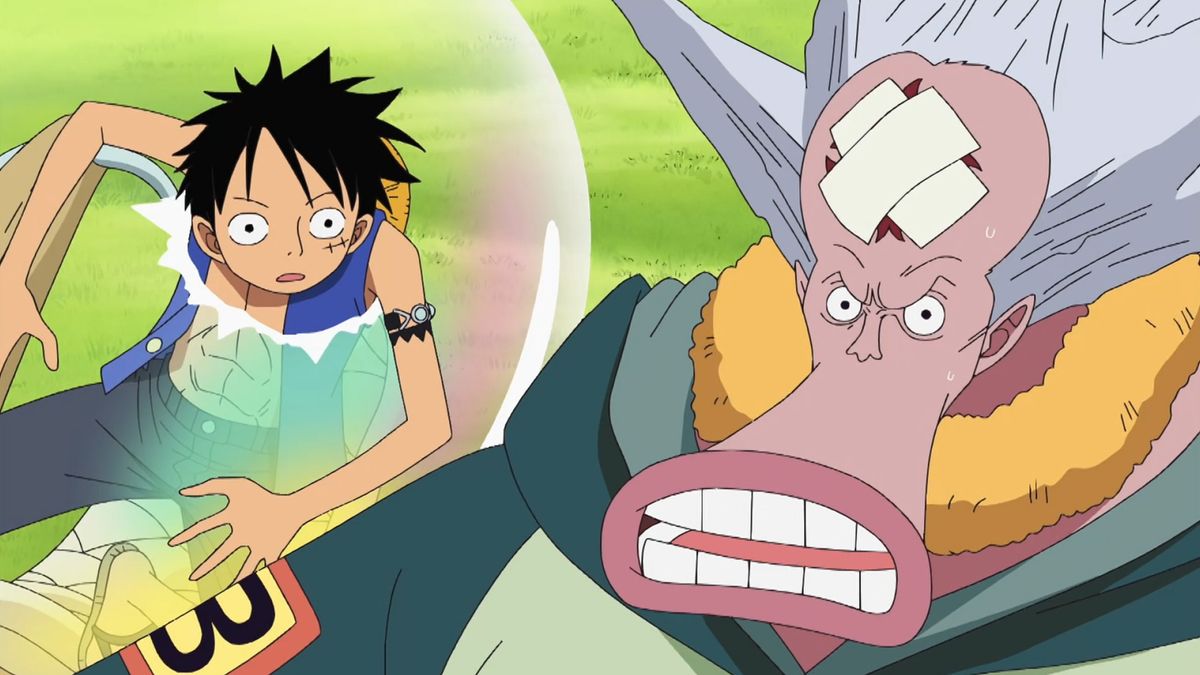
The crew divides across Sabaody while Luffy, Brook, Chopper, and Hatchan ride bubble bikes. Hatchan explains the Celestial Dragons and warns everyone not to challenge them. A runaway pirate named Devil Dias begs for help removing his slave collar, but the device explodes. Saint Shalria and Saint Rosward arrive, degrade and shoot the injured man, and force the crowd to kneel while Luffy struggles against intervention that would summon a Marine admiral.
RaeRae’s opening receipt
Episode 391 stops asking whether Sabaody has a dark side. The Celestial Dragons walk through public streets wearing air bubbles because sharing oxygen with ordinary people feels beneath them. Everyone kneels, a wounded slave gets shot, and law protects the shooters. That is not corruption around the system. That is the system introducing itself.
Bubble bikes make freedom feel effortless
Luffy races through the groves on technology shaped from local resin. Movement looks playful, fast, and available.
Devil Dias appears wearing a collar designed to make movement punishable by death. The contrast turns the same setting from playground into prison.
The collar puts ownership directly on the body
A chain could be cut from outside. The explosive device forces the captive to police his own escape because touching freedom may trigger death.
Control becomes more efficient when terror travels with the person.
Devil Dias asks strangers because official help does not exist
He begs anyone nearby to remove the collar and let him reach his family. No guard, court, or public office will protect him from the people claiming ownership.
When law recognizes the owner instead of the captive, strangers become the only possible rescue.
The crowd knows intervention carries collective risk
People keep distance because the collar may explode and Celestial Dragons may punish resistance. Fear does not mean every witness approves.
A violent hierarchy survives partly by making solidarity expensive enough that ordinary people hesitate.
The explosion punishes the desire to return home
Dias does not attack his captors or demand power. He wants family and freedom. The collar answers that ordinary desire with mutilation.
The device turns hope into a trigger the owner controls.
Shalria sees damaged property where viewers see a wounded man
She evaluates whether Dias remains useful rather than whether he needs care. Her language strips personhood before the gun appears.
Dehumanization prepares violence by making compassion sound irrational.
Shooting Dias demonstrates impunity
Shalria attacks a collapsed man in public while everyone kneels. She does not hide the act because consequences are designed to fall on anybody who objects.
Power becomes most obscene when cruelty needs no secrecy.
The Celestial Dragons wear separate air as ideology
The bubbles around their heads are not medically necessary. The nobles refuse to breathe what common people breathe because superiority must be performed through every gesture.
A costume converts prejudice into portable architecture.
Kneeling makes hierarchy visible
Residents lower their bodies so the nobles can occupy public space above them. The ritual trains witnesses to participate in their own degradation.
Forced posture turns political inequality into a daily physical fact.
Hatchan knows survival requires compliance
He tells Luffy to kneel because striking a Celestial Dragon will bring an admiral and Marine Headquarters. The warning carries experience with a world where fish-men receive less protection and more punishment.
His restraint grows from threat assessment, not respect.
Luffy’s anger meets an enemy too large for one street
He can punch Shalria. He cannot prevent the full government response from endangering Camie, the crew, and everybody nearby.
The episode creates unbearable tension by making the morally obvious action strategically catastrophic.
Restraint does not become agreement
Luffy’s body strains against stillness. He kneels because people he protects have explained the consequence, not because the nobles deserve obedience.
Sometimes survival requires outward compliance while every internal judgment remains intact.
Pappag explains the legal shield
Celestial Dragons descend from the founders of the World Government. Attacking one brings military force because inherited status receives institutional protection.
The rule makes personal cruelty a state concern while the victim’s freedom receives no comparable defense.
An admiral functions as enforcement for aristocratic comfort
Marine power is supposedly organized around justice and piracy control. Here the threat of an admiral guarantees nobles can enslave and shoot people without resistance.
The episode exposes whose safety the institution prioritizes.
Piracy and slavery occupy different legal categories
The Straw Hats are criminals for sailing outside government permission. Buying, selling, and abusing people continues openly when protected classes benefit.
Legality reveals hierarchy rather than a consistent moral code.
Camie’s danger increases with every explanation
A mermaid carries extraordinary auction value in this market. The crew’s new friend is walking through a place where buyers and kidnappers can treat her body as fortune.
Knowledge turns general caution into urgent protection.
Hatchan asks to be treated as human
His warning that he and Camie should receive ordinary human treatment exposes how rarely that standard is granted. He knows visible difference can attract predators and casual contempt.
The request is painfully modest: recognize personhood before species.
His wound quietly records recent violence
Hatchan minimizes the injury while guiding the group. The mark connects rescue at Duval’s base to the current journey.
Moving forward does not mean everybody arrived unharmed.
Zoro wandering alone threatens every rule Hatchan explained
Zoro cannot follow simple directions and has no patience for aristocratic theater. The audience understands the collision before characters do.
Comedy about navigation becomes suspense when one wrong grove contains protected abusers.
Usopp and Franky staying behind protects the Sunny
The split crew means not everybody witnesses the same danger. Maintenance and guard duty continue while Sabaody reveals its hierarchy elsewhere.
Parallel responsibilities make information uneven across the crew.
Sanji waits with treasure while people are priced nearby
Nami’s money receives careful protection on the Sunny. Across the groves, traffickers assign prices to bodies.
The juxtaposition shows how markets can treat objects responsibly and people monstrously.
The episode refuses a comfortable villain distance
Celestial Dragons do not rule from a remote castle during this introduction. They walk past Luffy while a slave bleeds at their feet.
Proximity makes restraint feel physically painful.
Dias being a pirate does not weaken his claim to freedom
He may have harmed people during his own voyage. Slavery remains wrong without requiring a spotless victim.
Personhood cannot depend on passing a moral-purity test administered by owners.
The family plea restores the life outside the collar
Dias wants to see people who know him beyond captivity. His captors reduce him to labor and resale value, while family memory confirms a fuller identity.
The desire to return home makes the public indifference harder to excuse.
Shalria’s contempt depends on inherited distance
She has never needed to imagine herself inside the collar. Birth placed her among people protected from consequences and taught her that protection proved superiority.
Privilege becomes ideology when luck is retold as worth.
The crowd’s silence shows terror working
No mass uprising follows the shooting. Everybody understands an objection could bring punishment beyond one family or street.
Silence under armed hierarchy should not be confused with consent.
Luffy’s eventual response gains power from this restraint
The story makes him watch, listen, and hold back before the later breaking point. Anger accumulates through witnessed cruelty rather than arriving as random heroism.
When restraint ends, the audience will know exactly which system demanded too much.
The collar explosion turns spectators into warning recipients
Dias suffers physically, but the device also communicates with everyone watching. Escape brings pain. Assistance brings attention. Resistance may summon greater force.
Public punishment trains a crowd without placing a collar on every neck.
Shalria’s gun completes the message
The explosion already incapacitates Dias. Shooting him serves no defensive purpose. The extra violence demonstrates that a Celestial Dragon can decide whether an enslaved person remains alive after property value declines.
Arbitrary cruelty becomes a privilege she performs publicly.
Rosward treats violence as family routine
He accompanies Shalria without challenging the abuse. Their shared status turns individual cruelty into inherited culture.
Silence from powerful relatives protects the practice as effectively as direct participation.
The Marines’ promised response reverses justice
An enslaved man receives no admiral when kidnapped, collared, or shot. A noble receives an admiral if somebody strikes back.
Resource allocation reveals whose pain the government recognizes as emergency.
Hatchan’s command to kneel protects Luffy from incomplete knowledge
Luffy sees an immediate attacker and victim. Hatchan sees the chain connecting one punch to Marine Headquarters, Camie’s exposure, and the crew’s unfinished coating.
Local knowledge expands the moral calculation without making the current cruelty acceptable.
Brook and Chopper witness a boundary they cannot joke away
Both characters often soften scenes through unusual bodies and comedy. The collar and gun stop that rhythm.
Shock across the group tells viewers that Sabaody has crossed beyond ordinary pirate brutality.
The nobles’ air bubbles mock actual survival technology
Camie may need a coating bubble to move safely through human spaces. The Celestial Dragons wear bubbles as symbols of disgust toward everybody else.
One barrier supports life across environments. The other performs imagined superiority.
The episode asks viewers to feel the cost of strategic patience
Holding back is not framed as calm wisdom free from consequence. Dias suffers while Luffy obeys a rule designed to protect the attacker.
Sometimes no available choice feels morally clean because powerful people arranged every consequence to punish resistance.
Chopper’s medical instinct has no safe route toward the patient
A wounded man lies nearby, yet approaching could challenge the nobles or place more people at risk. The doctor’s ability to help becomes trapped behind political power.
Systems create harm twice when they injure people and block care.
Brook’s offer of tea shows ordinary manners colliding with terror
His habitual politeness sounds almost surreal beside collars and guns. The moment demonstrates how quickly the crew’s normal rhythm has become inadequate for the scene.
Some violence cannot be softened through courtesy.
The bounty hunters watching Luffy add another layer of danger
Even while the Celestial Dragons command public attention, opportunists track pirate targets through the crowd. The crew faces state power above and private profit around them.
Sabaody monetizes vulnerability from several directions at once.
Every observer therefore reads the same street differently. Luffy sees abuse demanding interruption. Hatchan sees an admiral waiting behind one wrong move. Bounty hunters see money. The nobles see bodies arranged beneath their status. Dias sees one final chance to reach home. Power determines whose reading becomes law.
Sabaody’s beauty now becomes evidence against neutrality
The groves support entertainment, shopping, and technological wonder while slavery operates openly. Prosperity did not eliminate abuse.
Beauty without justice gives cruelty a prettier address.
This remains an episode React
This page responds to the bubble bikes, Devil Dias’s escape, the explosive collar, Shalria and Rosward’s arrival, and Luffy’s forced restraint. A complete Sabaody Review belongs on the arc-level record.
React classification keeps the episode’s political introduction visible in full rather than reducing the Celestial Dragons to setup.
The official local still remains canonical
The Episode 391 still serves as featured image, hero, bounded-directory card, and social preview. One local attachment keeps recognition consistent.
Complete source, descriptive, accessibility, and filing metadata remain attached. No other record reuses the image.
RaeRae’s final receipt
Episode 391 introduces the Celestial Dragons through air, posture, collars, and a gun. They refuse shared oxygen. They make everybody kneel. They turn escape into an explosion and injury into proof that enslaved property has lost value. Then the World Government promises an admiral against anyone who objects too forcefully.
Luffy kneels because Hatchan knows the cost and because Camie needs protection. That restraint hurts precisely because his moral instinct remains correct. Devil Dias deserves freedom without first proving he was a perfect pirate. Shalria deserves consequence without inherited status summoning military retaliation. Sabaody’s law reverses both claims. The bubbles keep floating above a public street where cruelty has official protection, and the crew has only begun learning what this beautiful gateway charges people who lack power.
Every later breaking point begins here, with a man asking to go home and a crowd trained to watch. The episode refuses to call obedience peace. Guns, collars, inherited status, and threatened admirals manufacture the silence. Luffy’s restraint delays conflict; nothing in the scene makes the ruling order legitimate.