RaeRae Reacts · One Piece Episode 385
The Straw Hats Reach the Red Line and Meet Camie and Pappag Below the Surface
One Piece Episode 385 React follows the Sunny reaching the Grand Line midpoint, a failed search for Fish-Man Island, and a Sea King coughing up two unexpected guides.
One Piece Episode 385 React: the Thousand Sunny reaches the Red Line, the Log Pose points uselessly downward, and a search for Fish-Man Island produces a mermaid and talking starfish instead of directions.
What happened in Episode 385
The crew survives a dangerous current and reaches the Red Line for the second time, marking a voyage halfway around the Grand Line. Because the Log Pose points beneath the sea, the Straw Hats use Shark Submerge III to search for Fish-Man Island. They fail to find a route, encounter sea creatures, and rescue Camie and Pappag after a Sea King spits them onto the Sunny.
RaeRae’s opening receipt
Halfway around the world should feel like a finish line. The Log Pose responds by pointing straight down. One Piece loves a milestone that celebrates survival for five minutes before assigning everybody a stranger problem.
The Red Line turns distance into something visible
The crew crossed the mountain at Reverse Mountain and now meets the same world-spanning landmass from the opposite side. Geography confirms progress more powerfully than a speech could.
They have traveled far enough to encounter the wall again, yet the destination remains beyond another impossible route.
Halfway is achievement and warning
Every island, battle, loss, and new crewmate sits behind the Sunny. An equal concept of distance sits ahead, though the New World will refuse any simple symmetry.
The milestone honors endurance without promising the remaining voyage will behave.
The Log Pose tells the truth without giving useful advice
The needle points downward because Fish-Man Island lies beneath the Red Line. Accurate information can still be completely insufficient.
Navigation requires interpretation, local knowledge, equipment, and somebody willing to admit the obvious route has vanished.
Nami reaches the limit of maps she currently owns
Her skill remains intact. The problem exceeds available information. Treating experts fairly means recognizing when uncertainty comes from missing data rather than incompetence.
The crew needs a guide, not a new navigator.
Shark Submerge III makes the Sunny’s versatility matter
Franky built a ship capable of sending a compact submarine below the surface. The machine turns an impossible question into a search, even when the search does not produce the answer.
Useful technology expands what a crew can investigate. Technology does not guarantee the ocean will cooperate.
The deep water changes the scale of danger
Above sea level, the Red Line looks like an immovable wall. Below, pressure, darkness, currents, and enormous creatures create a different world around a very small craft.
Fish-Man Island stops sounding like another island with unusual residents and starts sounding physically remote.
The current refuses to treat the Sunny like a triumphant ship
Reaching the midpoint requires surviving water that can seize even Franky’s masterpiece. The sea remains stronger than reputation.
That humility keeps navigation tense after hundreds of episodes.
The crew celebrates because milestones need witnesses
No government issues a certificate for crossing half the Grand Line. The Straw Hats recognize the achievement for one another.
Shared celebration records labor that institutions would only classify as criminal movement.
Brook crosses a threshold with a crew again
His previous voyage ended before any promised reunion. Reaching the Red Line aboard the Sunny gives him a new relationship to forward motion.
The milestone carries extra weight for somebody who spent fifty years going nowhere.
Failure to find Fish-Man Island corrects overconfidence early
The crew can defeat a Warlord and still fail at locating the next stop. Combat power cannot substitute for regional knowledge.
The episode wisely makes information the scarce resource.
A Sea King becomes the least dignified delivery service
Camie and Pappag enter by being expelled from a monster, which prevents their introduction from becoming too precious. One Piece can reveal a mermaid and talking starfish while still landing the scene as physical comedy.
Wonder arrives covered in chaos.
Camie changes the route from abstract to personal
Fish-Man Island was a point below the needle. A mermaid on deck turns the destination into a place connected to actual people.
Geography becomes relationship before the crew reaches the shore.
Pappag talks because this world has confidence
A speaking starfish should stop the episode. Pappag behaves as though his career, opinions, and vocabulary require no special permission.
The absurdity works because the world refuses to apologize for him.
Sanji’s reaction reveals his priorities immediately
The arrival of a mermaid overwhelms any calm discussion of directions. His excitement remains funny and exhausting, especially when the crew remembers that Granny Kokoro already complicated his claim about meeting a first mermaid.
Selective memory protects Sanji’s fantasy until Usopp brings receipts.
Kokoro’s shadow keeps the joke honest
Sanji wants mermaid beauty to fit one narrow image. Kokoro’s existence disrupts that fantasy, and the crew refuses to let him rewrite history.
The joke exposes expectation rather than making Camie responsible for fulfilling every expectation.
Camie and Pappag arrive with needs of their own
They may know the region, but they do not exist as navigation tools waiting for pirates. Their relationships and danger will determine whether help becomes possible.
A guide is a person before becoming a service.
The Red Line marks a political boundary as well as a natural wall
The crew cannot simply climb and pass through the territory above. Access belongs to institutions that would never welcome the Straw Hats.
The underwater route therefore reflects unequal power, not only adventurous preference.
Fish-Man Island already carries the weight of separation
A homeland beneath the sea sits apart from the human world by pressure, danger, and restricted passage. The distance hints at why contact between communities develops through fear and exploitation.
The route prepares political questions before the series names all of them.
The episode opens Sabaody by withholding Sabaody
The crew aims for Fish-Man Island and instead needs information that will lead toward coating and the archipelago. Progress becomes a chain of dependencies.
Good journey structure lets the obstacle reveal the next place organically.
The midpoint does not divide the story neatly
Thriller Bark has ended, but emotional and geographic consequences travel forward. Brook is new, Kuma remains a warning, and the world ahead will make earlier threats look local.
A line on the globe cannot reset character history.
Reverse Mountain and the present Red Line meeting rhyme
The first crossing carried a tiny crew into the Grand Line with more confidence than information. The second meeting arrives with a larger family, a better ship, and hard-earned knowledge that still cannot answer the next question.
Growth does not eliminate uncertainty. Growth changes how many resources and relationships face uncertainty together.
The world wall exposes limits imposed by government routes
Mary Geoise occupies the passage above, where pirates cannot request ordinary transit. The legal route belongs to power, so the crew must seek a dangerous path below.
Geography and politics cooperate to decide who moves safely.
A downward needle demands conceptual flexibility
The crew has followed horizontal bearings from island to island. Now the destination requires thinking vertically through an ocean layer most humans cannot inhabit.
The Grand Line changes the rules whenever routine starts to look dependable.
Franky’s invention provides information even through failure
The submarine search confirms that simply diving and looking will not solve the route. Negative results narrow the problem and prove specialist guidance is necessary.
Failed exploration remains productive when people learn what their current method cannot reach.
Nami’s leadership appears through naming uncertainty
She does not bluff a course to protect her image as navigator. She reads the Log Pose, evaluates the terrain, and accepts that the crew lacks crucial knowledge.
Honest expertise keeps the ship safer than confident guessing.
The sea below the Red Line feels inhabited before any city appears
Currents and creatures show an environment with routes humans cannot read. Fish-Man Island belongs inside that living system rather than sitting like a submerged human town waiting to be discovered.
Arrival will require learning how another community understands the water.
Camie’s entrance interrupts human assumptions
The crew talks about reaching a place associated with fish-men and mermaids. Then a real mermaid lands on deck with her own personality, history, and urgent priorities.
An idea about a people becomes accountable to a person.
Pappag refuses the role of adorable accessory
He speaks, works, boasts, and explains himself. Camie calls him a friend rather than property.
The relationship quietly corrects any viewer prepared to treat a talking sea creature as decoration.
Sanji’s fantasy gets challenged by lived diversity
He expects one beauty standard to define mermaids. Kokoro and Camie demonstrate that a people cannot be reduced to the image a visitor wants to consume.
The comedy lands because his narrow expectation takes the hit.
The episode makes help reciprocal without balancing a ledger
The Straw Hats save Camie and Pappag from immediate danger. Their new guests may help with directions once their own crisis is addressed.
Reciprocity grows through relationship rather than exact payment for services rendered.
Every route toward Fish-Man Island now has a human cost
The crew cannot treat coating, guidance, or local contacts as neutral logistics. Access passes through communities targeted by kidnappers and buyers.
Travel will require moral choices before the destination becomes visible.
The milestone also belongs to the ships that carried them
The Going Merry crossed much of the distance and could not stand at this wall. The Thousand Sunny reaches the midpoint carrying design choices, salvaged relationships, and grief from Water 7.
Celebration can honor the vessel present while remembering the vessel absent.
Luffy’s dream gains geographic proof
Becoming Pirate King often sounds like impossible confidence shouted toward the horizon. The Red Line shows that the crew has converted a portion of that claim into traveled distance.
Proof of progress strengthens the dream without guaranteeing the outcome.
The crew cannot muscle through every boundary
Climbing the Red Line would trigger political and physical danger. Diving without coating would destroy the ship. The correct route requires preparation rather than bravery performed for its own sake.
Restraint becomes a survival skill as the world grows larger.
Camie arrives before the crew knows how much danger follows her community
Her cheerfulness can make the meeting feel light, yet the surface world places mermaids at extreme risk of capture and sale. That reality will soon redefine every crowded public space.
The episode introduces warmth before exposing the system threatening her.
The rescue from the Sea King begins a chain of mutual care
Luffy’s crew acts because somebody is in danger. Camie responds through gratitude, local knowledge, and concern for Hatchan.
One rescue does not settle a debt. The act creates a relationship capable of carrying the next request.
The meeting also changes the emotional weather of the midpoint. A wall that first signaled blocked progress becomes the place where new companions appear. The crew still lacks a route, but the problem now has voices, names, and people willing to face the uncertainty together.
That shift captures how the Grand Line keeps working. Maps provide bearings, ships provide movement, and strength keeps danger from ending the voyage. People provide the route nobody could calculate alone. Camie and Pappag do not solve every problem upon arrival. They make the next honest question possible, which is more useful than another confident guess beneath the Red Line.
This remains an episode React
This page responds to reaching the Red Line, the downward Log Pose, the submarine search, and Camie and Pappag’s arrival. A complete Sabaody Review belongs on the arc-level record.
React classification keeps the midpoint’s broadcast-level details visible while Reviews cover complete works.
The official local still remains canonical
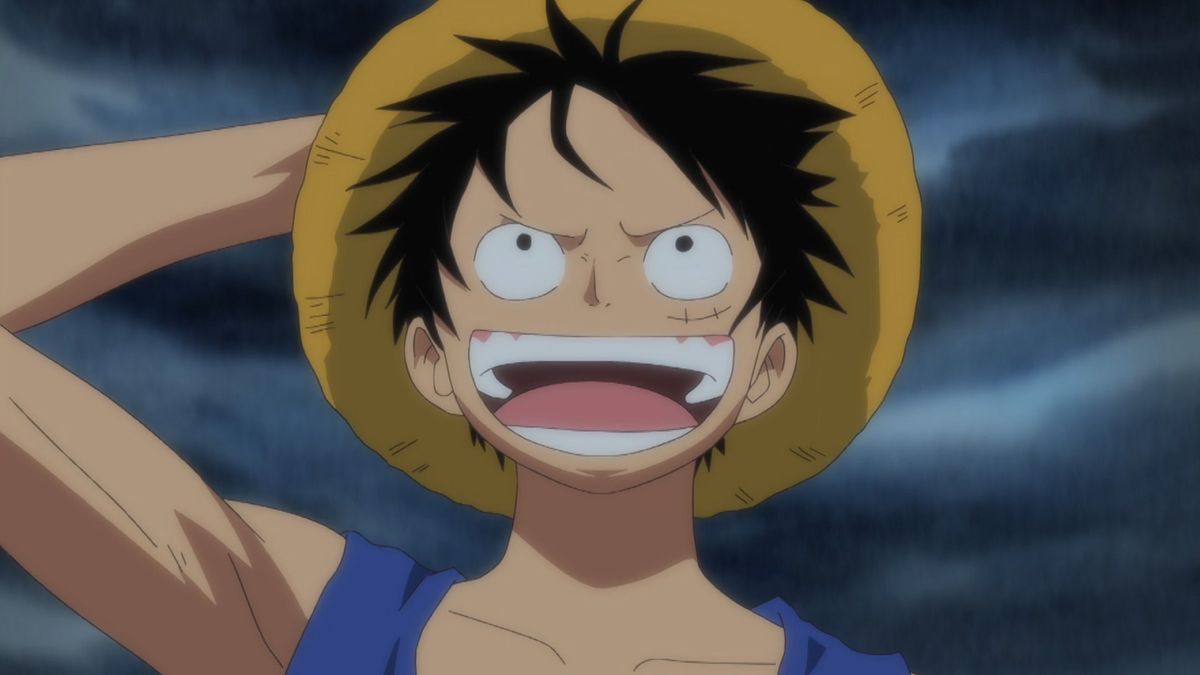
The Episode 385 still serves as featured image, hero, bounded-directory card, and social preview. One local attachment keeps recognition consistent across each route.
Full source, descriptive, accessibility, and filing metadata remain attached. No other record reuses the image.
RaeRae’s final receipt
The Straw Hats reach the Red Line and deserve the celebration. They crossed half the Grand Line with a crew that did not exist when Luffy left home, ships that did not both survive, and promises that grew heavier with every island. Then the needle points down because the sea has jokes.
The failed search matters. Nami cannot map information nobody has supplied. Franky cannot build past every unknown. Strength cannot punch directions out of deep water. Camie and Pappag arrive as two ridiculous, necessary people with their own crisis attached. The next route will begin through relationship, because this story has never let geography stay separate from who gets protected along the way.