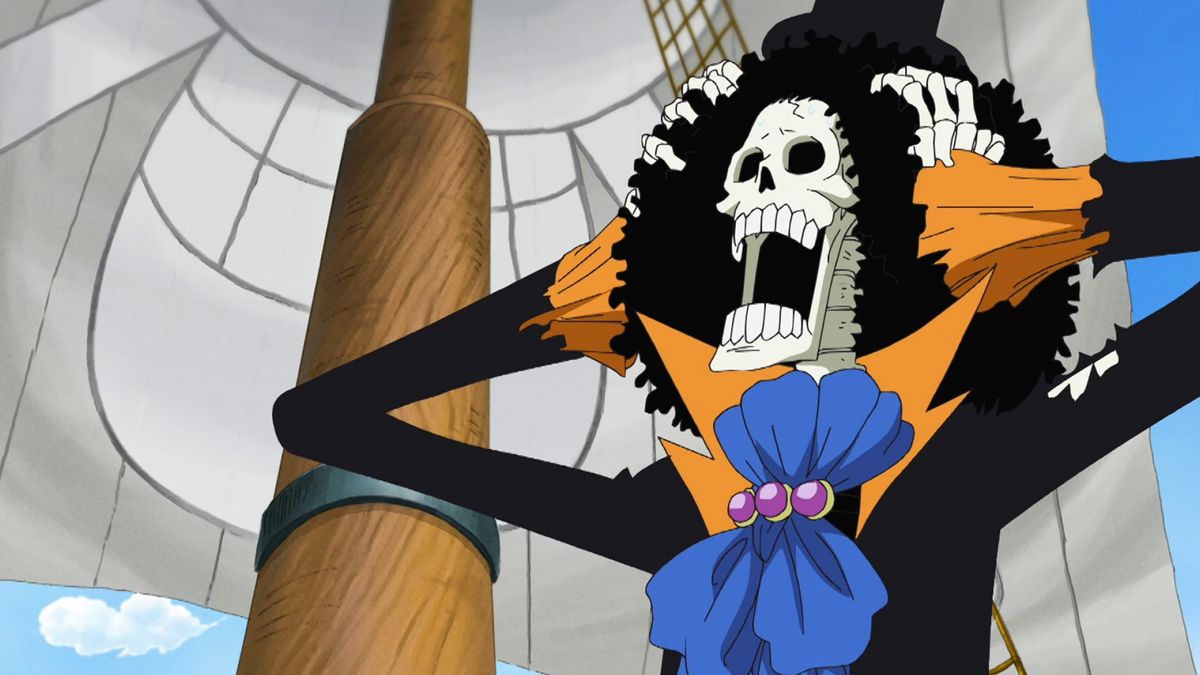
RaeRae Reacts · One Piece Episode 384
Brook Tries Too Hard to Earn a Place the Straw Hats Already Gave Him
One Piece Episode 384 React follows Brook’s anxious first days aboard the Sunny as every failed attempt to help exposes the cruelty of treating belonging like a test.
One Piece Episode 384 React: Brook reads the crew’s log, decides every Straw Hat has already earned a place he has not, and spends the day turning ordinary help into an impossible audition.
What happened in Episode 384
Brook studies the Straw Hats’ adventures and worries that his new crewmates have achievements he cannot match. He tries helping Sanji, Nami, Usopp, Franky, and others, but spills tea on a map, loads soy sauce where cola belongs, and creates fresh problems. Robin eventually helps him understand that companionship is not a ranking. Brook’s music gives the crew something only he can offer without requiring him to become anybody else.
RaeRae’s opening receipt
This quiet episode understands a nasty little truth about joining an established group: welcome can be sincere while the newcomer still expects the welcome to expire. Brook hears yes and immediately starts searching for the hidden performance review.
The ship’s log becomes evidence against Brook in his own mind
Every recorded adventure shows courage, skill, sacrifice, and history. Brook reads those achievements without seeing the boring days, mistakes, fights, and gradual trust that made the crew possible.
An archive can preserve truth while still giving a newcomer a distorted comparison.
Brook turns admiration into self-indictment
He respects the Straw Hats so deeply that their strengths become proof of his supposed inadequacy. Admiration stops nourishing connection and starts building a courtroom where he prosecutes himself.
The crew never asks him to make that case.
Joining after the adventure began creates a false debt
Brook did not fight at Arlong Park, Alabasta, Skypiea, Enies Lobby, or the earlier battles in the log. He cannot retroactively earn years he never had.
A new relationship cannot require backdated labor as an entrance fee.
Sanji’s kitchen already has a working rhythm
Brook tries to help where Sanji is fast, precise, and deeply particular. Dropped plates do not prove Brook lacks value. They prove another person’s practiced workspace has rules Brook has not learned.
Good intentions need patience before they become useful assistance.
The spilled tea hurts because Nami’s map represents responsibility
Brook does not merely stain paper. He damages work tied to the crew’s route and Nami’s professional pride. His embarrassment therefore has a real reason.
Accountability matters, but one accident cannot become a verdict on whether he belongs aboard.
Sanji’s reaction carries its own comedy
Sanji wanted to bring Nami the tea himself, so Brook blunders into service and courtship at once. The collision keeps Brook’s anxious mission inside the crew’s existing personalities.
He is not entering an empty organization. He is learning a family full of habits, vanities, and territorial routines.
Soy sauce in the cola machine is a perfect failure
Franky and Usopp know the weapon because they built the mechanism. Brook sees a container, hears a task, and moves too quickly. The resulting explosion turns his desperation into slapstick.
The joke works because his mistake comes from trying to prove usefulness before understanding the work.
Urgency makes Brook less observant
Each failed attempt increases his need for the next attempt to succeed. That pressure narrows attention, so he rushes into another role with even less confidence.
Anxiety can create the evidence anxiety claimed already existed.
The crew does not keep one definition of contribution
Nami navigates. Sanji cooks. Chopper heals. Franky builds. Robin reads history. Zoro fights and sleeps with elite commitment. Luffy leads through instinct that would get anybody else fired.
No single metric could evaluate them fairly, which makes Brook’s imaginary ranking absurd and painfully believable.
Brook mistakes visible skill for permanent certainty
He sees crewmates operating in familiar roles and assumes they never doubted themselves. The log cannot show every private fear behind those accomplishments.
Belonging often looks effortless from outside because the difficult negotiations happened before the newcomer arrived.
Robin recognizes the problem without humiliating him
She knows what entering this crew while expecting rejection feels like. Her history gives her a language for Brook’s fear that does not reduce him to a joke.
Understanding becomes most credible when the speaker has survived a related lie about personal worth.
Enies Lobby sits behind Robin’s patience
Robin once believed her existence endangered anybody who loved her. The Straw Hats answered by declaring war against the institution demanding her disappearance.
She can tell Brook that welcome is real because the crew already proved how violently serious their welcome can become.
Brook does not need to become useful in everybody else’s lane
Helping Sanji badly does not make Brook a bad musician. Confusing cola and soy sauce does not erase the discipline behind his swordsmanship or music.
A person can respect another role without treating imitation as the price of membership.
Music answers the question without becoming a productivity lecture
Brook can wake the crew, lift a room, hold memory, and turn separate voices into shared time. Those effects matter even when nobody can measure them like repaired boards or plotted coordinates.
Art contributes by changing how people inhabit a life together.
The Rumbar Pirates remain inside Brook’s way of caring
His morning music reaches back to habits formed with his old crew. Bringing that ritual aboard the Sunny does not copy one family onto another.
Brook carries learned care forward and lets the new relationship change its meaning.
A musician does more than decorate parties
Luffy wanted music before the crew had enough practical specialists to survive a week. That desire sounded ridiculous until Brook’s history showed how a song can carry people across death and distance.
The episode brings that grand truth down to daily scale. Music can also begin a morning.
Failure becomes safer when nobody threatens exile
The Straw Hats can complain about tea, maps, plates, and explosions without suggesting Brook should leave. Irritation and acceptance coexist.
A secure group does not need to pretend mistakes feel pleasant. Security means conflict does not automatically revoke personhood.
Brook’s politeness hides panic
His formal speech, bows, and cheerful requests make every attempt look light. Underneath, he is checking whether the crew has discovered a reason to regret him.
Comedy becomes more tender once that fear is visible.
The episode gives transition the time recruitment scenes skip
A dramatic invitation can happen in seconds. Learning where cups belong, when somebody wants help, and how friends express annoyance takes longer.
Episode 384 treats adjustment as story rather than dead space between arcs.
Ordinary ship life becomes character evidence
No warlord threatens the Sunny. No government force arrives. The episode can therefore watch how people share work, space, breakfast, and embarrassment.
Those small interactions explain why later sacrifices carry weight.
Brook’s age does not protect him from newcomer anxiety
He has lived longer than everybody aboard and endured more solitude than they can imagine. Experience does not erase the vulnerability of needing a new group.
People can be old, accomplished, funny, and still frightened that welcome has conditions.
The crew’s reassurance works because behavior came first
They fed Brook, heard his story, helped bury his friends, and invited him aboard before this anxious day. Words of acceptance rest on repeated action.
Reassurance without behavior would sound cheap. Here the evidence already surrounds him.
Brook finally contributes by being Brook
The answer is not self-esteem pasted over every mistake. He has a craft, history, temperament, and sound no other Straw Hat carries.
Difference becomes useful after he stops treating sameness as the assignment.
The Black Handkerchief of Happiness bridges crews
Brook uses an old wake-up ritual from the Rumbar Pirates with the Straw Hats. The gesture honors people who died without trapping the ritual in the past.
Memory stays alive through practice, not only through mourning.
Brook’s mistakes reveal how much knowledge lives outside instructions
A person can hear “bring tea” without knowing where Nami placed the map, how the ship moves beneath a full cup, or why Sanji wanted the task. A person can hear “add cola” without recognizing every container nearby.
Daily competence grows through context that established members often forget they once had to learn.
The crew allows observation after failed participation
Brook does not need another assignment immediately. Watching how others work gives him a chance to learn rhythms without making every interaction prove his worth.
Rest can be part of joining rather than evidence of laziness.
Robin offers solidarity across different histories
Her fear centered on being dangerous to anyone who kept her. Brook’s fear centers on becoming unnecessary to anyone who welcomed him. The stories differ, but both fears predict abandonment before the crew chooses abandonment.
Robin connects the pattern without claiming identical pain.
Luffy never recruited Brook through a résumé
The captain wanted a talking skeleton and musician almost immediately. Luffy’s instinct can look unserious, yet the invitation recognized a person before productivity entered the discussion.
Brook creates the performance standard that now frightens him. Luffy never wrote that standard.
Every existing Straw Hat once disrupted the group
Nami stole from them. Usopp left during a devastating conflict. Robin surrendered herself. Franky’s family attacked Usopp. Zoro threatened early meals through pure appetite. Their present roles do not erase messy entry histories.
Brook joins a crew formed through conflict, repair, and repeated choice.
The Sunny becomes home through permission to be inconvenient
Guests try to minimize every need and mistake. Family members eventually occupy space, irritate one another, and remain part of tomorrow’s breakfast.
Brook’s difficult day moves him closer to home because the crew sees the inconvenience and keeps the relationship.
Music creates value nobody else can substitute
Another fighter could strengthen a battle. Another cook could share galley work. Brook’s relationship to music carries the Rumbar history, Laboon’s promise, and his own precise joy.
Unique contribution grows from lived identity rather than frantic comparison.
The episode protects Brook from becoming only tragedy
Thriller Bark gave him one of the series’ bleakest histories. Episode 384 lets him be anxious, clumsy, intrusive, funny, and tender in ordinary daylight.
Survivors deserve characterization beyond the worst event they survived.
A quiet success can repair a loud day
Brook does not need to erase every mistake before nightfall. One authentic musical moment gives the crew a shared experience and gives him evidence that contribution can feel natural.
Repair begins through connection, not a perfect scorecard.
The episode trusts character interaction over spectacle
No giant opponent arrives to validate Brook through combat. His conflict remains internal and social, which allows the crew’s daily responses to carry the resolution.
That restraint makes this standalone one of the more revealing post-recruitment episodes.
Brook will fight beside the Straw Hats soon enough. Episode 384 gives him something battle cannot provide: permission to fail in front of people and return the next morning. A crew becomes home when survival no longer depends on presenting the most impressive version of oneself every hour. His music matters, but his continued presence matters before the first note.
This standalone deserves its own label
Common episode guides often fold 384 into Spa Island because of numbering convenience. The story contains no Spa Island plot and instead follows Brook aboard the Sunny.
Calling that distinction out helps viewers find the episode they actually remember.
This remains an episode React
This page responds to Brook reading the log, failing across other crewmates’ jobs, receiving Robin’s perspective, and finding his role through music. A complete series or arc Review belongs elsewhere.
React classification protects the episode’s small-scale emotional argument from being flattened into a season summary.
The official local still remains canonical
The Episode 384 still serves as featured image, hero, bounded-directory card, and social preview. One local attachment preserves visual continuity across every discovery route.
Full source, descriptive, accessibility, and filing metadata remain attached. No other record reuses the still.
RaeRae’s final receipt
Brook spends the day auditioning for a job he already has because trauma taught him that company disappears. That fear does not become silly merely because the failures are funny. He spills tea, ruins work, blows up a machine, and keeps searching for a contribution large enough to guarantee permanence.
The crew’s answer is better than a motivational speech. They keep him. Robin names the pattern. Music fills the Sunny. Brook does not win belonging by becoming a second cook, navigator, or shipwright. He starts believing the invitation when he offers the sound only Brook can carry. The path to becoming a true crewmate was never a path toward somebody else.