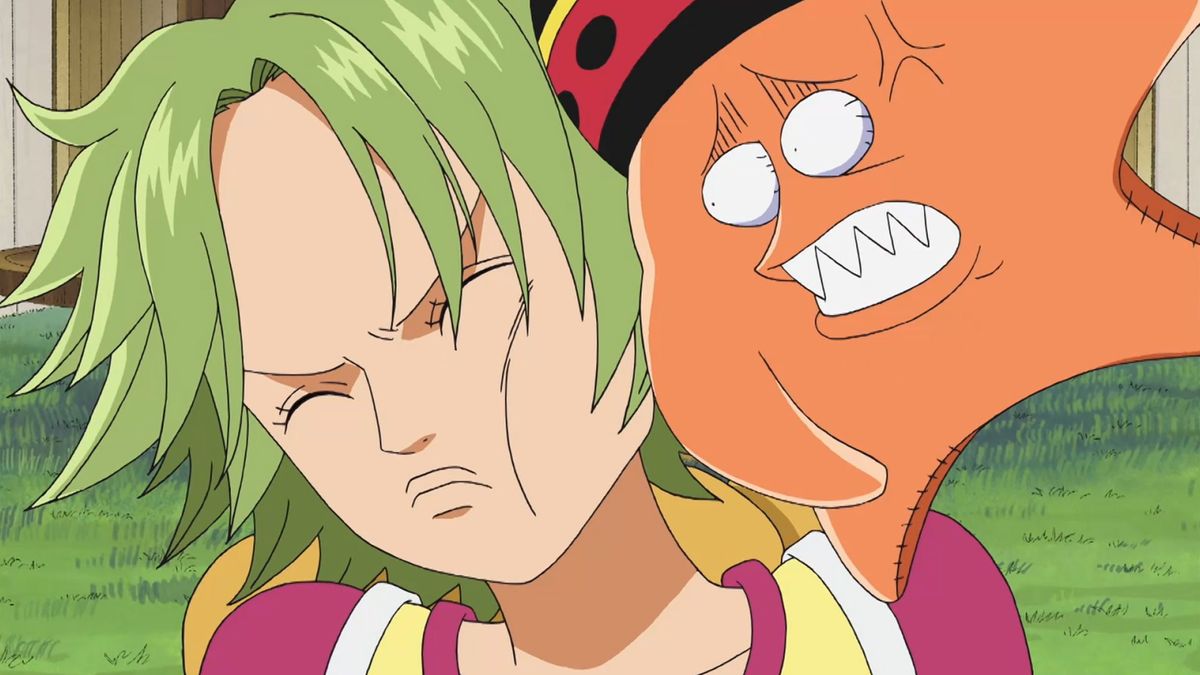
RaeRae Reacts · One Piece Episode 386
Camie’s Rescue Request Leads the Straw Hats Straight Toward Iron Mask Duval
One Piece Episode 386 React follows Camie and Pappag revealing Hatchan’s capture before the Flying Fish Riders attack and Duval recognizes the Straw Hat flag.
One Piece Episode 386 React: Camie and Pappag ask the Straw Hats to rescue their captured fish-man friend, the Flying Fish Riders attack from above, and Duval recognizes a flag connected to the man he hates.
What happened in Episode 386
Camie and Pappag introduce themselves and explain that Hatchan has been taken by the Macro Gang, working with Iron Mask Duval and the Flying Fish Riders. The Straw Hats agree to help in exchange for guidance toward Fish-Man Island. Flying fish carry attackers over the Sunny, but Luffy and Zoro repel the bombs. The riders retreat after identifying the Straw Hat flag, and Duval declares that the man who ruined his life is coming.
RaeRae’s opening receipt
Camie needs a rescue crew and finds the Straw Hats, which is lucky. The name of the captive friend will become less lucky once Nami hears the full truth. Episode 386 builds that tension while Duval prepares the most aggressively personal grudge based on the worst drawing in government history.
Camie does not hide that she needs help
Her introduction moves quickly from gratitude to worry about Hatchan. She has regional knowledge the Straw Hats need, but she also has a relationship worth protecting.
The exchange works because both sides can name what they need without pretending generosity erases consequence.
Pappag brings confidence larger than his body
He explains his speech, fashion work, and role with the certainty of somebody who has never considered that a starfish should lower expectations.
That confidence keeps Camie from carrying every explanatory scene alone.
Sanji needs the crew to remember Kokoro for him
He treats Camie as the first mermaid he has encountered because his preferred fantasy depends on deleting evidence. Usopp supplies the evidence.
Friends who preserve embarrassing history perform a valuable public service.
Hatchan enters as a relationship before a revealed identity
Camie describes a trusted fish-man friend in danger. The Straw Hats agree to save somebody through her account before recognizing the person from Arlong Park.
That sequence creates a moral commitment before old injury complicates the request.
The Macro Gang turns bodies into inventory
They capture Hatchan because a rare fish-man can be sold. Duval’s network connects kidnapping, transport, and buyers through organized profit.
The episode begins exposing a market where personhood disappears behind auction value.
Camie understands the danger personally
She is also a target for traffickers. Asking for help risks bringing herself closer to the people who would sell her.
Her courage should not be reduced to cheerful innocence. She acts while knowing the threat.
The Straw Hats agree before knowing every complication
Luffy hears that a friend was captured and wants to go. The crew also needs directions, but practical benefit does not erase genuine concern.
Mixed motives can still produce ethical action when nobody claims ownership over the rescued person afterward.
The promise to help will matter once Nami learns the name
Hatchan belonged to Arlong’s crew. Nami’s history cannot become a footnote merely because Camie loves him.
The story creates room for accountability, changed behavior, and Nami’s authority over her own response.
Flying Fish Riders make the sky above the sea dangerous
The attackers use giant fish capable of short airborne bursts, turning open water into a three-dimensional ambush. The Sunny cannot rely on distance from shore for safety.
The design feels ridiculous until bombs begin falling.
The five-minute flight limit gives absurdity rules
Flying fish cannot remain aloft forever. A defined constraint makes the attack easier to follow and gives the creatures biological weight inside the joke.
One Piece fantasy becomes persuasive through specific limitations.
Luffy and Zoro answer bombs with direct force
The riders expect height and speed to create helpless targets. Gum-Gum Pistol and the 72 Pound Cannon erase that assumption quickly.
The defense shows how far the crew’s response range has grown without turning the attackers into final-boss material.
The retreat is recognition, not defeat
Once the riders identify the Straw Hat flag, they pull back to report. Their mission changes because Duval’s private grudge outranks the immediate attack.
Information reorganizes the threat faster than combat does.
Duval has built an identity around somebody else’s face
The iron mask, dramatic entrance, and promise of revenge present a man who expects his pain to command the scene. The cause remains hidden, allowing menace and absurdity to grow together.
A grudge can be real while its target remains spectacularly wrong.
The man who ruined Duval’s life is already aboard
The episode lets viewers scan the crew for possible enemies. Luffy collects grudges easily. Zoro has cut through many organizations. Robin carries government history. Sanji looks least likely until the reveal makes perfect comedic sense.
Misdirection works because nearly everybody aboard has earned an enemy.
The Straw Hat flag carries accumulated consequences
Recognition once meant small-town notoriety. Now a symbol on the sail can stop an attack, trigger revenge, or announce danger before names are spoken.
Reputation travels faster than the Sunny.
Camie’s fish guides turn the sea into community knowledge
She can call local creatures and read relationships the Straw Hats do not understand. Her ability is not a magical map. Her place in the environment creates access.
Local knowledge grows through connection rather than ownership.
Fish-Man Island remains one rescue away
The crew wanted a direct route. The route now passes through Hatchan, Duval, and a trafficking network.
Adventure gains moral shape when progress depends on how travelers treat people encountered before the destination.
Duval and Macro represent different forms of exploitation
Macro wants saleable captives. Duval wants labor, fear, and revenge through an organized rider gang. Their partnership works while each receives access to vulnerable people.
The alliance turns personal cruelty into infrastructure.
The episode balances comedy against an ugly market
Pappag’s explanations, Sanji’s mermaid reaction, and flying fish keep the surface lively. Beneath that comedy sits a trade in fish-men and mermaids.
Humor can make the episode watchable without making trafficking harmless.
Robin’s calm creates contrast
While the crew reacts loudly to Camie and Pappag, Robin receives strangeness with her usual composure. Her attention often moves toward what the new information means rather than how unusual the messenger looks.
The ensemble needs somebody who can hear a briefing through chaos.
Zoro arrives late to the mermaid excitement
His introduction to Camie repeats the collision between wonder and memory. Even he cannot escape the Kokoro comparison once the crew has committed to preserving that receipt.
Running jokes become social history aboard the Sunny.
The rescue request tests whether directions are transactional
Camie offers help reaching Fish-Man Island after Hatchan is safe. The crew accepts, yet Luffy’s urgency suggests he would not leave a captive behind merely because the route changed.
The arrangement names reciprocity without reducing rescue to purchase.
Duval’s grudge promises comedy with material consequences
The reason will be absurd, but bounty posters, Marine errors, and public images can still wreck a person’s life. A joke about Sanji’s face becomes a story about institutions circulating bad information with force attached.
Ridiculous cause does not prevent real fallout.
Camie’s twentieth Sea King incident does not make her disposable
Her history of being swallowed becomes a running joke, but repeated danger also shows how casually she moves through a hostile environment. Survival skill can wear a cheerful face.
The crew laughs with the absurdity while still responding when she names a serious threat.
Pappag’s fashion identity previews Sabaody’s commercial world
He presents himself as a designer with status, taste, and ambition. That detail connects undersea life to markets and culture beyond pirate assumptions.
Fish-men, mermaids, and their friends do not exist only as victims or guides. They have work, vanity, art, and social networks.
The Den Den Mushi turns worry into confirmed captivity
Camie tries to contact Hatchan and reaches the people controlling access to him. Communication becomes another surface the kidnappers exploit to bait a target.
The call removes uncertainty while increasing danger.
Macro boasts because the market rewards cruelty
He expects a rare captive to produce money and status. That confidence reveals an established buyer network beyond one gang’s bad choices.
Trafficking survives through demand, transport, and people willing to call a person merchandise.
Duval’s riders give organized crime a branded spectacle
Iron masks, leather, giant flying fish, and coordinated attacks create an image larger than the men underneath. Branding helps the gang manufacture fear before direct contact.
The Straw Hats puncture that image by swatting explosives aside.
The crew protects the Sunny without abandoning the rescue
An ambush could justify retreat, especially with a new ship and unclear enemy numbers. Luffy and Zoro defend the deck while keeping the destination in view.
Safety and solidarity do not have to become competing commitments when the crew acts together.
Zoro’s attack confirms his recovery enough for present danger
He recently carried Luffy’s extracted pain and slept through parts of Brook’s welcome. His 72 Pound Cannon shows functional strength without erasing what recovery cost.
Action resumes, but the earlier sacrifice still belongs to the continuity.
Duval interprets the flag through personal injury
Most enemies see piracy, bounty value, or institutional defiance. Duval sees the arrival of one face connected to his destroyed life.
Symbols gather meanings their owners cannot control.
The mystery target gives each Straw Hat a different kind of guilt
Luffy destroys regimes. Zoro defeats hunters and agents. Robin survived organizations that want her dead. Franky fought government power. Any name could fit a masked avenger’s speech.
Sanji’s eventual connection wins because nobody expects bad portraiture to compete with those records.
The attack announces Sabaody before the island appears
Kidnappers, traffickers, branded gangs, and flying patrols form an economy around vulnerable travelers. The archipelago’s beauty will sit beside this machinery rather than replacing the warning.
Episode 386 makes exploitation part of the route from the beginning.
Hatchan’s captivity forces an old enemy into a new moral frame
The Straw Hats know only Camie’s trusted friend for now. Once his identity emerges, rescue will not erase Arlong Park or require Nami to forget.
The harder question asks whether present danger can be opposed while past harm remains named. The answer must belong to Nami before anybody else claims closure.
Duval delays his attack because revenge wants an audience
He could let the riders continue bombing the Sunny. Recognition changes his priority because personal vengeance needs direct confrontation and control over the reveal.
His theatrical pause exposes ego inside the threat.
The Straw Hats carry consequences they have never seen
A bounty poster helped the government identify Sanji while harming a stranger who resembled the terrible sketch. The crew could not know that chain existed.
Episode 386 prepares a reminder that public records can create collateral lives far beyond their intended targets.
Duval will still be responsible for the gang he built and the people his operation endangered. Harm received does not grant a blank check for harm delivered. The coming joke works because blame has become wildly misdirected, yet the episode should never let his victimhood erase Camie, Hatchan, or every captive treated as merchandise along the route.
This remains an episode React
This page responds to Camie and Pappag’s introductions, Hatchan’s capture, the Flying Fish Riders’ ambush, and Duval recognizing the Straw Hat flag. A complete Sabaody Review belongs on the arc-level record.
React classification keeps the broadcast turn visible while whole-work Reviews stay separate.
The official local still remains canonical
The Episode 386 still serves as featured image, hero, bounded-directory card, and social preview. One local attachment preserves recognition across every discovery route.
Full source, descriptive, accessibility, and filing metadata remain attached. No other record reuses the still.
RaeRae’s final receipt
Episode 386 turns a request for directions into a rescue because the road to Fish-Man Island runs through people the surface world treats as merchandise. Camie is not a map. Pappag is not comic luggage. Hatchan is not inventory. The Straw Hats will need to deal with every truth attached to his name, especially Nami’s, but traffickers do not gain moral authority while that conversation waits.
Then the Flying Fish Riders recognize the flag and retreat to a masked man promising revenge. Duval has organized an entire identity around the person who ruined his life. The reason will be hilarious. The damage behind his rage will still expose what happens when government paperwork circulates a lie with guns attached. One terrible portrait is coming home to Sanji.