RaeRae Reacts · One Piece Episode 352
Brook Begs Ryuma to Spare the Afro Carrying His Promise Home
One Piece Episode 352 React returns to Brook’s first defeat by Ryuma and the desperate request to protect the afro tied to his unfinished promise.
What happens
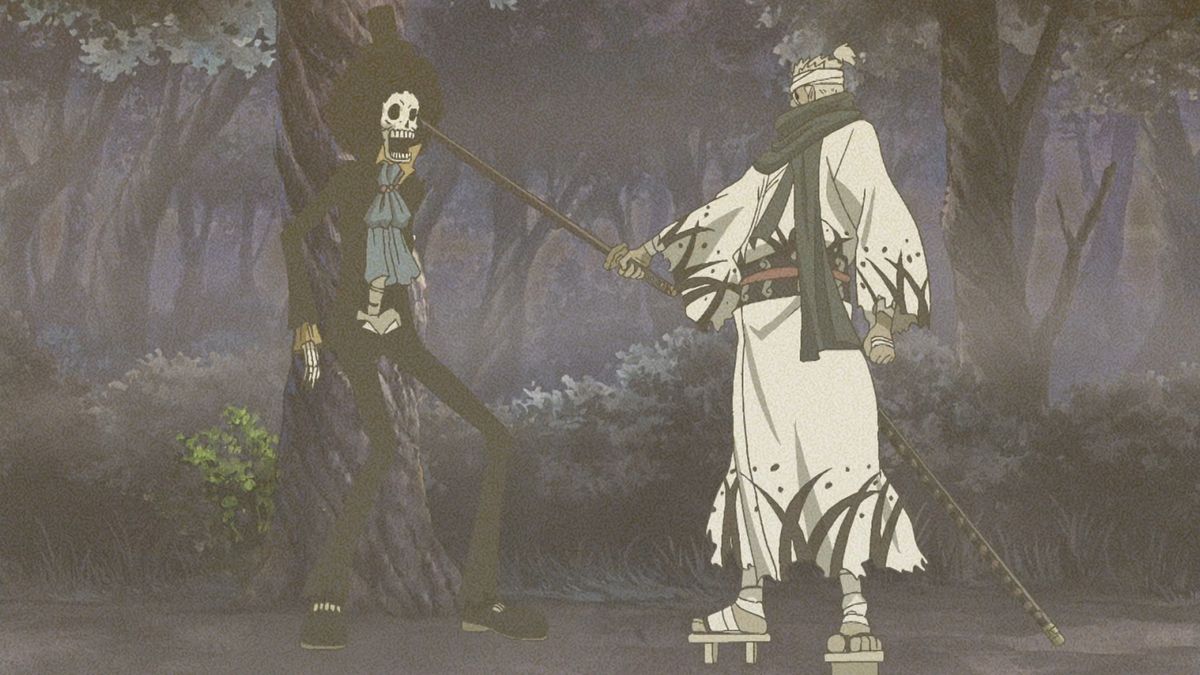
Brook’s duel with Ryuma returns to the skeleton’s first Thriller Bark campaign five years earlier. After purifying zombies and reaching the samurai carrying his shadow, Brook discovers the corpse’s physical power overwhelms him. When Ryuma threatens the afro, Brook begs for the hair to be spared.
RaeRae reacts
The plea is not vanity. Brook has protected one recognizable bridge between the man Laboon knew and the skeleton trying to return. Survival means reaching the promise with enough continuity to be recognized.
Canon note
Episode 352 continues the manga-canon Thriller Bark Arc.
Brook’s duel with Ryuma began five years before the Straw Hats arrived
The current fight carries a history the crew has not witnessed. Brook discovered salt, purified zombies, and fought his way toward the corpse carrying his shadow long before companionship returned to his ship.
Repetition turns the duel into an unfinished struggle rather than a sudden obstacle.
Survivor knowledge did not guarantee survivor victory
Brook understood the zombie weakness and still could not overcome Ryuma’s physical advantage. Correct information can create possibility without erasing differences in body, reach, durability, and force.
The episode respects expertise by showing both its value and its limits.
Ryuma’s corpse gives Brook’s shadow a stronger platform
The stolen habits may come from Brook, but the samurai body can execute those habits with physical capacity Brook cannot match. Moria’s system intentionally separates skill from its owner and pairs skill with a more useful vessel.
The duel makes extraction feel like being outperformed by an appropriated version of oneself.
Brook confronts recognizable technique without recognizing a whole person
Ryuma’s timing and mannerisms echo Brook while the body carries another history and the orders serve Moria. Familiarity offers no comfort.
The zombie is a forced composite, not Brook’s replacement and not a simple continuation of Ryuma.
Losing to one’s own shadow creates a specific humiliation
Brook sees traits taken from him succeed more powerfully elsewhere. Moria’s design implies that the skill was more valuable after separation from the person who developed the skill.
That message attacks dignity alongside freedom.
The physical gap does not make Brook’s claim less rightful
Ryuma may be stronger, but strength cannot convert possession into ownership. Brook’s shadow belongs with Brook because the shadow was taken, not because Brook can win a contest.
Rights should not depend on a victim overpowering the person benefiting from theft.
Brook asks Ryuma to spare the afro
The plea arrives when the swordsman threatens the last part of Brook’s appearance that survived decay. Viewers may initially read the hair as vanity or comedy.
The desperation reveals that the afro carries a promise larger than appearance.
Begging can be an act of conviction
Brook is willing to lower pride in order to protect what another person needs him to preserve. He does not beg for comfort, status, or an easier fight.
The request serves a relationship that has endured fifty years of separation.
The afro is a continuity object
Brook’s body changed beyond ordinary recognition after his soul returned too late. Hair remained. The afro connects the skeleton in the present to the musician his crewmates and Laboon knew.
Physical continuity becomes precious when death altered nearly everything else.
Recognition matters because Brook intends to keep a promise
He does not merely want to reach a destination. He wants the friend waiting there to know who returned. The afro carries visual evidence across decades.
Survival gains direction through anticipated reunion.
Memory becomes embodied without becoming superficial
A hairstyle can look like surface detail, yet surfaces often carry culture, relationship, and history. Brook’s attachment does not reduce him to appearance.
The afro is one material anchor for a life that otherwise lost its recognizable body.
Ryuma threatens more than hair when the blade rises
Cutting the afro would sever a line between Brook’s past and hoped-for future. The physical act would not erase memory, but Brook fears losing a sign capable of making memory mutual at reunion.
The sword approaches his ability to be recognized.
Brook’s plea protects Laboon without naming Laboon yet
The audience receives emotional stakes before full explanation. Somebody matters enough for Brook to risk humiliation and return to a losing fight.
Withholding the name makes the conviction legible before nostalgia supplies additional force.
The first defeat explains Brook’s years of isolation
He knew where the shadow was and knew how zombies could be purified. Ryuma still blocked the route. Knowledge without allies left him trapped between lethal sunlight and an opponent he could not surpass.
His loneliness was enforced by a material stalemate.
Repeated challenge keeps failure from defining Brook
He lost five years ago and continues returning. Persistence does not guarantee victory, but persistence preserves the claim Moria wants exhaustion to erase.
Brook refuses to accept long possession as legitimate ownership.
The shadow makes Ryuma a living archive of Brook’s stolen time
Every familiar phrase and technique records years during which Brook could not walk freely in daylight. The zombie displays what Moria took while benefiting from the taking.
The duel forces Brook to fight evidence of his own exclusion.
Ryuma also deserves an identity beyond being a stronger vessel
The corpse belonged to a legendary swordsman with history unrelated to Brook or Moria. Reducing Ryuma to superior anatomy repeats the logic of the laboratory.
Both histories deserve separation from the weapon constructed through them.
The duel asks whether technique belongs to body, shadow, or person
Brook’s shadow supplies style, Ryuma’s corpse supplies capacity, and the zombie produces performance. None of those facts gives Moria authorship.
The ethical answer is simpler than the metaphysics: coercive combination remains wrong regardless of which component produces each movement.
Brook’s swordsmanship continued developing after the theft
Isolation did not freeze him completely. He could practice, investigate, and create methods for purifying zombies. The living person kept changing while the stolen shadow repeated an earlier imprint.
That development proves why a copy cannot replace ongoing selfhood.
The afro changed less than the person beneath the afro
Brook carries grief, knowledge, and years of solitude Laboon never witnessed. Recognition will begin with hair, not end there.
Reunion requires meeting who each person became as well as honoring who each person remembers.
Asking for mercy does not surrender the larger fight
Brook wants one irreplaceable part spared even if he cannot win that encounter. Tactical defeat does not cancel his intention to return.
Protecting future possibility becomes more important than performing invulnerability.
The scene rejects courage as permanent emotional hardness
Brook can be a skilled swordsman, comic performer, grieving survivor, and person desperate enough to plead. Those states do not contradict one another.
Courage has meaning because attachment creates something he is terrified to lose.
The Straw Hats change the conditions of the rematch
Brook is no longer the only person who understands shadow theft. Robin, Franky, Usopp, Chopper, Nami, Luffy, Zoro, and Sanji now have stakes in the same system.
Collective knowledge can reach beyond the physical limit that defined his first defeat.
Zoro’s presence creates a path without stealing Brook’s claim
A stronger swordsman may be able to confront Ryuma’s body, while Brook remains the person entitled to his shadow. Assistance does not transfer ownership of the rescue.
Community can supply capacity while respecting whose loss defines the outcome.
The promise gives the afro a destination
Hair survives as more than a relic because Brook intends to carry the afro somewhere. Memory stays active through the planned return.
The object points toward a living friend rather than trapping Brook entirely inside the past.
Episode 352 turns a visual gag into emotional infrastructure
The afro has always been part of Brook’s silhouette and comedy. The duel reveals why the design cannot be treated as interchangeable.
One Piece often hides devotion inside the loudest joke and waits until attachment changes how the audience sees every earlier laugh.
This page remains an episode React
The article responds to Brook’s first Ryuma duel, the physical mismatch, the threatened afro, and the plea to preserve the afro. A whole Thriller Bark Review belongs after the arc resolves his shadow and promise.
Correct classification keeps individual broadcast analysis in Reacts.
The official local still remains the canonical visual
The Episode 352 story image serves as featured image, hero, directory card, and social preview. Readers receive one consistent episode identity across every entry point.
Complete metadata records the source, and no neighboring post reuses the asset.
RaeRae’s final receipt
Episode 352 makes Brook beg, and that choice gives him more dignity rather than less. Five years ago, he knew salt could free stolen shadows, fought through Thriller Bark, and reached Ryuma. Knowledge was not enough. The legendary corpse carrying Brook’s shadow had a physical advantage Brook could not close, and the blade moved toward the afro.
Brook’s plea is not about looking pretty. Death returned him to a body Laboon would never recognize at first glance, and the afro remained as one visible bridge to the musician who made a promise fifty years earlier. He lowers pride to protect that bridge. Moria’s system already took his shadow, daylight, and years. Brook refuses to let a sword take the sign he still intends to carry home. Ryuma’s strength does not make the theft rightful, and Brook’s inability to win alone does not weaken his claim. A person should not have to overpower the beneficiary of theft to deserve restoration. The afro is memory with a destination. Brook keeps fighting because somebody is still waiting at that destination.
RaeRae watches the loss before the rescue
The cruelest part of this flashback is the order of information. We already know Brook can be funny, generous, dramatic, and delighted by the smallest proof of company. Then Episode 352 shows the version of him who had none of that company beside him. Five years earlier, Brook arrived with a method, a purpose, and the nerve to confront the corpse holding his shadow. The effort still ended with his body on the floor and a blade near the one feature he believed Laboon might recognize.
That sequence matters because future friendship cannot retroactively soften past isolation. The Straw Hats will change the conditions of Brook’s fight, but they cannot become witnesses who were present five years ago. Brook had to survive that defeat without knowing a rescue crew would ever exist. His hope remained irrational by every practical measure and necessary by every emotional one.
Ryuma’s advantage exposes Moria’s entire business model
Moria does not merely steal movement. He selects bodies that can exploit movement more efficiently than the original owner. Brook’s swordsmanship placed inside Ryuma’s corpse becomes a weapon against Brook, while Brook keeps the experience of building those techniques and loses the social recognition attached to them. The system rewards extraction and tells the source that replacement proves inferiority.
Episode 352 refuses that logic. Ryuma may hit harder and move through damage that would stop a living opponent, but superior output does not establish ownership. Brook remains the person whose shadow was taken, whose daylight was restricted, and whose unfinished promise gives restoration moral urgency. The duel is unequal because theft created the inequality.
The afro carries proof that Brook still imagines an arrival
Brook could preserve the afro as a private memorial, yet his language keeps pointing outward toward Laboon. He wants to arrive at Reverse Mountain and give his friend a recognizable sign that the musician who left has finally returned. That imagined meeting lets the future exert pressure on the present. Brook protects his silhouette because he still believes his body will stand before Laboon someday.
The belief is not sentimental decoration. The belief governs decisions under a sword. Brook accepts humiliation, pain, and another defeat before accepting damage to the bridge between who Laboon remembers and who Brook has become. Fifty years have changed nearly everything else. Protecting one surviving feature becomes a way to insist that time has not voided the promise.
A plea can be an act of command over one’s values
Begging appears powerless when the opponent controls the blade, but Brook chooses exactly what he will surrender and what he will defend. Pride can go. Performance can go. The fantasy that he might win cleanly can go. The promise cannot go.
That hierarchy gives the scene its force. Brook is not asking the audience to confuse defeat with victory. He is showing that conviction sometimes survives through an undignified posture. When power cannot protect everything, character appears in the decision about what must remain.
The Straw Hats inherit a fight Brook already defined
Later intervention will matter because Brook has already explained the stakes through action. The crew does not invent his purpose or grant him one. They enter a struggle he maintained alone for years and gain the chance to respect the claim he never abandoned.
That distinction protects Brook from becoming a passenger in his own rescue. Community expands what is possible, while the original demand remains his: return the shadow, preserve the afro, and let the promise continue toward Laboon.