RaeRae Reacts · One Piece Episode 351
Oars Opens His Eyes After Five Hundred Years and Absalom Hears Nami Scream
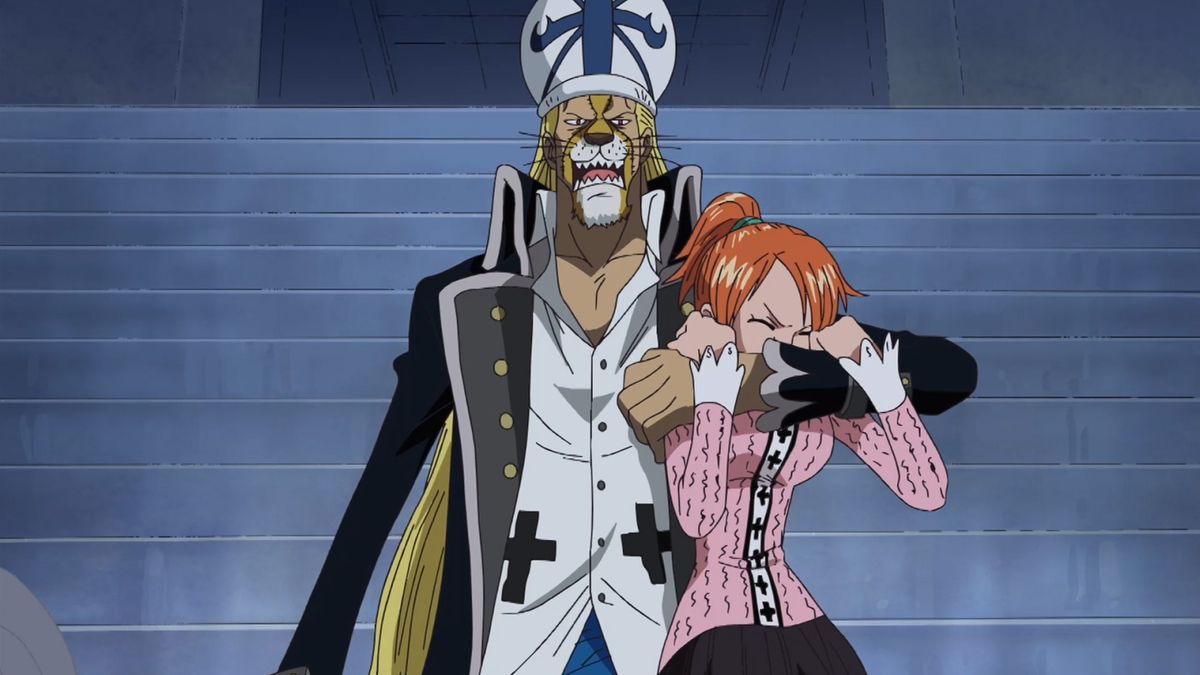
One Piece Episode 351 React awakens Oars beneath Luffy’s stolen shadow as Nami, Usopp, and Chopper expose their hiding place and flee Absalom.
What happens
Moria places Luffy’s shadow inside Oars, the five-hundred-year-old warrior used for zombie number 900. Ice falls from the giant body as Oars opens his eyes. Nami, Usopp, and Chopper scream, exposing their hiding place to Absalom.
RaeRae reacts
Awakening is not resurrection when the returned body exists under another man’s command. Oars carries Luffy’s energy without Luffy’s consent and a dead warrior’s body without the warrior’s consent. Moria calls the combination power because neither source can veto his design.
Canon note
Episode 351 continues the manga-canon Thriller Bark Arc.
Oars awakens after five hundred years without choosing to return
The giant body begins moving because Hogback preserved the corpse and Moria supplied Luffy’s stolen shadow. Neither the ancient warrior nor the living captain authorized the combination.
Awakening becomes evidence of technical power rather than evidence of ethical resurrection.
Ice falls away like a seal on somebody else’s project
The frozen surface preserved Oars until the body could become useful to Moria. As the ice breaks, the spectacle invites awe at scale.
The same image reveals how long a corpse has been treated as stored material awaiting an owner’s command.
Zombie number 900 opens his eyes as an inventory item
The serial number remains attached to the strongest body in the operation. Moria’s hierarchy values Oars while refusing the dignity of a name-centered identity.
Numbering makes exceptional power easier to possess because the label keeps the body inside a production sequence.
Luffy’s first impulses emerge through an enormous frame
Appetite, movement, and restless curiosity begin appearing at a scale the crew has never faced. The habits feel familiar while the body and command structure remain foreign.
Moria has created recognition without reunion.
Familiar behavior does not make Oars the captain
Luffy is a person shaped by memory, choice, relationship, and continuing responsibility. The shadow carries patterns, not the whole life.
The Straw Hats will need to recognize their captain’s traits without treating the zombie as a legitimate replacement.
Oars’s body also has a history beyond Moria’s label
The ancient warrior existed long before Thriller Bark’s laboratory. His size and reputation do not make his remains public property.
A dead person cannot voice refusal, which increases the responsibility of the living rather than eliminating consent from consideration.
Moria celebrates a combination built from two silences
Luffy cannot object while shadowless and incapacitated. Oars cannot object from death. The Warlord interprets both absences as permission.
Power becomes easiest to exercise when the room excludes every voice capable of saying no.
Hogback sees proof of genius where Chopper would see patients
The giant body works, but function is not the only medical outcome. Oars has been denied rest, Luffy has been denied safety, and the resulting consciousness has been assigned compulsory labor.
A procedure can succeed technically while failing every person involved.
The scale of Oars magnifies the scale of the ethical failure
A smaller zombie already requires a corpse and stolen shadow. Number 900 adds engineering, preservation, and enormous destructive capacity without changing the origin.
More impressive theft remains theft.
Nami, Usopp, and Chopper watch history become a weapon
The trio knows the body is ancient, the shadow belongs to Luffy, and Moria intends military use. Their hiding place gives them the complete moral diagram.
Escaping with that information becomes part of protecting the crew.
Their scream is an honest response to impossible scale
Oars moves, ice crashes, and the crew’s captain has been converted into the animating force. Fear breaks through the silence that kept the trio hidden.
The reaction is not incompetence. Their bodies register a threat large enough to overwhelm careful control.
The scream gives Absalom access to their location
Sound turns hidden witnesses into targets. Like the red flare at the arc’s beginning, involuntary visibility transfers information to the person hunting them.
Thriller Bark repeatedly makes being noticed dangerous while offenders remain concealed.
Absalom’s pursuit resumes through another stolen informational advantage
He hears where Nami is while she still cannot reliably see an invisible attacker. The asymmetry favors the assailant before physical contact begins.
Invisibility and architecture cooperate to narrow her choices.
Nami is fleeing an attacker, not avoiding a suitor
Absalom assaulted her, assigned her the role of bride, and now pursues her through the mansion. Marriage language cannot soften that sequence.
The correct description remains escape from coercive violence.
Usopp and Chopper become witnesses capable of interrupting isolation
Nami no longer carries knowledge of the attack entirely alone. Friends nearby can believe her, help identify danger, and contest Absalom’s control of the story.
Collective awareness weakens the secrecy on which his power depends.
The trio must choose movement over perfect stealth
Once their location is exposed, remaining inside Kumacy becomes another trap. They have to flee before Absalom closes the distance.
Survival strategy changes when the enemy’s information changes.
Kumacy’s body again becomes contested space
The zombie served as Perona’s subordinate and the trio’s hiding place. Different people assign different functions to a body created without clear consent.
Thriller Bark makes even shelter part of the larger question about who controls embodied space.
Oars’s awakening shifts the arc from investigation to emergency
The crew already understood shadow theft and salt purification. Now Moria has deployed a body capable of overwhelming ordinary plans before the team can regroup.
Knowledge remains useful, but urgency multiplies.
The giant threatens Sunny as well as individual fighters
Oars’s scale can damage the crew’s trapped home and the architecture holding every separated group. The battlefield is no longer one room or path.
A weapon built from Luffy’s shadow may destroy the vessel carrying Luffy’s dream.
Moria wants Luffy’s freedom without Luffy’s disobedience
The captain’s relentless motion makes him powerful, but his refusal to submit makes him unusable as a subordinate. Shadow extraction attempts to preserve the motion while removing the refusal.
Oars becomes Moria’s fantasy of rebellion converted into obedience.
The plan misunderstands where Luffy’s strength comes from
His crew challenges him, rescues him, feeds him, and gives his choices consequence. Raw impulse without those relationships may produce force without judgment.
Moria has copied the visible engine while discarding the navigation.
Oars may resist because Luffy’s habits were shaped around autonomy
A shadow trained by someone who rejects control may not fit cleanly inside military command. Inuppe already showed that transplanted priorities can disrupt an officer’s plan.
Moria’s strongest asset may also carry the operation’s strongest contradiction.
The awakening makes restoration more urgent than destruction
Luffy needs the shadow back before sunrise, and Oars’s body needs release from Moria’s command. Simply damaging the giant cannot guarantee either outcome.
Brook’s salt method remains the moral and tactical center even as the target becomes enormous.
Every step toward Oars requires protecting the witnesses
Nami, Usopp, and Chopper hold knowledge about the extraction and the giant’s location. Absalom’s pursuit threatens to isolate or silence that knowledge.
The crew’s counterattack depends on people escaping with facts as much as fighters landing blows.
The episode refuses to make awe morally neutral
Oars is visually astonishing, and the production wants viewers to feel the scale. A fandom response can enjoy the reveal while naming the bodies and stolen choices that made the reveal possible.
Spectacle becomes richer when the cost remains visible.
Five hundred years becomes a measure of interrupted rest
The title celebrates the length of dormancy, yet the return does not belong to Oars. Time has carried his body into somebody else’s war.
Age increases wonder and sharpens the violation simultaneously.
Episode 351 is an individual React
The page responds to Oars awakening, Luffy’s shadow animating zombie 900, the hidden trio’s scream, and Absalom’s pursuit. A full Thriller Bark Review belongs after the arc resolves those consequences.
Correct classification keeps episode analysis inside Reacts.
The official local still remains the canonical visual
The Episode 351 story image serves as featured image, hero, directory card, and social preview. Readers receive one consistent visual identity across every entry point.
Complete metadata records the source, and no neighboring post reuses the asset.
RaeRae’s final receipt
Episode 351 lets Oars open his eyes and asks us not to confuse movement with a miracle. Hogback preserved an ancient body, Moria stole Luffy’s shadow, and zombie number 900 woke after five hundred years carrying a captain’s impulses under a Warlord’s command. The ice falling away looks magnificent. The receipt underneath remains two lives combined without either person’s permission.
Nami, Usopp, and Chopper see the entire process, and their scream gives Absalom the location he wanted. That does not make their fear foolish. They just watched history stand up as a weapon powered by their stolen captain. Now they must flee an invisible attacker while carrying information the crew needs. Oars is enormous, but size is not the most dangerous part. Moria believes Luffy’s freedom can be separated from Luffy’s relationships and reassigned as obedience. Inuppe already showed why shadows do not always cooperate with that fantasy. The same drive that made Luffy valuable may refuse to remain a perfect servant. Until the shadow comes home, awakening is captivity with open eyes.
Oars’s first movement belongs to a command chain
The giant does not wake into open possibility. Moria and Hogback have already defined a purpose, rank, and expected obedience. Resurrection enters the world with an assignment attached.
A returned life cannot be called free when another person wrote the job before the eyes opened.
The body becomes public spectacle while both sources remain voiceless
Officers gather to celebrate what they built, treating Oars’s scale as proof that the project deserves admiration. Luffy is elsewhere without his shadow, and the ancient warrior cannot contest use of his remains.
The audience hears the creators because the operation structurally removed every competing account.
The scream restores moral proportion to the celebration
Moria’s side sees achievement. Nami, Usopp, and Chopper see their captain’s shadow inside a giant weapon. Their fear interrupts the triumphant narrative.
A witness’s horrified response can reveal harm that powerful people have trained themselves to describe as success.
Absalom follows sound because surveillance does not require sight alone
Invisibility gives him visual control, but the mansion supplies other channels for locating targets. A scream crosses walls and bodies, allowing pursuit to resume.
Nami’s safety depends on reducing an information imbalance the architecture keeps recreating.
The trio’s escape carries more than personal survival
They must protect Nami from Absalom, preserve knowledge of Luffy’s extraction, warn the crew about Oars, and help distribute Brook’s salt strategy. Losing the witnesses would fragment the counterattack.
Their movement becomes communication infrastructure for a separated crew.
Usopp’s fear keeps scale from becoming abstract
Numbers such as five hundred years and zombie 900 can sound like lore. Usopp’s reaction translates those facts into the bodily understanding that something impossibly large has started moving nearby.
Fear makes information actionable when awe might otherwise create paralysis.
Chopper sees a body carrying incompatible medical stories
Preservation, surgery, and animation demonstrate technical mastery. Compulsory service, stolen identity, and denied rest demonstrate failure of care.
Oars forces Chopper to decide which story defines professional greatness.
Nami must navigate people through a building that keeps changing risk
The route out depends on Absalom’s position, the zombie hierarchy, the trio’s visibility, and the newly awakened giant. Ordinary direction is not enough.
Her leadership combines spatial judgment with attention to who is being hunted and why.
Luffy’s appetite inside Oars reveals a copied need without copied context
The shadow can reproduce hunger and impulse, but the giant body has not shared meals with Sanji or learned what food means inside the crew. A familiar trait appears without the relationships that shaped its expression.
Moria copied a signal and discarded the network around the signal.
Autonomy may become the flaw in Moria’s strongest zombie
Luffy’s habits were built through rejecting cages, titles, and commands. Transplanting those habits into a soldier expected to obey creates an internal contradiction.
The Warlord wants force separated from freedom, yet the shadow may not contain a clean boundary between them.
The operation cannot control what relationships taught the shadow
Inuppe protected Nami because Sanji’s priorities survived reassignment. Oars may carry Luffy’s instinct to explore, eat, and reject restriction in ways Moria did not request.
Identity resists extraction because behavior develops inside social history.
Awakening expands the crew’s task without changing the ethical center
Oars is larger, stronger, and more destructive than earlier zombies. The answer remains returning a stolen shadow to its owner and releasing a corpse from imposed service.
Scale changes tactics, not the definition of rescue.