RaeRae Reacts · One Piece Episode 270
Sogeking Gives Oimo and Kashii Their Stolen History Back
One Piece Episode 270 reveals the lie that kept Oimo and Kashii guarding Enies Lobby while Luffy begins testing Blueno’s Six Powers.
Bottom line: Episode 270 exposes the government’s favorite weapon before Luffy throws a punch at Blueno
One Piece Episode 270 connects Oimo and Kashii to Dorry and Brogy, the giant captains Usopp met on Little Garden. The gatekeepers have been serving Enies Lobby under a government story about their missing leaders. Sogeking recognizes the relationship and gives Oimo information capable of breaking decades of manipulated loyalty.
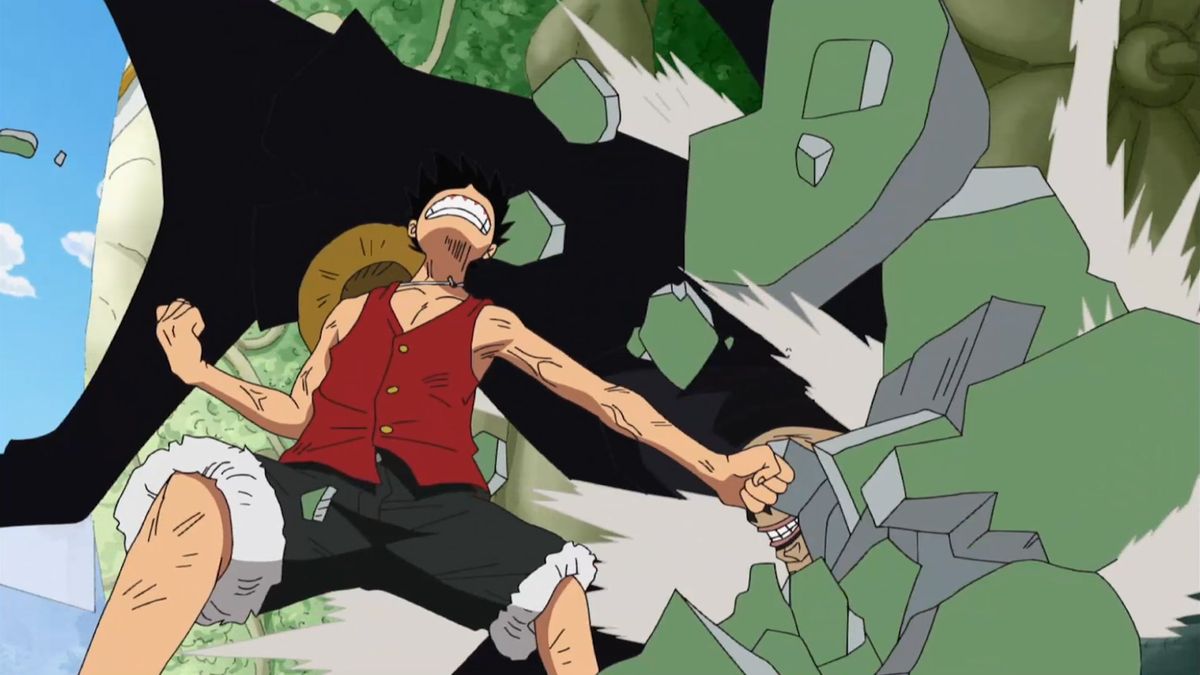
On the courthouse roof, Luffy faces Blueno and demands Robin back. Both fronts reveal the same system. Officials find a real bond, lie about the people inside the bond, and turn loyalty into obedient labor.
Oimo’s tears restore the person hidden behind the giant obstacle
The coalition first encountered Oimo through size and force. Episode 270 lets him cry, explain, and connect his service to people he loves. The emotional change does not make the earlier danger imaginary. The change gives that danger a history.
Government power benefited while outsiders saw only a gatekeeper. A weapon is easier to fight than a worker who has been deceived. Sogeking’s recognition forces the rescue to hold both truths at once.
Dorry and Brogy mattered to Usopp before their connection became useful
Usopp admired the giant captains on Little Garden because their long duel embodied pride, scale, endurance, and a warrior ideal he wanted to understand. That relationship was not created to solve Enies Lobby. The earlier experience returns naturally when he hears Oimo’s story.
Continuity becomes emotionally satisfying when memory changes a current choice. Usopp can help because he listened, cared, and carried the giants as mentors in his imagination long after leaving the island.
Sogeking can tell the truth even while hiding his own name
The mask lets Usopp speak with heroic certainty about Dorry and Brogy while avoiding the personal truth between himself and the Straw Hats. That contradiction fits him. Courage and avoidance can occupy the same body.
His information still matters. A person does not need every private conflict resolved before telling someone else the fact that ends a harmful lie. The rescue gives Usopp useful work while his own reconciliation remains unfinished.
The government recruited loyalty instead of earning loyalty
Oimo and Kashii did not simply wake up and decide the World Government represented justice. Their service grew from a story tied to their captains. Officials found a devotion strong enough to sustain decades of duty and attached that devotion to Enies Lobby.
Earned loyalty requires truth, reciprocity, and room to leave. Manufactured loyalty depends on incomplete information and consequences controlled by the employer. The gatekeepers were useful precisely because their faithfulness was real.
The deception survived because distance blocked verification
Dorry and Brogy remained on Little Garden while Oimo and Kashii served far away. The Grand Line makes travel dangerous, communication uneven, and direct confirmation difficult. Government authority occupies the gap between those separated people.
Lies become easier to maintain when the target cannot reach the source. Sogeking acts as an accidental information route across islands. Adventure knowledge becomes resistance because he carries a fact the institution expected geography to contain.
Robin and the giants are controlled through the same emotional mechanism
Robin surrendered to protect the Straw Hats. Oimo and Kashii served to remain connected to Dorry and Brogy under the terms officials described. In both cases, the government uses care as leverage.
The parallel prevents the story from treating manipulation as a private weakness. Loyalty does not cause the abuse. Authorities choose to weaponize loyalty because attachment can move people more reliably than open force.
Luffy’s demand is simple because Blueno’s legal language cannot change the fact
Robin was threatened, deceived, and transported. Luffy tells Blueno to return her. The demand ignores the institution’s categories because those categories were used to hide coercion rather than examine the evidence.
Simplicity becomes a strength when procedure has been designed to confuse responsibility. Luffy does not need to master every government title before recognizing that his friend did not receive a free choice.
Blueno represents controlled force at the courthouse door
His body, Six Powers training, and Door-Door Fruit make him an ideal defender for an institution obsessed with access. He can control openings, movement, and the boundary between spaces. The power is almost architectural.
Luffy meets him on a roof after breaking through ordinary defenses. The fight asks whether specialized state violence can restore the boundary the crew’s invasion already violated.
Water 7 taught Luffy what Blueno’s strength feels like
CP9 overwhelmed the Straw Hats during the earlier confrontation. Luffy arrives at Enies Lobby with the memory of that defeat and the knowledge that Robin’s situation leaves no room for the same result.
A rematch means more when the first loss changed the fighter. He has had time to observe movement, feel the gap in speed, and decide his current body needs another method.
Blueno assumes institutional victory has already defined Robin’s future
CP9 delivered her to Enies Lobby, the gates were staffed, and the crew entered as criminals. From his position, each official milestone confirms that the operation is succeeding.
Luffy’s presence makes those milestones less final. A completed transport can be interrupted. A guarded courthouse can be breached. Official confidence describes the current arrangement, not an inevitable ending.
The courthouse roof turns a personal demand into a public challenge
Luffy is not whispering to one agent in a hidden carriage. He has crossed the island and announces the purpose of the invasion on government architecture. Robin’s disappearance can no longer remain a quiet administrative success.
Public resistance does not guarantee a fair hearing. The declaration changes who must respond and makes the institution spend visible force defending its claim.
Oimo’s grief shows the cost of discovering years were organized around a lie
Learning the truth is not instantly liberating. He must confront time spent guarding the wrong place, fighting people who might have helped, and believing service would benefit his captains. Anger and relief arrive beside humiliation.
The person who was deceived does not owe the audience a clean emotional transition. Trust can collapse faster than a new identity forms. Oimo needs facts, relationship, and room to decide what he does next.
Sogeking offers information without demanding immediate forgiveness
He tells Oimo about Dorry and Brogy because the giant deserves the truth. The fact should not become a transaction where Oimo must instantly serve the Straw Hats in exchange.
A better alliance can grow after deception loses control. Consent becomes possible when the giant understands the actual situation and chooses where his loyalty belongs.
The episode makes memory part of Usopp’s fighting style
Usopp contributes more than ammunition. He remembers people, stories, fears, tools, and details stronger fighters may overlook. Those memories create connections across the Grand Line.
His dream of becoming a brave warrior of the sea includes learning what bravery looked like to others. Dorry and Brogy changed his imagination. Episode 270 lets that change help their own subordinates.
Luffy versus Blueno begins as a test of whether observation became growth
Luffy has faced Soru, Iron Body, and CP9’s physical control before. Knowing the names is not enough. He has to read the timing, create openings, and use a body that previously could not keep pace.
The opening exchange builds anticipation because viewers can see him measuring the difference. His refusal to repeat Water 7 is becoming physical preparation rather than another speech about determination.
The two fronts reject the idea that authority controls every doorway
Blueno creates doors through his Devil Fruit and guards the route toward Robin. Enies Lobby controls gates and bridges. The government controlled the information doorway between Oimo, Kashii, Dorry, and Brogy.
Sogeking opens one route with truth while Luffy attacks another through combat. Access can be physical, informational, or emotional. The rescue needs all three.
Takahiro Imamura’s direction keeps revelation and combat in one argument
Hirohiko Kamisaka’s screenplay divides the episode between Oimo’s history and Luffy’s rooftop confrontation. Takahiro Imamura’s direction connects the scenes through government control rather than treating the giant story as a pause before the important fight.
Takeo Ide’s animation direction supports Oimo’s emotion and the beginning of Luffy versus Blueno. Miyuki Sato and Michiyo Kawasaki’s art keeps the gate and courthouse roof visually distinct while both remain parts of Enies Lobby’s defended structure.
Episode 270 aired on July 2, 2006
The official One Piece record places Episode 270 one week after the paired June 25 episodes. The episode belongs to the Enies Lobby arc and connects to manga Volume 40.
The official summary identifies Oimo and Kashii as subordinates of Dorry and Brogy, describes the giants as Usopp’s warrior mentors from Little Garden, and begins the decisive Luffy versus Blueno confrontation on the courthouse roof.
Where to watch One Piece Episode 270
Use the current licensed One Piece route available in your region, including Crunchyroll where Episode 270 is offered. Confirm the episode number and title because catalog coverage, subtitles, and dubs differ by country.
The official Japanese episode page provides the original title, broadcast date, summary, production credits, manga volume connection, and arc classification.
Usopp’s hero worship becomes responsible when he protects the giants’ actual history
Admiring Dorry and Brogy could have remained a private fantasy about becoming brave. Episode 270 asks Usopp to do something with that admiration. He must remember accurately, recognize the men’s subordinates, and speak before Oimo’s grief is used for more government labor.
Responsible fandom works the same way. Loving a legend means caring about the people, context, and consequences around the legend, not only borrowing the coolest image for personal motivation. Usopp honors his mentors by returning truth to their community.
Blueno’s calm depends on believing Luffy has already shown his limit
Water 7 gave CP9 a clean measure of the crew’s strength under shock, confusion, and Robin’s apparent departure. Blueno carries that result into the courthouse fight. He expects another version of the same opponent because institutions often treat one successful assessment as permanent knowledge.
Luffy has been thinking about the defeat while crossing the sea. Growth becomes dangerous to authority when the official record freezes a person at yesterday’s capacity. Blueno knows the body he fought. He does not yet know what the loss taught that body.
The giants’ story exposes a chain of officials, not only one liar
Decades of service require more than a single sentence spoken once. Schedules, assignments, commanders, replacements, records, and gate operations kept the arrangement functioning. Many workers could inherit the benefit without asking how Oimo and Kashii were recruited.
That chain is why removing one cruel superior cannot automatically clean the institution. A lie becomes structural when ordinary procedures preserve the outcome long after the original deception disappears from view.
Truth changes the battlefield without striking anyone
Sogeking’s information can remove two enormous bodies from the government’s defense more effectively than another round of direct attacks. The fact does not hypnotize Oimo or force a new loyalty. The fact restores the possibility of an informed decision.
Enies Lobby invests heavily in physical power because force controls people who remain isolated. Connection breaks that isolation. Once Oimo knows where his captains have really been, every order he followed can be reevaluated under a light the government never wanted him to have.
RaeRae verdict: Sogeking’s truth and Luffy’s demand attack the same system from different sides
Episode 270 gives Usopp a beautiful job. He remembers Dorry and Brogy, recognizes what Oimo lost, and carries information across a distance the government used to preserve deception. The mask cannot make that compassion fake, small, temporary, or less important to the people who urgently needed him.
Luffy confronts Blueno with an equally direct truth: Robin must be returned. One friend opens an emotional gate through memory. Another attacks the physical gate through force. Enies Lobby depends on controlling both routes, and the Straw Hats have reached the point where control starts failing in front of workers, prisoners, guards, allies, and every official who assumed the government’s version would remain the only version anyone could hear.