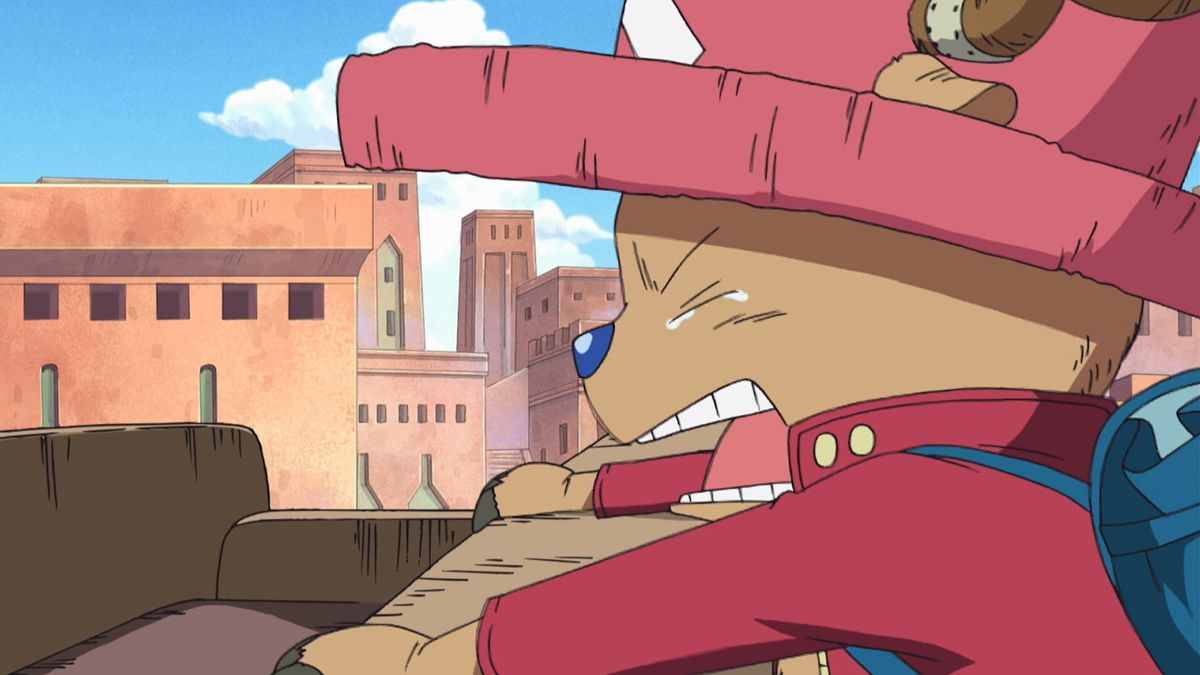
RaeRae Reacts · One Piece Episode 271
Chopper Hears the Ally Inside the Government’s Battlefield
One Piece Episode 271 makes Sodom’s fall, Gomorrah’s choice, and Chopper’s animal communication central to the rescue coalition’s survival.
Bottom line: Chopper’s “nobody gets off” only works because he is protecting Gomorrah’s chosen effort, not spending an animal like equipment
One Piece Episode 271 pushes the coalition toward the courthouse after Sodom falls under cannon fire. Everyone transfers to Gomorrah, who is then struck by a hidden iron-ball attack. Fighters prepare to dismount and force the route on foot. Chopper tells them to stay aboard.
The command sounds reckless until we read Chopper’s role. He is a doctor, an animal, and the person best positioned to understand Gomorrah’s condition and determination. The scene becomes powerful when his judgment recognizes capacity without pretending injury has no cost.
Sodom’s fall gives the invasion a body count beyond defeated guards
The coalition has relied on the King Bulls for transport through crowds and broken terrain. Cannon fire turns that support into a casualty. Progress across Enies Lobby is being purchased by bodies that cannot explain their pain in human speech.
One Piece risks treating large animals as vehicles whenever the action moves fast. Episode 271 works better when we remember Sodom as a living ally whose fall changes Gomorrah, the Franky Family, Chopper, and the route.
The Franky Family’s grief cannot stop the mission
Sodom belongs to their chosen family. They have history, work, routines, and affection tied to the King Bulls. Watching him collapse under government fire hurts differently from seeing an unnamed fighter fall.
The mission still has a narrow window. Robin and Franky are moving deeper inside while Luffy fights ahead. Grief must exist beside action because waiting for a clean emotional moment would surrender the people they came to save.
Gomorrah carries more after losing his partner
He takes the full group forward while Sodom remains behind. The physical burden increases at the same moment the emotional shock lands. Animals form relationships, recognize danger, and respond to loss even when a story cannot translate every feeling into dialogue.
His continued movement should not be reduced to obedience. The King Bulls are participating in a rescue shaped by their bond with the Franky Family. That participation deserves the same attention the story gives a human ally’s resolve.
The hidden iron-ball attack turns uncertainty into another weapon
The coalition can see ordinary guards and cannon positions. A heavy strike from an unidentified source creates fear beyond the immediate damage. They do not know the attacker’s location, range, timing, or whether another impact is already coming.
Institutions gain advantage when defenders can harm people without becoming visible targets. The hidden attack forces the rescue party to choose under incomplete information while officials remain protected by distance.
Dismounting looks sensible because injured transport can become a trap
If Gomorrah collapses inside a guard crowd, riders may be pinned, separated, or exposed to another projectile. Continuing aboard concentrates people on one wounded ally. The instinct to get off is not cowardice.
Chopper’s command carries weight because he must be evaluating more than urgency. He understands animal bodies and can read signs human fighters may miss. The crew trusts specialized judgment when the obvious choice would slow the rescue.
A doctor can respect a patient’s agency without approving unlimited harm
Medical care does not mean forcing every injured person into rest regardless of circumstances or wishes. Chopper has to weigh Gomorrah’s condition, the danger around them, the mission, and the animal’s own drive to continue.
Respecting agency also means setting limits when continued effort becomes fatal or impossible. The scene is strongest when “keep riding” represents a clinical and relational judgment, not motivational denial of injury.
Chopper recognizes animal speech the human fighters cannot hear
His ability to communicate with animals changes the ethical structure of the moment. Gomorrah is not a silent vehicle whose body can be assigned by whoever holds the reins. Chopper can receive intention from the person carrying them.
That communication protects the coalition from confusing usefulness with consent. The others may see damage and movement. Chopper can understand whether Gomorrah is choosing the next charge.
The order reverses how the crew usually sees Chopper
Chopper is young, small, emotionally transparent, and often treated as someone the stronger adults protect. Here, he gives the command because expertise outranks size. The group’s survival depends on listening.
That reversal is part of the crew’s distributed leadership. Luffy chooses the destination. Chopper can still control a medical decision when the captain is far ahead and the patient is beneath everyone else.
Forward movement becomes collective trust
Staying on Gomorrah requires the riders to trust the King Bull, Chopper’s reading, and the people protecting the sides. Nobody can personally verify every condition while the group moves through gunfire.
Trust here is practical rather than sentimental. Each person accepts dependence on knowledge and strength located outside their own body.
The courthouse remains close enough to see and hard enough to reach
Enies Lobby’s geography turns visible distance into frustration. Luffy is fighting on the roof, yet the crew still faces plazas, defenders, attacks, and injured transport before they can join him.
The institution benefits from layered space. Seeing the destination can exhaust people when every apparent final stretch reveals another barrier. Gomorrah’s charge refuses that psychological design.
Luffy’s isolated fight increases pressure on everyone behind him
The crew knows he is facing Blueno without support. They trust his strength and remember CP9’s victory in Water 7. Every delay creates room for the earlier defeat to repeat.
Luffy chose the head start, so part of the pressure belongs to his recklessness. His friends respond because rescuing Robin includes keeping their captain from becoming another prisoner.
The coalition’s mixed bodies make transport essential
The rescue party includes elite fighters, ordinary family members, shipwrights, animals, children, and people already battered by the train crash and gate assault. A route designed only for the strongest would abandon much of the coalition.
Sodom and Gomorrah turn the group’s difference into mobility. Their labor allows people with different speeds and abilities to remain part of one advance.
Enies Lobby uses artillery to separate support from heroes
Cannon fire and hidden projectiles target the moving platform carrying many allies. The tactic can break the coalition without defeating Zoro, Sanji, or Luffy directly. Remove transport, scatter support, and the strongest fighters must choose between rescue and protection.
The attack shows institutional intelligence. The government does not need every defender to win a duel. Defenders only need to damage the relationships and systems that let the invasion function.
The Franky Family sees loyalty reflected back from the King Bulls
They came because Franky gave discarded people a family and because CP9 reduced him to blueprints. Sodom and Gomorrah carry those same people toward him despite fire and injury.
Loyalty flows across species and rank. The family is not only a human organization using animals. The rescue becomes a network where care and risk move in several directions.
Chopper’s command protects morale without lying about pain
“Nobody gets off” gives the coalition one clear action at the moment panic could split them. The command prevents every rider from improvising a separate route.
Clarity does not require pretending Sodom and Gomorrah are fine. Chopper can acknowledge damage and still identify the next survivable choice. Honest hope names the injury and the remaining capacity.
The episode’s title rejects paralysis, not grief
“Do not stop” can become cruel when leaders use urgency to silence exhaustion. Episode 271 earns the phrase by connecting continued movement to a specific rescue and to Gomorrah’s participation.
Stopping would leave Robin, Franky, and Luffy farther from help. Moving does not cancel the responsibility to return for Sodom, treat Gomorrah, and reckon with every cost after the immediate danger.
Yoshihiro Ueda’s direction makes transport feel like character action
Hirohiko Kamisaka’s screenplay centers the episode on Sodom’s fall, the transfer to Gomorrah, the hidden attack, and Chopper’s command. Yoshihiro Ueda’s direction keeps the King Bulls emotionally present while the wider invasion continues.
Naoki Tate’s animation direction supports impact, crowd motion, and Chopper’s decisive reaction. Miyuki Sato and Kumiko Fukuzawa’s art keeps the courthouse route visible so every injury changes the audience’s understanding of distance.
Episode 271 aired on July 9, 2006
The official One Piece record places Episode 271 one week after Luffy began fighting Blueno. The episode belongs to the Enies Lobby arc and connects to manga Volume 40.
The official summary identifies Sodom falling to cannon fire, the group transferring to Gomorrah, a mysterious iron-ball attack bringing Gomorrah down, and Chopper ordering everyone not to dismount.
Where to watch One Piece Episode 271
Use the current licensed One Piece route available in your region, including Crunchyroll where Episode 271 is offered. Confirm the episode number and title because catalog coverage, subtitles, and dubs differ by country.
The official Japanese episode page provides the original title, broadcast date, summary, production credits, manga volume connection, and arc classification.
Animal labor becomes invisible when people only remember the destination
Fans naturally focus on Robin, Luffy, and the courthouse. Sodom and Gomorrah make the physical connection between the crash site and that emotional destination. Their effort can disappear from memory precisely because the transport works.
Episode 271 interrupts that invisibility by showing what the route costs the bodies carrying everyone. The rescue is not a sequence of human decisions floating above the ground. Weight must be moved, wounds must be endured, and somebody has to keep the group from scattering.
Chopper must separate courage from shock
An injured body can continue moving because adrenaline hides damage, panic overrides pain, or the person understands a real emergency. A doctor cannot assume movement proves safety. Chopper has to read breathing, balance, responsiveness, bleeding, and the way Gomorrah answers him.
That assessment makes his order serious. He is not cheering loudly enough to create health. He is deciding that continued movement remains possible under the current conditions and accepting responsibility for monitoring what changes.
The riders owe Gomorrah support while receiving support
Staying aboard does not mean sitting passively while the King Bull absorbs every attack. Fighters must clear the sides, watch for artillery, distribute weight, and prevent enemies from reaching vulnerable areas. Transport creates reciprocal duties.
The same principle applies across the crew. A person who carries the group in one moment may need protection in the next. Strength does not cancel dependence. Strength changes where the group must place care.
Sodom’s condition remains part of the unfinished rescue
Leaving him behind is justified only by the immediate need to reach Robin and Franky. The family cannot treat separation as disposal. Someone must remember his location, communicate what happened, and return when the battlefield allows.
Emergency triage often means choosing which need receives attention first. Triage is not a judgment that the delayed life matters less. Chopper’s presence keeps that distinction inside a story moving too quickly for complete treatment.
The unknown attacker forces the crew to trust without control
They cannot eliminate a threat they cannot identify before moving. The coalition has to proceed while gathering clues, shielding vulnerable riders, and accepting that another strike may come. Complete certainty is unavailable.
That condition mirrors Robin’s larger problem in a healthier form. She tried to control every risk alone. The coalition shares uncertainty across many people, allowing expertise, observation, and mutual protection to carry what one person could never guarantee.
RaeRae verdict: Chopper turns animal communication into the leadership the rescue needs
Episode 271 could have used Sodom and Gomorrah as disposable spectacle. The better reading keeps their relationships, injury, work, and choice in view. Chopper is the person who can hear the ally beneath the transport role when nobody else can understand him.
His order keeps the coalition together because specialized care creates confidence under pressure. Gomorrah carries them forward, but the King Bull is not a machine being spent. He is a participant whose determination deserves to be understood and whose body will still need patient medical care, safety, food, rest, familiar voices, careful observation, and enough quiet time to fully recover after the courthouse is reached.