RaeRae Reacts · One Piece Episode 264
Luffy Is Right About Robin and Wrong About Waiting
One Piece Episode 264 opens the Enies Lobby invasion when Luffy breaks the five-minute landing plan and transfers the tactical cost to the coalition behind him.
Bottom line: Luffy breaks the landing plan because five minutes feels obscene when Robin is already inside Enies Lobby
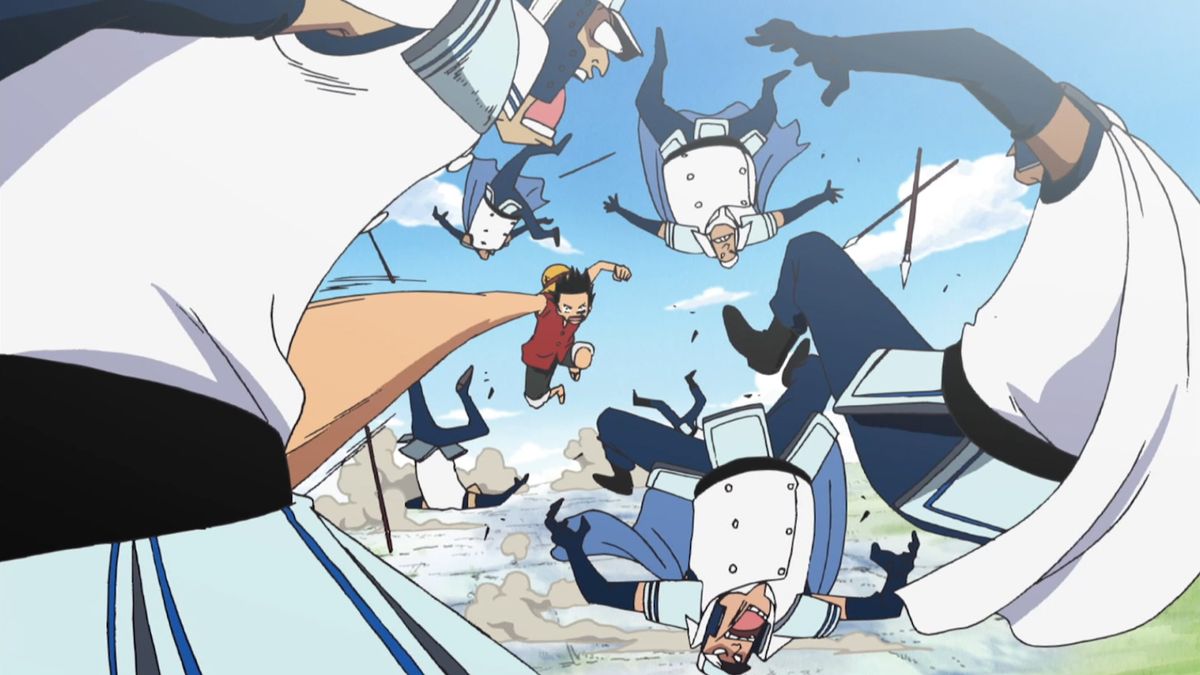
One Piece Episode 264 begins the Enies Lobby invasion with a plan everybody understands and a captain who refuses to follow the plan. Galley-La and the Franky Family will enter first, open the route, and give the Straw Hats a cleaner path toward Robin. Luffy hears “wait five minutes” while picturing Robin moving deeper into government custody, so he launches himself onto the island alone.
I understand the impulse completely. I also understand why everybody wants to strangle him. Luffy’s urgency keeps the rescue morally honest, but his decision transfers extra risk to allies who now have to fight through the gates while tracking a captain already buried in enemy territory.
Enies Lobby begins with a disagreement about what rescue requires
The coalition agrees on the goal and disagrees on timing. Paulie, the shipwrights, and the Franky Family see gates, guard numbers, transport, and the need to keep Rocketman moving. Luffy sees Robin. Both perspectives respond to real danger, which makes the conflict better than a simple argument between courage and cowardice.
A rescue needs speed because custody can become irreversible. A rescue also needs routes because reaching Robin means nothing if everybody gets trapped. Episode 264 lets those truths collide inside people who have different jobs. The planners protect the group’s ability to continue. Luffy protects the reason they came.
Luffy’s five-minute problem is rooted in loyalty, not impatience alone
Luffy hates waiting on a normal day. Here, his inability to wait grows from the belief that Robin has already spent too long carrying fear alone. Every minute inside Enies Lobby places more guards, doors, and officials between her and the crew. His body moves before caution can turn that distance into permission to hesitate.
That loyalty is one of his best qualities and one of the reasons his crew regularly ends up improvising around him. Luffy will accept danger to himself without calculating how his early move changes everybody else’s assignment. Love gives him direction. Love does not automatically give him logistics.
The coalition plan deserves respect because somebody has to open the road
Galley-La and the Franky Family are not background noise waiting for the Straw Hats to become impressive. They have to land, absorb the first defensive response, break through physical barriers, and create space for Rocketman. Their work is slower because gates and crowds do not disappear when a hero feels strongly enough.
One Piece often understands that grand adventure rests on practical labor. Shipwrights build and repair vessels. Station workers know routes. Navigators read weather. Fighters hold doors long enough for somebody else to pass. Episode 264 gives the coalition a real task instead of using extra bodies as applause.
Robin’s coercion makes patience feel morally complicated
If Robin had freely chosen a hearing and asked the crew to remain outside, rushing the island would disrespect her choice. CP9 secured her cooperation through threats against the Straw Hats and Water 7. The government cannot use coerced words as proof that she wants to disappear.
Luffy understands that much without knowing every detail of trauma or law. He knows Robin’s behavior changed under pressure, that CP9 lied, and that she kept protecting the crew while leaving. Waiting becomes harder because the institution gains power from making the transfer look settled.
The government expects the gate to do emotional work before guards fight
Enies Lobby’s entrance is built to make visitors accept defeat. Huge walls, layered gates, endless personnel, and the island’s impossible setting announce that the World Government has already measured every challenger. The first defense is intimidation.
Luffy ruins that performance by treating the front gate like another obstacle. His refusal does not reduce the actual danger. The refusal prevents the danger from becoming sacred. A wall can stop a body, but a wall does not deserve obedience merely because officials made the wall enormous.
Charging alone creates clarity and chaos at the same time
Luffy gives every defender one obvious target. That concentration can pull attention away from the coalition and create an opening at the outer gate. The same concentration can also bring stronger forces onto him before the crew reaches the island.
His decision works partly because his body and combat instincts can survive mistakes that would kill most allies. That fact does not make the choice universally smart. Luffy’s leadership depends on a crew capable of translating his moral certainty into a plan after he has already broken the first plan.
Leadership inside the Straw Hats is distributed because their captain is not a manager
Luffy decides who matters, where the crew must go, and which moral line they will not cross. Nami, Sanji, Zoro, Usopp, Chopper, and Robin repeatedly handle the details he overlooks. Their authority changes with the problem because navigation, food, medicine, engineering, reconnaissance, and combat require different knowledge.
Episode 264 shows the weakness and strength of that arrangement. Luffy’s certainty gets the invasion moving. Everyone else must preserve communication, timing, and a path through the island. The crew works because loyalty does not require pretending the captain is good at every job.
Sogeking rejoins the rescue without receiving an easy emotional shortcut
Usopp arrives behind a mask after fighting Luffy and leaving the crew over the Going Merry. The disguise gives him enough room to help Robin without settling his pride, grief, or responsibility. That compromise feels ridiculous because Usopp is ridiculous, and useful because people do not always repair a relationship before the emergency arrives.
The crew largely accepts Sogeking’s presence because Robin needs every skill available. Temporary cooperation does not erase the apology still owed. Usopp’s choices at Enies Lobby can prove his loyalty, but reconciliation will still require his own name and an honest conversation.
Sanji returns with information and keeps the rescue connected
Sanji’s Sea Train advance gave him direct knowledge of Robin’s condition, CP9’s strength, and the route ahead. His value is not limited to kicking guards. He carries observations the coalition needs, and he understands that protecting Robin requires timing as well as fury.
That role balances Luffy’s charge. Sanji can move quickly while still reading the room, finding hidden routes, and asking what one action will change downstream. The crew needs both instincts because Enies Lobby punishes anyone who confuses movement with progress.
Zoro accepts the target even when the path becomes stupid
Zoro rarely wastes time begging Luffy to become a different captain during a crisis. He recognizes the reckless choice, adjusts, and prepares to cut through the consequences. That loyalty is not passive agreement. Zoro’s steadiness gives the crew a second center when Luffy disappears ahead.
His duel with T-Bone also sharpened the stakes. Zoro has seen that decent people can defend an unjust transport. Enies Lobby will contain more uniforms, more orders, and fewer chances to debate every person’s motives. The crew has to break the route without pretending every human being inside the institution is identical.
Nami sees the island as a route before she sees a battlefield
Nami’s first responsibility remains getting people where they need to go and keeping enough of them alive to leave. The island has gates, elevation changes, bridges, currents, and a giant abyss. Those details matter more than Luffy’s confidence once the coalition spreads across the terrain.
Her practical fear is part of the crew’s strength. Nami can be terrified and still calculate. Courage does not require enjoying danger. Her work gives reckless people a better chance to survive the danger they chose.
Chopper enters a government stronghold as a doctor and fighter
Chopper’s size and sweetness can make enemies underestimate him, but the rescue party needs both his strength and medical judgment. A mass breach guarantees injuries. Somebody must notice when determination is hiding blood loss, exhaustion, broken bones, or the cost of a new technique.
The doctor’s presence also keeps the mission tied to life rather than victory alone. Defeating guards means little if Robin, Franky, or the rescuers cannot survive the return. Chopper protects the bodies that turn loyalty into more than a dramatic promise.
The Franky Family fights for a boss the government reduced to blueprints
CP9 wants Franky because Tom passed down Pluton’s plans. The operation treats his life, grief, inventions, chosen family, and years in Water 7 as secondary to information he may possess. The Franky Family answers that reduction with bodies, loyalty, and a refusal to let officials define their boss as evidence.
Their methods remain loud and rough because Enies Lobby did not suddenly make them polished heroes. They are dismantlers and street fighters who built a family around a deeply wounded man. Their rescue carries every contradiction in that history.
Galley-La’s presence turns betrayal into action
Paulie, Lulu, and Tilestone learned that coworkers they trusted were CP9 agents who attacked Iceburg and used Galley-La as cover. Joining the breach gives them something to do with that betrayal besides standing in the ruins and feeling foolish.
Their skills belong on the island because carpentry, rope work, strength, and construction knowledge apply directly to gates and damaged routes. Emotional recovery begins through useful action here, but the story does not need to pretend one battle will restore years of stolen trust.
The guards are numerous because the government treats quantity as certainty
Enies Lobby holds enough personnel to make one intruder look absurd. The crowd visualizes institutional confidence: if one line fails, another line waits behind the first. Luffy responds by continuing forward, which turns the episode into a collision between mass organization and individual refusal.
Numbers still matter. Every guard consumes time and energy while stronger opponents wait deeper inside. The coalition cannot celebrate each victory as though the gate were the whole island. Attrition is part of the government’s design.
The episode separates spectacle from progress
Luffy knocking people aside looks impressive, but the real measure is whether he reaches Robin. The coalition landing looks chaotic, but the real measure is whether they open a route for Rocketman. Episode 264 keeps showing action while quietly asking what each burst of action accomplishes.
That question protects the invasion from becoming an empty highlight reel. A punch that creates ten seconds of movement has a different job from a rope that opens a gate. Both can matter when the story remembers the destination.
Munehisa Sakai’s direction makes the arc transition feel immediate
Hirohiko Kamisaka’s screenplay has to introduce a new official arc without stopping to rebuild momentum from zero. Munehisa Sakai’s direction keeps the arrival connected to the Sea Train pursuit, then uses Luffy’s premature charge to snap the story into the island assault.
Takeo Ide’s animation direction supports the crowd movement and elastic action required for Luffy to look fast without making the island feel empty. Miyuki Sato and Michiyo Kawasaki’s art work keeps gates, walls, and levels readable enough for viewers to understand why the coalition cannot simply follow one straight hallway.
Episode 264 officially opens the Enies Lobby anime arc
The official One Piece record places Enies Lobby across manga Chapters 375 through 441 and anime Episodes 264 through 325. Episode 264 aired in Japan on May 21, 2006, three weeks after the Water 7 finale revealed the full island.
That classification matters because the emotional story does not reset at an arc label. Water 7 supplied the betrayal, Robin’s bargain, Usopp’s departure, Franky’s history, and the coalition. Enies Lobby changes the battlefield and forces every unresolved relationship into public action.
Where to watch One Piece Episode 264
Use the current licensed One Piece route available in your region, including Crunchyroll where Episode 264 is offered. Catalogs, subtitles, and dubs can differ by country, so confirm the episode number and title before watching.
The official Japanese episode page provides the original title, broadcast date, summary, and production credits. CVM Sekai keeps the viewing route separate from the React because platform access may change while the episode analysis remains useful.
RaeRae verdict: Luffy is right about Robin and wrong to make everybody chase his timing
Episode 264 gives Luffy one of those choices that makes me cheer and complain in the same breath. Robin cannot wait for a perfectly controlled rescue while Spandam moves her deeper into a process built to erase her. Luffy’s refusal to treat five minutes as harmless keeps the mission focused on a person rather than a plan.
He also leaves Galley-La, the Franky Family, and his crew to absorb the tactical cost of his decision. Their labor opens the road his conviction alone cannot build. The invasion works because one captain refuses delay and dozens of other people turn that refusal into a route.