RaeRae Reacts · One Piece Episode 263
Enies Lobby Looks Impossible Until the Rescue Actually Arrives
One Piece Episode 263 reveals Enies Lobby as government propaganda built in stone while the Water 7 coalition proves that authority still has borders people can cross.
Bottom line: Enies Lobby looks impossible because the World Government designed the island to make resistance feel foolish
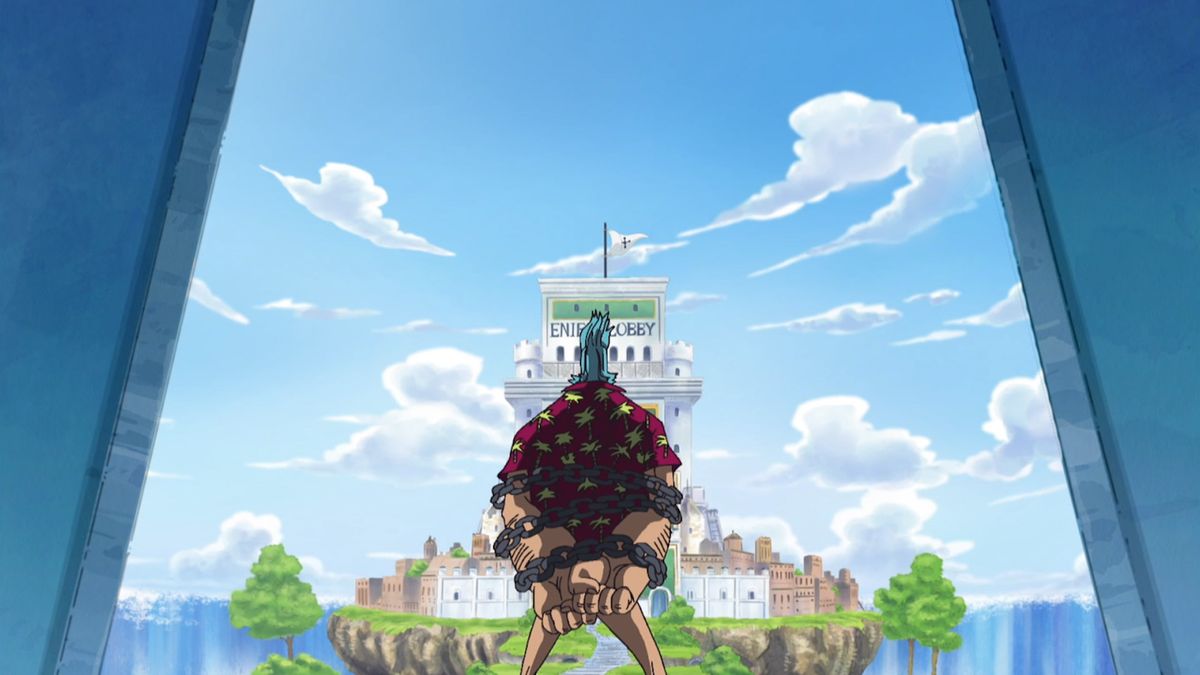
One Piece Episode 263 finally puts Enies Lobby in front of the rescue party, and the first full view tells us exactly what kind of fight waits ahead. The island is bright, enormous, armed, crowded with government personnel, and built around the idea that nobody sane would challenge the authority gathered there. That display is supposed to end the argument before Luffy reaches the gate.
The Straw Hats arrive anyway. Their arrival does not erase Robin’s fear or guarantee a victory. The arrival proves something smaller and more useful: government power has a location, a route, guards, doors, and limits. Once people can reach those limits, “impossible” becomes a problem they can attack.
The full view of Enies Lobby is propaganda made out of stone
Enies Lobby does not look like a neutral courthouse waiting to weigh evidence. The scale, permanent daylight, military presence, and impossible geography create a public statement about who controls judgment. Visitors are meant to feel tiny before anybody hears a charge. Prisoners are meant to understand that the verdict belongs to the institution, not the facts.
I love the visual because One Piece lets architecture do political work. The government does not need Spandam to deliver a speech about absolute authority when the island already performs that claim. Every tower, bridge, gate, and uniform says the same thing: resistance will be processed, contained, and forgotten.
Permanent daylight does not make the island honest
A place without night should feel open, visible, and safe. Enies Lobby turns that expectation inside out. The brightness exposes prisoners while protecting the system that labels them guilty. Everybody can see the courthouse, but visibility does not create accountability when the same authority controls the accusation, transport, hearing, punishment, and historical record.
Robin knows that difference better than anyone on the train. Ohara was destroyed in broad daylight under an official order. The government did not need darkness to hide the massacre from the people carrying out the massacre. Power can commit violence openly when power also controls which deaths count as justice.
Reaching the island changes the rescue from pursuit to invasion
The Sea Train chapters were a race against distance. Sanji, Franky, and Sogeking fought carriage by carriage while Rocketman chased from behind. Episode 263 closes that moving corridor and opens a fixed battlefield where every route has been prepared for government defense.
The tactical problem becomes uglier. The crew must enter hostile ground, locate Robin and Franky, survive thousands of defenders, cross the island, and create a return route. Courage remains necessary, but courage without coordination could leave everybody trapped beside the people they came to save.
Luffy treats the government’s front door like a suggestion
Luffy has never been impressed by a title when somebody he loves is hurting. That blunt moral instinct can look reckless, and sometimes the recklessness creates extra danger for everybody around him. Here, the refusal to bow before the institution is exactly why the rescue still has momentum.
Enies Lobby depends on visitors accepting the island’s meaning. Luffy sees walls, guards, and Robin on the other side. His thinking is not sophisticated, but the simplicity cuts through the performance. A courthouse that denies Robin a real choice does not earn his obedience merely by calling itself lawful.
Galley-La and the Franky Family make this bigger than one pirate crew
The rescue coalition carries people who were enemies a short time ago. Shipwrights, dismantlers, pirates, and Water 7 troublemakers now share transport because CP9 injured their people and took Franky and Robin. Nobody suddenly becomes best friends. They have a common target and enough practical trust to move together.
That messy alliance fits Water 7 better than a clean heroic army would. Conflict does not vanish when people recognize a larger threat. The coalition works because each group brings bodies, skills, information, grief, and a reason to refuse the government’s version of events.
Franky’s abduction exposes how the government treats inherited knowledge
Franky is not being transported because he built a criminal career worthy of this specific operation. CP9 wants the Pluton blueprints passed down through Tom’s workers. The government treats knowledge as property to seize, even while claiming that dangerous knowledge must disappear for public safety.
The contradiction matters because Robin faces the same logic. Her ability to read the Poneglyphs becomes a crime when she controls that knowledge and an asset when officials believe they can use her. The danger never belonged only to information. The government fears people who can choose what forgotten information means.
Robin’s rescue cannot end with the crew speaking over her
The Straw Hats have correctly rejected a bargain made under threats, but love does not grant them ownership of Robin’s answer. Her years of flight, the destruction of Ohara, and the repeated deaths around her created a survival logic that one successful chase cannot remove.
The coming confrontation needs Robin’s voice. The crew can break doors, defeat agents, and show that they accept the risk of standing beside her. Robin must still decide whether she believes her life can contain more than sacrifice. Anything less would replace government control with affectionate control.
Spandam mistakes institutional backing for personal worth
Spandam stands near the center of a machine built by stronger, smarter, and more dangerous people, then treats the machine’s power as proof of his own importance. That gap makes him funny until his access to violence hurts someone. Cowardice does not become harmless when a coward can issue orders.
His behavior also shows why institutions cannot be judged only by the best worker inside them. T-Bone’s decency does not cancel Spandam’s authority, CP9’s coercion, or the Buster Call hanging over Robin’s life. A system must answer for the power its worst authorized people can use.
CP9’s professionalism keeps hiding the moral emptiness of the mission
CP9 agents are skilled, disciplined, and frighteningly effective. Those qualities make their choices more serious, not less. Competence does not clean up assassination, infiltration, threats against civilians, or the forced transfer of a survivor toward a predetermined judgment.
Fans can enjoy the fights and still name the job. The agents are not simply cool rivals waiting to test new techniques. They are enforcing a state decision that Robin never received a fair chance to challenge. The choreography should not blur the custody underneath the action.
The episode uses scale without forgetting the people inside the spectacle
A giant island reveal can become empty wallpaper when the story only wants viewers to admire the budget. Episode 263 keeps the scale connected to Robin, Franky, Usopp, Luffy, and the coalition rushing toward the gate. The wide view increases the distance between the rescuers and the people they need to reach.
That human anchor prevents the spectacle from becoming a travel brochure. Enies Lobby looks magnificent because the government spent resources making authority visible. The same beauty becomes threatening when we remember who is being dragged through the structure and why.
Usopp has crossed a line his pride could not cross back in Water 7
Usopp left the crew after a fight rooted in grief, shame, and fear that the Straw Hats would discard him as easily as they had to leave the Going Merry. Sogeking lets him stand beside them without solving the apology. By Episode 263, however, his actions already reveal where his loyalty lives.
He boarded the dangerous train, helped interrupt Robin’s transfer, and reached the government island. The mask protects his pride, but the work exposes his heart. I do not need the story to rush reconciliation. I need Usopp’s eventual honesty to match the responsibility he is showing now.
Rocketman delivers more than transportation
Rocketman carries a temporary public built from Water 7’s losses. The train contains people who watched Iceburg get attacked, saw Galley-La infiltrated, lost Franky, feared for Robin, and learned that respected coworkers had been government agents. The vehicle moves all of that anger toward one destination.
Transportation matters in One Piece because geography controls who can help whom. Aqua Laguna nearly sealed Water 7 away. The Sea Train turned the impossible crossing into a route, and Kokoro’s knowledge turned an old machine into a rescue tool. Infrastructure can serve authority, commerce, community, or rebellion depending on who gets access.
Kokoro’s knowledge deserves credit beside the fighters
Kokoro does not win attention by punching through a carriage. She knows the trains, the sea, the route, and the history connecting Tom’s work to the current crisis. Without that knowledge, muscle would remain stranded in Water 7 while Robin disappeared toward Enies Lobby.
The series is strongest when practical expertise changes the outcome. Navigators, shipwrights, cooks, engineers, doctors, and station workers make adventure possible. Kokoro’s contribution reminds viewers that rescue depends on people who understand systems, not only people powerful enough to break them.
The government counted on isolation, and Water 7 answered with a crowd
Robin has survived by leaving before attachment could become another funeral. CP9’s bargain exploits that habit and tries to separate her from every person willing to challenge the government’s claim. The crowd arriving at Enies Lobby is the physical answer to that isolation.
Not everyone aboard knows Robin equally well. Some came for Franky, Iceburg, revenge, loyalty, or pride. That variety makes the support more believable. A rescue movement does not require identical feelings. People can attack the same injustice from different relationships and still change what the target believes is possible.
Enies Lobby gives the crew a political enemy without changing their basic motive
The Straw Hats are not arriving with a policy paper or a plan to reform the World Government. They came because Robin was coerced and taken. Their personal motive does not make the conflict apolitical. The government turned Robin’s existence, scholarship, history, and relationships into matters controlled by state force.
Personal loyalty collides with political power the moment officials claim the right to erase a person. Luffy does not need formal language to understand the choice. If the law requires him to abandon Robin, then the law has placed itself between him and his family.
The island’s impossible geography mirrors Robin’s learned hopelessness
Enies Lobby hangs above an abyss and seems separated from ordinary rules. Robin’s belief about her own future has the same shape. She sees no safe place to stand, no route backward, and no ending that does not swallow somebody she loves.
The visual parallel works because the crew responds to both problems through movement. They found a train across the storm, allies inside old enemies, and paths through defended carriages. Reaching Enies Lobby does not cure Robin’s despair, but the arrival gives her hopelessness new evidence to argue with.
The production credits carry a major transition cleanly
Hirohiko Kamisaka’s screenplay has to close the Sea Train pursuit and establish the next battlefield without making the episode feel like a checklist. Hiroaki Miyamoto’s direction gives the island reveal room while keeping the rescue’s urgency alive. Katsumi Ishizuka’s animation direction supports faces, movement, and scale during a handoff that could have felt purely mechanical.
Miyuki Sato and Kumiko Fukuzawa’s art direction work matters because Enies Lobby must become a readable place, not only a dazzling backdrop. Viewers need to feel the size and understand that the crew will have to cross distinct barriers before reaching Robin.
The broadcast gap makes the arrival feel like a deliberate event
Episode 263 aired in Japan on April 30, 2006, after Episode 262’s April 16 broadcast. That scheduling space does not change the story, but the return lands on a clean threshold. The moving train conflict gives way to one of the franchise’s defining locations.
Modern streaming can erase those pauses by rolling straight into the next episode. Watching in a binge makes the momentum stronger, while remembering the original broadcast helps explain why the full island view receives such careful emphasis. Weekly viewers had reached the door of a fight the story had been building for months.
Where to watch One Piece Episode 263
Use the current licensed One Piece route available in your region, including Crunchyroll where Episode 263 is offered. Catalogs and language options change by country, so confirm the episode number and title before pressing play.
The official Japanese episode page remains useful for the original title and broadcast record. CVM Sekai keeps the viewing route separate from the React because access information can change while the episode analysis should remain readable.
RaeRae verdict: reaching Enies Lobby proves the government can be confronted before anybody knows whether the crew can win
Episode 263 does not need to hand out a victory. The arrival is the achievement. Aqua Laguna, the Sea Train, CP9, internal crew conflict, Robin’s bargain, and the government’s intimidating geography all tried to turn rescue into a fantasy. The coalition reaches the island carrying every unresolved problem with them.
Enies Lobby looks beautiful, ridiculous, terrifying, and deeply dishonest. Permanent daylight cannot make a predetermined judgment fair. Towers cannot make coercion consent. A flag cannot make Spandam worthy. The Straw Hats still have to cross the island and Robin still has to choose life aloud, but the government has already lost one useful lie: nobody would ever come for her.