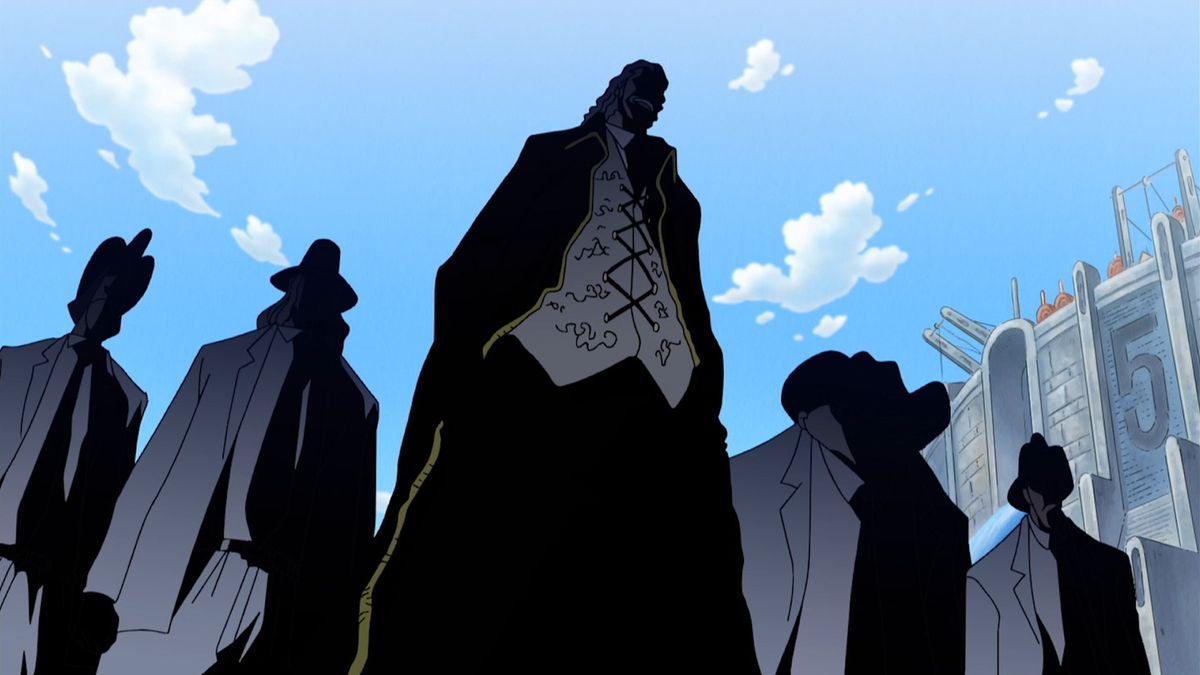
RaeRae Reacts · One Piece Episode 249
Spandam Steals the Ships, the Story, and the Right to Define Guilt
One Piece Episode 249 has Spandam steal Franky’s battle ships and frame Tom’s Workers before the promised pardon can free Tom.
Bottom line: Spandam turns Franky’s name into the weapon that destroys Tom
One Piece Episode 249 shows Spandam steal Franky’s battle ships, attack the judicial vessel, and frame Tom’s Workers on the day Tom expects his pardon. The plan works because every ship carries the BF mark Franky proudly placed on his creations. Spandam does not need to invent the weapons. He needs access, timing, and a justice system willing to treat possession of a name as the end of the investigation.
This is the episode where Tom’s lesson about pride meets the part Franky had not learned: creators must consider who can seize what they build. Franky did not order the attack. His ships still make the attack possible, and Spandam makes sure the guilt lands on the family he wants to control.
The official episode record
ONE PIECE.com lists Episode 249, “Spandam’s Scheme! The Day the Sea Train Shook,” with a Japanese broadcast date of November 13, 2005. Hirohiko Kamisaka wrote the screenplay, Katsumi Tokoro directed, Naoki Tate served as animation director, and Miyuki Sato and Kunihiro Chida handled the credited art work.
The official summary confirms that the attack happens on the day Tom’s crime for building Roger’s ship should be pardoned, Franky’s battle ships assault the judicial vessel, and CP5 leader Spandam arranged the frame-up to obtain the blueprints Tom protected.
Spandam arrives after Tom’s success creates leverage
The sea train proves Tom has fulfilled the government’s condition. A legitimate process should end with the promised pardon. Spandam sees the deadline as a closing window.
He cannot persuade Tom to surrender the Pluton plans, so he creates a new crime before the old punishment disappears. Bureaucratic power becomes a race to manufacture guilt.
CP5 treats the blueprints as government property without legal ownership
Spandam believes the World Government deserves Pluton because the government claims authority over global security. Tom understands that the same institution seeking the plans has already shown how casually power becomes coercion.
The dispute is not about whether the weapon is dangerous. Both sides know the danger. The dispute concerns whether an institution willing to fabricate an attack should control the means to build something worse.
Tom refuses because character matters more than official title
Spandam presents himself as an agent of lawful order. Tom judges the man asking, the methods behind the request, and the likely consequences. A badge does not turn hunger for power into stewardship.
That refusal humiliates Spandam because he expects institutional rank to end moral questions. Tom makes him face the fact that authority has not earned trust.
Franky’s battle ships were never secured against theft
Young Franky built increasingly powerful vessels to fight Sea Kings and display his skill. He marked them, tested them, and left them accessible around the workshop. He imagined himself controlling every future use.
Spandam exploits that assumption. A weapon does not remain loyal to the creator when another person can take the controls.
The BF marks provide true evidence for a false story
The attacking vessels are Franky’s creations. Their names and construction can be verified. That genuine connection makes the fabricated accusation difficult to challenge after the attack begins.
Spandam builds the lie around facts instead of inventing every detail. The strongest propaganda often uses accurate fragments arranged to hide the person who controlled the event.
The judicial ship gives the attack the largest possible audience
Targeting a government vessel guarantees official witnesses, emotional outrage, and pressure for immediate punishment. The site of the attack also lets Spandam define the response before Tom’s Workers can explain what happened.
The spectacle is part of the weapon. A quiet theft might invite investigation. Cannon fire against a judicial symbol demands a villain on schedule.
Tom runs toward the ships because he recognizes the construction
Tom does not hide when the attack begins. He knows the vessels, understands their capabilities, and tries to stop the damage. His response comes from responsibility rather than an admission of command.
That distinction disappears inside Spandam’s version. The shipwright at the crime scene becomes proof of guilt even though expertise is exactly why Tom can respond.
Iceburg tries to protect the workshop through reason
Iceburg understands how the accusation will look. He has spent years watching Water 7’s reputation and knows Franky’s ships can connect the family to the attack.
Reason cannot work normally when the person presenting evidence arranged the crime. Iceburg is arguing inside a process whose desired conclusion already exists.
Franky sees his creations firing at the people he loves
The horror is immediate because the ships still look like his work. Every cannon, hull choice, and BF mark returns as proof that skill can be stolen and redirected.
Franky has to watch a private fantasy of strength become public violence against Tom and Iceburg. Spandam weaponizes authorship itself.
Tom’s lesson about pride becomes harder, not false
Franky wants to reject the ships after seeing the attack. Shame tells him that disowning the creations may separate him from the harm. Tom refuses that escape.
Standing by a creation does not mean endorsing theft or accepting Spandam’s guilt. The lesson demands that Franky name the ships as his, understand how they were used, and learn what responsibility requires next.
Creator responsibility is not the same as criminal blame
Franky should have secured dangerous vessels and considered misuse. Spandam chose to steal them, ordered the attack, and constructed the frame-up. Those responsibilities are not equal.
The government needs them to look equal because blurring negligence into command hides the agent who acted deliberately.
Spandam’s plan depends on institutional laziness
A real investigation would ask who crewed the ships, how they launched, who benefited, why the attack happened on pardon day, and why CP5 immediately returned to the blueprint demand. The official response stops at visible ownership.
That failure is not accidental incompetence. A shallow inquiry protects the institution’s preferred story and keeps every uncomfortable question away from the agent who controlled the scene, selected the target, and demanded Tom’s blueprints before the smoke cleared.
Water 7 receives another reason to fear Tom’s Workers
Residents have already lived with the government’s accusation surrounding Roger’s ship. Seeing marked battle vessels attack a judicial ship activates the old suspicion that Tom’s craft naturally serves pirates and violence.
Spandam uses public memory as fuel. He does not need the city to know the details. He needs enough fear that nobody slows the punishment.
The sea train shakes because the future and the frame-up share one day
Tom’s greatest public achievement should confirm Water 7’s survival and close the case against him. Instead, Spandam attaches fresh violence to the moment.
The title connects machinery with political shock. The train keeps representing connection while the justice system uses another set of machines to isolate its builder.
CP5 shows the earlier version of CP9’s Water 7 method
Spandam’s unit uses infiltration, stolen tools, controlled evidence, and a staged narrative. Years later, CP9 repeats the pattern inside Galley-La with greater discipline.
The organization learns that Water 7 can be manipulated through its respect for craft. Shipwright identities become both cover and evidence.
Spandam wants advancement as much as national security
The Pluton blueprints offer prestige, influence, and a result he can present upward. His ambition makes every moral claim about protecting the world less convincing.
Tom and his family become career obstacles. That personal incentive does not replace institutional responsibility. The system rewards agents who convert coercion into successful reports.
Franky’s anger cannot reach the architecture of the trap
He can fight people, destroy machines, and throw himself toward danger. The accusation exists across witnesses, official authority, marked hulls, and a court prepared to believe CP5.
Physical courage cannot punch every part of a narrative assembled by the state. Franky is facing the kind of power that decides what an event will be called.
Tom protects both apprentices while the evidence closes in
Tom understands that Iceburg and Franky still have futures beyond the workshop. He moves toward the danger and absorbs attention because the government already sees him as the central criminal.
That protection begins before his final choice in the next episode. He is already rearranging blame around the people he raised.
Iceburg’s fear of Franky’s weapons was never simple jealousy
Iceburg repeatedly warned Franky that the battle ships could cause harm. Those warnings came from a shipwright who understood that construction continues to matter after launch. Episode 249 gives the fear a body count and a government uniform.
He does not get the satisfaction of being right. The attack injures Tom’s Workers and turns the entire workshop into evidence. Iceburg’s caution cannot protect the family once Spandam controls the ships.
The frame-up punishes Water 7 for depending on official judgment
The city trusted the pardon process because a judicial authority promised Tom freedom after the sea train. Spandam proves that a written condition means little when another agent can manufacture a charge and make emergency fear outrun examination.
Water 7 now has a public route built by Tom and a public accusation designed to erase the builder’s credibility. Residents must decide whether government language matters more than the years of work they personally witnessed. That decision is harder because fear moves faster than memory during an attack. People see cannon fire, uniforms, and marked ships before they hear how CP5 obtained control. Spandam counts on panic turning neighbors into an audience for punishment rather than witnesses capable of comparing the official claim with the family they knew.
Katsumi Tokoro stages the attack as stolen authorship
The direction repeatedly connects Franky’s recognition of the vessels with the destruction they cause. Viewers cannot dismiss the machines as generic enemy weapons. The familiar designs are the emotional evidence.
Spandam remains the author of the operation while forcing Franky’s signature into every visible frame.
Naoki Tate makes the battle ships look powerful enough to justify fear
The vessels need speed, cannon force, and recognizable construction for the frame-up to work. If they looked harmless, the accusation would collapse. Their effectiveness reflects Franky’s talent and his failure to imagine hostile control.
The animation lets pride and terror occupy the same machinery. Franky built well. That quality magnifies the damage.
What changed after another watch
The first watch makes Spandam’s cruelty the obvious focus. Another watch makes the procedural timing even uglier. He waits until Tom has completed the public work, then creates a fresh charge before the promised pardon can remove the government’s leverage.
The BF marks also become harder to look at. Franky named the ships because he wanted ownership. Spandam turns that honest pride into the shortcut that convicts his family.
RaeRae verdict: Spandam steals the ships, the story, and the right to define responsibility
Episode 249 understands that a frame-up works best when the victim supplied some of the evidence. Franky built dangerous vessels, marked them, and failed to secure them. Those choices deserve serious judgment. None of those choices ordered an attack on the judicial ship.
Spandam takes the final step and then disappears behind the government’s authority. He wants Franky to carry the shame, Tom to carry the sentence, and CP5 to carry the blueprints away. I do not accept that distribution at all. Franky has a lesson to learn about weapons. Spandam has a crime to answer for, and the institution protecting him is part of that crime.
Receipts and where to watch
The official ONE PIECE.com Episode 249 record supplies the Japanese title, November 13, 2005 broadcast date, judicial-ship attack, Spandam frame-up, and official image used on this page. Credited staff include Hirohiko Kamisaka, Katsumi Tokoro, Naoki Tate, Miyuki Sato, and Kunihiro Chida. Crunchyroll provides the licensed episode route.
This React stops with Episode 249 knowledge. Episode 250 resolves Tom’s response to the fabricated charge and Franky’s attempt to stop the sea train. The evidence available now is enough to identify the author of the attack: Spandam arranged the violence and used Franky’s name to hide his own.