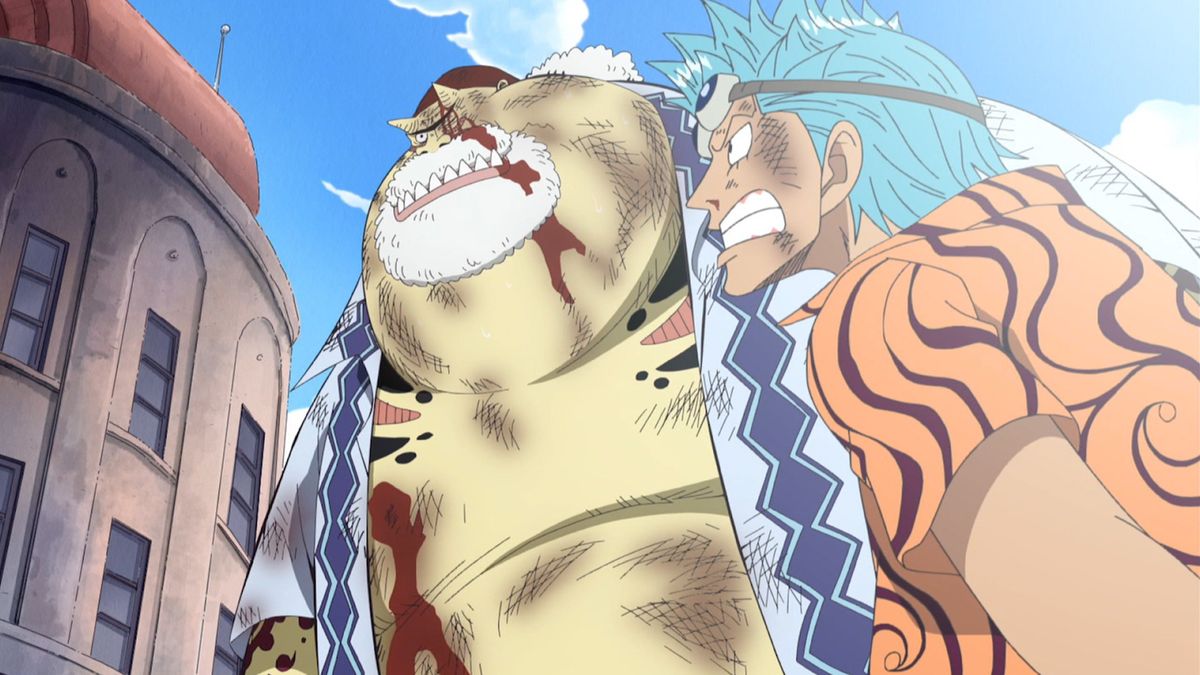
RaeRae Reacts · One Piece Episode 250
Tom Dies Proud Because Spandam Does Not Get to Author His Life
One Piece Episode 250 has Tom accept death for building Roger’s ship, save his apprentices, and leave Franky a future where creation survives shame.
Bottom line: Tom uses his final choice to save Franky from carrying Spandam’s crime
One Piece Episode 250 completes Tom’s story by making him choose which accusation the government will use to kill him. He accepts punishment for building Gol D. Roger’s ship and asks that the fabricated judicial-ship attack be pardoned instead. That choice clears Franky and Iceburg from the new charge while preserving Tom’s pride in the Oro Jackson.
Franky responds by trying to stop the sea train carrying Tom away. The train he helped build becomes the machine separating him from his father. Franky survives the collision, rebuilds his body, and carries the lesson forward under a new name.
The official episode record
ONE PIECE.com lists Episode 250, “The Legendary Man’s End! The Day the Sea Train Cried,” with a Japanese broadcast date of November 27, 2005. Hirohiko Kamisaka wrote the screenplay, Munehisa Sakai directed, Takeo Ide served as animation director, and Miyuki Sato and Kumiko Fukuzawa handled the credited art work.
The official summary confirms that Tom’s Workers are arrested for the judicial-ship attack, Tom strikes Franky after he regrets building the battle ships, and Tom accepts the death sentence attached to Roger’s ship so the attack charge can be pardoned.
Franky tries to disown the battle ships after seeing the damage
Shame makes him say the vessels should never have existed. The reaction is understandable because Spandam turned his craft against Tom, Iceburg, and the judicial ship.
Tom hears a deeper danger inside that regret. If Franky learns that creation becomes shame whenever another person commits evil, Spandam will control not only the ships but the meaning of Franky’s talent.
Tom’s punch rejects shame, not responsibility
Tom hits Franky for denying his own creations. He does not tell the boy that the unsecured weapons were harmless or that consequences do not matter. He insists that a shipwright must face what he made.
Responsibility requires ownership of the truth. Franky built the vessels. Spandam stole and commanded them. Erasing either fact produces another lie.
Spandam wants Franky to become the easiest version of guilty
A broken child blaming himself saves CP5 from scrutiny. If Franky believes his talent caused everything, he will stop asking who took the ships, planned the timing, and benefited from the attack.
Self-hatred can serve power because a victim who internalizes the accusation begins policing his own future.
Tom refuses to let the government choose his source of shame
The court offers him punishment for the current attack. Tom redirects the sentence toward the old charge of building Roger’s vessel. He would rather die for work he proudly completed than accept guilt for Spandam’s operation.
The distinction protects his identity. The government can execute Tom, but Tom will not sign their version of his life.
Choosing the Oro Jackson charge preserves the truth about craft
Tom built a ship capable of carrying Roger’s crew through the Grand Line. He remains proud because the vessel met the highest standard of his profession.
Accepting that charge says the act was his without agreeing that excellent shipbuilding deserved death. His sentence exposes the law rather than validating the law.
The pardon for the attack saves Iceburg and Franky
Tom uses the value of the completed sea train and the court’s own bargain to remove the new accusation. His apprentices are no longer treated as the team that attacked the judicial ship.
That legal maneuver cannot restore the workshop or undo the injuries. The choice gives the boys a future outside the fabricated crime.
Tom spends his final leverage on his children
He could plead for himself, expose Spandam without proof, or collapse under the injustice. Instead, Tom identifies the one outcome still available: keep the apprentices alive and free enough to build.
The sacrifice is parental without becoming sentimental performance. He makes a practical decision inside a rigged process.
Iceburg understands that survival now carries an assignment
Tom’s choice leaves Iceburg with skills, memory, and responsibility for Water 7. The young shipwright cannot remain only a grieving apprentice.
Galley-La will later turn that inheritance into an institution capable of protecting the city and unifying its shipyards.
Franky hears rescue as another reason to blame himself
Tom gives his life partly to clear the apprentices, and Franky interprets that protection through guilt. He sees his ships, his recklessness, and his master’s sentence as one chain.
That burden helps explain why adult Franky hides behind a new name and criminal performance. Cutty Flam becomes the boy whose work got Tom taken away.
The sea train becomes both Tom’s achievement and the route to his death
Puffing Tom saved Water 7 by reconnecting the city. The same rails now carry the builder toward Enies Lobby. Infrastructure does not choose how institutions use the route.
That reversal is brutal because Tom cannot regret the train without denying the people he saved. Spandam turns public good into a transport system for punishment.
Franky stands on the tracks because grief rejects engineering
He knows the train’s weight, speed, and inability to stop instantly. He helped create the machine. None of that knowledge matters when Tom is inside and distance keeps growing.
Franky puts his body where the argument feels simplest: if the train cannot pass, Tom cannot leave.
The collision is not a heroic plan
Franky’s stand is desperate, loving, and nearly fatal. The episode does not need to pretend the action could work. He is a child using his body against a system too large to fight directly.
The failure belongs to the power imbalance, not a shortage of devotion.
Tom’s final words keep Franky attached to creation
Tom wants the apprentice to survive without hating every machine that carries his hands. The message reaches beyond the battle ships. Franky still has vessels, inventions, and perhaps a dream ship ahead.
Spandam cannot be allowed to end that future by making creation itself feel criminal.
Franky rebuilds his body with the skills Tom taught him
After the collision, Cutty Flam survives through mechanical reconstruction. The body becomes evidence that shipbuilding knowledge can also preserve a human life.
His cyborg form is not separate from Tom’s workshop. Every modification extends the apprenticeship into flesh and metal.
The new name protects the survivor and buries the child
Iceburg tells Cutty Flam to stop using the old identity. Becoming Franky helps hide him from the government’s search for Tom’s other apprentice and the Pluton blueprints.
The change also gives him emotional distance from the boy on the tracks. A protective alias becomes a place to store grief.
Iceburg and Franky split because one visible bond could expose both
The brothers carry different parts of Tom’s legacy. Iceburg moves toward public authority. Franky moves into the city’s outlaw spaces with the blueprints.
Their separation protects the documents and makes ordinary family repair nearly impossible.
Spandam is rewarded by a system that can ignore the obvious
The timing, stolen ships, blueprint demand, and CP5 presence should invite investigation. The government accepts the result because Tom’s removal and the search for Pluton align with institutional interests.
Spandam’s corruption succeeds because the structure above him values outcomes over truth.
Water 7 keeps Tom’s train even when the law takes Tom
Residents continue using the route he built. Daily life absorbs his achievement while the official story marks him as a criminal tied to Roger.
That contradiction becomes part of the city’s foundation. Water 7 survives through the labor of a man the government condemned.
Tom’s family receives no private place to grieve
The arrest, train departure, and public accusation happen in front of workers, officials, and neighbors. Iceburg and Franky cannot separate the loss of their father from the story the government tells about him. Grief arrives already politicized.
That public pressure helps drive the brothers into opposite survival strategies. Iceburg learns to manage institutions and reputation. Franky builds an identity loud enough to reject respectable judgment before respectable people can reject him.
Kokoro has to live beside the route that carried Tom away
Kokoro remains connected to the sea train after losing the man who designed the system. Every successful run proves Tom’s achievement while repeating the sound and direction of his removal.
Her later work is not evidence that the tragedy stopped mattering. Keeping the train operating protects the public good Tom chose to build and prevents Spandam from owning the meaning of that machine.
Franky’s body becomes the first creation he cannot abandon
The collision leaves him with damage too severe for ordinary recovery. Rebuilding himself forces Franky to apply Tom’s lesson under the most personal conditions possible. He cannot call the broken body a mistake and walk away.
Every mechanical replacement says survival is still worth making. The cyborg body carries grief, engineering, and refusal in the same frame.
Tom’s death reshapes how Franky protects the Pluton blueprints
Franky now knows the government will steal machines, stage attacks, manipulate courts, and sacrifice shipwrights to obtain technical power. Guarding the plans cannot depend on good faith, official promises, or visible family unity.
His outlaw life becomes a security strategy. The ridiculous clothes, criminal reputation, dismantling business, and distance from Iceburg make Cutty Flam harder to recognize as the apprentice carrying Tom’s most dangerous inheritance.
The episode separates legacy from official memory
The World Government can record Tom as the criminal who built Roger’s ship. Water 7’s economy, Iceburg’s company, Franky’s machines, Kokoro’s train work, and the surviving blueprints preserve a larger account.
Legacy lives through consequences and relationships, not only the archive controlled by the institution that imposed the sentence. Tom’s work keeps contradicting the label placed on his name. People ride his train, apprentices repeat his lessons, and Water 7 survives because he refused to let official contempt decide what the city deserved. The government owns the verdict. The family owns the fuller memory.
Munehisa Sakai lets the machinery carry the grief
The train whistle, rails, forward motion, and Franky’s small body create the emotional structure. Characters do not need to explain every contradiction aloud.
The machine Tom built for connection becomes visually inseparable from forced separation.
Takeo Ide makes Tom’s strength feel human at the end
Tom remains physically enormous, injured, proud, and capable of comforting his apprentices. His size does not prevent vulnerability under chains and state authority.
Franky’s damaged body reflects the same collision between immense will and material limits.
What changed after another watch
The first watch makes Franky standing before Puffing Tom the unforgettable image. Another watch makes Tom’s legal choice the sharper act. He identifies the only charge that can preserve both truth and his children’s future.
The sea train also becomes harder to reduce to tragedy. Tom still saved Water 7. Spandam’s use of the rails cannot erase the good built into the route.
RaeRae verdict: Tom dies proud because Spandam does not get to author his life
Episode 250 refuses the cheap version of sacrifice where a good man accepts every accusation and becomes noble through silence. Tom chooses his charge carefully. He claims the Oro Jackson because he built that ship and rejects the judicial attack because Spandam built that crime.
Franky will spend years learning the full lesson. He has responsibility for dangerous creations. He does not have responsibility for another man’s decision to steal them. Tom’s last gift is a future where Franky can keep building without confusing accountability with the government’s deliberate and self-serving lie about that day.
Receipts and where to watch
The official ONE PIECE.com Episode 250 record supplies the Japanese title, November 27, 2005 broadcast date, Tom’s sentencing choice, Franky’s regret, and official image used on this page. Credited staff include Hirohiko Kamisaka, Munehisa Sakai, Takeo Ide, Miyuki Sato, and Kumiko Fukuzawa. Crunchyroll provides the licensed episode route.
This React stops with Episode 250 knowledge. Episode 251 returns to Robin’s choice and the current Water 7 crisis. Tom’s history now explains Franky’s name, body, blueprints, anger toward the government, and refusal to stop building.