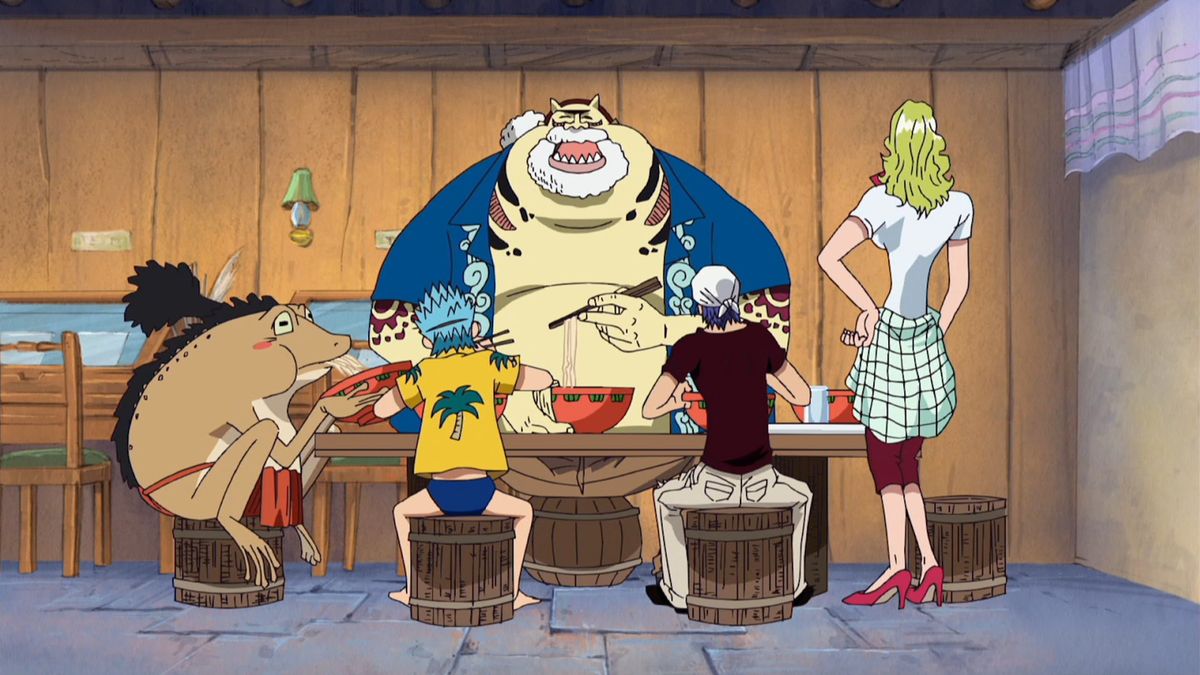
RaeRae Reacts · One Piece Episode 248
Tom Saved Water 7 and the Government Kept the Death Sentence Warm
One Piece Episode 248 opens Franky’s childhood with Tom’s Workers and the sea train that reconnects Water 7 while Tom remains condemned.
Bottom line: Tom built Water 7 a future and taught Franky to stop apologizing for creation
One Piece Episode 248 sends CP9 into Franky’s warehouse and opens the history of Tom’s Workers, the small shipbuilding family that raised Cutty Flam and Iceburg. Tom is the legendary shipwright who built Gol D. Roger’s vessel. He is also the man who answered Water 7’s economic collapse by designing a sea train.
The flashback matters because Franky’s loud present life comes from a workshop where pride, responsibility, and invention were daily rules. CP9 sees a hidden drafting room and a path to Pluton. Franky sees the remains of a home where Tom taught two abandoned boys what building something should mean.
The official episode record
ONE PIECE.com lists Episode 248, “Franky’s Past! The Day the Sea Train Ran,” with a Japanese broadcast date of November 6, 2005. Hirohiko Kamisaka wrote the screenplay, Hiroaki Miyamoto directed, Kazuya Hisada served as animation director, and Miyuki Sato and Michiyo Kawasaki handled the credited art work.
The official summary confirms that CP9 reaches Franky’s warehouse, discovers the drafting room once used by Tom’s Workers, and connects the location to the childhood Franky and Iceburg spent learning under the world’s greatest shipwright.
CP9 enters Franky’s home as though history belongs to the government
The agents arrive looking for blueprints, not memories. Every workbench, hidden room, tool, and surviving drawing becomes potential evidence. Their search turns a family workshop into an inventory of state targets.
Franky’s warehouse appears chaotic from outside, but CP9 recognizes technical order beneath the mess. That recognition is dangerous because the agents finally understand where Cutty Flam preserved Tom’s inheritance.
The drafting room survived because Franky never really left Tom’s Workers
Franky changed his name, rebuilt his body, formed a criminal family, and performed enough nonsense to keep respectable people at a distance. The room behind those choices still connects him to Tom and Iceburg.
Preserving the workspace is not simple nostalgia. Franky uses the skills, tools, and standards he learned there. His public identity changed while the apprenticeship continued inside everything he built.
Tom welcomes Cutty Flam without pretending the boy is easy
Young Franky is reckless, combative, and obsessed with building battle ships. He arrived after pirates abandoned him, carrying anger that found a home inside machines capable of fighting back.
Tom does not demand that the boy become quiet before receiving food, work, and instruction. He gives Franky a place where difficult energy can become craft.
Iceburg and Franky grow as brothers through constant disagreement
Iceburg is disciplined, cautious, and aware of how Water 7 judges their workshop. Franky is impulsive and delighted by whatever explodes. Their differences create friction because both care about Tom and shipbuilding.
The relationship is not polished found-family sweetness. They insult, compete, warn, and irritate one another. That ordinary mess makes their later separation feel like a real family wound.
Kokoro keeps the workshop connected to the city
Kokoro works with Tom’s Workers and understands the people behind the machinery. Her presence prevents the flashback from becoming three men building in isolation. Someone has to manage information, practical life, and the emotional weather around two growing apprentices.
She also carries the memory forward. When other people know Tom only through accusation, Kokoro remembers the daily work and the family he created.
Building Roger’s ship becomes a crime only after Roger changes the world
Tom built the Oro Jackson as a shipwright completing a commission. The Pirate King’s later fame allows the World Government to treat the vessel’s maker as though he authored every voyage and consequence.
That logic is politically useful and professionally dishonest. A craftsperson can be responsible for the quality and intended features of a creation without controlling every future act performed by the owner.
Tom refuses to be ashamed of the Oro Jackson
When people use Roger’s name to condemn him, Tom does not deny the work. He built a ship worthy of carrying its crew across the world, and he remains proud of that achievement.
His position is not careless. Tom understands the danger attached to Roger. He refuses the government’s demand that fear rewrite honest craft into personal disgrace.
Franky hears pride as permission to exist loudly
Tom’s rule about standing by what one creates lands inside a child already rejected by his first family. Franky learns that a maker should not disown a creation because outsiders hate or misuse the result.
That lesson helps explain his adult performance. Franky shows every ridiculous invention, body modification, and emotional reaction without asking respectable Water 7 for permission.
The lesson also contains responsibility Franky does not understand yet
Pride is not the same as ignoring consequences. Tom wants his apprentices to build with conviction and accept the relationship between creator and creation. Young Franky mostly hears that nobody should make him feel ashamed.
The gap between those meanings becomes the opening Spandam later exploits. Franky builds armed ships without imagining somebody else can turn them against Tom.
Water 7 is dying from broken trade routes
The city’s sinking foundations and violent tides make ordinary travel harder. Shipbuilding skill cannot protect an economy when customers, supplies, and neighboring communities lose reliable access.
Tom sees a structural problem rather than blaming individual workers. Water 7 does not need another inspirational speech about trying harder. Water 7 needs transportation capable of surviving the sea.
The sea train answers geography with engineering
Tom proposes rails across the ocean and a train capable of connecting islands despite dangerous currents. The idea sounds impossible because the environment has already defeated normal routes.
His solution does not erase the sea. The design studies water, weather, and movement closely enough to create a new relationship with them.
Ten years of labor sit behind the first successful run
The sea train is not a miracle that appears after one montage and a confident line. Tom, Iceburg, Franky, Kokoro, and workers spend years building tracks, testing systems, repairing failures, and surviving public doubt.
That duration gives the achievement social weight. Water 7’s future emerges from sustained labor rather than a genius acting alone.
Iceburg learns to build institutions while Franky learns to build machines
Both apprentices inherit Tom’s craft, but their strengths develop in different directions. Iceburg thinks about coordination, reputation, contracts, and how shipwrights can work together. Franky thinks through mechanisms, weapons, bodies, and audacious physical solutions.
Galley-La and the Franky Family later look opposed because each man built a life around a different part of the same workshop.
The sea train gives Water 7 an economic reason to survive
Reliable transportation reconnects markets, workers, materials, visitors, and government routes. Tom’s invention does not merely look impressive. The train changes what Water 7 can plan.
That public benefit makes the government’s treatment of Tom uglier. The state accepts the infrastructure while preserving the right to punish its creator after taking everything useful from his labor and calling the exchange lawful.
Water 7 celebrates the machine before accepting the man
The first successful run gives the city a reason to cheer Tom’s Workers, but public gratitude remains attached to the result. The same neighbors who benefit from the train can still retreat when the government names Tom a criminal. Infrastructure becomes easier to love than the accused person who built the infrastructure.
That separation protects institutions. Water 7 can use Tom’s genius without challenging the law that condemns him for Roger’s ship. The city receives connection while Tom continues carrying the political cost of making something history later called dangerous.
The Puffing Tom turns memory into a route people can ride
Tom does not leave Water 7 a statue or a slogan. He leaves daily transportation. Workers, families, officials, merchants, and travelers will enter the train without needing to know every year of labor behind the rails.
That ordinary usefulness is part of the beauty and the cruelty. His care becomes public routine while his own name remains vulnerable to government storytelling. Every schedule proves the project worked, but success does not automatically correct the record about the builder. Children can grow up believing sea travel was always possible while the adults avoid explaining who made possibility available and what the government demanded from him in return.
Tom’s pardon is structured as conditional usefulness
The judicial arrangement delays punishment while Tom completes the sea train. His life becomes acceptable for as long as the government wants the project.
That bargain is not mercy. The state places a timer around valuable labor and calls the arrangement justice.
Franky’s battle ships begin as a child’s answer to abandonment
He builds vessels marked as his creations and imagines defeating sea monsters. The weapons give him a way to feel powerful in a world where pirates discarded him and adults control every route.
The ships are creative, dangerous, and emotionally legible. Understanding the wound behind them does not remove the need to secure what they can do.
Tom allows invention because prohibition would not teach judgment
Tom does not crush Franky’s imagination every time a cannon appears. He wants the apprentice to develop skill and take responsibility for the result.
That teaching method respects Franky as a future shipwright. The risk is that responsibility often arrives after somebody discovers how easily another person can steal a creation.
CP9 reads the flashback’s legacy without respecting the people
Lucci and the agents care that Tom’s apprentices inherited the Pluton blueprints. They do not care that Tom saved Water 7, raised abandoned children, or treated shipbuilding as a moral relationship.
Institutional intelligence can collect accurate facts while remaining deliberately ignorant about meaning.
Hiroaki Miyamoto balances warmth with the approaching frame-up
The direction gives Tom’s household enough ordinary humor and work to feel lived in. Viewers see meals, arguments, building, and celebration before the government operation closes around them.
That warmth prevents the tragedy from becoming a history lecture. Spandam is not about to destroy an abstract workshop. He is targeting a family.
Kazuya Hisada makes the sea train feel earned
The first run needs scale, mechanical weight, spray, speed, and the reaction of a city that doubted the project. The animation sells the train as machinery rather than a decorative fantasy object.
Tom’s body and smile carry equal importance. The machine matters because a builder spent years believing Water 7 deserved the connection.
What changed after another watch
The first watch makes Tom’s connection to Roger and the sea train the major reveals. Another watch makes the drafting room more painful. Adult Franky kept the physical heart of Tom’s Workers hidden beneath the city while pretending the old family was gone.
Iceburg’s later public respectability also stops looking like rejection of Tom. Galley-La is another form of the same rescue project.
RaeRae verdict: Tom saved Water 7 and the government kept the death sentence warm
Episode 248 introduces one of the clearest examples of how One Piece treats infrastructure as power. Tom looks at a sinking city and builds a route back to the world. Water 7 gets trade, movement, and a future because a condemned shipwright spends ten years solving a public problem.
The government does not become grateful. The government delays punishment while his labor remains useful. That arrangement tells me everything about the justice system CP9 serves. Tom’s work can be essential, his family can be real, and his life can still be treated as expendable once the train runs.
Receipts and where to watch
The official ONE PIECE.com Episode 248 record supplies the Japanese title, November 6, 2005 broadcast date, Tom’s Workers history, sea-train focus, and official image used on this page. Credited staff include Hirohiko Kamisaka, Hiroaki Miyamoto, Kazuya Hisada, Miyuki Sato, and Michiyo Kawasaki. Crunchyroll provides the licensed episode route.
This React stops with Episode 248 knowledge. The next episodes show how Spandam uses Franky’s battle ships, how Tom answers the frame-up, and why Franky’s body and name change. The achievement remains complete before the tragedy arrives: Tom built Water 7 a future.