RaeRae Reacts · One Piece Episode 214
Sanji Uses Catnip and Luffy Finally Stands
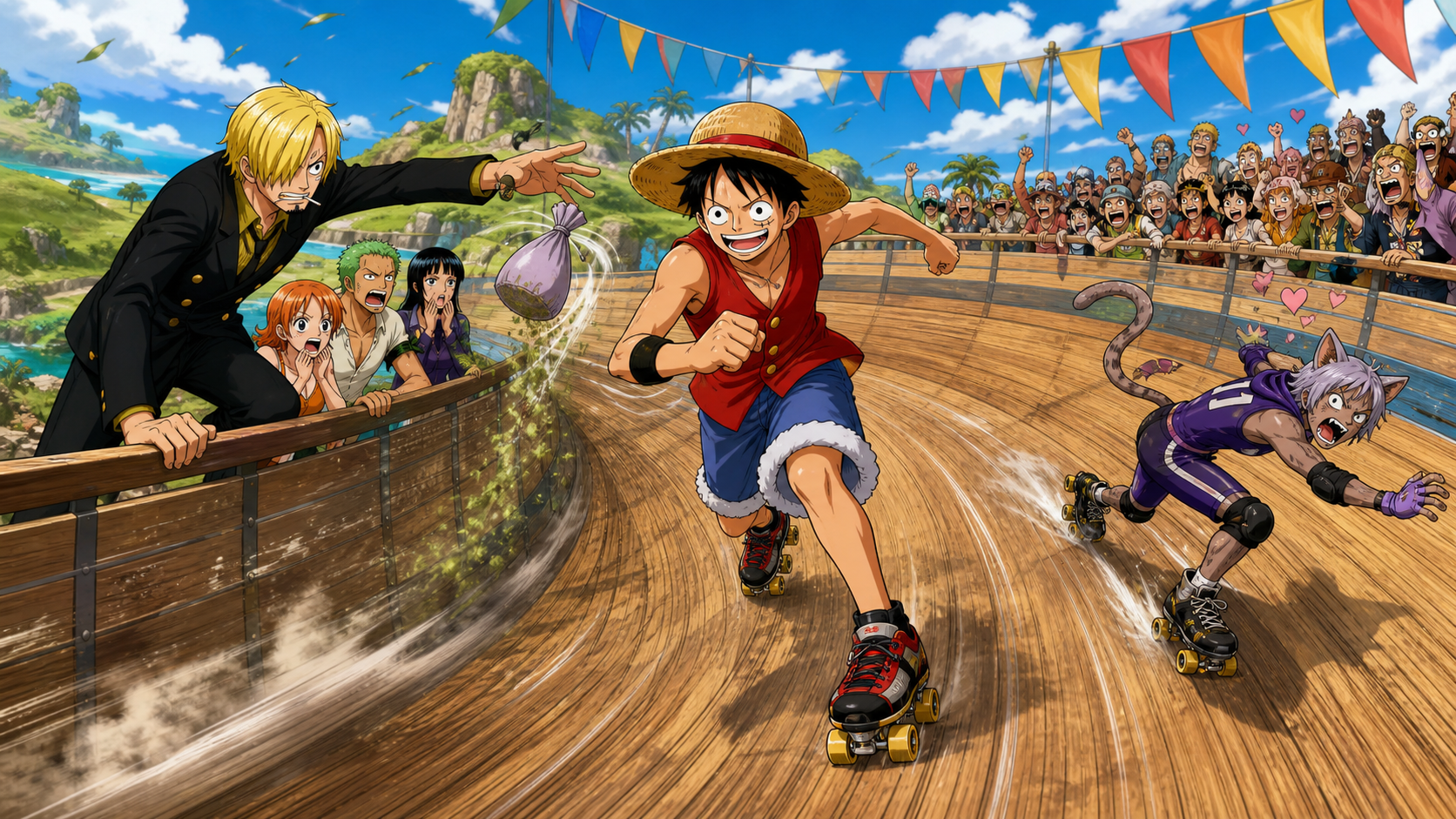
One Piece Episode 214 turns the roller race with Sanji’s catnip strategy, Luffy’s first successful balance, and a comeback Foxy did not plan for.
Bottom line
One Piece Episode 214 turns the Run Roller Round into a comeback story built on two things Foxy keeps underestimating: Sanji can think like a coach, and Luffy can learn after looking completely hopeless. The Foxy Pirates take the first two races, Chiqicheetah appears too fast to catch, and the Straw Hats are one loss away from giving the home team another victory. Sanji answers with catnip. Luffy answers by finally standing on his skates.
The episode is wonderfully ridiculous because the solutions fit the people. Sanji does not ask a slower racer to become faster through a speech. He studies the feline opponent and changes the course around that weakness. Luffy does not become elegant. He reaches the minimum level of competence needed to stay in the fight, celebrates like he conquered the Grand Line, and carries that tiny breakthrough into the final rounds.
First watch: Sanji brought strategy to a circus
The Straw Hats enter the third race down two rounds in a best-of-five contest. Foxy’s team has speed, experience, and the psychological advantage of watching Luffy fail to stand. Sanji refuses to treat that scoreboard like a prophecy.
His catnip plan is silly enough for the setting and specific enough to count as real analysis. Chiqicheetah’s feline traits create a vulnerability that raw skating speed cannot protect. Sanji sees the opening, prepares the distraction, and trusts the racer to use the new lane.
Two losses force the crew to stop improvising blindly
The early rounds punish the Straw Hats for learning during competition. They cannot keep assuming superior individual strength will erase practiced skating, track familiarity, and Foxy’s interference. Two losses make the cost visible on the board.
That pressure improves the episode. A comeback means more when the team has to identify why they are losing. The answer is not bad luck. Foxy’s racers understand the event, while the Straw Hats have been trying to survive each new problem after the starting signal.
Chiqicheetah is fast enough to make panic reasonable
Chiqicheetah’s speed changes the race from a normal pursuit into damage control. The Straw Hats cannot plan around a clean pass if the rival disappears down the track before their racer settles into rhythm.
That gap also protects Foxy’s broader scam. When the home racer looks overwhelmingly gifted, biased conditions become easier to ignore. Fans can point at speed and pretend the surrounding advantages had nothing to do with the result.
Sanji studies the opponent instead of worshipping the scoreboard
Sanji recognizes that Chiqicheetah is not only a fast skater. The racer has feline instincts, and instincts can redirect attention faster than a shouted instruction. Catnip attacks the decision behind the movement rather than the movement itself.
I appreciate that Sanji does not call the tactic noble. Foxy’s crew has spent the entire event using hidden interference, crooked calls, and conditions designed for them. A legal distraction based on observation is mild by comparison.
The catnip plan is funny because the logic is sound
A weak comedy plan asks the audience to accept random nonsense because the scene wants a laugh. Sanji’s plan follows the world already on screen. Chiqicheetah has obvious cat traits. Catnip attracts cats. The rival’s greatest strength becomes useless when aimed away from the finish.
The joke grows from tactical clarity. Everybody can understand the plan before the result, which lets anticipation carry the comedy. We watch a supposedly unbeatable racer speed directly toward the wrong objective.
Coaching gives Sanji a different kind of authority
Sanji often leads through protection, cooking, or direct combat. Coaching asks him to stay outside the race, read another person’s strengths, and change the conditions without taking the finish for himself.
That role suits his practical intelligence. A professional kitchen runs on timing, division of labor, observation, and correction under pressure. Sanji brings the same instincts to the track, minus the knives and plus one deeply confused cat racer.
The racer still has to use the opening
Catnip does not carry a Straw Hat across the line. The plan removes Chiqicheetah from the best path, but the crew still needs a racer ready to move through the space. Strategy creates opportunity. Execution turns opportunity into a point.
That balance keeps Sanji’s plan from becoming a magic trick. The comeback belongs to the coach and the competitor. One sees the weakness. The other refuses to waste the gift.
Foxy hates being beaten inside his own kind of game
Foxy treats deception as clever when his crew benefits. The same man takes every countermeasure as a personal insult. His outrage exposes a familiar double standard: tricks are tradition when power uses them and cheating when the target learns to answer.
The Straw Hats do not need his approval. They need to understand that the Davy Back Fight’s stated honor has always been conditional. Foxy respects rules only when rules preserve his advantage.
The crowd discovers that speed can look very stupid
Chiqicheetah’s speed initially produces awe. The catnip turn converts the same speed into a public mistake. The faster the racer moves in the wrong direction, the more complete the reversal becomes.
That visual gag also punctures Foxy’s performance of inevitability. His crew wants every event to look like proof of superior destiny. One pouch reminds the audience that talent without discipline can sprint away from the actual goal.
Luffy standing up should not feel this triumphant
Luffy finally balances on roller skates after spending Episode 213 as a danger to himself and everyone nearby. The achievement is basic. The celebration is enormous. I still cheered because the story showed the struggle instead of skipping from incompetence to mastery.
Progress does not need to look impressive from the outside. For Luffy, standing means the track has stopped controlling every part of his body. He can finally decide where the next movement begins.
Confidence becomes useful after practice joins the conversation
Luffy never lacked belief. His first falls proved belief alone could not control wheels. Repetition gives his confidence something solid to work with.
The episode does not punish optimism. The episode gives optimism a job. Luffy keeps trying long enough for his body to understand the equipment, then his usual fearlessness can push that new skill forward.
The crew celebrates a small win because they know the cost
Nami, Usopp, Chopper, Robin, Zoro, and Sanji have watched Luffy hit the track, wobble, and threaten the plan. Standing upright changes the final-round calculation for everyone.
Their relief is affectionate and practical at once. They love their captain. They also desperately need their captain to remain vertical. One cheer can hold both emotions without turning into a speech about friendship.
Chopper gets to worry from the right side again
Chopper’s presence among the Straw Hats continues to matter after his rescue. He reacts to Luffy’s progress as a member of the crew, not as property displayed behind Foxy’s boundary. The difference is quiet but important.
His return also reminds viewers why the next points matter. Another loss could reopen the same wound or cost another piece of the crew. Every silly skate carries a threat the bright uniforms cannot completely hide.
Nami can finally plan with a moving captain
A Luffy who cannot stand is a fixed obstacle. A Luffy who can move becomes an unpredictable asset. Nami does not need elegance from him. She needs enough control to place his strength, rubber body, and refusal to quit inside the team plan.
That shift expands the available choices for the final rounds. The Straw Hats remain inexperienced, but they are no longer building every strategy around preventing their captain from falling before contact.
Usopp understands the scale of the breakthrough
Usopp knows the gap between owning equipment and using equipment under pressure. He has built tools, watched inventions fail, and survived because adjustments happened before the next attack.
Luffy’s upright stance therefore deserves more than a laugh from him. The captain has crossed the first technical threshold. Usopp can now imagine a plan that includes motion instead of rescue.
Robin’s calm faith receives evidence
Robin watched Luffy’s early failure without joining the loudest panic. His eventual balance rewards that patience, but her confidence was never passive. She understood that the crew often needs time to transform disorder into a usable pattern.
Her reaction keeps the comeback grounded. Luffy has learned one skill, not mastered an entire sport. Robin can appreciate the change without confusing a first step with a guaranteed win.
The final round arrives with momentum still contested
Sanji’s plan prevents a sweep and Luffy’s progress changes the mood, but Foxy’s team still owns experience and home advantage. The comeback opens the contest rather than settling the result.
That uncertainty is the correct place to end the episode’s main movement. The Straw Hats have earned hope. They have not earned permission to relax.
The animation sells speed through direction
The banked track lets the episode turn bodies into moving lines. Chiqicheetah’s acceleration, the sudden course deviation, and Luffy’s unstable posture all communicate direction before dialogue explains the tactic.
The most important visual contrast sits between controlled speed and uncontrolled speed. Sanji wins a round by changing where speed goes. Luffy improves by changing whether his own body can choose a direction.
Production notes
Episode 214 aired in Japan on December 19, 2004. Hirohiko Uesaka wrote the script, Hiroyuki Kakudo directed the episode, Noboru Koizumi served as animation director, and Miyuki Sato with Kunihiro Chida handled the art. The official ONE PIECE guide confirms that the Straw Hats enter the third round after losing twice, Sanji uses a catnip strategy against Chiqicheetah, and Luffy finally succeeds in standing on his skates.
The production team understands that a middle chapter needs more than additional laps. The episode gives the race a tactical reversal, a character breakthrough, and a clear push toward the final rounds.
What the episode gets right
Episode 214 makes adaptation visible. Sanji changes the matchup through observation. Luffy changes his own usefulness through practice. The crew’s hope returns because specific problems receive specific answers.
The comedy never requires the characters to become foolish strangers. Sanji’s trick fits his intelligence, Luffy’s celebration fits his emotional scale, and Foxy’s anger fits a man who considers fairness an attack whenever fairness reaches him.
What still bothers me
The Davy Back Fight continues to use bright sports imagery around stakes that involve forced membership. A comeback can make the contest exciting without making the underlying bargain acceptable.
Foxy’s repeated home advantages also risk becoming predictable. The strongest moments come when the Straw Hats solve a defined skill problem, as Sanji does here, rather than merely surviving another unseen trick.
Best character beat
Sanji choosing catnip wins because the plan is observant, petty, and effective. He does not waste time complaining that Chiqicheetah is faster. He asks what can make that speed irrelevant.
Luffy standing provides the emotional runner-up. The captain celebrates a beginner’s milestone with complete sincerity, and the crew lets that milestone matter because they saw every ugly attempt that came first.
RaeRae verdict
Episode 214 gives the roller race the tactical personality Episode 213 promised. Sanji coaches instead of grandstanding, Luffy earns progress instead of receiving a convenient skill upgrade, and Foxy’s polished advantage begins to crack.
The lesson is not that anybody can win by believing. The episode shows something better. Watch the opponent, use the people you actually have, practice the skill everybody assumed would appear by magic, and throw catnip when a cat man refuses to leave the racing line.
Official source
ONE PIECE.com Episode 214 guide
Winning on Skates Still Counts
Sanji using catnip against Pickles sounds ridiculous because the Groggy Ring is ridiculous by design. The smart part is that Sanji reads the opponent instead of pretending raw strength solves every problem. Luffy finally standing on skates delivers the same lesson from the opposite direction. Balance comes late, panic comes first, and the captain still finds a way to contribute. RaeRae verdict: Episode 214 turns slapstick into teamwork. Nobody looks elegant, but the crew adapts fast enough to keep the game from stealing another friend.