RaeRae Reacts · One Piece Episode 213
Luffy Cannot Stand Up on Roller Skates
One Piece Episode 213 puts Luffy on roller skates, leaves the Straw Hats one racer short, and proves that confidence cannot replace balance.
Bottom line
One Piece Episode 213 gives Luffy a problem that punching cannot solve: roller skates. The captain who throws himself at warlords, sea monsters, and impossible odds cannot stand upright on eight little wheels. That weakness would be funny by itself, but the Run Roller Round turns Luffy’s missing skill into a crew-wide tactical emergency because the Straw Hats are still one player short.
The episode works because confidence and competence are finally separated. Luffy believes he can race before his feet have offered any evidence. Nami, Usopp, Robin, Chopper, Zoro, and Sanji have to build a team around the reality in front of them, not the captain they wish they had. Foxy’s crew arrives with practice, numbers, and another event designed around home advantage. The Straw Hats arrive with stubbornness, improvisation, and one human projectile wearing skates.
First watch: somebody please teach the captain how wheels work
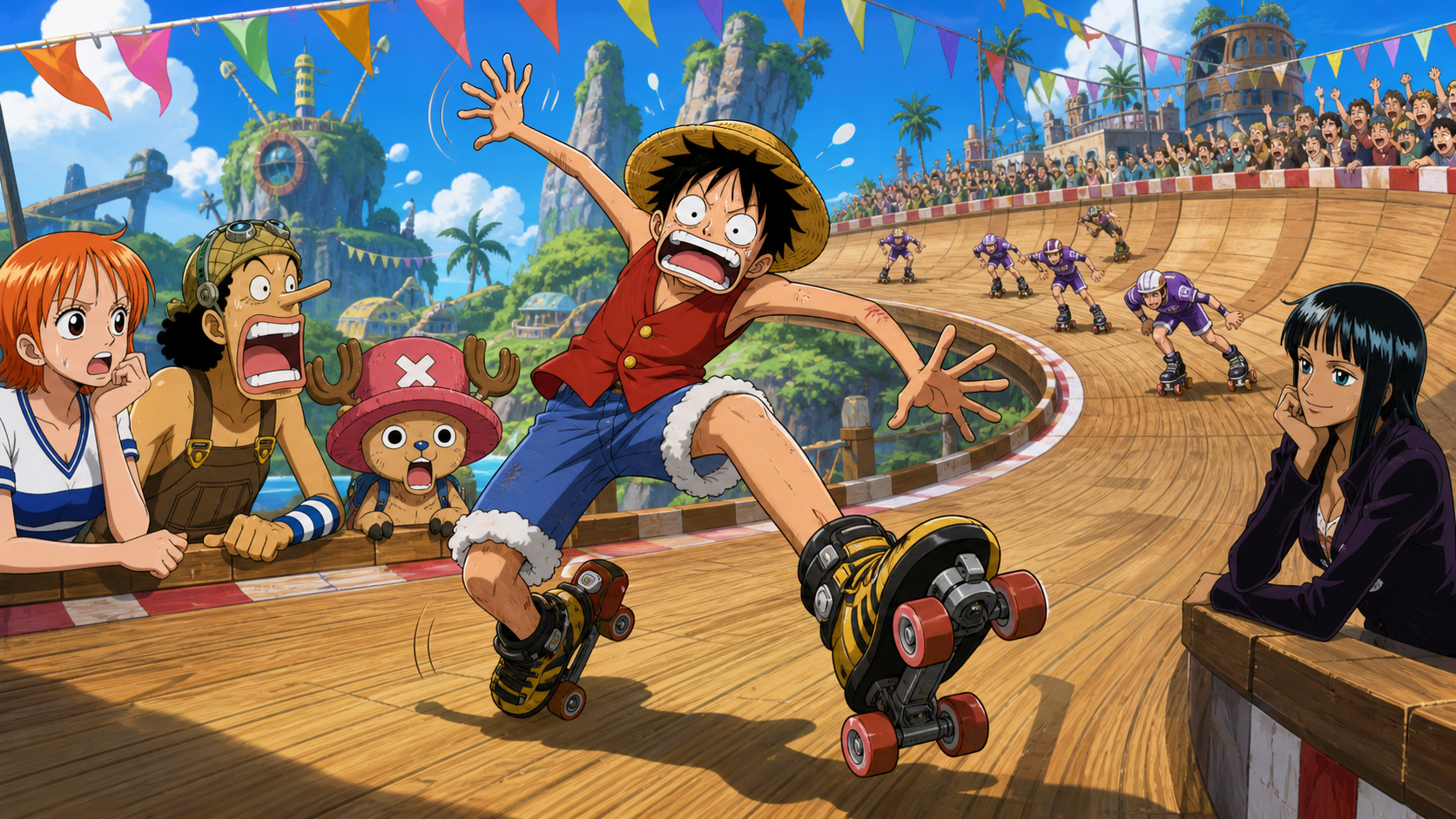
Luffy’s first attempt to stand answers the main tactical question immediately. He cannot balance, push, stop, or turn. His body has survived falls that would kill ordinary people, so fear is not the problem. The basic mechanics simply refuse to cooperate with him.
I laughed, then remembered he has to race twice. Chopper’s temporary removal leaves the Straw Hat Danger team short-handed, and the rules demand another appearance from one racer. Luffy volunteers with the certainty of a man who hears “twice” and imagines twice the fun. Everybody else hears twice the opportunity for disaster.
The Run Roller Round changes the kind of fight
The third contest uses a banked oval track, roller skates, relay-style participation, and several rounds with different matchups. Raw strength can help with blocking or acceleration, but balance, cornering, drafting, handoffs, and team placement decide who can use that strength.
That design gives Foxy another field where preparation matters. His pirates know the equipment and the course. The Straw Hats are learning rules while standing at the starting line. A neutral competition would provide practice time. A Foxy competition treats unfamiliarity as part of the trap.
Chopper’s absence keeps changing every game
Winning Chopper back in Groggy Ring repairs the emotional wound, but the Davy Back structure still carries consequences forward. The crew entered the event with a missing member, and the roster problem shapes the roller race before Chopper can fully settle back into his place.
Foxy’s first stolen victory therefore reaches beyond one tearful transfer. Every contest changes the conditions of the next contest. That compounding advantage is why the whole event feels less like playful piracy and more like a recruitment machine built to keep winners winning.
Luffy volunteers before understanding the assignment
Luffy sees an open role and steps forward because captains should carry extra weight. The instinct is generous. The decision-making remains pure Luffy: commitment arrives before information, preparation, or proof.
His crew knows this pattern. Luffy will accept pain, embarrassment, and impossible responsibility without hesitation. He will also create three new problems while solving the first. Leadership through courage can move people. Leadership without self-knowledge can make everybody else perform emergency math.
Nami starts managing the actual person in front of her
Nami cannot plan around a fantasy version of Luffy who suddenly becomes an expert skater. She has to account for his terrible balance, his refusal to quit, the rival team’s experience, and the fixed roster. Her tactical value begins with accepting bad news quickly.
That practical intelligence keeps the Straw Hats alive across the series. Nami rarely receives the luxury of perfect resources. She works with a captain who stretches, a swordsman who gets lost, a cook who can be distracted, and an inventor who may panic before becoming brilliant. Planning means using those people as they are.
Usopp understands that equipment can humble anybody
Usopp approaches unfamiliar tools with more respect because tools are central to his fighting style. He knows confidence cannot replace testing. A weapon, vehicle, dial, or pair of skates has rules, and ignoring those rules usually hurts the person holding the equipment.
His alarm around Luffy carries both comedy and experience. Usopp has watched the captain turn simple objects into hazards before. The sensible response is not to tell Luffy to believe harder. The sensible response is to find a way for Luffy’s chaos to land somewhere useful.
Robin watches the circus without mistaking chaos for failure
Robin’s calm provides a useful contrast to the louder panic. She does not assume Luffy’s first fall predicts the entire outcome. She watches how people move, how the course works, and where the rival team expects control.
Her confidence feels different from Luffy’s. Luffy trusts desire. Robin trusts observation and the crew’s history of turning terrible beginnings into workable plans. Both forms of faith matter, but only one has examined the wheels.
Zoro and Sanji have already proved the important point
The previous round established that Zoro and Sanji can cooperate when Chopper’s place is threatened. Episode 213 does not need to repeat the five-second truce as another emotional revelation. Their proven reliability now becomes part of the team’s available strength.
They still bicker because the rivalry remains alive. The difference is that nobody has to wonder whether either man will sabotage the crew forever. When the race demands effort, both will move. The question concerns method, not loyalty.
Roller skates expose Luffy’s relationship with control
Luffy fights through instinctive movement. His rubber body turns momentum, impact, and strange angles into advantages. Skates place a layer of equipment between intention and motion. The wheels keep carrying him after his brain has decided to stop.
That loss of immediate control frustrates him because the problem cannot be intimidated. Gravity does not care about his dream. Bearings do not respond to a captain’s declaration. He has to adjust his body to a system that will not adjust itself around him.
The comedy stays rooted in character
Luffy falling on skates is not random humiliation pasted into the episode. He rushes ahead, assumes enthusiasm will cover technique, and learns through impact. The joke comes from the same traits that make him heroic in a crisis.
Nami’s exasperation, Usopp’s panic, Robin’s composure, and Chopper’s concern also sound like these specific people. Nobody needs a generic reaction shot when the crew already contains six different ways to answer one wobbling captain.
Foxy keeps choosing games his crew has rehearsed
Every event arrives with a home team that understands the format. Foxy’s pirates know the course, the officiating culture, the loopholes, and the ways a crowd can hide interference. The visitors receive a quick explanation and a starting signal.
Foxy calls that arrangement tradition. I call that a man building the exam after reading his own answer sheet. His victories may require skill, but the surrounding structure protects that skill from a fair comparison.
The purple uniforms sell organization
Foxy’s racers look like a coordinated unit before anyone moves. Matching gear, practiced positions, and a familiar course create the image of professionalism. The Straw Hats look like people who were handed skates during an argument.
Visual organization has power. A polished team can make a disorganized opponent feel defeated before the race. The Straw Hats survive that pressure because their bond does not depend on looking official.
A relay makes every weakness public
Individual races let a strong competitor hide a weaker teammate. A relay carries each person’s performance into the next person’s starting position. One bad turn, slow exchange, or fall becomes shared debt.
That structure fits the arc’s larger question about crew membership. Foxy treats people as collectible advantages. The Straw Hats treat weakness as a planning problem shared by everybody. Luffy’s poor skating belongs to Luffy, but managing the consequence belongs to the team.
Luffy racing twice is courage and bad roster management
The captain taking the extra slot sounds noble until the episode shows his feet. Courage does not automatically make him the best choice, but the remaining roster and event rules leave limited options. The crew cannot conjure another racer.
That tension keeps the choice from becoming a simple leadership lesson. Luffy accepts responsibility, yet responsibility also requires preparation. Showing up twice helps only if the second appearance learns something from the first.
Chopper’s return brings relief without restoring normal
Chopper is back among the people he chose, and his reactions carry the relief of that return. He can worry about Luffy as a crewmate instead of watching from behind Foxy’s line. The emotional distance created by the first round has closed.
The event has not returned to normal because normal never existed here. Foxy can still place the crew at risk through rules Luffy accepted. Chopper’s rescue is a victory inside a larger mistake, and the roller race keeps that mistake moving.
The episode understands the difference between fear and inability
Luffy is not afraid of skating. He wants to move and fully expects success. His body lacks the skill. Stories sometimes treat confidence as a magic solvent that removes every limitation, but Episode 213 lets physical incompetence remain real long enough to shape the contest.
That choice makes later improvement more satisfying. Learning requires a starting point. Luffy’s starting point is the floor.
The track gives the animators a different rhythm
A banked course creates continuous lateral motion, sharp perspective changes, and repeated passes in front of the crowd. The episode can build speed through curves rather than another exchange of punches on flat ground.
The skates also make balance visible. Knees, shoulders, arms, and wheel angles tell the audience who controls momentum. Luffy’s frantic posture communicates failure before dialogue explains anything.
The race begins before Luffy is ready
Foxy’s structure does not pause for a visitor to become competent. The countdown turns preparation into pressure and forces the crew to choose roles with incomplete information. Luffy learns while the result already matters.
That timing is another home advantage disguised as excitement. Fans get a faster spectacle. Foxy gets opponents who have no time to close the experience gap.
Production notes
Episode 213 aired in Japan on December 12, 2004. Hirohiko Uesaka wrote the script, Munehisa Sakai directed the episode, Takeo Ide served as animation director, and Miyuki Sato with Michiyo Kawasaki handled the art. The official ONE PIECE guide identifies the event as the Run Roller Round and confirms that Luffy must compete twice because the Straw Hat Danger team has one fewer participant.
The episode shifts from Groggy Ring’s heavy impacts to the rolling instability of a race. That change keeps the Davy Back Fight from becoming one repeated cheating gag with different costumes.
What the episode gets right
The setup gives every crew member a reason to matter. Nami plans, Usopp reads equipment and risk, Robin observes, Chopper reacts from a newly restored place, and the fighters have to translate strength into a race format. Luffy remains the center without swallowing every useful thought.
The comedy also preserves stakes. His falls are funny, but the roster shortage and Foxy’s practiced team make those falls expensive. The audience can laugh while understanding why everyone around him looks horrified.
What still bothers me
The arc continues to ask viewers to enjoy games whose stakes involve ownership of people and crew symbols. Chopper has just returned from a forced transfer, yet the event rolls directly into another bright spectacle. The tonal speed can make the harm feel easier to forget than Chopper’s history deserves.
Foxy’s cheating remains entertaining because the crew keeps resisting, but repeated rigging can flatten suspense if every rule exists only to reveal another trick. The race needs tactical surprises from both teams, not only another referee pretending not to see purple sleeves.
Best character beat
Luffy volunteering twice before proving he can stand captures the captain perfectly. He sees a burden and reaches for the burden. He also assumes his body will solve the details after the declaration.
The crew’s response completes the beat. Nobody doubts his loyalty. Everybody doubts his wheels. Love and exasperation occupy the same railing while Luffy tries not to fall.
RaeRae verdict
Episode 213 is a strong reset after the Groggy Ring payoff. The story trades bruising combat for unstable speed, gives the whole crew a tactical problem, and finds a fresh way to make Luffy’s greatest qualities inconvenient.
Confidence gets him onto the track. Confidence cannot teach balance. The Straw Hats have to carry both truths at once, which is basically life with Monkey D. Luffy in one ridiculous roller rink.