RaeRae Reacts · One Piece Episode 212
Zoro and Sanji Need Five Seconds to Win Chopper Back
One Piece Episode 212 gives Zoro and Sanji a five-second truce, a crooked referee, and one job that matters more than their pride: bring Chopper home.
Bottom line
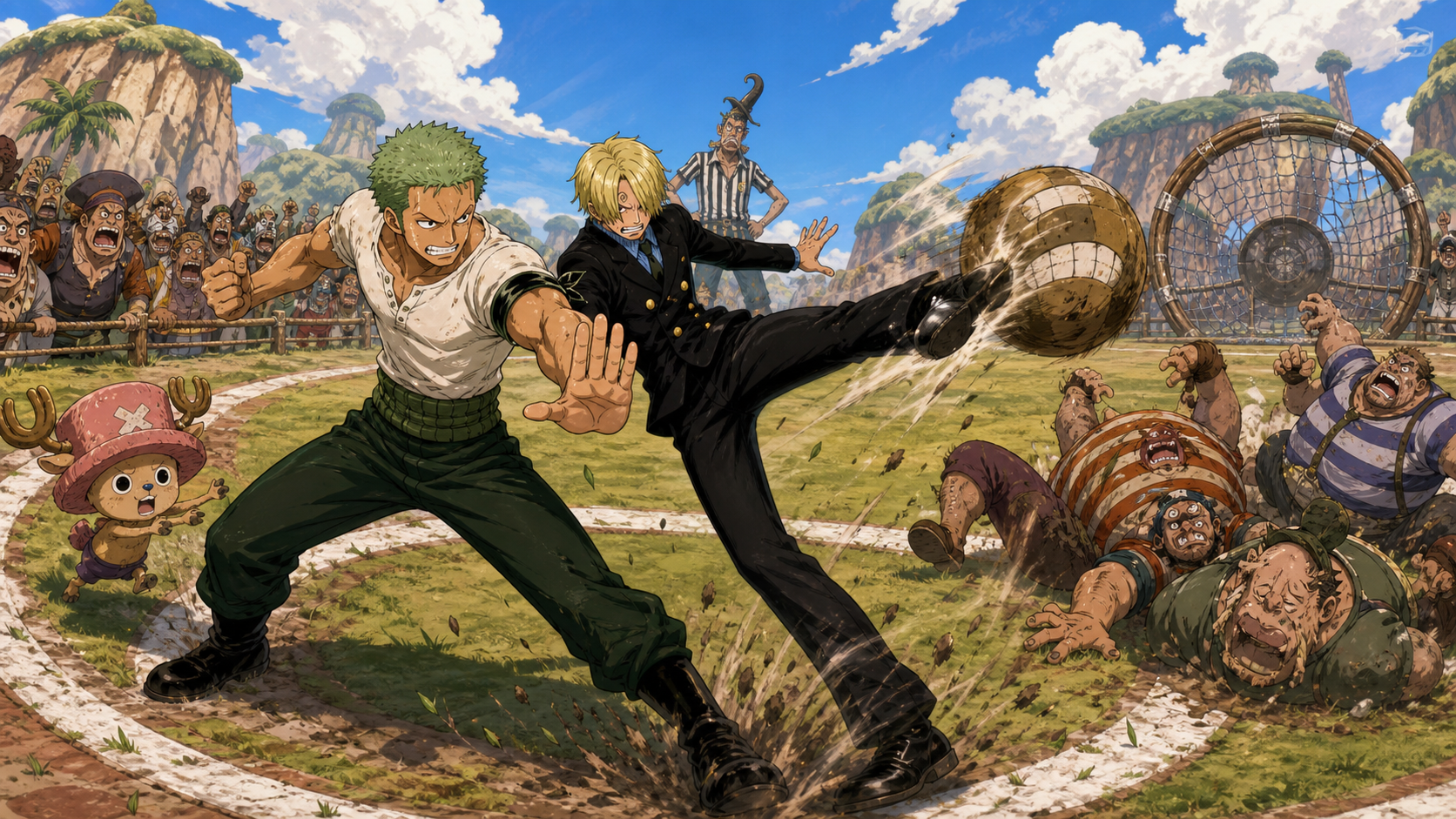
One Piece Episode 212 finally lets Zoro and Sanji do the obvious thing: stop fighting each other and use all that shared combat instinct against the people trying to keep Chopper. Their truce lasts five seconds. That tiny agreement is enough to wreck the Groggy Monsters, expose the referee as another Foxy weapon, and turn an ugly mismatch into a rescue.
I love the payoff because the episode does not suddenly rewrite their relationship. Zoro and Sanji do not hug, apologize, or discover friendship through sports. They recognize that Chopper matters more than their pride, make a brutally efficient plan, and return to insulting each other once the job is done. That is honest teamwork for these two.
First watch: five seconds was all I asked for
Episode 211 spent a lot of time proving that buried trust cannot run a formation by itself. Episode 212 cashes in that frustration. Zoro asks for five seconds, Sanji understands the assignment, and the entire match changes because both men finally point their strength in the same direction.
The short time limit makes the moment funnier and sharper. Neither man offers permanent peace. Five seconds feels almost insulting after Chopper has spent the round terrified on the opposing sideline, but the result proves how much damage their stubbornness caused. The Groggy Monsters never had an answer for the team the Straw Hats could have fielded from the opening whistle.
The referee is wearing Foxy colors without wearing the uniform
The Groggy Monsters openly bring weapons into a game that supposedly forbids weapons. The referee sees the equipment and chooses blindness. Every warning, penalty, and red card moves in one direction because officiating serves Foxy’s desired result rather than the written rules.
That distinction matters more than one bad call. A crooked system does not need to erase every rule. The people in charge can keep the rulebook, apply protections to friends, apply restrictions to opponents, and call the outcome fair. Foxy loves ceremony because ceremony gives theft a costume.
Red cards become another form of crowd control
The referee throws red cards so freely that punishment becomes part of the comedy. The joke lands because everybody can see the scam. Zoro and Sanji receive discipline for surviving attacks while the home team receives permission to escalate.
A red card normally protects a contest from dangerous play. Here, the card protects the dangerous players from meaningful resistance. The visual language of fairness remains intact while the purpose has been reversed. That is Foxy’s whole operation in miniature.
The Groggy Monsters stop pretending this is only a game
Hamburg, Pickles, and Big Pan already had size, practiced formations, and home-field protection. Pulling out weapons reveals how little confidence sits beneath the undefeated reputation. The trio does not simply want to score. They want to punish two visitors who refuse to collapse on schedule.
The escalation also answers any lingering argument that Zoro and Sanji should keep appealing to the rules. No neutral authority exists inside the ring. Survival and rescue depend on reading the real contest, not the contest Foxy announced.
Zoro does the least sentimental brave thing possible
Zoro proposes cooperation without dressing the decision in warm language. He knows their separate attacks are being absorbed, redirected, or interrupted. He also knows Sanji can follow a combat opening faster than a detailed plan can be explained.
That confidence is trust, even when Zoro would rather swallow a sword than call the feeling trust. He places his body and timing inside Sanji’s range with no fear that the cook will misunderstand the movement. Their mouths may stay hostile, but their instincts have years of shared danger behind them.
Sanji agrees because Chopper is still waiting
Sanji has plenty of reasons to reject an order from Zoro on principle. Chopper gives him a better reason to cooperate. The little doctor has already been treated like a prize, dressed in Foxy colors, and forced to watch his rescue become a public spectacle.
Sanji’s protective instinct finally becomes useful action instead of another excuse to argue. He does not need Zoro to ask politely. He needs the plan to work, and he trusts the swordsman’s judgment enough to move when the opening arrives.
Five seconds reveals years of unspoken practice
Their coordination looks immediate because neither man starts from zero. They have watched each other fight across islands, ships, streets, and impossible battlefields. Zoro knows the reach and rhythm of Sanji’s kicks. Sanji knows how Zoro plants his weight and forces an opponent into a bad line.
That history turns five seconds into a believable deadline. A new partnership would need instructions. Zoro and Sanji need permission to stop resisting what they already know about each other.
The combination attack respects both fighting styles
The winning sequence does not reduce one man to an assistant. Zoro supplies force, placement, and an immovable center. Sanji supplies speed, redirection, and the kick that converts an opponent’s mass into momentum. Their strengths connect without becoming identical.
Good team action should preserve character. The scene works because Zoro still fights like Zoro and Sanji still fights like Sanji. Cooperation adds possibilities instead of sanding away the differences that make the rivalry entertaining.
Big Pan’s size becomes the Foxy team’s problem
Big Pan dominated the field when the Groggy Monsters controlled his direction. Once Zoro and Sanji break that formation, his enormous body becomes difficult for his own teammates to manage. Weight is power only when somebody can aim the weight.
The reversal is satisfying because the Straw Hats do not magically become larger. They understand leverage, timing, and each other. The same mismatch that looked hopeless becomes a tool when the two-man team stops attacking the problem from separate angles.
Hamburg and Pickles lose the formation before they lose the fight
Hamburg and Pickles are dangerous when they can support Big Pan and keep the Straw Hats divided. The five-second truce breaks those roles. Once the formation collapses, their individual strength cannot restore the old advantage quickly enough.
That is the tactical payoff Episode 211 prepared. The Groggy Monsters were undefeated because they operated as a unit. Zoro and Sanji win when they become the better unit for one decisive stretch.
Knocking out the referee feels completely earned
Normally, attacking an official would destroy any claim to victory. This referee abandoned that protection when he became an active participant in Foxy’s cheating. He ignores weapons, invents violations, and uses authority to hold the Straw Hats still for punishment.
The knockout works as slapstick and accountability. Zoro and Sanji cannot file an appeal with a neutral league after the match. Removing the crooked official is the only available way to stop authority from helping the assault.
The crowd goes quiet when the script breaks
Foxy’s audience knows how these games are supposed to end. The visitors struggle, the home team performs dominance, and another person or symbol joins the Foxy Pirates. Zoro and Sanji ruin that familiar script in seconds.
The shock around the ring exposes how much confidence depended on repetition. Foxy’s crew mistook a long winning pattern for a natural law. The Straw Hats remind everybody that a rigged tradition can still fail when the targets refuse their assigned roles.
Chopper gets to see the choice behind the promise
Luffy promised to win Chopper back, but Zoro and Sanji have to carry the promise inside this round. Their cooperation tells Chopper that his place on the Sunny’s predecessor, the Going Merry, is not a captain’s speech without support. Other crewmates will change their behavior to bring him home.
That evidence matters for somebody with Chopper’s history. He has been feared, rejected, and treated as an oddity. The rescue does not depend on his medical usefulness. His family fights because Chopper belongs with them.
Chosen family becomes a verb again
One Piece talks about chosen family often, but the strongest episodes make belonging visible through labor and risk. Zoro and Sanji absorb hits, swallow pride, coordinate under pressure, and finish a job neither could finish alone.
The action keeps the theme from becoming a greeting-card line. Family does not mean everybody behaves sweetly. Family means the argument stops when a vulnerable member needs both people to show up.
Luffy celebrates without pretending the danger was harmless
Luffy’s confidence never seriously wavers, and the win validates his belief in the crew. The captain still helped create this crisis by accepting the Davy Back Fight terms. Victory restores Chopper without erasing the cost of the gamble.
That tension is useful. Luffy’s faith can be beautiful and reckless in the same story. One Piece works best when his certainty inspires action while the consequences remain visible around him.
Nami and Robin were right about the real problem
Nami and Robin recognized that the match demanded coordination long before the men acted. Their sideline analysis was not background commentary. Both women identified the exact failure: Zoro and Sanji were fighting opponents while also refusing the structure that could beat them.
The five-second turnaround proves the diagnosis. More strength was never the missing ingredient. The missing ingredient was cooperation, which is irritatingly obvious and therefore perfect for these two men.
Usopp gets the relief after helplessness
Usopp could contribute directly during the Donut Race. Groggy Ring forced him outside the boundary with Chopper’s future at stake. Watching Zoro and Sanji finally connect gives him the release of a crew member who has been shouting the answer with no power to enter the field.
His reaction helps the victory feel communal. Two men score, but the entire crew has carried the fear of losing Chopper since Foxy announced his choice.
The episode earns the comedy after the tension
Zoro and Sanji returning to their normal hostility works because the cooperation already happened. The episode does not need a sentimental conversation to prove growth. Their actions said enough, and the immediate bickering preserves the personality that made the team-up satisfying.
The comedy also stops the scene from claiming their rivalry has been solved. Nothing has been solved. They simply established a reliable truth: when the crew needs both of them, the rivalry can be put down long enough to win.
Production notes
Episode 212 aired in Japan on December 5, 2004. Junki Takegami wrote the script, Katsumi Tokoro directed the episode, Naoki Tate served as animation director, and Miyuki Sato with Kumiko Fukuzawa handled the art. The episode adapts material connected to One Piece Volume 33 and the Davy Back Fight story.
The direction understands that the payoff has to feel faster than the stalemate. Once the truce begins, movement replaces argument. The sudden efficiency is the joke, the action reward, and the character point at the same time.
What the episode gets right
The episode gives the rivalry a consequence before giving fans the team-up. Zoro and Sanji are funny together because their insults sit beside undeniable competence. Letting the rivalry actively endanger Chopper prevents the gag from floating outside the story.
The payoff also avoids false emotional polish. They do not explain their bond. They demonstrate knowledge of each other’s timing under pressure, save their crewmate, and move on before either man has to admit what happened.
What still bothers me
Chopper remains the emotional price of Luffy’s wager, and the round cannot completely erase that discomfort. The Davy Back Fight treats people as transferable property for comedy, while Chopper’s fear comes from a history that makes forced belonging especially cruel.
The rescue is satisfying because the crew refuses Foxy’s claim. I still want the story to remember that Chopper never consented to becoming the stake. A happy return does not make the original gamble wise.
Best character beat
Zoro asking for five seconds wins. The request is small, practical, and loaded with everything he refuses to say. He believes Sanji can read the plan, match his timing, survive the contact, and finish the rescue.
Sanji’s immediate acceptance completes the beat. The cook does not need reassurance or a rehearsal. Chopper is waiting, so the argument can wait too.
RaeRae verdict
Episode 212 turns one of the crew’s loudest rivalries into a rescue tool without making the relationship soft or simple. The cheating is shameless, the referee deserves the knockout, and the five-second truce delivers exactly the kind of character-specific teamwork One Piece does best.
Zoro and Sanji do not win because friendship gives them a sudden power boost. They win because years of watching, fighting beside, and trusting each other become usable the second both men stop wasting energy on pride. Chopper comes home because two stubborn fools finally remember which fight matters.