RaeRae Reacts · One Piece Episode 215
Luffy Swallows the Dodgeball and Loses
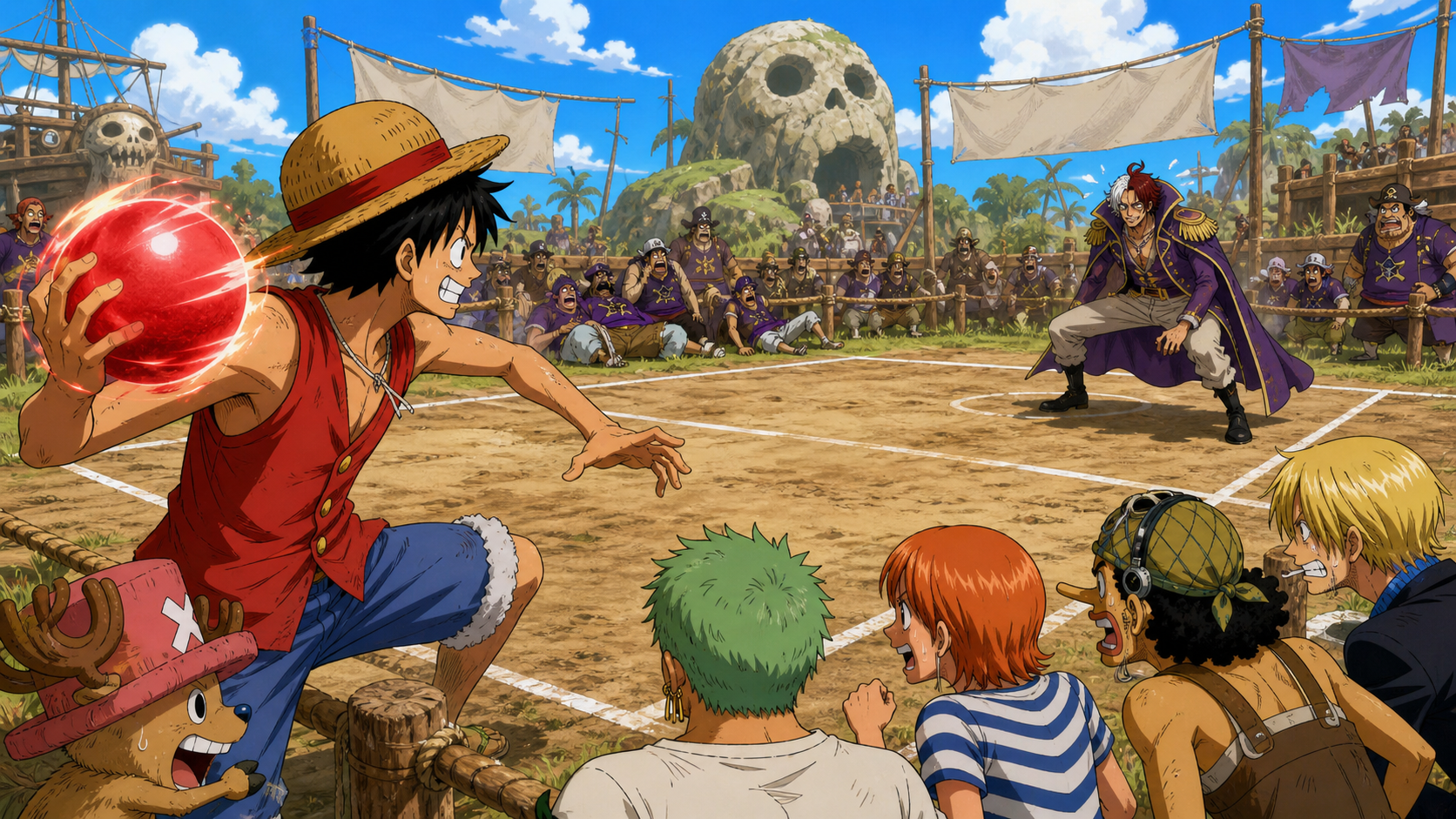
One Piece Episode 215 sends the Straw Hats into pirate dodgeball, lets Chopper save Luffy, and punishes the captain with the strangest rule in the book.
Bottom line
One Piece Episode 215 proves that Luffy can rescue Chopper and learn absolutely nothing about gambling with his crew. Foxy demands a three-coin rematch, Luffy accepts before the relief from the first set has settled, and the Straw Hats walk directly into Hit and Dead Ball. The dodgeball match looks fairer than the earlier events because a referee change and severe penalties limit obvious interference. Then the rulebook reveals a loophole for every breath anybody takes.
The episode is funny, fast, and maddening in the right places. Zoro and Sanji eliminate eighteen opponents, Big Pan wipes out twenty-two members of his own side, Chopper saves Luffy with his face, and Luffy loses by swallowing the final ball. That ending sounds like nonsense because the entire match is organized nonsense. Foxy wins after his army shrinks to one man, and Luffy’s original decision remains the reason another crew member can now be taken.
First watch: Luffy, we just got Chopper back
Foxy cannot accept a draw in pride, so he offers another three-coin game. Luffy hears a challenge and agrees. Nami and Usopp hear the sound of their own names entering a prize pool.
I understand Luffy’s competitive instinct. I do not excuse the decision. Chopper spent the first set crying in Foxy’s uniform because Luffy accepted rules that allowed people to be transferred. Winning Chopper back should have ended the experiment, not encouraged another wager.
A captain cannot volunteer everybody else’s freedom
Luffy can risk his own body whenever he wants. The Davy Back Fight risks crew membership, the flag, and the relationships everybody built together. Those are shared assets and shared lives.
His confidence in the Straw Hats does not replace consent. Trusting friends to win is beautiful during a crisis they chose together. Creating a new crisis on their behalf is reckless leadership wearing a smile.
Robin and Sanji search for a reason that makes sense
Robin and Sanji wonder whether Luffy wants a shipwright from Foxy’s crew. That possibility gives the rematch a strategic shape. The Going Merry needs help, and Luffy has already heard the crew discuss repair limits.
Even a useful goal would not repair the method. Recruiting a shipwright through forced transfer repeats the logic that hurt Chopper. The crew needs skilled help, but another person’s freedom cannot become a shortcut around an honest invitation.
Nami and Usopp know exactly who looks stealable
Nami and Usopp panic because Foxy chooses useful people. Nami navigates. Usopp shoots, invents, repairs, and lies convincingly when survival needs theater. Both know they could become attractive prizes.
Their fear lands as comedy while exposing the rematch’s cruelty. They have to calculate whether a rival captain values them enough to separate them from home. Nobody should need that thought because Luffy enjoys a challenge.
Hit and Dead Ball brings an ancient rulebook to a playground fight
The first rematch event is a pirate dodgeball game where a team loses after every player is eliminated. The long history has produced layers of rules, exceptions, legal weapons, boundary restrictions, and ways a hit can fail to count.
Nami assumes Foxy wrote every clause for himself. The swapped officials and severe penalties create more genuine enforcement than earlier rounds, but fairness becomes difficult when nobody can remember the full rulebook until a strange situation occurs.
Equal enforcement does not guarantee understandable rules
A neutral referee improves the match. Both teams can still suffer under rules nobody reasonably learned before play. Foxy’s crew has years of experience with those exceptions. The Straw Hats hear each clause after somebody has already been hit.
That knowledge gap acts like another home advantage. A rule can be applied equally and still favor the people who built their tactics around the rule for years.
Luffy and Chopper win the opening jump through nerve
Luffy and Chopper face two opposing starters, evade the first attacks, seize the balls, and immediately target Foxy. Their coordination is simple and effective because both understand the real danger sits behind the larger roster.
The opening also restores Chopper as an active teammate. He is not a worried prize on the sideline. He moves beside his captain and helps attack the man who tried to claim him.
A ball to Foxy’s face somehow counts as safe
Luffy and Chopper hit Foxy directly in the face, which feels like the cleanest possible elimination. The referee declares him safe because face hits do not count. Of course that clause exists.
The moment teaches the Straw Hats what kind of match they entered. Common playground logic will not save them. Every apparent success needs confirmation from a rulebook thick enough to become its own weapon.
Zoro and Sanji eliminate eighteen people without a truce ceremony
Zoro and Sanji receive the balls and remove eighteen Foxy players. Their efficiency continues the lesson from Groggy Ring: both men can aim their aggression away from each other when the crew needs results.
No emotional announcement is required. They understand force, timing, and crowded battlefields. Dodgeball gives them legal targets and permission to hit those targets very hard.
Luffy removes ten more because subtlety has left the court
Luffy takes another turn and eliminates ten opponents. Foxy’s numerical advantage begins collapsing under the simple fact that the Straw Hats fight enemies in groups all the time.
The mass elimination is satisfying while increasing the danger of complacency. Foxy’s crew rarely needs every player to be competent. The crowd, hidden tools, and rulebook can protect the final survivors after the obvious bodies are gone.
Big Pan becomes friendly fire with legs
Big Pan gains control of both balls and manages to eliminate Usopp along with twenty-two members of the Foxy team. His enormous power does not distinguish between useful force and catastrophic aim.
The sequence is hilarious because Foxy’s numerical advantage destroys itself. A huge roster creates more targets for a reckless teammate. Quantity becomes liability when nobody controls the throw.
Usopp pays for standing near somebody else’s mistake
Usopp’s elimination gets buried under the scale of Big Pan’s friendly fire. He still loses his place because one giant opponent cannot manage his own strength.
That is an annoying truth about team games. A player can make reasonable choices and still absorb the consequence of chaos created by somebody else. Usopp knows that lesson better than most Straw Hats.
Robin gets Hamburg out and forces the referee to do the job
Robin eliminates Hamburg, but an official initially tries to call the result safe. Correction and reprimand follow, showing that this event has some mechanism for holding a referee accountable.
The brief dispute matters after the shameless Groggy Ring officiating. Rules remain absurd, but enforcement cannot simply bend without consequence. Robin makes the correct play and refuses to let authority erase the result.
Sanji loses to women before Foxy has to beat him
Several women trick Sanji into surrendering the ball and then eliminate him. His weakness around women remains predictable enough to become formal team strategy.
I can laugh and still be irritated. Sanji knows the crew is being wagered. He knows Foxy exploits every opening. His refusal to defend himself around women stops being a private quirk when teammates carry the cost.
The Dead Hit cannon is legal because the rulebook says so
Foxy reveals the Dead Hit cannon, a weapon explicitly permitted in a game that otherwise resembles dodgeball. Robin confirms the exception. The absurdity is official rather than hidden.
This is how Foxy prefers power. He wants the weapon written into tradition so nobody can call the advantage cheating. A legal cannon can still make a contest ridiculous.
Zoro cuts the ball and loses to the clause
Porche and Foxy try to deceive Zoro. He answers by cutting the incoming ball with his bare hands. The defensive move works physically and fails legally because cutting a ball causes disqualification.
Zoro solves the threat according to combat logic. The match punishes him for forgetting that preserving the equipment matters more than proving he can destroy the attack.
Chopper uses his face to protect Luffy
A thrown ball rebounds toward Luffy, and Chopper moves into the path. Face hits are safe, so the block should preserve him. The crowd even supports the little doctor after seeing the courage behind the choice.
Then the boundary claims him. Chopper stepped out of bounds during the save, which means elimination. His action still protects Luffy and keeps the captain alive for the final exchange.
Chopper’s courage feels different after the first game
Earlier, Chopper needed the crew to prove he belonged. Here, he chooses risk for the crew with no hesitation. The forced Foxy uniform did not weaken his identity. The rescue strengthened his confidence in that identity.
His sacrifice also carries an uncomfortable echo. Luffy is back in danger because he accepted another wager. Chopper saves the captain from a consequence the captain voluntarily reopened.
Porche turns the crowd into a shell game
Porche steals the live ball during Luffy’s stretched throw and mixes the real ball among decoys held by spectators. The court boundary no longer contains the tactic. Foxy’s whole audience becomes part of the deception.
Luffy cannot identify the legal threat, so he tries to catch everything. The response fits him: if information fails, expand the body and take the entire problem at once.
Swallowing the ball is exactly how Luffy would lose
Nami tells Luffy to let Foxy’s throw hit his face because his arms are full. He catches the ball in his mouth and swallows. The rulebook forbids swallowing balls, and the clause is real.
No grand villain attack defeats him. Appetite, instinct, and a refusal to let anything pass combine into disqualification. The loss is infuriatingly fair within an event built from absurd rules.
Foxy wins after almost everybody else is gone
The Straw Hats reduce Foxy’s army to the captain, survive the cannon, and answer the crowd’s deception. Foxy still takes the point because the final legal mistake belongs to Luffy.
That outcome explains why Foxy loves these games. He does not need to dominate every exchange. He needs to know the last exception better than the opponent.
Production notes
Episode 215 aired in Japan on January 9, 2005. Hirohiko Uesaka wrote the script, Masaru Koyama directed the episode, Kazuya Hisada served as animation director, and Miyuki Sato with Kumiko Fukuzawa handled the art. The official ONE PIECE guide identifies Hit and Dead Ball as the oldest event in the Davy Back Fight and confirms that Luffy accepts Foxy’s three-coin rematch.
The direction packs a large roster into readable bursts. Eliminations arrive in clusters, then the episode narrows the court until every odd rule around Luffy, Chopper, and Foxy becomes easy to follow.
What the episode gets right
The dodgeball match gives every elimination a character reason. Big Pan cannot control force. Sanji cannot resist women. Zoro treats equipment like an attack. Chopper protects Luffy. Luffy puts a ball in his mouth.
The rulebook comedy therefore stays attached to personality. Random clauses do not create every outcome. The clauses catch people making choices that already fit them.
What still bothers me
Luffy’s rematch decision deserves more than temporary shouting. He knowingly returns the crew to a system that treats people as prizes immediately after Chopper’s distress showed the emotional cost.
The episode can be entertaining while the captain is wrong. RaeRae is not letting that man hide behind a funny dodgeball because he swallowed the evidence.
RaeRae verdict
Episode 215 is a sharp anime-original extension of the Davy Back Fight because Hit and Dead Ball tests personality as much as strength. The Straw Hats shred Foxy’s numbers, but one legal cannon, several personal weaknesses, and an absurd swallowing rule decide the point.
Chopper is brave, Robin is alert, Zoro and Sanji are devastating, and Luffy is still responsible for putting everybody back on the line. Foxy wins the round. The larger loss began when the captain said yes.