RaeRae Reacts · One Piece Episode 196
The Merry Becomes a Ghost Ship
One Piece Episode 196 traps the Going Merry inside G-8, scatters the Straw Hats across Navarone, and lets Jonathan turn panic into a patient hunt.
Bottom line
One Piece Episode 196 drops the Going Merry into a Marine fortress, scatters the Straw Hats before the guards can board, and turns one impossible landing into a full-base security crisis. The episode barely needs a fight. Empty coffee cups, a burning cigarette, wet footprints, confused patrols, and Vice Admiral Jonathan’s patience create the pressure.
I came into G-8 expecting the usual anime-original detour: a loud officer, a quick chase, and eleven episodes between manga arcs. The opening immediately argues for something smarter. Navarone feels like a place where people work. Ships need repair. Kitchens need supplies. guards gossip about readiness, and commanders have to separate panic from evidence. The Straw Hats did not land on a painted backdrop. They landed inside an institution with routines.
Episode facts
Fuji TV broadcast Episode 196 on June 20, 2004. Hirohiko Kamisaka wrote the screenplay, Takahiro Imamura directed, Noboru Koizumi served as animation director, and Miyuki Sato with Kunihiro Chida handled the art direction. The official Japanese title translates to “A State of Emergency Is Issued! A Notorious Pirate Ship Has Infiltrated!”
The episode begins the anime-original G-8 arc, which runs through Episode 206. The placement matters. The crew leaves Skypiea carrying gold, stories, Dials, and the emotional release of the bell. G-8 does not pretend those experiences vanished between broadcasts. The octopus balloon fails, the Merry drops, and the sky adventure becomes material evidence inside a military base.
The Going Merry makes the worst entrance possible
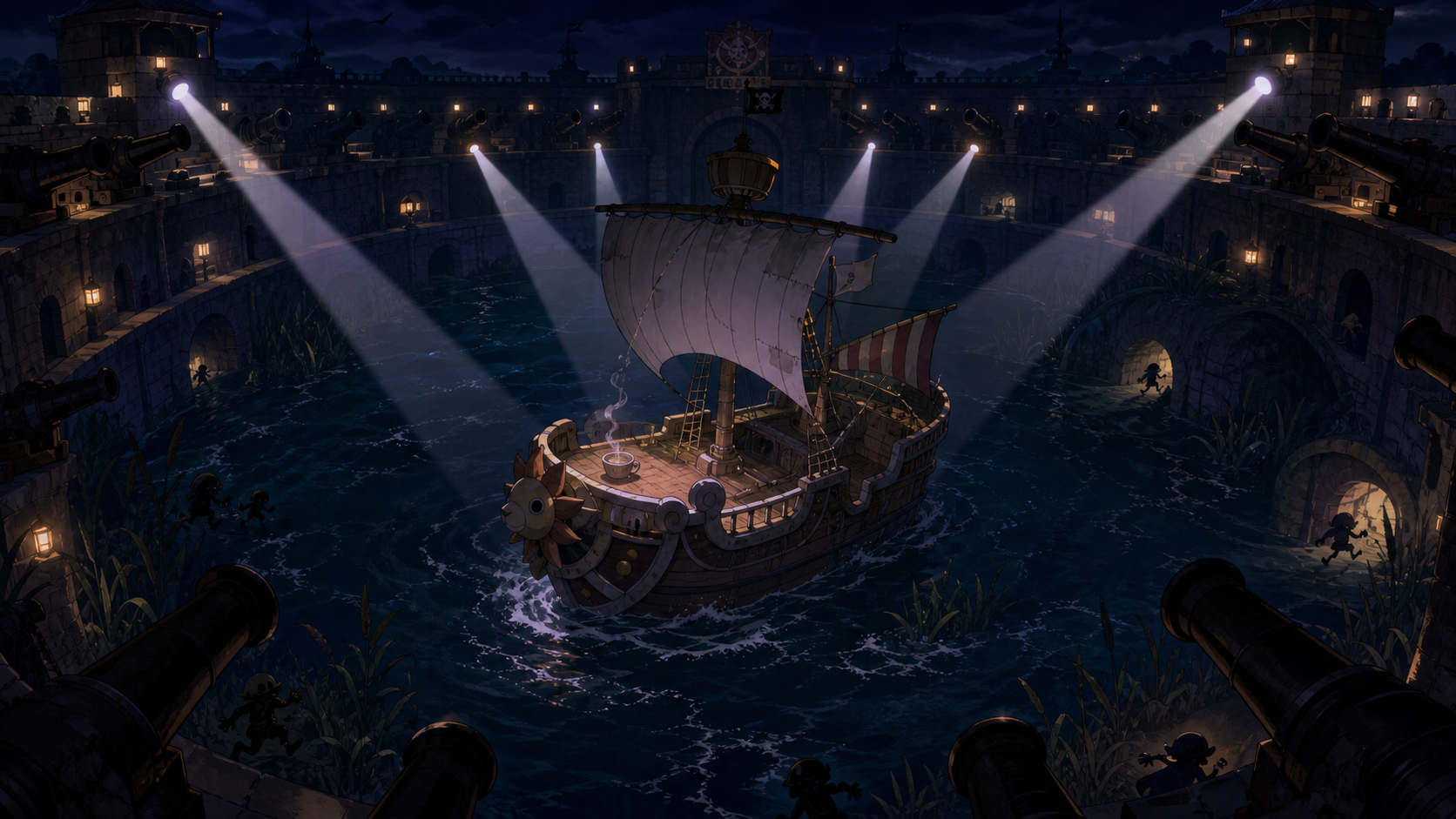
A normal pirate crew sneaks toward a fortress from the sea. The Straw Hats fall through the roof of the military neighborhood. Searchlights pin the Merry in the harbor while cannons swing toward the ship. Every exit looks controlled before anyone aboard has time to understand the map.
The absurd entrance works because Episode 195 prepared the drop as a victory lap. The crew escaped the White Sea beneath an octopus balloon. Everybody had time to celebrate, argue about treasure, and imagine the next route. Then gravity delivers the bill. One Piece loves consequences that arrive dressed as punch lines.
The abandoned deck is a perfect ghost story
The boarding party finds nobody. A cup of coffee remains unfinished. A cigarette still burns. The ordinary signs of life make the absence worse. The Marines start imagining a ghost ship because a vessel cannot fall from the sky, land inside Navarone, and empty itself before trained guards arrive.
I love the joke because the Marines are not stupid. Their available explanation is ridiculous, but the true explanation sounds worse. Seven pirates and a reindeer doctor jumped overboard or scattered through a fortified base within minutes of a celestial crash landing. “Ghosts” almost feels professional by comparison.
The crew survives through separation
The Straw Hats usually gain strength by gathering. Episode 196 reverses the rule. Staying on the Merry would give the cannons one clean target. The crew abandons the center, hides across unfamiliar ground, and trusts each member to remain uncaught long enough to regroup.
That trust has limits. Nobody has a complete map. Nobody knows the base’s command structure. The crew cannot shout names across the harbor or solve confusion with a giant attack. Separation changes every skill. Nami’s navigation becomes reconnaissance. Robin’s observation becomes disguise. Zoro’s sense of direction becomes a public safety concern.
Nami saves the Waver because equipment matters
Nami does not treat the Waver as a cute souvenir from Skypiea. She hides the craft in tall grass because mobility can decide whether the crew escapes. The choice also protects continuity. A lesser filler arc would forget the sky vehicle until the plot returned to manga material.
Nami reads value broadly. Gold matters. Maps matter. Weather tools matter. A strange one-person craft powered by sky technology absolutely matters. Her instinct to secure the Waver tells us she is already planning beyond the next hiding place.
Zoro meets the fortress the Zoro way
Zoro surfaces near moving ships and has to avoid being run over before the man can even choose a direction. Of course. The swordsman can cut steel, endure wounds that should end a career, and sleep through weather. Put him inside organized infrastructure and a traffic lane becomes the immediate enemy.
The gag never reduces Zoro to incompetence because his problem is specific. He can respond brilliantly to danger directly in front of him. Systems built from signs, routes, shifts, and coordinated movement attack the one skill he refuses to develop.
Navarone behaves like a workplace
Marine patrols discuss whether the base has become soft. Dock crews argue about repair deadlines. An older worker remembers when sailors respected ships. Those small conversations give the fortress a history before the Straw Hats arrive.
That texture separates G-8 from filler built around disposable villains. Navarone has workers with pride, resentment, schedules, and opinions about leadership. The base can oppose the pirates without becoming one evil personality repeated through hundreds of uniforms.
Mekao sees a ship before he sees a threat
The older shipwright Mekao notices the Merry falling while other workers focus on damaged Marine vessels and impossible deadlines. His response carries professional curiosity. A ship descending from the clouds violates every rule of the harbor, but the craft still reaches him first as a ship.
One Piece repeatedly gives craftspeople a different moral lens. A carpenter sees joints. A cook sees hunger. A doctor sees injury. A navigator sees pressure and current. Military categories may call the Merry enemy property, yet workmanship and damage tell another story.
The Marines have a readiness problem
Some guards have heard that other bases consider Navarone soft. Their defensiveness tells us the insult already hurts. A fortress can have walls, cannons, ships, and trained personnel while still doubting whether the organization can respond when routine breaks.
The Straw Hats become an unplanned readiness drill. No officer scheduled the crash. No manual explains pirates falling from a sky island. The base has to reveal whether procedures support judgment or replace judgment.
Jonathan does not perform panic
Vice Admiral Jonathan enters as a commander willing to wait. He plays chess, listens, and asks why the Straw Hats would appear inside G-8. That question is more dangerous than immediate rage. A loud commander would chase the first footprint. Jonathan wants the crew’s objective, because an objective predicts movement.
I already understand why fans remember him. He does not need a theatrical execution speech to feel capable. Calm becomes pressure when the man with the map refuses to waste pieces.
Chess tells us how Jonathan sees people
The chessboard is not subtle, but the image earns the comparison. Jonathan commands fixed positions, patrol routes, gates, docks, and information. The Straw Hats arrive as pieces that refuse normal movement. Luffy never respects a straight line. Robin can become another person. Nami turns terrain into opportunity.
A commander who treats the crew as ordinary pirates will fail. Jonathan’s advantage comes from noticing that the board has changed. His possible weakness will come from believing every person prefers survival over loyalty.
The episode builds suspense from information
Episode 196 keeps asking who knows what. The Marines know a pirate ship arrived, but they cannot find the pirates. Each Straw Hat knows the crew scattered, but no member knows where everybody landed. Jonathan knows the base better than the intruders, while the crew knows one another better than he does.
No side holds the whole picture. That imbalance creates better suspense than a countdown pasted over random explosions. Every footprint, uniform, corridor, and overheard order can move knowledge from one side to the other.
The comedy does not cancel the threat
Marines whisper about ghosts. Zoro nearly loses a fight with harbor traffic. The crew hides in ridiculous places. None of those jokes removes the cannons aimed at the Merry or the locked geography surrounding the harbor.
One Piece works best when comedy reveals pressure instead of pausing pressure. Nervous guards invent ghosts because they cannot explain the evidence. Zoro’s route problem becomes dangerous because one wrong turn can expose him. The funny behavior belongs to the crisis.
Anime-original does not have to mean disposable
G-8 cannot change the manga’s central outcome. The Straw Hats cannot lose a member, surrender the gold forever, or end their voyage inside Navarone. Those limits do not excuse empty writing. A side arc can test skills, relationships, and institutions without rewriting canon.
Episode 196 chooses continuity over amnesia. The Merry still carries Skypiea’s physical aftermath. The crew’s escape problem grows directly from the way they left the sky. The arc begins as an unplanned consequence, not a side quest announced by a stranger holding a map.
What worked
The fortress geography works. The quiet commander works. The abandoned-ship joke works. Most of all, Navarone feels populated by people whose lives began before the Merry landed. That foundation gives later disguises and deceptions something solid to push against.
The episode also trusts setup. We do not need a major battle before the credits to justify watching. The creative team spends time establishing routines, blind spots, labor, and command style because those details will become the arc’s machinery.
What held the episode back
The premiere scatters the crew so widely that some Straw Hats receive only a quick location check. That choice is structurally necessary, but emotional momentum from Skypiea cools fast. A little more reaction to leaving the sky and seeing the fortress would have strengthened the handoff.
The Marines’ ghost panic also risks running longer than the joke deserves. The evidence is funny. Repeating disbelief cannot replace investigation. Jonathan’s arrival rescues the balance by shifting the base from rumor toward strategy.
What changed on the replay
On the first watch, the empty Merry and frantic search carry the episode. On replay, the labor details stand out: repair estimates, dock frustration, patrol insecurity, and Mekao’s attention to the falling ship. Those details explain why G-8 can support eleven episodes.
I also watched Jonathan more closely. His calm is not kindness, and his patience is not passivity. He has the luxury of waiting because the fortress controls food, routes, uniforms, gates, and ships. The Straw Hats have surprise. Jonathan has infrastructure.
RaeRae’s verdict
Episode 196 is an excellent opening because the story respects the fortress enough to make escape interesting. Navarone is not a row of guards waiting for Luffy to punch through the middle. The base is a workplace, a community, a repair yard, a security system, and Jonathan’s chessboard.
The Straw Hats escaped a god by ringing a bell. Now they have to survive administrators, cooks, dock crews, patrol routes, and one commander who knows panic wastes information. Honestly, that may be the more dangerous enemy.
Official source and next route
Official ONE PIECE Episode 196 guide
Previous: Episode 195 React
One Piece Anime Hub
Jonathan Wins the First Round by Refusing to Rush
Jonathan matters because G-8 understands the Straw Hats almost immediately without pretending every Marine shares one brain. He does not scream for every cannon to fire at once. He watches the empty ship, the scattered landing points, and the guards reporting impossible details. That patience gives Navarone personality. The fortress feels staffed by people who know their corridors, their routines, and one another. A less confident commander would turn the base into noise. Jonathan turns confusion into a map.
The ghost-ship idea also fits the Going Merry at this exact point in the story. Skypiea already asked us to accept that the ship has a presence beyond lumber and sails. Now Marines enter and find evidence of life without finding the family who made that life. Meals, tools, repairs, and personal spaces become clues. The Merry tells the crew’s story even while every Straw Hat hides somewhere else. That detail makes the escape problem emotional before anyone throws a punch. Recovering the ship means recovering their shared home.
RaeRae verdict: this is how filler earns trust. Episode 196 does not pause the adventure to hand us random errands. The episode studies how this crew survives after a terrible landing, gives the enemy a believable advantage, and builds tension from observation. Jonathan does not need Enel’s lightning to feel dangerous. He only needs enough patience to let pirates make the next mistake.