RaeRae Reacts · One Piece Episode 197
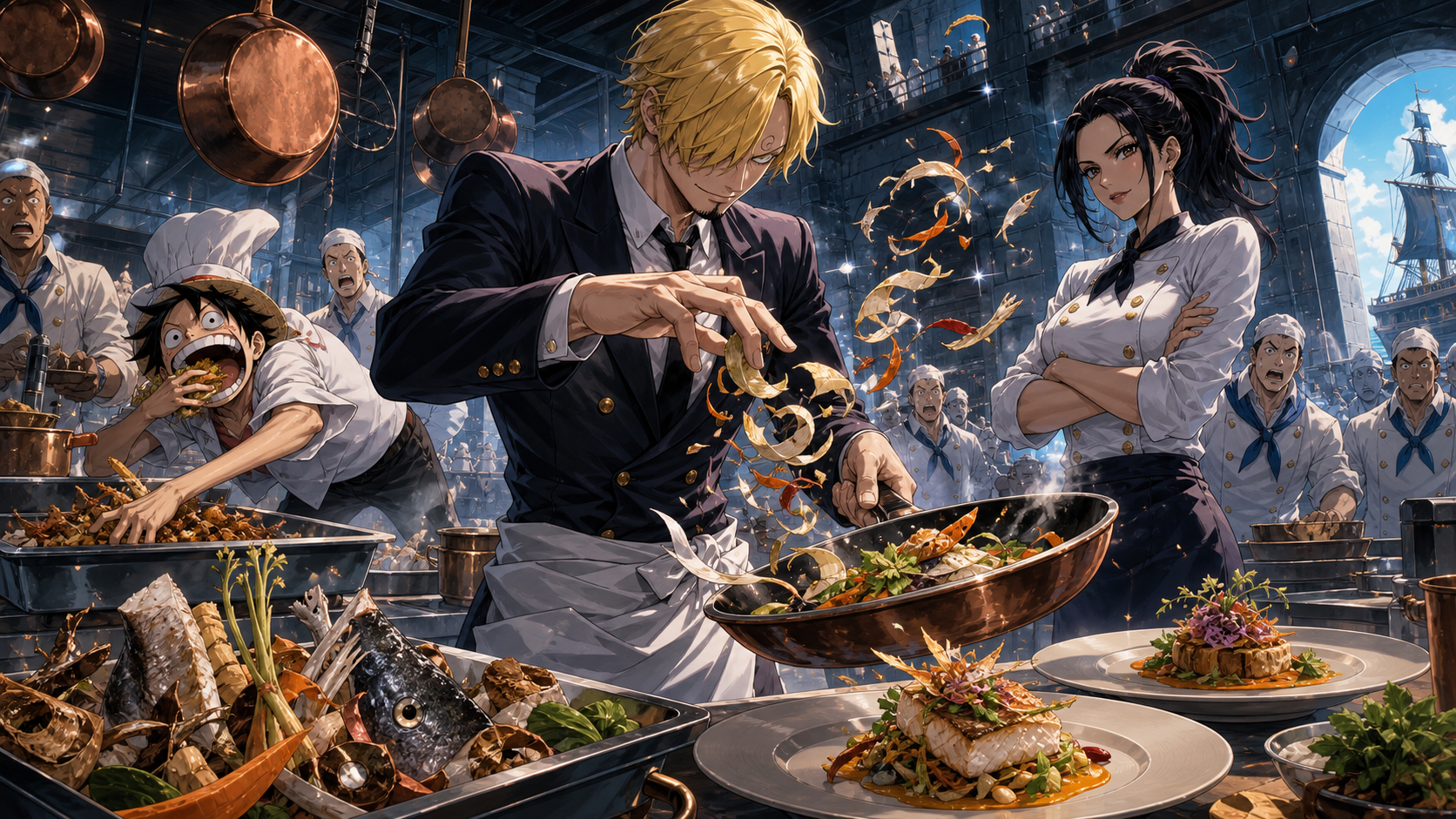
Sanji Feeds G-8 With the Food They Threw Away
One Piece Episode 197 sends Sanji into Jessica’s Marine kitchen, where discarded ingredients become a cooking lesson, a disguise, and a professional challenge.
Bottom line
One Piece Episode 197 puts Sanji inside a Marine kitchen and lets professional skill become camouflage, argument, and escape plan at the same time. Jessica expects a visiting cook. Sanji sees wasted ingredients, hungry workers, and a challenge to his pride. Luffy sees lunch. Everybody remains perfectly in character.
This is the moment G-8 proves the arc understands why the Straw Hats work beyond combat. Sanji does not survive because nobody recognizes him. He survives because the kitchen needs what he can do, and competence becomes harder to question than a uniform.
Episode facts
Fuji TV broadcast Episode 197 on June 27, 2004. Michiru Shimada wrote the screenplay, Ken Koyama directed, Naoki Tate served as animation director, and Miyuki Sato with Kumiko Fukuzawa handled the art direction. The official Japanese title translates to “Sanji the Cook! Showing His True Worth in the Marine Dining Hall!”
The episode continues the anime-original G-8 arc. Sanji and Luffy enter the dining hall in disguise and are mistaken for cooks expected from Marine Headquarters. Jessica, Navarone’s proud head chef, challenges Sanji to prove his ability.
The kitchen is the smartest hiding place and the worst hiding place
A fortress kitchen gives Sanji access to knives, food, uniforms, schedules, gossip, and enough movement to disappear inside a shift. The same room also contains professionals who can expose a fraud within minutes. A cook cannot bluff through service. Every hand movement becomes identification.
Sanji walks into that pressure and relaxes. He may not know the fortress map, but he knows stations, timing, heat, prep, and the look of a crew racing a meal deadline. The kitchen speaks a language he learned long before piracy.
Luffy treats infiltration like an all-you-can-eat disguise
Luffy wearing cook whites does not create a cook. The uniform only gives him closer access to trays. His appetite threatens the cover immediately because he cannot understand food as evidence that needs to remain untouched.
The joke works because Sanji’s relationship with hunger is serious. Luffy eats without fear because Sanji has made regular meals part of the crew’s life. Inside enemy territory, that trust becomes a logistical nightmare. Sanji has to protect the disguise, perform service, and keep his captain from consuming the workplace.
Jessica recognizes standards before identity
Jessica runs the dining hall with authority. She does not accept two men as experts because a schedule says experts should arrive. She watches their behavior and tests the claim. That skepticism makes her a good head chef and a dangerous opponent.
I appreciate that the episode gives Sanji a woman who can challenge his professional judgment. His attraction makes him ridiculous, but Jessica’s authority never depends on whether he approves. She owns the room before he enters.
The challenge is about waste
Sanji notices useful ingredients treated as scraps. Peels, trimmings, bones, and overlooked pieces can become food when a cook understands flavor and preparation. His response is not a cute recycling demonstration. Baratie taught him that throwing away edible food can become a moral failure when hunger exists one bad week away.
A fortress feeding hundreds should understand that lesson. Military abundance can make waste look normal because budgets and supply ships hide the cost. Sanji sees meals where the institution sees refuse.
Baratie enters the room without a flashback
Zeff’s lesson lives inside Sanji’s hands. The cook once experienced starvation so severe that food stopped being preference and became time left alive. He will insult someone’s manners, clothing, intelligence, or face. He will not disrespect edible food.
Episode 197 does not need to replay the rock, the bags, or Zeff’s missing leg. Sanji’s technique carries the history. The best continuity often appears through behavior rather than a recap speech.
Sanji cooks for enemies without surrendering
The diners are Marines searching for his crew. Sanji still prepares good food. Feeding people does not convert him into a government supporter. Cooking remains an ethic he controls, not a reward reserved for allies.
That distinction has followed him since Gin at Baratie. A hungry enemy receives a meal. The meal does not erase danger or cancel the right to fight back. Sanji refuses to make starvation part of his weapon kit.
Professional pride becomes better than a fake name
Sanji and Luffy have borrowed identities, but Sanji’s real craft makes the lie persuasive. Nobody needs a detailed backstory for the visiting cook when plates arrive on time and the food exceeds expectations.
G-8 understands that institutions often verify people through usefulness. A uniform opens the door. Competence keeps the door open. Jonathan will eventually exploit that assumption, but the kitchen staff first experiences the practical relief of somebody solving a problem.
The dining hall makes Navarone feel inhabited
Soldiers do not live on patrol routes alone. They eat, complain, rush through service, and depend on workers whose names may never reach the command office. Episode 197 gives the base a stomach.
That choice strengthens the entire arc. A functioning fortress requires food planning, sanitation, repair, medicine, lodging, and schedules. The Straw Hats can hide because a large organization contains more roles than any commander can personally monitor.
Jessica and Sanji share a language before they share trust
They disagree through ingredients, technique, and standards. Jessica challenges him because she cares about her kitchen. Sanji answers because he cares about cooking. Neither character needs to become friendly before recognizing skill.
That professional recognition gives their exchange more weight than his usual hearts-and-swooning routine. Sanji’s flirtation remains annoying because competence already created a better connection. Let the woman finish judging the plate before turning the kitchen into a pickup attempt, sir.
Sanji’s sexism still follows him into good work
The episode celebrates his craft and immediately reminds us that he loses judgment around an attractive woman. Jessica can be a beautiful head chef. Sanji can notice. The exaggerated worship still reduces a professional encounter to his romantic performance.
I do not need Sanji stripped of desire. I need his admiration to leave room for women as workers, leaders, rivals, and people with objectives unrelated to him. Jessica creates that room through force of personality even when the gag tries to crowd her.
Luffy is the pressure test for every food system
A kitchen can survive a normal rush. Luffy is not a normal rush. His appetite exposes storage, plating, guard attention, and every weak point in the disguise. Sanji’s greatest customer becomes his worst coworker.
The comedy also reveals why the crew needs Sanji. Feeding Luffy requires planning on the scale of disaster response. Nami may control the money, but Sanji converts limited stores into enough meals to keep an impossible body moving.
Food waste becomes a class question
The scraps Sanji rescues represent labor already spent. Somebody caught the fish, grew the vegetables, transported supplies, unloaded crates, and prepared ingredients. Throwing edible parts away discards all of that work.
Navarone can waste because the institution expects replacement shipments. Pirates crossing unpredictable seas cannot rely on the same pipeline. Sanji’s thrift comes from hunger and navigation reality, while the base’s habits come from centralized supply. The cooking contest quietly compares two economies.
The episode gives filler a character job
Episode 197 cannot change Sanji’s central biography, but the story can demonstrate his values in a new environment. A filler episode earns time when the conflict reveals a character through action instead of attaching a temporary trauma that disappears next week.
The kitchen challenge does exactly that. Sanji reads waste, hierarchy, hunger, and technique faster than he reads fortress geography. His craft moves the plot because his craft is part of who he is.
What worked
The professional setting works. Jessica works. The anti-waste argument works. Sanji’s ability to enter an enemy system through labor feels clever and specific. The episode also understands that cooking action needs rhythm: hands, heat, ingredients, timing, reactions, and the reveal of finished plates.
Luffy supplies chaos without stealing Sanji’s victory. The captain can consume half the room, but the episode’s authority belongs to the cook who turns ignored ingredients into proof.
What held the episode back
Sanji’s reaction to Jessica leans on the same romantic gag long after professional respect has become more interesting. The joke does not destroy the episode, but the writing keeps reaching for an easier version of him.
The challenge also resolves faster than the labor question deserves. I wanted more from Jessica about why the kitchen discarded usable parts and whether Sanji’s demonstration changes practice after the pirates leave. One impressive plate can win a contest. A policy change would prove the lesson reached the institution.
What changed on the replay
On the first watch, Sanji showing off dominates the memory. On replay, Jessica’s skepticism carries the scene. She refuses to let headquarters credentials outrank evidence. That instinct matches Jonathan’s command style more than either character may realize.
I also noticed how naturally Sanji studies the station before acting. He identifies the room’s waste and need, then builds his disguise through solving both. The sequence is infiltration through listening.
RaeRae’s verdict
Episode 197 is G-8 doing filler correctly. The story takes a Straw Hat skill, places that skill inside an enemy institution, and lets the character’s values create both danger and protection. Sanji does not need a kick to win the room. He needs scraps everybody else stopped seeing.
Jessica remains the person I want running a fortress kitchen. Sanji remains the person I want feeding a ship with no reliable supply route. Luffy remains banned from prep until every tray has been counted twice.
The service line is battlefield logistics
A dining hall feeding an active base has to move food with the same discipline used to move ammunition. Portions, timing, temperature, storage, and cleanup determine whether hundreds of people can return to duty. Sanji reads that system instantly because a pirate ship creates the same problem on a smaller scale. A crew cannot fight, repair sails, keep watch, or navigate after the cook treats meals as decoration.
Jessica’s kitchen therefore matters to Navarone’s defense more than the officers eating lunch probably admit. Her team converts supply shipments into daily readiness. Sanji’s use of discarded ingredients does not embarrass kitchen labor. His demonstration argues that skilled workers deserve enough authority to question waste before a budget turns waste into routine.
Official source and routes
Official ONE PIECE Episode 197 guide
Previous: Episode 196 React
G-8 Episodes 196-206 Directory
Sanji Treats Waste Like a Personal Insult
Sanji’s kitchen flex works because the scene is not merely about proving that he can cook. Jessica’s staff throws away edible pieces because habit has replaced attention. Sanji looks at the same scraps and sees labor, flavor, and people who still need dinner. That reaction belongs to the child who learned hunger beside Zeff. Food never becomes disposable decoration around him. Every peel and bone carries the question of whether somebody could have eaten better.
Jessica deserves credit too. She does not protect her authority by dismissing the stranger. She tastes, watches, and recognizes skill. Their clash becomes professional rather than cartoonishly hostile. Sanji can be arrogant because the food backs every word, while Jessica can be irritated without becoming incompetent. G-8 keeps winning through choices like this. Marines have jobs, standards, pride, and internal relationships instead of standing around as identical uniforms waiting for pirates.
The disguise also tells on Sanji in the funniest possible way. He could stay quiet, serve an acceptable plate, and leave. His entire soul rejects that option once he sees waste. Professional pride pulls him closer to discovery, but the same pride wins over the room and creates cover. RaeRae verdict: Episode 197 makes competence thrilling. No kick lands harder than Sanji turning garbage-bin ingredients into a meal that forces a Marine kitchen to reconsider its own standards.