RaeRae Reacts · One Piece Episode 426
Little East Blue Rebuilds Home as Shiki’s Hunters Search for Boss
One Piece Episode 426 movie tie-in special React follows the reunited Straw Hats, Little East Blue, Yoko, Boss, the Amigo Pirates, and Shiki’s retrieval order.
One Piece Episode 426 movie tie-in special React: the anime pauses Luffy’s Impel Down descent, reunites the full Straw Hat crew for a Strong World prologue, and lands the Thousand Sunny beside Little East Blue, a handmade island where emigrants rebuilt the homes they still miss.
What happened in Episode 426
A narrator marks the story as a movie-connected special. Shiki’s operation searches for a giant beetle named Boss, and the Amigo Pirates accept the retrieval job. Largo leads with his younger brother Corto beside him. Elsewhere, the reunited Straw Hats sail the Thousand Sunny and discover a strange island whose buildings, food, landmarks, and businesses reproduce pieces of East Blue. Residents descended from people born in that sea created Kansorn Island as Little East Blue.
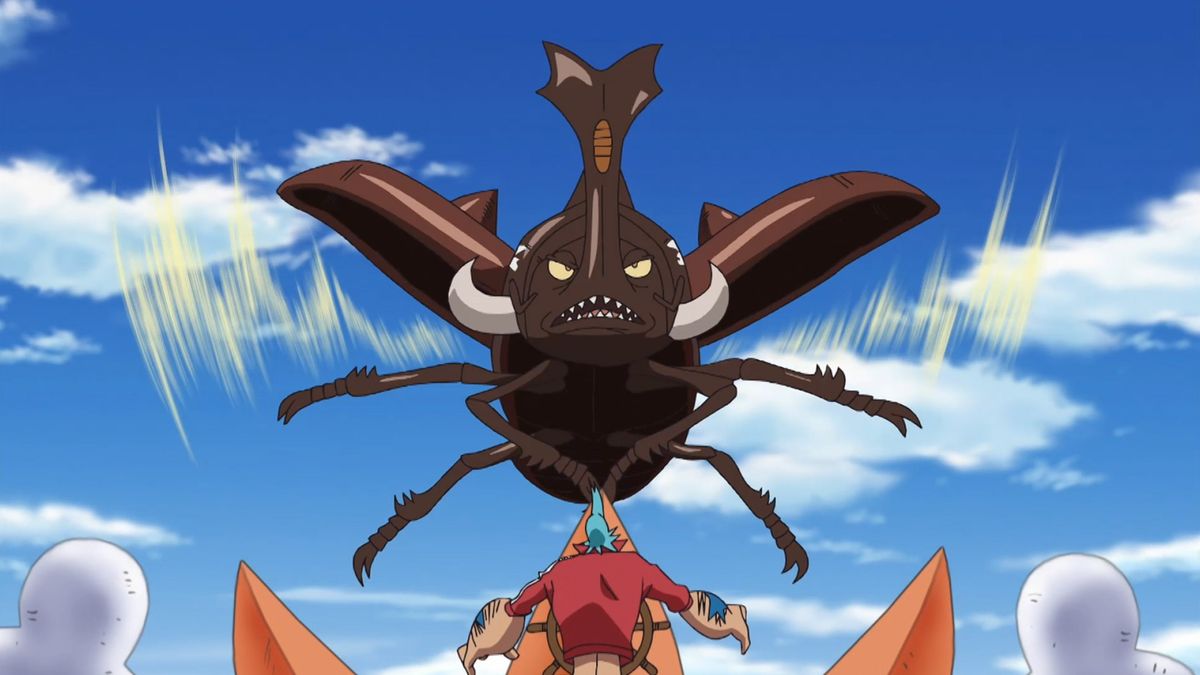
Luffy, Zoro, Nami, Usopp, Sanji, Chopper, Robin, Franky, and Brook explore spaces built from remembered homes. Yoko watches the pirates with suspicion because her father served as a Marine. The crew meets Boss, the enormous beetle hunted by Shiki’s associates, without yet understanding the animal’s connection to the coming threat. Nostalgia, danger, and movie promotion begin sharing one small island.
RaeRae’s opening receipt
One Piece drops this four-episode detour between two Impel Down floors and does not pretend the placement is seamless. The title says movie tie-in special. The reunited crew says alternate promotional space. Clear labeling matters because viewers deserve to know why Luffy suddenly has everybody back while Ace remains under an execution deadline.
Once that housekeeping is handled, Little East Blue has a real emotional hook. Immigrants rebuild restaurants, landmarks, and neighborhood details because memory needs somewhere physical to live. The island is fan culture inside the story: people recreating a beloved world from fragments, food, and stubborn affection.
The movie connection receives an explicit label
Episode 426 does not belong to the manga-canon Impel Down sequence.
The React treats the episode as a numbered television special tied to Strong World, not as a missing prison chapter.
Continuity bends for promotion
The scattered Straw Hats appear together aboard the Sunny despite the surrounding chronology.
That contradiction needs acknowledgment rather than an invented explanation.
The crew reunion changes the energy instantly
Weeks of separation stories give way to familiar arguments, appetites, and roles.
Even a promotional detour reminds viewers how much chemistry vanished when Kuma struck.
Shiki enters through command rather than presence
His organization sends others to retrieve Boss.
The distant order makes the giant beetle feel connected to a threat larger than the island can see.
The Amigo Pirates accept the hunt
Largo and Corto treat the assignment as an opportunity to rise within Shiki’s orbit.
Ambition travels downward through subcontracted violence.
Largo leads through appetite and confidence
He expects Little East Blue to surrender the target once his crew arrives.
The job looks simple because he has not met the island’s attachment to Boss.
Corto performs loyalty beside his brother
The younger sibling reinforces Largo’s authority and shares the expected reward.
Family loyalty appears on the antagonist side before the island conflict begins.
The Sunny discovers a familiar impossibility
East Blue details appear far from East Blue.
The crew recognizes pieces of home before understanding who assembled the pieces.
Kansorn Island carries two names
The official location exists as Kansorn while residents call the recreated culture Little East Blue.
One name marks geography. The other marks belonging.
Emigrants built memory into architecture
People who left their birth sea did not stop missing neighborhoods, tastes, and landmarks.
Construction becomes a way to refuse cultural erasure.
The island is not a perfect replica
Different towns and regions sit beside one another in compressed form.
Memory organizes emotional importance more readily than accurate distance.
Luffy recognizes home through appetite
Food gives him immediate access to the island’s purpose.
A recreated meal can collapse years and miles faster than explanation.
Sanji reads restaurants as personal history
Baratie imagery touches apprenticeship, Zeff, and the place where he chose the Straw Hats.
A sign carries more weight than decorative nostalgia.
Nami finds Cocoyasi echoes
Familiar details connect freedom after Arlong to the community that raised her.
Home includes pain survived as well as comfort remembered.
Usopp receives Syrup Village recognition
The recreated setting validates a hometown the wider world would consider small.
Ordinary places become legendary when someone carries them across an ocean.
Zoro sees East Blue without becoming sentimental aloud
His journey began through Shells Town, a promise, and a captain who cut his restraints.
Silence does not mean the replica lacks meaning.
Robin studies reconstruction as living history
Little East Blue is an archive built by residents rather than rulers.
Every imitation reveals what emigrants decided could not be left behind.
Franky sees a community-scale build
The island converts collective longing into structures people can enter and use.
Engineering serves emotional continuity.
Brook visits a sea he never knew this way
He joins the crew’s nostalgia without sharing their original memories.
Belonging lets newer members inherit stories they did not witness.
Chopper recognizes home as a complicated category
Drum Island, not East Blue, shaped his childhood.
The crew’s affection still gives him a route into their origin story.
Little East Blue resembles fandom
Residents collect details, reproduce beloved places, and share stories with newcomers.
Accuracy matters, but affection explains the labor.
Nostalgia can preserve and simplify
A recreated landmark keeps memory alive while smoothing contradictions from the original place.
The island offers home as curated experience.
Yoko refuses the instant welcome
She watches pirates through lessons learned from a Marine father.
Suspicion protects memory of him and complicates the residents’ enthusiasm.
Her distrust deserves more than correction
The Straw Hats know their own moral code. Yoko knows pirate violence as a category.
Trust must arrive through evidence rather than audience familiarity.
A Marine daughter carries inherited duty
Her father’s service shapes how she reads flags, weapons, and outlaw reputations.
Grief can make broad rules feel safer than uncertain individuals.
The islanders see guests before threats
Shared East Blue origins create immediate warmth.
Cultural recognition lowers defenses that Yoko keeps raised.
The Straw Hats enjoy being recognized
Familiar tastes and stories offer temporary relief from constant pursuit.
The pause works emotionally even when continuity remains promotional.
Boss arrives as an animal and a target
The giant beetle belongs to the island’s daily relationships before outsiders assign strategic value.
Those two definitions will drive the conflict.
Size does not make Boss a monster
Residents know temperament, history, and personality.
Shiki’s organization sees biological capacity instead.
The name Boss creates comic expectation
A giant beetle receives a title usually reserved for a criminal leader.
Affection and scale combine into neighborhood legend.
Shiki reduces life to military inventory
Boss matters because engineered animals can support conquest.
Strategic usefulness replaces relationship in the hunting order.
The Amigo Pirates turn retrieval into extraction
They do not ask whether the island claims responsibility for Boss.
Power assumes that identifying a valuable creature creates ownership.
The special establishes stakes before invasion
Warm exploration gives viewers reasons to care about shops, residents, and memories.
Threat gains weight because the island becomes a community rather than a set.
East Blue remains the crew’s emotional foundation
Grand Line victories did not replace the villages and restaurants where promises began.
Growth adds distance without cancelling origin.
The replica asks what home means after departure
Can a person rebuild home elsewhere, or does reconstruction prove that home stayed behind?
Little East Blue answers with both possibilities at once.
Residents made absence communal
Private homesickness became public streets, menus, signs, and celebrations.
Sharing memory prevents longing from remaining lonely.
The crew becomes evidence that East Blue stories traveled
People from the recreated towns stand before residents who preserved those towns abroad.
The encounter lets memory meet consequence.
Yoko becomes the necessary skeptic
Without her, the island would accept famous pirates because the narrative says they are heroes.
Her resistance demands that the crew earn local trust inside the episode.
The Amigo threat will test that trust
When violence arrives, labels matter less than who protects whom.
Action can distinguish pirates without pretending all suspicion was foolish.
The special should not be confused with a Review
A numbered episode response still belongs in Reacts, even when anime-original and movie-connected.
The eventual Strong World film assessment belongs in Movies and Reviews.
This remains a numbered television special React
This page responds to the movie-tie-in framing, the reunited crew, Little East Blue’s immigrant community, Yoko’s suspicion, Boss, Largo, Corto, and Shiki’s retrieval order. Film-level judgment remains separate.
Clear labeling protects the episode-versus-Review boundary and warns viewers about the continuity detour.
The official local still remains canonical
The Episode 426 official story image serves as featured image, hero, static directory card, and social preview through one local attachment.
Complete metadata preserves source, accessibility, filing, and unique use.
RaeRae’s final receipt
Episode 426 interrupts Impel Down with a full-crew movie prologue and labels the interruption honestly. That label matters. Viewers should not wonder whether they missed Kuma reversing the separation or Ace receiving a generous deadline extension.
Little East Blue earns attention beyond promotion because the island understands homesickness as creative labor. Emigrants rebuild the places, tastes, and signs they carried in memory. The result is not geographically accurate East Blue. The result is emotionally accurate longing.
Then Shiki’s machine looks at the island and sees Boss as inventory. Yoko looks at the Sunny and sees pirates as danger. The Straw Hats look around and see home reflected back by strangers. Episode 426 sets the conflict inside those competing acts of recognition.
Promotional placement changes the reading
Watching Episode 426 as a direct Impel Down continuation creates confusion before the opening conflict can work.
Watching the episode as a Strong World television special clarifies why the crew, villain network, and tone suddenly reset.
Clear classification respects completists
Anime-original does not mean disposable, and numbered does not mean manga canon.
The directory can preserve both facts without forcing viewers into a false choice.
Little East Blue turns adaptation into a story subject
Residents translate remembered locations into new materials and compressed space.
Every reconstruction asks which details make an original recognizable.
Food carries the strongest archive
Recipes survive migration because people can repeat taste in kitchens far from birthplace.
Luffy’s appetite becomes a serious route into cultural memory beneath the joke.
Names protect continuity
Calling the island Little East Blue lets descendants claim a relationship to somewhere they may never have seen.
Language keeps origin active across generations.
Yoko protects a different inheritance
Her father’s Marine identity taught her that pirate flags can precede loss.
She preserves his warning while neighbors preserve hometown landmarks.
Conflicting inheritances do not make either child foolish
Community nostalgia and personal grief can both produce sincere conclusions.
The episode must give experience room to revise those conclusions.
Boss embodies belonging without citizenship
The beetle cannot explain origin papers or consent to Shiki’s project.
The residents’ care supplies the strongest claim against extraction.
Shiki’s plan industrializes exceptional life
A unique animal becomes a prototype, specimen, or weapon once power notices useful traits.
The language of ambition strips the creature’s local story away.
Largo accepts that language for advancement
Delivering Boss may improve his standing with the Golden Lion.
Career ambition makes another community’s relationship look expendable.
The Straw Hats are uniquely equipped to object
Their crew includes people once treated as weapons, property, monsters, or tools.
Protecting Boss fits a pattern deeper than simple animal rescue.
The island offers a temporary homecoming
Each East Blue member can revisit origin without reversing growth.
The pause lets memory breathe before the special demands action.
Robin and Franky widen the idea of home
Neither began in East Blue, yet both belong inside the crew visiting the replica.
Chosen family grants participation without requiring identical origins.
Brook makes the same point through chronology
His life predates the current crew by decades and his Straw Hat membership remains recent.
Home can be inherited forward through stories.
The episode carries a fan-service risk
Recognizable signs and crew callbacks can become empty applause cues.
Yoko and Boss give the nostalgia conflict, consequence, and local ownership.
The special works when Little East Blue belongs to residents
The island cannot exist only for Straw Hat reactions.
People who built and maintain the replica must remain central to what gets defended.
RaeRae’s extra receipt
Little East Blue feels like somebody turned a fan scrapbook into streets, then invited the original characters to walk through. That premise could have stayed cute and weightless. Yoko’s suspicion and Shiki’s hunt give the scrapbook borders worth defending.
The islanders built memory because leaving home did not erase home. Shiki’s organization arrives to take the one living being military ambition finds useful. Episode 426 therefore places preservation against extraction before the first major fight begins.