RaeRae Reacts · One Piece Episode 425
Luffy Breaks Wild Beast Hell as Poison Warden Magellan Starts Moving
One Piece Episode 425 React follows the giant hippo, Basilisk, Gear Third, Galdino’s release, Hancock’s descent, and Magellan’s poison-powered debut.
One Piece Episode 425 React: Luffy drags a reluctant Buggy through Wild Beast Hell, defeats a Basilisk with Gear Third, and blows open cells that release Galdino, while Hancock reaches Level Four and meets Magellan, a warden whose poison makes his ridiculous bathroom schedule no less lethal.
What happened in Episode 425
Luffy and Buggy land on Level Two, where Buggy wants distance from every beast and every lower floor. A giant hippo swallows Buggy’s separated body, a mantis joins the pursuit, and Luffy keeps pulling the clown toward Ace. The Basilisk attacks near a surveillance room. Luffy uses Gear Third to smash the monster through the monitoring station, but the technique leaves him temporarily small. Buggy opens cells during the chaos, and former Baroque Works agent Galdino steps into the escape.
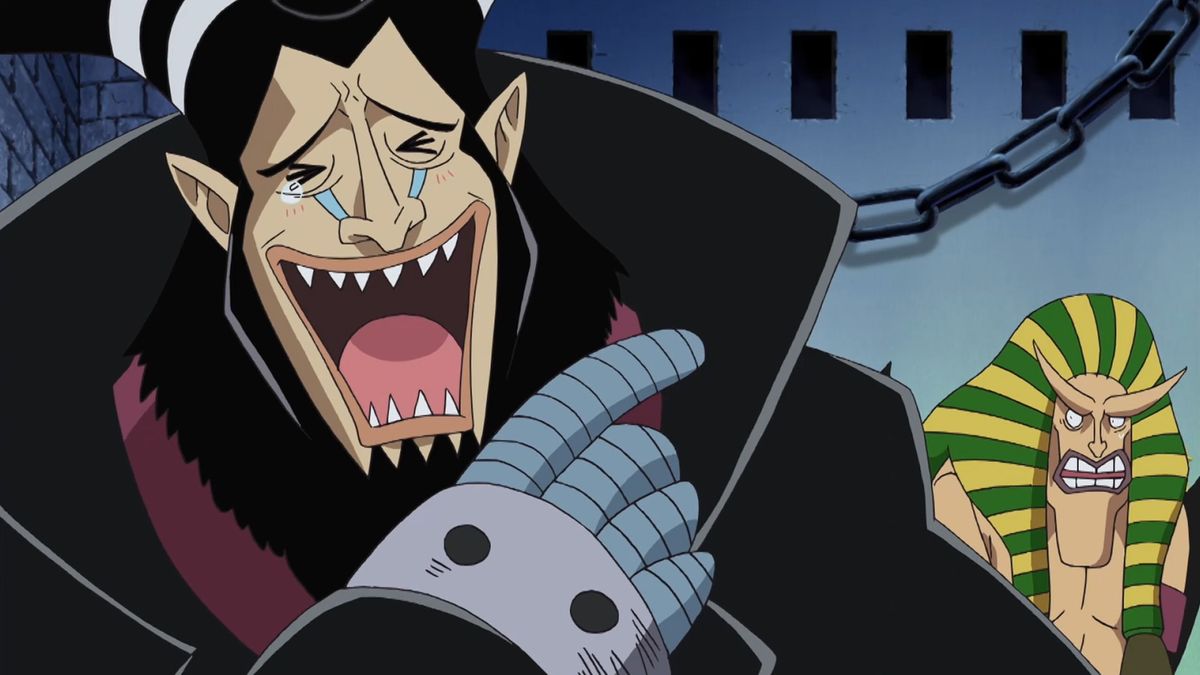
Hancock, Momonga, Domino, and Hannyabal descend to Level Four. Domino explains that Warden Magellan spends much of each day suffering digestive consequences from eating poison, sleeps eight hours, and works roughly four. Magellan emerges breathing poison, attacks Hannyabal during their usual promotion argument, and becomes infatuated with Hancock after she strikes him. A report warns of an intruder on Level Two. Hancock quickly pressures Magellan to take her to Ace before surveillance can expose Luffy.
RaeRae’s opening receipt
Magellan spends ten hours in the bathroom because he eats poison for breakfast and still remains the strongest man in the prison. That combination is peak One Piece: a humiliating joke attached to a threat nobody should underestimate. The digestive schedule does not make the poison less fatal. The poison makes the schedule funnier.
On Level Two, Luffy and Buggy discover a hippo fast enough to make physics file a complaint. Wild Beast Hell has teeth, surveillance, and one former Baroque Works strategist waiting behind a door. The rescue party keeps growing through pure institutional failure.
Level Two begins with a one-way landing
Luffy chose the fall. Buggy received the fall from a Blugori axe.
Intent does not change the floor waiting beneath either body.
Buggy wants to reverse direction immediately
Experience tells him that every lower level increases danger.
The armband feels less valuable when treasure requires surviving the prison first.
Luffy treats fear as directional noise
Ace remains below, so down remains correct.
Buggy’s warnings supply information without changing the decision.
Wild Beast Hell turns animals into policy
Creatures roam corridors where prisoners cannot escape their cells.
The institution transforms appetite into punishment.
The giant hippo looks harmless for one second
Round shape and blank expression invite the wrong confidence.
The mouth opens and removes every soft assumption.
Speed completes the joke
A massive body races after two pirates with impossible acceleration.
Visual comedy becomes a real pursuit before Buggy finishes protesting.
Buggy’s body gets swallowed without ending him
The Chop-Chop Fruit lets separated parts survive inside the mouth.
His power keeps producing solutions no dignified person would request.
Luffy asks whether Buggy needs the missing body
The question sounds absurd because Buggy’s head continues shouting beside him.
Devil Fruit logic makes basic anatomy negotiable.
Buggy attacks from inside
His swallowed parts seize control and drive the hippo into a wall.
The prey turns the predator’s mouth into a cockpit.
Victory restores his ego instantly
Buggy takes credit with full theatrical confidence once the danger stops moving.
Terror and boasting share one uninterrupted breath.
A mantis expands the beast floor
Level Two does not rely on one signature monster.
Every corner can introduce another anatomy built for killing.
Surveillance follows the chase
Visual Den Den Mushi feed movement back to guards.
The prison starts connecting two escapees to one unknown intruder.
The Basilisk carries the real announcement
A chicken-headed serpent dominates the corridor and the prisoners’ fear.
Wild Beast Hell finally presents a guardian sized for legend.
Luffy answers scale with Gear Third
He inflates bone and turns one limb into a giant weapon.
Power expands according to the obstacle rather than the room.
The Gigant Pistol crosses into the monitor station
The Basilisk does not merely fall.
The monster crashes through the room watching the floor, destroying observation alongside defense.
Security loses sight at the worst moment
Guards can identify the crisis but cannot continue tracking movement.
Luffy creates another blind spot without planning one.
Gear Third leaves a small captain behind
The old drawback shrinks Luffy after the enormous strike.
Maximum force creates temporary vulnerability exactly when the alarm spreads.
Buggy sees weakness and opportunity
The terrifying ally becomes portable and less able to command.
His loyalty remains sensitive to the current balance of power.
Cell doors open during the confusion
Buggy releases prisoners for practical disruption rather than humanitarian principle.
Selfish strategy produces collective possibility anyway.
More bodies make pursuit harder
Guards must separate the original escapee, the intruder, and newly freed inmates.
Control breaks through multiplication.
Galdino enters with history attached
Mr. 3 once used wax, deception, and elaborate execution traps against the Straw Hats.
Impel Down turns a former enemy into potential expertise.
His intelligence matters more than combat scale
Galdino understands systems, locks, materials, and survival through calculation.
Luffy’s rescue needs minds willing to see routes before fists clear them.
Baroque Works keeps returning in pieces
Crocodile waits deeper while one former officer steps free on Level Two.
Old organizations do not disappear simply because an arc ends.
The escape party is nobody’s ideal crew
Luffy, Buggy, and Galdino share history built from conflict.
Impel Down makes usefulness more urgent than comfort.
Hancock’s elevator reaches Blazing Hell
Heat announces Level Four before the doors finish opening.
Official transport protects visitors from punishments surrounding the route.
Domino explains Magellan’s bathroom schedule
The warden loses roughly ten hours daily to digestive distress.
Administrative legend meets bodily consequence.
Eating poison is a self-created problem
Magellan enjoys toxic food despite the predictable result.
Power does not automatically produce sensible habits.
Eight hours of sleep leaves four hours of work
Hancock reasonably questions whether the schedule can run a prison.
Domino answers that crisis response matters more than desk time.
Magellan’s reputation rests on decisive force
Staff believe any major problem ends when the warden appears.
Efficiency becomes terrifying when one body can poison a rebellion.
He emerges wanting darkness
Bright light irritates him after hours in the bathroom.
The prison’s strongest man enters like a miserable cave creature.
Hannyabal sees another promotion opening
Every complaint becomes a reason Magellan should retire.
Ambition survives poison, embarrassment, and terrible timing.
Poison breath settles the argument
Magellan exhales and drops his deputy.
Workplace discipline becomes a medical emergency.
Antidote is ordinary office equipment
Domino orders treatment with practiced speed.
Staff routines reveal how frequently proximity to leadership becomes hazardous.
Hancock strikes Magellan for breathing toward her
Her contempt does not pause for rank or lethal biology.
The blow shocks the room because most visitors understand the risk.
Magellan becomes infatuated instead of angry
Beauty redirects his response as quickly as poison redirected Hannyabal’s body.
Hancock gains leverage inside another dangerous man’s desire.
The intruder report interrupts comedy
Level Two surveillance identifies a crisis before staff understands the full route.
Luffy’s name threatens to connect Hancock to the breach.
Hancock moves before the footage can arrive
She demands immediate access to Ace and uses Magellan’s attraction to accelerate the visit.
Romantic performance becomes crisis containment again.
Her priority remains protecting Luffy’s window
Every delayed conversation gives guards more time to identify him.
Reaching Ace matters, but preserving Luffy’s cover matters first.
Magellan and Luffy occupy opposite floors
The prison’s strongest defender stands on Level Four while the intruder crashes through Level Two.
Vertical distance delays a confrontation the episode has already promised.
Power arrives in two comic bodies
Luffy shrinks after Gear Third. Magellan returns from a ten-hour bathroom sentence.
Ridiculous presentation does not reduce either man’s ability to break the floor around him.
Wild Beast Hell has already failed containment
The Basilisk falls, the monitor room breaks, and cells open.
One intruder turns the punishment ecosystem against administrative order.
This remains an episode React
This page responds to the giant hippo, the mantis, the Basilisk, Gear Third, the broken monitor room, freed prisoners, Galdino, Magellan’s poison, Hannyabal’s ambition, and Hancock’s urgent request. Arc-level judgment remains separate.
React classification protects the episode-versus-Review boundary.
The official local still remains canonical
The Episode 425 official story image serves as featured image, hero, static directory card, and social preview through one local attachment.
Complete metadata preserves source, accessibility, filing, and unique use.
RaeRae’s final receipt
Episode 425 introduces Magellan with every possible reason to laugh and one excellent reason to stop laughing. He eats poison, lives in the bathroom, hates bright rooms, and drops his ambitious deputy with a breath. Impel Down can tolerate his dysfunction because nobody else can end a crisis as brutally.
Luffy creates that crisis two floors above. A hippo swallows Buggy, a Basilisk meets Gear Third, surveillance loses a wall, and Galdino walks out of a cell. None of this resembles Hancock’s requested quiet mission.
The rescue now has a strategist, a clown, a temporarily tiny captain, and a warden beginning to receive reports. Hancock uses Magellan’s attraction to keep moving toward Ace before the prison connects her arrival to Luffy’s breach. The clock is not merely ticking anymore. The clock has poison breath.
Magellan’s comedy protects the reveal
The audience lowers defenses while listening to bathroom arithmetic.
Poison breath then restores the danger without abandoning the joke.
Competence can coexist with absurd habits
Magellan runs a near-infallible prison while making choices that ruin most of his day.
One Piece refuses the tidy idea that powerful people must look dignified.
His staff manage the collateral routine
Antidotes, warnings, schedules, and distance rules form part of ordinary operations.
The institution adapts around the leader instead of asking the leader to stop poisoning coworkers.
Hannyabal’s ambition survives direct evidence
Magellan can disable him casually, yet the deputy keeps imagining the office as future property.
Status desire outlives self-preservation.
Hancock reads the room faster than prison staff
She recognizes attraction as leverage and the intruder report as an approaching deadline.
Her response joins emotional intelligence with tactical speed.
Luffy defeats surveillance physically
Hancock created a precise blind spot on Level One. Luffy sends a giant monster through the monitor room on Level Two.
Different methods produce the same missing image.
The Basilisk victory carries a cost
Shrinking after Gear Third limits Luffy exactly when guards escalate.
Strength solves the immediate wall while creating the next vulnerability.
Buggy’s body mechanics remain essential
Swallowed parts, flying sections, and grounded feet let the group survive threats designed for ordinary anatomy.
His strange power contributes even when his courage does not.
Opening cells changes the political scale
An infiltration focused on one prisoner begins destabilizing confinement for many.
Institutions fear cascades because one broken door teaches every locked person that doors break.
Galdino brings old cruelty and new usefulness
His Little Garden crimes do not vanish because the prison now threatens him too.
Alliance does not require historical amnesia.
Luffy repeatedly recruits through immediate action
He breaks the obstacle in front of someone, then keeps moving toward the declared goal.
People follow because momentum makes possibility visible.
Level Two exposes the weakness of themed punishment
Beasts terrify isolated prisoners but become targets once an outside fighter enters.
A closed system confuses controlled victims with universal weakness.
Magellan represents the prison’s answer to that weakness
When architecture, animals, and ordinary guards fail, one overwhelming body restores fear.
The system ultimately depends on concentrated personal violence.
That dependency creates another point of failure
Four working hours, digestive distress, and Hancock’s influence can delay the strongest response.
Absolute security rests on a deeply imperfect schedule.
Hancock and Luffy keep operating as a divided team
She manages leadership and information below. He manages barriers and accidental allies above.
Neither can see the other’s work, but both keep the rescue alive.
The approaching confrontation gains shape
Luffy cannot punch Magellan safely in the same way he punched the Basilisk.
Poison changes the terms before the two men share a room.
Episode 425 ends by expanding both sides
Luffy gains Galdino while the prison activates Magellan.
The rescue party and containment response grow together.
RaeRae’s extra receipt
Wild Beast Hell works only while prisoners remain separated, watched, and convinced that every creature is unbeatable. Luffy breaks the Basilisk and the monitor room in one swing. Buggy opens doors for selfish reasons. Galdino steps free. Suddenly the floor contains movement the system did not authorize.
Magellan exists for that moment. His bathroom schedule is ridiculous because his power gives the prison permission to tolerate ridiculousness. Hancock understands both the man and the deadline. She gets him moving toward Ace before surveillance can say Luffy’s name, which may be the last clean advantage the rescue receives.