RaeRae Reacts · One Piece Episode 424
Captain John’s Armband Buys Buggy’s Route Through Crimson Hell
One Piece Episode 424 React follows the Blugori fight, Captain John’s treasure marker, Blade Trees, Spike Needle Grass, and the fall toward Level Two.
One Piece Episode 424 React: Luffy turns Blue Gorillas into a hallway inconvenience, Buggy trades partial directions for Captain John’s treasure marker, and both pirates cross the Blade Tree forest and Spike Needle Grass of Crimson Hell before falling into Level Two.
What happened in Episode 424
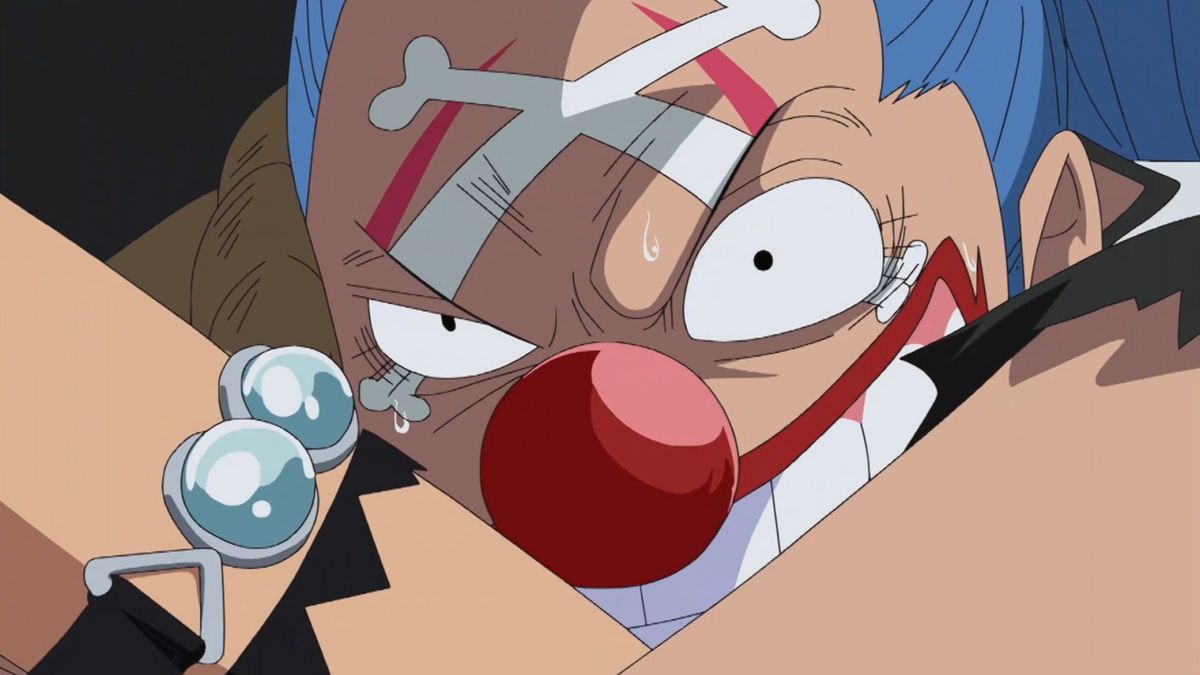
Luffy and Buggy fight the Blugori while prisoners beg them to open cells. Buggy learns that Luffy entered Impel Down to rescue Ace and remembers meeting Ace during a feast. Fear of Whitebeard and the warships outside makes Buggy refuse help until he notices Luffy’s armband. The band marks the route to Captain John’s treasure. Luffy hands the treasure clue over without hesitation, and Buggy agrees to guide him toward the lower floors while privately planning to escape.
Buggy explains Impel Down’s structure, including rumors about a hidden Level Six. A collision with a wall becomes Luffy’s shortcut into a guard room and then the Crimson Hell. Blade Trees and Spike Needle Grass cut prisoners while venomous spiders chase them through the forest. Buggy separates from his feet and flies safely above the blades while Luffy carries the feet. They reach the one-way opening to Level Two. Luffy jumps. Buggy tries to flee with the armband, but a Blugori axe sends the rest of him down after Luffy.
RaeRae’s opening receipt
Buggy sees the rescue of Ace as suicidal, the prison as inescapable, and Luffy’s armband as the most beautiful object on earth. Luffy sees the same band as a thing Nami handed him and gives the thing away in one breath. Their value systems meet, shake hands, and immediately start lying to each other.
Crimson Hell makes pain part of the landscaping. Trees cut, grass punctures, spiders chase, and guards call the result order. Luffy does not pause to admire the design. He asks which hole gets him closer to Ace.
The Blugori expect ordinary prisoners
Blue Gorillas dominate people weakened by confinement and torture.
Luffy meets their axes with strength trained far beyond Level One’s assumptions.
Buggy’s Chop-Chop body dodges the blade
Separation makes a lethal swing look theatrical.
His Devil Fruit remains perfectly suited to panic performed at full volume.
Luffy finishes what Buggy starts
Buggy spins and throws a guard. Luffy knocks the Blugori down again when the creature rises.
Improvised teamwork appears before either pirate agrees to partnership.
Five defeated guards change Buggy’s calculation
He remembers an older version of Luffy from East Blue.
Impel Down introduces him to the power accumulated since Orange Town.
The prisoners ask for release again
Every victory in the corridor makes freedom look briefly possible.
Locked doors turn spectators into people with immediate claims on the escapees.
Buggy refuses collective responsibility
His plan contains one beneficiary: Buggy.
Other cells remain background unless opening them helps his route.
Luffy names Ace as the reason
The rescue goal stays plain through every distraction.
He does not need Buggy to approve the mission, only to provide directions.
Buggy remembers sharing food with Ace
A feast gives the imprisoned man a face beyond bounty and headline.
Personal memory makes execution harder to treat as distant politics.
Whitebeard’s likely response terrifies him
Buggy understands that Ace’s death could bring an Emperor to war.
His knowledge produces caution rather than courage.
Ten warships close the outside route
Escaping upward no longer sounds simple once Marine force waits at the dock.
Buggy needs a plan that survives both prison and sea.
The armband changes everything
Treasure desire catches his attention more effectively than family loyalty or prisoner suffering.
Greed becomes the lever Luffy can actually use.
Captain John’s mark carries unfinished obsession
Buggy has searched caves and followed rumors without reaching the hoard.
The band turns failed years into possible direction.
Luffy barely values the object
Nami gave him the armband after Thriller Bark, but no emotional promise anchors the gift.
Saving Ace outweighs hypothetical treasure instantly.
Buggy expects negotiation and receives surrender
Luffy hands the clue over before manipulation becomes elaborate.
Simplicity disarms a schemer accustomed to bargaining.
The bargain contains asymmetrical honesty
Luffy states exactly what he needs. Buggy promises guidance while planning escape.
Both men move together, but only one speaks the whole purpose.
Buggy leaves his feet with Luffy
The Chop-Chop Fruit lets his body fly only within range of grounded feet.
Physical mechanics create both navigation trick and accidental leash.
Luffy carries the leverage without realizing
Buggy cannot simply vanish while his feet remain in Luffy’s hands.
Trust gets replaced by anatomy.
The prison levels become a vertical class system
Deeper floors contain prisoners judged more dangerous and punishments designed as more severe.
The institution ranks human worth through escalating suffering.
Buggy knows Level Four firsthand
His memory of torture gives the tour practical fear.
Comic cowardice grows from evidence rather than imagination alone.
Rumors of Level Six exceed the official map
Criminals erased from history supposedly disappear beneath the named floors.
Secrecy becomes another punishment because even existence can be administratively denied.
Ace may be lower than expected
Luffy learns that a high bounty may not fully explain his brother’s placement.
The descent becomes longer as the execution clock keeps shrinking.
Buggy’s old treasure hunt explains his capture
He followed Captain John rumors into a location connected to a Marine base.
Greed delivered him to the prison where another treasure clue finally arrives.
Destiny is Buggy’s favorite explanation
He recasts bad planning as fate whenever reality embarrasses him.
The armband lets him rewrite incarceration as a necessary stop on a grand quest.
He flies directly into a wall
The new guide loses against basic architecture.
Luffy interprets collision as evidence of a shortcut.
Luffy solves walls according to brand
If a route does not exist, he creates a route through masonry.
Subtlety leaves the partnership exactly when Buggy feared.
The guard room becomes a transit point
Institutional control assumes walls will separate staff space from punishment space.
A punch erases that assumption.
Crimson Hell weaponizes the environment
Prisoners cannot stand, run, or fall without meeting blades.
The floor turns every survival instinct into another injury.
Blade Trees parody natural shelter
Branches normally promise shade or cover.
These branches slice anyone forced beneath them.
Spike Needle Grass attacks the feet
The ground punishes the basic act of movement.
Escape becomes self-harm by design.
Venomous spiders provide pursuit
Standing still and running both carry consequences.
The prison removes safe choices, then calls suffering justice.
Prisoners run because pain remains comparative
Blades ahead can still feel preferable to venom behind.
Crimson Hell governs through forced selection among injuries.
Buggy’s body can avoid much of the floor
Flying parts pass above grass and between branches.
Devil Fruit mechanics create privilege inside a punishment designed for whole bodies.
His feet remain vulnerable
Every separated part does not receive equal freedom.
Luffy must place and carry the grounded pair carefully.
The arrangement forces cooperation again
Buggy needs Luffy to protect the feet. Luffy needs Buggy to identify the route.
Mutual dependence keeps surviving mutual distrust.
The one-way opening points deeper
Level Two offers no staircase back in Buggy’s explanation.
Descent means choosing a worse hell before finding any exit.
Luffy jumps without debate
Closer to Ace outweighs the certainty of greater danger.
His decision remains reckless and completely consistent.
Buggy tries to end the bargain
Armband secured, he turns toward escape while Luffy falls.
Greed kept him close only until greed appeared paid.
The Blugori axe enforces accidental loyalty
A guard knocks Buggy’s body into the same shaft.
The prison physically reunites partners whose agreement already collapsed.
Level Two announces a waiting beast
Roars reach prisoners before the fugitives land.
The next floor introduces appetite as punishment.
Galdino waits behind bars
Another former enemy occupies the path ahead.
Luffy’s impossible rescue keeps collecting people from earlier adventures.
This remains an episode React
This page responds to the Blugori battle, Buggy’s Ace memory, Captain John’s armband, the prison map, Level Six rumors, Blade Trees, Spike Needle Grass, venomous spiders, and the Level Two fall. Arc-level judgment remains separate.
React classification protects the episode-versus-Review boundary.
The official local still remains canonical
The Episode 424 official story image serves as featured image, hero, static directory card, and social preview through one local attachment.
Complete metadata preserves source, accessibility, filing, and unique use.
RaeRae’s final receipt
Luffy buys directions with a treasure map he did not know he was wearing. Buggy receives the clue he has chased for years and immediately plans betrayal. That exchange should fail. Instead, feet, guards, walls, and one very committed axe keep the partnership functioning after trust leaves.
Crimson Hell reveals Impel Down’s governing philosophy. The prison does not merely stop movement. The prison makes movement hurt. Blade Trees cut above, Spike Needle Grass pierces below, spiders chase from behind, and the only open route drops into a worse level.
Luffy jumps because Ace is down. Buggy falls because consequences finally catch his flying body. Episode 424 turns greed into navigation, anatomy into leverage, and a prison escape into the strangest rescue alliance available.
Buggy treats knowledge as merchandise
He knows floor structure, guard strength, torture routes, and prison rumors.
Information becomes the only asset he can trade against Luffy’s power.
Luffy treats possessions as tools
The armband has value only if keeping the armband serves someone he loves.
Once the clue can buy progress toward Ace, ownership ends.
Their exchange exposes two pirate economies
Buggy measures treasure through scarcity and future wealth. Luffy measures value through immediate relational need.
The same object cannot hold the same meaning in both hands.
Captain John connects Thriller Bark to Impel Down
A band recovered after Moria’s defeat becomes currency beneath the sea.
One adventure leaves material consequences inside the next.
Buggy’s betrayal remains legible from the start
His face, private monologue, and sudden enthusiasm announce the plan.
The suspense comes from how the environment will ruin the betrayal.
Luffy does not need moral purity from a guide
He needs a person who knows which direction leads lower.
Practical cooperation can survive accurate knowledge that a partner is selfish.
Crimson Hell punishes bodies without asking guilt
Trees and grass cannot distinguish offense, innocence, remorse, or coercion.
Automated cruelty removes judgment after judgment supposedly justified confinement.
The landscape performs permanence
A blade forest looks grown rather than built, making punishment feel natural.
Design hides political choice inside scenery.
Buggy’s Fruit breaks the intended body logic
A torture system built around cutting meets a man who survives separation as a normal condition.
The prison cannot perfectly standardize pain across unusual bodies.
Luffy breaks the intended movement logic
Walls, drops, and blocked doors become routes under rubber strength.
Architecture loses authority when a prisoner refuses prescribed circulation.
Together they expose design assumptions
Crimson Hell expects whole bodies, fear of descent, and respect for walls.
Buggy and Luffy violate all three expectations between arguments.
Prisoners witness possibility without receiving release
The fugitives prove guards can fall and routes can open.
Hope arrives before material freedom, which can feel cruel as well as necessary.
Galdino’s reveal promises another transactional ally
Baroque Works history places intelligence and wax powers one floor below.
The rescue crew is becoming a reunion of people who once tried to kill Luffy.
The descent reverses ordinary escape storytelling
Freedom usually means climbing toward daylight.
Luffy must travel deeper into confinement before any true escape can begin.
Buggy’s fall removes the illusion of separation
He cannot collect the treasure clue without surviving the same lower hell as Luffy.
Payment arrives before service, but consequences demand service anyway.
Episode 424 makes mechanics carry character
Detached feet, flying parts, rubber punches, one-way holes, and cutting plants never function as spectacle alone.
Every physical rule reveals motive, trust, fear, or greed.
RaeRae’s extra receipt
Buggy spends the episode trying to turn every relationship into an exit strategy. Ace becomes a reason to avoid Whitebeard. Luffy becomes transport. The armband becomes destiny. His own feet become collateral. Every clever conversion works for about thirty seconds before reality adds an axe.
Luffy remains simpler and therefore harder to divert. Ace is below. A guide knows the floors. A treasure clue buys the guide. A hole leads down. He does not mistake complexity for wisdom, which lets him move while Buggy keeps constructing brilliant reasons to run in circles.
The armband bargain keeps Nami inside the rescue
Nami is nowhere near Impel Down, yet the object she passed to Luffy becomes the payment that secures a guide. Crew relationships continue producing practical help across impossible distance.
Luffy does not cling to the gift as a museum piece. He uses what a crewmate gave him to protect another person he loves. Shared treasure becomes active care instead of decoration.