RaeRae Reacts · One Piece Episode 423
Hancock Blinds Surveillance Before Luffy Reunites with Buggy in Hell
One Piece Episode 423 React follows Hancock petrifying Domino, Luffy entering Crimson Hell, Buggy escaping, and Blue Gorillas ending the quiet plan.
One Piece Episode 423 React: Hancock petrifies Domino and the surveillance snail long enough to release Luffy, hears a thank-you as a marriage proposal, and sends him into Level One, where an unauthorized intruder meets an escaping Buggy beneath axes carried by Blue Gorillas.
What happened in Episode 423
Domino prepares the Seastone cuffs and full-body search. Hancock uses her Love-Love Mellow to petrify both the officer and the visual Den Den Mushi, then frees Luffy from beneath her cloak. She cannot carry him farther without exposing the hiding place. Luffy thanks her, finally pronounces Hancock correctly, and promises to avoid trouble. She revives Domino and completes the inspection before Hannyabal enters. As the elevator descends, Hancock sees Luffy’s farewell and interprets his silent thanks as a declaration of love.
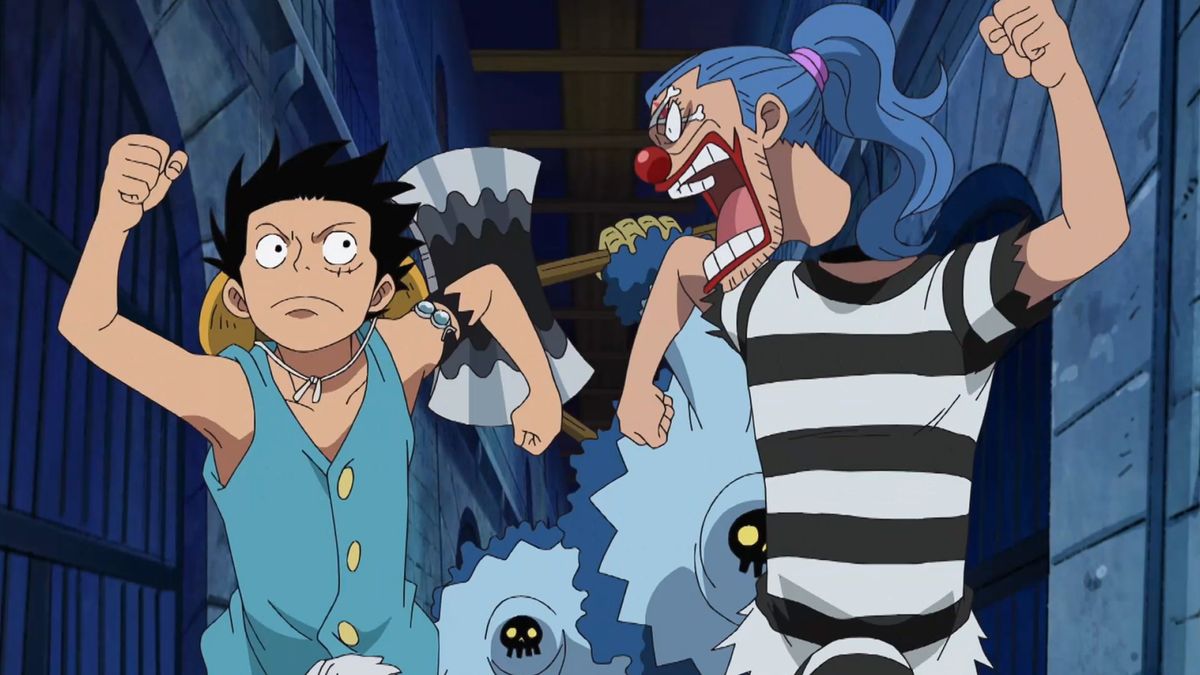
Luffy follows Ace’s Vivre Card downward. Hannyabal describes the prison’s punishment floors while Blue Gorillas return with Sea King meat. Buggy has escaped his cell and attracts surveillance, guards, and the Blugori. Luffy slips through a guarded door, reaches the Crimson Hell, asks prisoners about Ace, and learns that the most dangerous inmates live far below. Buggy and Luffy recognize each other during the chase. Both abandon stealth and attack the pursuing guards.
RaeRae’s opening receipt
Hancock defeats surveillance by turning the witness into stone, then restores the witness and lets procedure continue as though no gap ever happened. That move is not brute force. That move is editing the official record while everybody responsible believes the record stayed whole.
Luffy promises not to cause trouble approximately one hallway before meeting Buggy. Nobody familiar with either man should trust that sentence. Impel Down built six kinds of hell and still failed to budget for two East Blue disasters recognizing each other at running speed.
Domino reaches for Seastone
The cuffs would remove Hancock’s Devil Fruit advantage before the search begins.
Security understands power well enough to neutralize the obvious threat.
Hancock attacks the observer and the camera
Petrifying Domino alone would leave visual evidence.
She removes both human memory in motion and mechanical transmission in one decision.
The Love-Love Mellow becomes an infiltration tool
A power usually framed through attraction now creates a clean operational blind spot.
Hancock converts objectification into control over who gets to look.
Luffy finally leaves the cloak
The cramped hiding place carried him past the front gate but cannot survive a body search.
Protection has reached the limit of fabric.
Hancock apologizes for not taking him farther
She has already crossed the Calm Belt, deceived Marines, risked her title, and entered the world’s worst prison.
Love keeps measuring enormous labor as insufficient.
Luffy recognizes the achievement
His thanks is direct because he understands that entry would have been impossible without her.
Gratitude gives Hancock credit before the mission races onward.
He finally says Hancock correctly
The name replaces Hammock at the exact moment of separation.
One corrected word hits harder than every romantic fantasy she invented.
Hancock turns pronunciation into destiny
She imagines marriage because emotional hunger translates recognition into a complete future.
The joke works because Luffy remains entirely sincere and entirely elsewhere.
Her warning deserves attention
If guards catch Luffy, escape from beneath the sea may become impossible.
Hancock knows the prison better than his confidence allows.
Luffy promises quiet
He means the promise when he gives the promise.
Good intentions do not rewrite the chaos attached to his movement.
Hancock restores Domino
The officer returns without understanding the interruption.
Restoration completes the deception because a missing guard would trigger alarms.
The surveillance snail returns too
Recorded visibility resumes after the crucial passenger disappears.
An uninterrupted system can contain an invisible edit.
Hannyabal accepts the completed procedure
Timing, restored witnesses, and Hancock’s performance supply enough legitimacy.
Authority often trusts paperwork more readily than instinct.
The elevator separates allies vertically
Hancock descends through official channels while Luffy searches for stairs and openings.
Both routes move toward Ace under completely different rules.
A silent thank-you becomes I love you
Distance and desire do the translation before language arrives.
Hancock reads the message she hopes to receive.
Her collapse alarms the escort
Momonga and Hannyabal see a Warlord behaving inexplicably.
Romantic comedy almost becomes a security incident.
Luffy uses the Vivre Card as a compass
The burning paper points toward Ace through walls and numbered floors.
Family connection becomes physical navigation.
The card keeps the deadline visible
Shrinking edges remind Luffy that Ace’s life is running out.
Urgency travels in his hand rather than through a clock.
Hannyabal narrates institutional cruelty
Each lower level receives a themed punishment and a more dangerous population.
The tour turns suffering into an attraction for authorized guests.
Crimson Hell holds lower-ranked prisoners
Minor status does not mean minor pain.
The first floor already normalizes torture before deeper levels appear.
Wild Beast Hell waits below
Level Two uses creatures as guards, punishment, and terror.
The prison delegates violence to an ecosystem.
Starvation Hell weaponizes deprivation
Level Three turns food and water into instruments of obedience.
Need itself becomes the jailer.
Blazing Hell industrializes pain
Level Four boils bodies beneath administrative supervision.
Hannyabal describes the floor with the enthusiasm of a tour guide.
Enjoy the screams exposes the culture
Punishment has moved beyond confinement into entertainment for staff and visitors.
Dehumanization becomes workplace hospitality.
Blue Gorillas butcher Sea Kings
The Blugori return carrying meat from creatures that make the Calm Belt terrifying.
The guards establish strength before meeting Luffy.
Buggy has already escaped his cell
The clown treats collective imprisonment as an individual problem.
He leaves other prisoners behind without wasting breath on solidarity.
Surveillance catches the performance
Buggy spots the visual snail, greets the watcher, then attacks the instrument.
Stealth ends because his ego needs an audience even during escape.
The prisoners laugh because Buggy remains Buggy
His breakout carries bravado, panic, and unnecessary conversation.
Humiliation does not make him less theatrical.
Luffy slips through a door opened for another crisis
Guards responding to Buggy accidentally create Luffy’s route.
One escape destabilizes security for one infiltration.
Crimson Hell prisoners misunderstand Luffy’s direction
They assume a moving pirate must be escaping.
Entering voluntarily sounds more impossible than leaving.
Luffy asks about Ace before asking about safety
Every conversation becomes navigation toward his brother.
Self-preservation remains secondary.
The prisoners identify the lower level
Ace’s bounty and importance place him among inmates the Government fears most.
Hierarchy continues below ground through punishment categories.
They ask Luffy for keys
Hope attaches to any moving person who appears outside a cell.
Luffy cannot rescue everyone simply because everyone recognizes possibility.
Buggy appears in pieces
A Blugori attack looks fatal until detached body parts keep running.
The Chop-Chop Fruit makes panic visually impossible to ignore.
Recognition stops both men
Orange Town history enters the world’s most secure prison without invitation.
Old enemies become familiar faces in a place designed to erase familiarity.
Buggy assumes Luffy was captured
Breaking into Impel Down sounds too stupid even for the man he knows.
Luffy corrects him with the worse answer.
Buggy briefly imagines a rescue
Ego proposes that Luffy crossed the sea for him.
Reality returns before the fantasy gathers furniture.
The promise of no trouble expires
Blugori axes leave no useful space for quiet negotiation.
Luffy’s mission changes tactics without changing purpose.
Buggy and Luffy choose the same direction for different reasons
Luffy needs to descend. Buggy needs to escape.
Temporary alliance grows from crossing routes rather than shared goals.
The Blugori force cooperation
Neither pirate has time to settle old grievances under falling axes.
A common threat converts recognition into combat partnership.
Impel Down receives an uproar
The quiet infiltrator and selfish escapee strike together.
The prison’s perfect control begins failing on Level One.
This remains an episode React
This page responds to Hancock petrifying Domino and the surveillance snail, Luffy’s promise, the prison-level tour, Buggy’s escape, the Vivre Card, the prisoners’ directions, and the Blugori clash. Arc-level judgment remains separate.
React classification protects the episode-versus-Review boundary.
The official local still remains canonical
The Episode 423 official story image serves as featured image, hero, static directory card, and social preview through one local attachment.
Complete metadata preserves source, accessibility, filing, and unique use.
RaeRae’s final receipt
Hancock gets Luffy inside by interrupting the prison’s gaze, not by defeating the whole prison. She turns Domino and the surveillance snail to stone, releases her passenger, restores the official scene, and walks away under escort. That is a heist compressed into one body search.
Luffy follows Ace’s Vivre Card into a system designed to make suffering both organized and entertaining. Hannyabal proudly lists the hells. Prisoners beg for keys. Buggy runs past them because his freedom remains the only freedom in his plan.
Then Orange Town crashes into Impel Down. Luffy and Buggy recognize each other, Blugori axes remove the option of quiet, and the least subtle alliance available becomes the only one moving. Hancock asked for no trouble. The prison has officially run out of that fantasy.
Hancock controls visibility rather than reality
Domino still performs the search and the camera still resumes observation.
The rescue succeeds because the crucial seconds disappear from institutional knowledge.
Restoration makes the deception elegant
No broken camera, missing officer, or unexplained fight remains behind.
Security sees continuity because Hancock repairs the stage after changing the cast.
Luffy’s gratitude matters to Hancock beyond romance
Most people approach her through fear, desire, or political calculation.
He thanks the person who helped rather than the beauty everyone else performs for.
The name correction confirms attention
Hancock hears evidence that Luffy remembered something about her specifically.
Her imagination overreacts because basic recognition has become emotionally rare.
The Vivre Card rejects prison architecture
Walls hide cells and signs control official movement, but the paper keeps pointing toward Ace.
Relationship supplies a map the institution cannot confiscate because guards never knew Luffy entered.
Hannyabal makes hell sound managerial
Named floors, inmate classifications, and guided elevators package torture as efficient administration.
Vocabulary cleans the surface while screams reveal the product.
Buggy attacks surveillance emotionally
He does not calculate a blind spot like Hancock.
He feels insulted by being watched and turns irritation into evidence of his location.
Two kinds of rule-breaking meet
Hancock violates procedure with control and precision. Buggy violates procedure with noise and offended pride.
Luffy benefits from both.
The prisoners become an immediate moral pressure
Every cell contains someone asking the intruder to expand his mission.
Luffy cannot stop, yet their requests prevent the prison from becoming background scenery.
Ace’s rescue already touches other lives
Opening routes, distracting guards, and defeating Blugori change conditions for inmates Luffy never came to meet.
Focused action creates wider consequences.
Buggy knows escape and Luffy knows force
The clown brings local experience from incarceration. The captain brings strength and refusal.
The alliance forms around complementary survival knowledge.
Neither man trusts the other
History gives them excellent reasons for suspicion.
Trust is unnecessary when axes make the next move obvious.
The Blugori reveal scale through defeat
Guards capable of butchering Sea Kings meet a pirate whose recent enemies included a Warlord and a Celestial Dragon’s protectors.
Impel Down’s baseline monster collides with Luffy’s rising baseline.
Stealth ends without ending the mission
The plan changes from invisible movement to managed chaos.
Adaptation matters more than loyalty to a failed method.
Hancock continues descending in parallel
Her official route may still bring her close enough to Ace to carry information or hope.
Separation does not end her part in the rescue.
Buggy changes the emotional temperature
The prison promises dread. His arrival injects irritation, vanity, and old rivalry.
Comedy gives Luffy company without making the danger smaller.
Episode 423 opens the ensemble door
Luffy entered alone, but Impel Down already contains former enemies, future allies, and people with separate escape plans.
The rescue begins assembling a crew nobody would choose on paper.
RaeRae’s extra receipt
Episode 423 proves that perfect security fails differently around different personalities. Hancock studies the gaze, removes the witnesses, and restores the scene. Buggy punches the camera because the camera annoys him. Luffy slips through the opening created by both approaches and calls that a plan after the fact.
The comedy never erases the prison’s cruelty. Hannyabal treats screams as atmosphere. Prisoners ask a stranger for keys. Blue Gorillas carry Sea King meat before turning axes toward human bodies. Luffy came for one brother, but every hallway keeps showing what the institution requires everyone else to endure.
The reunion makes Impel Down feel smaller and stranger
Buggy belonged to Luffy’s earliest pirate history, long before Warlords, sky islands, and government war. Finding him here folds the beginning of the voyage into the coming war.
The prison collects people the wider world wants contained, so old enemies can become the nearest familiar face. Recognition does not create friendship. Recognition does create a shared language under an axe, which is enough for the next fight.