RaeRae Reacts · One Piece Episode 422
Hancock Carries Luffy Through Impel Down Until Domino Demands a Search
One Piece Episode 422 React follows Garp and Ace, Whitebeard as chosen father, Hannyabal, Domino, Seastone cuffs, and the Impel Down body-search threat.
One Piece Episode 422 React: Garp visits Ace beneath the sea, Hancock carries Luffy through Impel Down’s front gate, Hannyabal introduces a prison built around ambition and spectacle, and Domino’s mandatory body search threatens the entire rescue before Luffy reaches Level One.
What happened in Episode 422
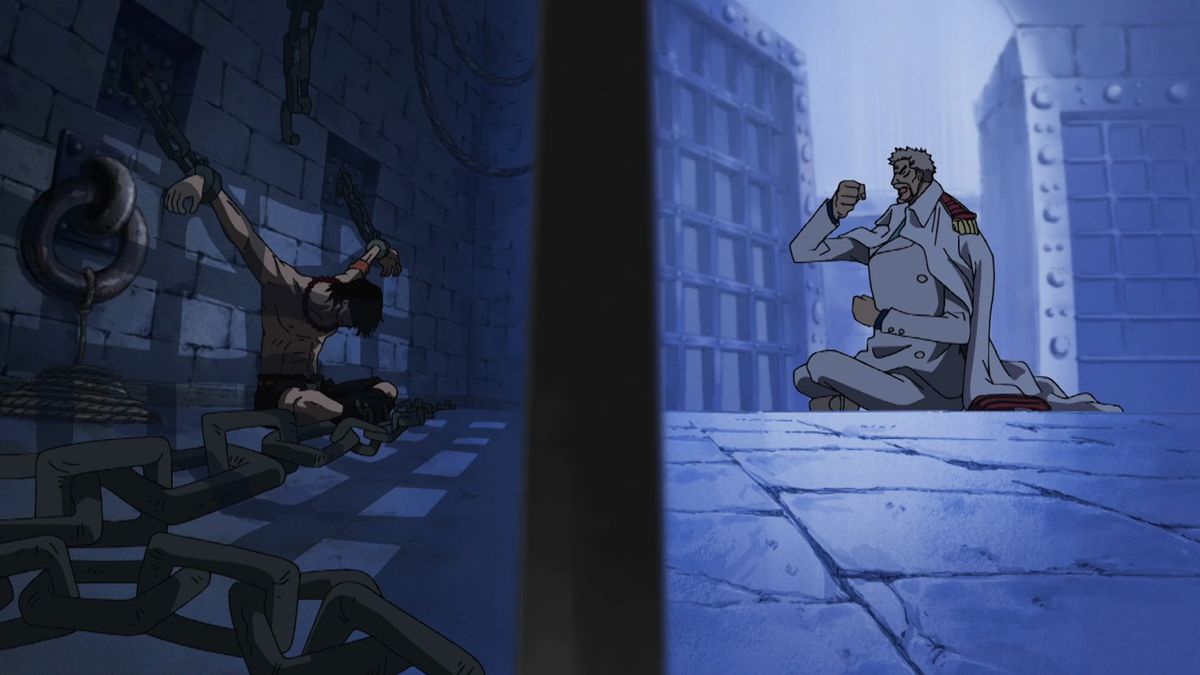
Garp sits with Ace in Impel Down and talks about Luffy’s attacks on Enies Lobby, Water 7, and a Celestial Dragon at Sabaody. The conversation reaches Dragon and inherited criminal reputations. Ace rejects blood as the final definition of family and names Whitebeard as his only father. Above the submerged prison, Momonga’s ship passes Buggy’s crew and arrives with Hancock. Luffy hides beneath her cloak while Hannyabal and Domino receive the Warlord.
Hannyabal keeps exposing his desire to replace Warden Magellan, then tries to disguise every confession as a harmless slip. Domino explains Impel Down’s security and takes Hancock into a private room for a full search. Seastone cuffs will disable her powers. Visual surveillance watches the room. Hancock must protect Luffy without revealing an unauthorized passenger, and the rescue mission reaches its first locked door before the prison tour begins.
RaeRae’s opening receipt
Impel Down sells absolute control through gates, currents, cameras, chains, and ritual humiliation. Episode 422 walks Luffy inside by exploiting the one thing the institution cannot process cleanly: Hancock’s status. She belongs to the pirate class the Government publicly condemns and the Warlord class the Government temporarily needs.
Meanwhile, Ace refuses the state’s favorite definition of identity. Blood connects him to Roger. Love connects him to Whitebeard. A prison can catalogue lineage, crime, and sentence. Ace still decides who receives the word father.
Garp arrives as family and jailer
He visits without pretending his Marine rank disappears at the cell door.
The conversation hurts because affection and institutional obedience occupy the same chair.
Ace remains chained beneath the sea
Seastone and depth turn escape into a mathematical impossibility.
The prison uses geography as another guard.
Garp talks about Luffy with unmistakable pride
Enies Lobby and Sabaody sound like disciplinary nightmares to the Marines.
To Garp, those disasters also prove that his grandson refuses cowardice.
The Celestial Dragon punch reaches the cell
News of Luffy striking Charlos travels farther than Luffy can.
Defiance becomes emotional contact between separated brothers.
Dragon enters through inherited reputation
Garp frames both brothers as men carrying blood connected to world-level criminals.
The Government reads ancestry as evidence before action begins.
Ace refuses the bloodline verdict
Roger’s name has followed him since before birth.
Rejecting that identity protects the self Ace built through chosen bonds.
Whitebeard receives the word father
Ace names the man who welcomed, disciplined, and claimed him.
Parenthood becomes sustained care rather than biological fact.
The statement carries loyalty and fear
Whitebeard will not accept Ace’s execution quietly.
Calling him father also names the person now sailing toward catastrophic danger.
Garp knows the war coming toward the prison
Marine planning treats execution as strategy against an Emperor.
Family knowledge makes that strategy personal before the battlefield opens.
A pirate ship appears near Momonga’s route
Buggy’s crew searches the sea without understanding how close their captain sits to Luffy’s destination.
Separate comic trouble begins converging on the same fortress.
Richie cannot solve a submerged prison
Buggy’s followers bring loyalty and noise, but Impel Down’s Calm Belt defenses exceed their reach.
Devotion does not automatically become capacity.
Momonga recognizes danger without seeing Luffy
The vice admiral escorts one Warlord while unknowingly transporting the pirate who attacked Enies Lobby.
Security depends on information, and Hancock controls the missing fact.
Hancock steps onto enemy architecture as an honored guest
Her title opens doors that would close around any ordinary pirate.
The Warlord system converts selective criminality into government access.
Luffy hides beneath ceremonial clothing
The same cape that performs imperial status becomes physical cover for rebellion.
Public image protects the person the public image should exclude.
Every step asks Hancock to control her body
A stumble, heartbeat, glance, or unexpected movement could expose Luffy.
Romantic panic must become operational discipline.
Impel Down appears engineered as finality
Sea, walls, gates, warships, and monstrous guardians tell visitors that escape belongs outside reasonable thought.
Architecture performs hopelessness before punishment begins.
The Calm Belt supplies living defenses
Sea Kings surround routes ordinary ships cannot safely cross.
Nature becomes part of the prison contract.
Justice enters through a controlled checkpoint
Visitors do not simply walk inside, regardless of rank.
Procedure assures the institution that every body has been named, searched, and placed.
Hannyabal greets power while advertising ambition
He wants Magellan’s office badly enough to announce the desire by accident again and again.
Professional courtesy keeps losing to career hunger.
His comedy reveals a hierarchy under strain
Impel Down looks monolithic from outside.
Inside, deputies compete, complain, and imagine promotion like workers anywhere else.
Hannyabal says my prison too early
The correction arrives after the truth.
Authority becomes personal possession in his imagination.
Domino represents the system without leakage
She explains each rule, directs movement, and notices every requirement.
Her professionalism creates a more dangerous obstacle than Hannyabal’s vanity.
The prison turns visitors into searchable objects
Warlord status does not exempt Hancock from a full-body inspection.
Control reaches beneath costume and title.
Seastone cuffs change the power balance
Domino requires Hancock to surrender Devil Fruit protection before the search.
Procedure deliberately removes the visitor’s strongest refusal mechanism.
Hancock agrees because Ace matters to Luffy
Every concession would normally offend her pride.
Love translates humiliation into a chosen cost.
The search room becomes the real gate
Ships, Sea Kings, and guards have already failed to detect Luffy.
One trained woman following protocol now threatens the plan more than the fortress exterior.
A visual Den Den Mushi watches
Even a private search remains institutional surveillance.
Hancock cannot merely distract Domino while unseen witnesses continue recording.
Luffy must trust someone else’s timing
He usually solves barriers by moving first and punching hard.
Under the cloak, action would destroy the rescue before entry.
Silence becomes Luffy’s first prison challenge
Remaining still demands a kind of discipline combat rarely requires from him.
The mission tests restraint before strength.
Hancock holds two performances at once
She must look contemptuous enough to remain herself and calm enough to avoid suspicion.
The private woman protecting Luffy operates beneath the public Pirate Empress.
Momonga sees only the official visit
He expects Hancock to meet Ace and then join the coming war.
Her cooperation gives the deception institutional credibility.
The Government built the opening
Recruiting pirates as Warlords created exceptions inside rigid security.
Luffy enters through a contradiction manufactured by the state.
Ace does not know help reached the gate
His conversation with Garp remains shaped by approaching execution and Whitebeard’s response.
Dramatic tension lives in the vertical distance between brothers.
Luffy does not know Garp just visited
Family members occupy the same prison without sharing knowledge.
Impel Down controls communication as tightly as movement.
Buggy’s presence adds another hidden variable
The former East Blue enemy has already entered the prison system.
Luffy’s solo rescue will not remain solo for long.
The episode refuses a triumphant infiltration
Arrival does not equal access.
Every completed step opens a more intimate security test.
Impel Down makes bodies administrative evidence
Chains identify prisoners, uniforms identify staff, and searches verify visitors.
Luffy survives by becoming an unregistered shape beneath someone else’s clothing.
Ace defines himself while Luffy hides himself
The prisoner speaks his chosen family aloud.
The rescuer temporarily erases his identity to get closer.
Both brothers reject Government categories
Ace rejects biological guilt as personal truth. Luffy rejects a fortress designed to make intervention impossible.
One uses language. One uses concealment.
This remains an episode React
This page responds to Garp’s visit, Ace naming Whitebeard as father, Buggy’s nearby crew, Hancock’s entrance, Hannyabal’s ambition, Domino’s search, Seastone cuffs, and the surveillance snail. Arc-level judgment remains separate.
React classification protects the episode-versus-Review boundary.
The official local still remains canonical
The Episode 422 official story image serves as featured image, hero, static directory card, and social preview through one local attachment.
Complete metadata preserves source, accessibility, filing, and unique use.
RaeRae’s final receipt
Episode 422 introduces Impel Down by showing how institutions manufacture certainty. The prison has ocean depth, monsters, warships, gates, cameras, searches, Seastone, and staff trained to account for every body. Then Hancock walks through carrying an unaccounted-for pirate under the symbol of her government-approved rank.
Garp and Ace supply the emotional thesis before the infiltration supplies the machinery. The world can name Ace as Roger’s son. Ace can still name Whitebeard as father. Systems classify people by blood and paperwork because those categories are easier to police than love.
Luffy reaches the front door without throwing a punch. Hancock pays for every meter through control, humiliation, and risk. Domino closes the room, raises the cuffs, and turns a body search into the first real boss fight of Impel Down.
Garp’s pride cannot rescue Ace
He can admire Luffy’s rebellion and love both brothers while continuing to serve the institution arranging execution.
Emotion without action leaves the cell locked.
Ace’s chosen father changes the meaning of war
Whitebeard does not sail merely to recover a subordinate.
The coming fleet carries a parent’s refusal to surrender a son.
Hancock weaponizes the Government’s assumption
Officials believe a Warlord will serve state interests because the title offers protection.
She uses that protection to shelter the state’s most disruptive intruder.
Contradictory alliances create security gaps
The Marines distrust pirates while depending on pirate strength.
Hancock crosses the gap created by that compromise.
Hannyabal wants responsibility as status
His promotion dream focuses on the title, office, and ownership language.
The episode has not yet shown equal hunger for the burden.
Domino performs responsibility as labor
She checks cuffs, surveillance, procedure, and visitor compliance.
Competence receives less comedy and creates more danger.
The search threatens Hancock’s autonomy
A government invitation still includes control over her clothing and body.
Warlord privilege remains conditional and revocable.
Her cooperation is strategic rather than submissive
Hancock chooses the temporary restraint because refusal would strand Luffy outside.
Consent under mission pressure can be chosen without becoming comfortable.
Luffy’s rescue depends on a woman doing invisible work
He receives the adventure headline. Hancock manages transport, food, concealment, access, and emotional control.
The infiltration succeeds through logistics before heroics.
That labor deserves more than a romance joke
Her feelings create comedy, but her planning creates the route.
Episode 422 lets both truths coexist.
Impel Down’s vertical design stages social power
Officials descend by controlled elevator while prisoners occupy named hells below.
Movement through the building maps rank onto space.
Ace sits at the bottom of policy
Decisions made by Sengoku and the World Government become chains around one body deep underground.
Hierarchy hides authors from consequences.
Surveillance promises objectivity and still misses context
The visual snail can record a room but cannot understand Hancock’s motives without seeing through her performance.
More observation does not guarantee better knowledge.
Luffy enters because people remain unpredictable
No security blueprint can fully model love, loyalty, vanity, or improvisation.
Human contradiction defeats institutional certainty.
The episode moves slowly on purpose
Every checkpoint stretches anticipation because one mistake can end the mission.
Suspense replaces combat without lowering stakes.
The brothers occupy opposite forms of agency
Ace cannot move but speaks his identity freely. Luffy can move only by remaining silent and hidden.
Freedom divides across body and voice.
Family drives every major decision
Garp visits, Ace names Whitebeard, Luffy infiltrates, and Hancock risks her standing because Luffy asked.
The prison holds bodies while relationships keep crossing walls.
The front gate victory remains incomplete
Luffy has entered the building but has not entered the prisoner levels.
Episode 422 refuses to mistake proximity for rescue.
RaeRae’s extra receipt
Impel Down believes nobody can enter uncounted because every visitor becomes a procedure. Hancock answers with performance sharp enough to turn official access against official security. Luffy contributes trust, silence, and the rare good sense to stay under the cloak.
Ace’s scene keeps the mission from becoming a clever burglary exercise. A man awaiting execution tells his grandfather that fatherhood belongs to the person who chose him. Above, another chosen brother crosses a fortress to answer that bond. Blood explains why the Government hates Ace. Love explains why the prison will not stay quiet.
The body-search cliffhanger earns the pause
Domino does not need greater strength than Hancock to threaten the mission. She needs a closed room, a clear rule, Seastone, and the expectation that every visitor complies. Procedure concentrates all of those advantages into one ordinary action.
Hancock must solve the search while protecting Luffy, preserving her Warlord cover, and leaving no evidence that would seal the prison. Episode 422 ends before the answer because the smallest checkpoint now carries the entire rescue.