RaeRae Reacts · One Piece Episode 407
Boss Luffy Rescues Brook and the Whole Town Rebuilds One Mikoshi
One Piece Episode 407 React follows Brook’s rescue, a coalition rebuild, the Grand Jipang race, and one ridiculous sacred treasure.
One Piece Episode 407 React: Brook tries to carry Thriller Company’s guilt alone, Boss Luffy and Zoro break him free, rival teams rebuild one shared mikoshi, and a crooked race ends with the most One Piece sacred treasure possible.
What happened in Episode 407
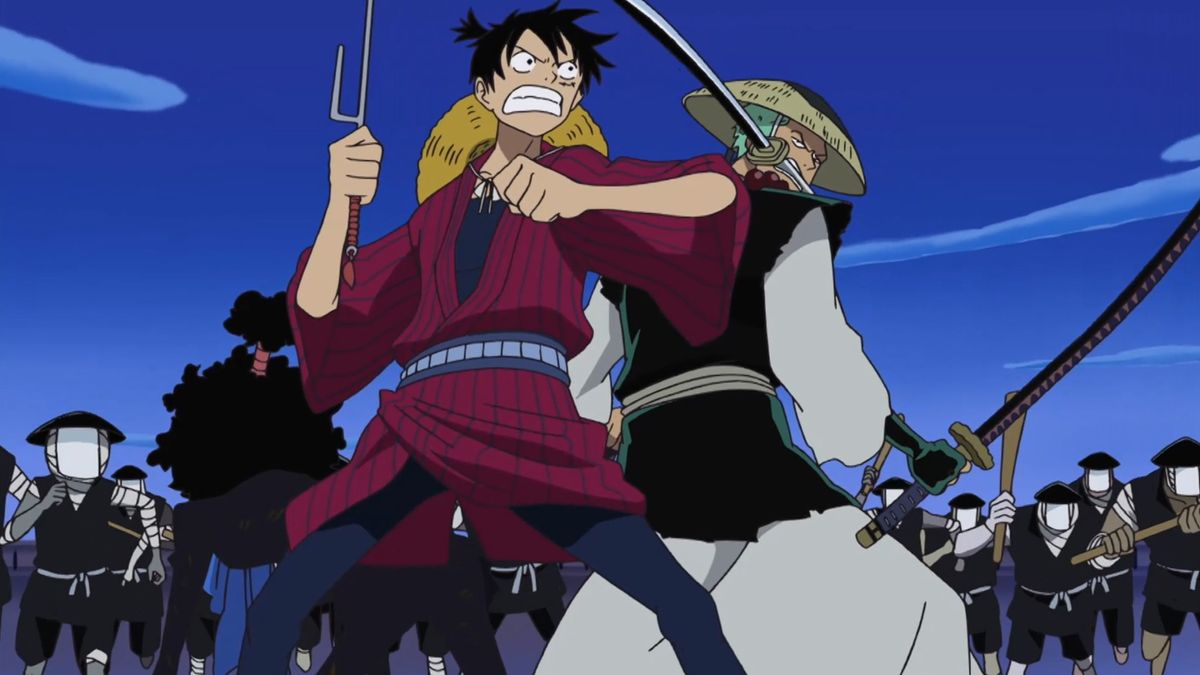
Brook attacks Thriller Company alone and gets captured. Robin explains that he left the company because he rejected its sabotage, so Boss Luffy goes after him. Luffy and Zoro free Brook, and Robin covers their escape. Franky’s team rebuilds the mikoshi with materials donated by the Flying Fish Riders and Rolling Express. During the race, Thriller Company cheats again, but the Pinwheel Eatery team wins. The sacred treasure turns out to be golden women’s underwear, and Brook’s final joke earns another blow to the head.
RaeRae’s opening receipt
Episode 407 understands that Brook’s guilt is useful to the people who betrayed him. If he fights alone, Thriller Company gets to isolate the dissenter again. If his new friends believe him and show up, the company’s version of his past loses control.
The rescue matters before the race because community is the prize worth winning.
Brook walks toward danger as though responsibility means solitude
He remembers belonging to Thriller Company and sees wrecked shrines around town. Shame convinces him every consequence now belongs on his shoulders.
Accountability becomes distorted when somebody treats support as undeserved.
His conscience was the reason the company rejected him
Brook did not leave because sabotage failed to benefit him. He left because destroying other people’s work was wrong.
The trait making him feel guilty is also the evidence that guilt does not belong to him.
Thriller Company captures the person who knows its methods
Hogback, Perona, and Absalom can punish dissent and prevent testimony at the same time.
Control depends on keeping former insiders isolated.
Brook’s solo attack repeats the original power imbalance
One skeleton enters an organization with zombies, hidden abilities, and established territory. Courage cannot correct the numbers by itself.
Bravery needs relationship to become sustainable resistance.
Robin supplies context instead of judgment
She explains that Brook opposed the company’s wrongdoing and likely blames himself for damage caused after his return.
Accurate history interrupts the easiest assumption that former membership equals shared guilt.
Knowing why somebody left matters
Affiliation records only where Brook once stood. Motive reveals the moral decision that separated him from the group.
Identity cannot be audited through labels alone.
Boss Luffy does not require a complete testimony
Robin’s explanation confirms what his instinct already recognized. Brook needs help, and enemies are hurting him.
The rescue begins before every historical detail becomes tidy.
Zoro arrives through irritation and perfect timing
Noise wakes him, danger attracts his attention, and complaint becomes participation. The swordsman never needs ceremonial recruitment into a friend’s problem.
Action carries loyalty beneath the grumbling.
Luffy breaks the gate because the company built separation physically
Walls and guards turn Brook’s punishment into private business. One smashed entrance returns witnesses and allies to the scene.
Breaking property can restore public accountability when property hides abuse.
The zombies lose power once the rescue becomes collective
Thriller Company planned for one guilty dissenter. Luffy and Zoro change the numbers and the emotional terms.
Support denies the villains their preferred battlefield.
Brook receives rescue without a lecture
Nobody pauses to explain that his guilt was irrational before cutting him free. Safety comes first.
Understanding can continue after the body leaves danger.
Robin’s smoke bomb values exit over domination
The group does not need to destroy every enemy inside headquarters. Cover creates a route home.
Strategic retreat protects the real objective.
The workshop welcomes Brook back through shared labor
He returns expecting wreckage and accusation. Instead he finds friends already rebuilding.
Community answers shame by making room for useful hands.
Franky’s injury does not end his role as builder
He directs, adjusts, and contributes while others supply strength and materials.
Craft knowledge survives when the craftsperson cannot perform every task alone.
The Flying Fish Riders donate what remains
Their mikoshi was destroyed through Perona’s attack. Salvaged material enters the new shrine rather than becoming proof that their race ended meaninglessly.
Loss gains a future through contribution.
Rolling Express joins the same rebuild
Another sabotaged rival refuses to let Thriller Company convert damage into division.
Competitors become collaborators because fair competition requires everybody’s right to reach the start.
The shared mikoshi contains several defeated entries
Wood and parts from separate teams become one vessel. The build records harm without preserving isolation.
Repair becomes a coalition in physical form.
Thriller Company accidentally creates its strongest opponent
By attacking everyone, the company gives every rival a common reason to unite.
Control strategies can manufacture solidarity when damage becomes visible.
Mao belongs inside the work rather than waiting as a mascot
Her presence connects the eatery, workshop, and festival community. The original character participates in the outcome her town will remember.
Belonging grows through shared stakes.
Brook’s music can accompany rebuilding rather than mourning
The skeleton’s art no longer belongs to a company that discarded him. Music enters a community choosing repair.
Creative work changes meaning through relationship.
The race finally begins after sabotage failed to erase competition
Reaching the starting line becomes a victory before anyone moves. Thriller Company could damage shrines but could not prevent a challenger from appearing.
Participation rejects their ownership of the festival.
A mikoshi race makes teamwork physically visible
Carriers must coordinate pace, direction, balance, and endurance. One strong person cannot drag everyone toward victory without rhythm.
The contest turns community alignment into motion.
Luffy supplies momentum without becoming the entire team
His energy pulls people forward, but steering and balance require every carrier.
Leadership works through shared movement rather than solitary speed.
Usopp reads cheating before confidence collapses
Thriller Company relies on hidden tricks and panic. Usopp’s suspicion becomes useful because he expects dishonest interference.
An anxious mind can detect danger optimistic rivals miss.
Onami keeps money and pride in honest view
She wants the prize, respects the work, and refuses to pretend the contest is spiritually pure.
Practical desire grounds the festival’s magic.
Sanji turns protective instinct into race support
Threats against women and teammates redirect his speed immediately. Comedy and reliability remain linked.
The alternate role preserves his central loyalty.
Chopper brings earnest belief to the sacred treasure
A wish-granting prize sounds possible because wonder remains available to him.
His faith makes the eventual joke gentler rather than cynical.
Franky’s finished mikoshi carries Sunny energy
Bold design and impossible mechanisms turn festival craft into spectacle. The builder refuses quiet adequacy.
His signature survives the historical remix.
Thriller Company cheats because open comparison threatens its image
A fair race could reveal that collective labor outperforms sabotage. Hidden attacks protect the company’s claim to superiority.
Cheating becomes reputation management.
Absalom’s invisibility cannot hide a pattern forever
Earlier attacks taught the team what unexplained movement means. Repetition turns mystery into evidence.
Survivors learn the shape of concealed harm.
Perona’s negativity meets people carrying one another
Individual shame becomes less effective when teammates can restore rhythm and purpose.
Connection does not make despair impossible, but connection gives despair opposition.
Brook faces his former company beside friends
The second confrontation changes the emotional geometry. He no longer needs to prove moral independence through solitary suffering.
Support lets accountability point outward toward the people who caused harm.
The Pinwheel team wins without becoming the only contributor
Several communities supplied the winning shrine. The result belongs beyond the official names on the entry.
Victory becomes shared memory rather than exclusive property.
The sacred treasure has survived a century of expectation
Rumor turned an unseen object into a wish machine. Ceremony magnified desire until no physical reveal could carry the same scale.
The joke begins with the distance between belief and inventory.
Golden underwear is exactly the wrong and right answer
The treasure cannot grant noble wishes and refuses sentimental closure. The visual is valuable, absurd, and connected to Brook’s most predictable joke.
One Piece punctures grandeur without mocking the relationships built along the route.
Brook returns to his underwear question immediately
Amnesia, betrayal, rescue, and community have not revised his shameless comic instinct.
Identity becomes undeniable through the joke everybody wishes he would retire.
Mao’s punch completes the loop
Brook receives a blow for the suggestion and loses memory again. The two-part plot closes where absurd discovery began.
Comedy resets biography after relationships already proved who he is.
The ending does not erase his moral choice
Even if memory disappears, Brook rejected sabotage, protected strangers, and accepted friendship through action.
Character survives the final gag.
The special gives viewers a reunion without falsifying canon
Familiar faces cooperate in Grand Jipang while their main-story counterparts remain scattered.
Clear alternate-setting labels allow comfort and continuity to coexist.
The two-part break earns its placement
Sabaody ended with helpless subtraction. Grand Jipang answers through gathering materials, allies, and laughter.
The broadcast offers emotional counterweight before Amazon Lily returns to Luffy’s isolation.
This remains a numbered episode React
Episode 407 is the second alternate-setting Grand Jipang television special inside broadcast chronology. The page responds to its rescue and race rather than classifying the installment as a movie Review.
React taxonomy preserves the numbered sequence and the site’s content-type rule.
The official local still remains canonical
The Episode 407 official still serves as featured image, hero, static card, and social preview through one local WordPress attachment.
Complete metadata identifies Grand Jipang, Brook, Thriller Company, and the mikoshi story while keeping the image unique.
RaeRae’s final receipt
Brook believed the broken shrines made him dangerous to his new friends. Robin provides the missing receipt: he left Thriller Company because he opposed the sabotage. Boss Luffy supplies the next receipt by smashing through the gate. Believing Brook means showing up.
The rebuild is the episode’s real victory. Flying Fish Riders and Rolling Express donate the remains of their own entries. Franky turns wreckage into one shared mikoshi. Thriller Company attacked competitors individually and accidentally built a coalition.
Then the sacred treasure is golden underwear because One Piece refuses to leave sincerity on a pedestal. Brook makes the joke, Mao supplies the punch, and memory disappears again. The community does not. A company tried to win by ensuring nobody else reached the road. Friends answered by carrying one another all the way to the finish.
The rescue separates responsibility from punishment
Brook can acknowledge former membership without accepting torture as accountability. The people who ordered sabotage remain responsible for sabotage.
Justice does not require a dissenter to absorb every consequence created after departure.
Robin acts as a witness for somebody whose memory failed
She knows enough to preserve the moral record Brook cannot fully narrate. Her explanation prevents enemies from owning his history.
Witnessing becomes a form of care.
Zoro’s accidental arrival still becomes chosen help
He may follow noise rather than a plan, but he stays once the problem becomes visible.
Commitment is measured after discovery.
Shared salvage refuses the shame of damaged work
Broken mikoshi parts do not need to disappear from view. They can become visible pieces of the winning build.
Repair honors labor by giving remnants another purpose.
The race belongs to everyone who made the start possible
Carriers receive attention, yet donors, builders, cooks, watchers, and rescuers created the entry.
Public victories rest on quieter networks.
The treasure joke protects the story from transactional morality
The team does not receive a perfect wish matching every good deed. Friendship, rescue, and solidarity already produced the meaningful reward.
Golden underwear exposes how little the promised object mattered.
RaeRae’s extra receipt
Episode 407 says a former bad affiliation does not own somebody forever. Brook’s refusal mattered. Robin’s testimony mattered. Luffy and Zoro showing up mattered. The town rebuilding together mattered.
The punchline can be underwear because the emotional account already settled elsewhere. Nobody needed a sacred object to grant the wish Brook could not name. He needed people who heard the truth and came through the gate.
The final laugh belongs to a town that reached the finish together after sabotage tried to erase every starting line.
The rebuilt shrine makes community visible at the finish
Franky’s design carries parts donated by teams Thriller Company tried to erase. Every step turns damaged entries into proof that sabotage failed to control memory.
The official winner is one team, but the mikoshi physically records a town choosing solidarity over isolated defeat.
The finish matters because everyone sabotaged before the race reaches the road through one shared build.