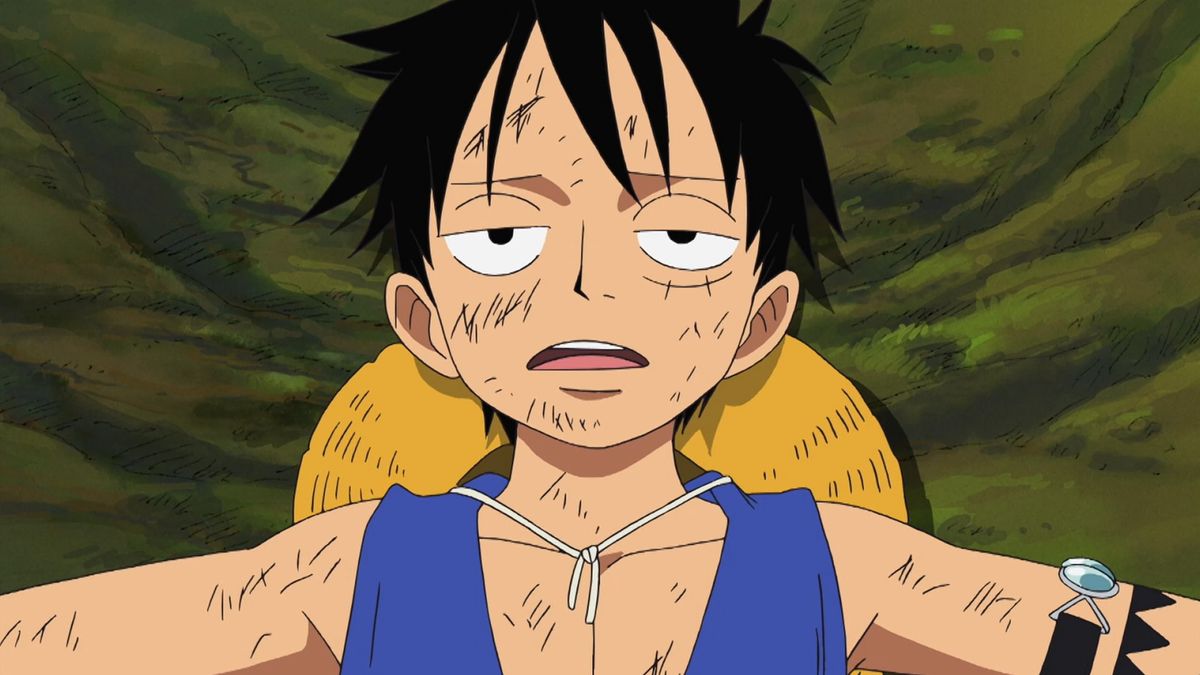
RaeRae Reacts · One Piece Episode 408
Amazon Lily Saves a Mushroom-Covered Stranger Before Naming Him Forbidden
One Piece Episode 408 React follows Luffy’s three-day flight, jungle landing, mushroom poisoning, and lifesaving Kuja treatment.
One Piece Episode 408 React: Luffy survives Kuma’s three-day flight, lands alone on Amazon Lily, eats the worst possible mushrooms, and receives lifesaving care from women who do not yet realize their strange patient is the island’s forbidden first man.
What happened in Episode 408
Duval’s riders guard the Sunny while Shalria demands revenge and Shakky shelters Camie, Hatchan, and Pappag. Luffy flies through the sky for three days, reasons that his crewmates may also be alive, and lands in a jungle. Hunger leads him to a boar and emotion-changing mushrooms, then a parasitic mushroom covers his body. Marguerite, Sweet Pea, and Aphelandra carry him to their village for treatment. During washing, Nyon identifies Luffy as a man on the women-only island Amazon Lily.
RaeRae’s opening receipt
Episode 408 answers the first Sabaody question with one body hitting one jungle. Luffy is alive. The crew remains absent. Relief and loneliness land together.
Amazon Lily begins through care before law. Three strangers find somebody dying under mushrooms and choose treatment without requiring a name.
Duval protects the Sunny because promises survive separation
The crew cannot guard its own ship, so the Rosy Life Riders take responsibility. Their earlier rescue relationship becomes practical loyalty.
A network built before crisis preserves the crew’s future route.
The Sunny becomes evidence that reunion remains possible
No Straw Hat stands on Sabaody, but their ship still occupies space. Protecting the vessel protects a shared destination.
Home can wait for people without knowing where they went.
Shalria wants bodies returned as property
Her response to Charlos’s injury is not reflection. She demands capture, enslavement, and torture.
Privilege reads resistance as proof that domination should intensify.
The nobles remain physically safe after creating island-wide violence
Marines, Pacifistas, pirates, and residents absorbed the consequence. Charlos and Rosward receive protection and care.
Power exports danger downward.
Shakky shelters the people the auction targeted
Camie, Hatchan, and Pappag remain together inside the bar. Immediate safety does not erase concern for the scattered rescuers.
Survival creates room for worry rather than replacing worry.
Shakky recognizes a changing era
The Supernovas, Rayleigh, Kuma, and the government’s response signal movement larger than one grove.
History often becomes visible first through pressure on ordinary relationships.
Luffy’s flight confirms Kuma displaced rather than erased him
The paw ability turned disappearance into three days of forced travel. Being alive changes the meaning without making the experience voluntary.
Rescue and violation can occupy the same action.
Three days in the air removes every captain’s tool
Luffy cannot steer, stop, contact anyone, or protect a crewmate. His body follows a destination chosen by Kuma.
Loss of agency continues after Sabaody leaves view.
He thinks about the crew before his own landing
The flight becomes bearable once he reasons that everyone else may also be moving through the sky alive.
Hope begins as an inference built from shared experience.
The fear of ocean remains immediate
A Devil Fruit user falling into open water would have no route back. Every cloud gap carries lethal uncertainty.
The same power that saved him leaves survival dependent on destination.
Sleep becomes the only decision still available
Luffy cannot control direction or duration, so he conserves body and mind. Rest looks absurd and rational at once.
Acceptance becomes survival when action has no purchase.
The jungle landing proves Kuma chose land
Luffy crashes through vegetation and wakes alive. The destination contains food, people, and danger rather than an empty sea.
Intent begins to show through geography before Kuma explains anything.
Rayleigh’s vivre card gives Luffy a direction
The paper still points toward a person connected to the Sunny and Sabaody. The crew’s last plan survives inside a small moving clue.
Navigation begins before Luffy understands the island.
A wild boar makes hunger the first local conflict
Grand questions about reunion meet an animal trying to eat him. Survival returns through appetite and immediate combat.
The story grounds catastrophe in lunch.
Garp’s training memories turn food into childhood history
The jungle struggle recalls a grandfather who treated danger as preparation. Luffy’s body knows how to improvise because hardship once arrived as education.
Memory supplies competence without softening the old cruelty.
Cooking the boar restores one ordinary rhythm
Hunt, fire, food, and sleep belong to countless travels. Alone, those routines feel newly fragile.
Normal appetite becomes proof that Luffy’s life continues.
The mushrooms weaponize curiosity and hunger
Bright fungi offer easy abundance after exhaustion. Luffy eats before learning local danger.
His greatest survival instinct remains inseparable from his worst culinary judgment.
Emotion-changing mushrooms turn the jungle into slapstick
Different bites trigger laughter, anger, sadness, and excitement. Internal feeling becomes environmental chemistry.
Comedy reintroduces emotional range after Sabaody fixed him inside grief.
The parasitic mushroom punishes abundance
One meal keeps growing after Luffy sleeps. Food becomes a drain on the body rather than restoration.
The island’s beauty contains precise biological hazards.
Luffy cannot punch a condition he does not notice
Unconsciousness lets mushrooms cover him while strength remains irrelevant.
Vulnerability returns through medicine rather than combat.
Marguerite, Sweet Pea, and Aphelandra follow smoke
They investigate a sign that could mean fire, trespass, or distress. Attention leads them to a stranger.
Community safety begins with people willing to check unusual evidence.
They identify a patient before an intruder
Mushrooms hide Luffy’s face and gender. The women see somebody whose vitality is being consumed.
Care receives priority over classification.
Marguerite recognizes the parasite
Local knowledge turns a bizarre body into a treatable emergency. Naming the mushroom changes panic into steps.
Expertise matters because the strongest visitor cannot diagnose himself.
Aphelandra carries Luffy without demanding reciprocity
Her size makes urgent transport possible. The stranger contributes nothing while unconscious.
Rescue begins from need rather than earned exchange.
The village gathers around treatment
Curiosity brings a crowd, but Belladonna directs practical care. Mushrooms must be removed before they consume remaining strength.
Collective attention becomes useful under expertise.
Pulling mushrooms removes the visible threat
Every growth leaves roots behind. Surface improvement cannot complete treatment.
The detail turns slapstick into a small medical process.
Burning the roots wakes Luffy through pain
The cure looks alarming and works. His screaming body confirms life while frightening everyone nearby.
Effective care does not always feel gentle.
Belladonna notices wounds beyond the mushrooms
Sabaody damage remains across Luffy’s body. The patient arrived with history the jungle did not create.
Good treatment looks past the loudest symptom.
The bath becomes examination and comedy
Washing allows the women to clean wounds while observing a body unfamiliar to their community.
The scene balances care with a joke built from cultural isolation.
The women assume Luffy belongs to a category they know
An unknown woman from elsewhere seems more plausible than a man reaching the Calm Belt.
Experience shapes interpretation until anatomy contradicts the available map.
The final mushroom cannot be pulled
Sweet Pea treats unfamiliar anatomy like another parasite. Collective effort only increases Luffy’s pain.
The joke depends on innocence rather than seduction.
Nyon supplies the missing category
Age and experience let her recognize a man where younger islanders see an impossible body.
Knowledge changes the patient into a legal crisis.
The revelation reorganizes every act of care
The person they carried, treated, washed, and worried over now violates Amazon Lily’s absolute rule by existing on shore.
Law arrives after relationship, forcing the village to reinterpret kindness.
Amazon Lily’s isolation explains the honest confusion
The Calm Belt and Kuja law have kept men outside for generations. Several women possess no direct reference for male anatomy.
Geography becomes culture through controlled contact.
A women-only warrior society enters through ordinary competence
The Kuja track smoke, identify plants, carry patients, direct treatment, and maintain a village before Hancock appears.
The island exists as a community rather than a decorative harem.
The no-men rule carries danger before explanation
The narrator warns that a male intruder faces death. Viewers do not yet know every historical reason behind the boundary.
Law creates immediate stakes while context remains pending.
Luffy has survived one system only to enter another
Sabaody punished people for challenging hierarchy. Amazon Lily may punish him for a category he cannot change.
Different institutions can turn bodies into offenses through different rules.
Care already complicates enforcement
Marguerite and the others touched Luffy’s wounds before knowing his gender. The stranger is no longer purely abstract.
Human contact makes absolute law harder to apply without friction.
The crew’s absence changes every joke
Nami would recognize danger, Chopper would treat the mushrooms, Sanji would combust, and Usopp would panic. None can answer.
Comedy keeps pointing toward the missing ensemble.
This remains an episode React
This page responds to Luffy’s flight, jungle landing, mushroom poisoning, Kuja rescue, and the revelation that Amazon Lily’s patient is a man. Arc-level judgment belongs elsewhere.
React classification preserves installment coverage and keeps Anime Reviews separate.
The official local still remains canonical
The Episode 408 official still serves as featured image, hero, static card, and social preview through one local WordPress attachment.
Complete metadata names Luffy’s Amazon Lily arrival and maintains unique visual use.
RaeRae’s final receipt
Luffy survives Sabaody because Kuma chose a jungle instead of the ocean. That truth does not make him feel rescued yet. He wakes without a crew, follows a vivre card through unfamiliar trees, fights lunch, eats hazardous mushrooms, and collapses under a problem strength cannot solve.
Marguerite, Sweet Pea, and Aphelandra save him before they know his name, history, or gender. That order matters. Amazon Lily enters through women practicing community care, not through Hancock’s beauty or Luffy’s future importance.
Then Nyon names him as a man, and kindness collides with an absolute rule. The episode closes on danger, but the receipt already exists: the Kuja met a dying stranger and chose life first. Law can demand another response next week. Nobody can erase what their hands already decided.
The Sabaody coda preserves consequence outside Luffy’s view
Duval, Shakky, Camie, Hatchan, Pappag, and the nobles continue responding after the crew disappears. The world does not pause around the protagonist’s landing.
Separate locations keep relationships active.
Shalria’s revenge exposes entitlement as memory
She remembers humiliation while refusing every event that caused resistance. Selective memory protects innocence.
Power narrates consequence without cause.
The vivre card preserves a thread through forced distance
Luffy cannot see Rayleigh or the Sunny, yet the paper responds to a living connection.
A tiny object carries direction when the crew’s map has shattered.
Hunger returns Luffy to the body
Grief and strategy remain enormous, but survival still requires calories. The boar and mushrooms force immediate attention.
Physical need prevents despair from becoming abstract.
The Kuja treatment scene makes knowledge communal
One woman identifies the parasite, another carries the patient, Belladonna directs the cure, and others assist.
No single rescuer owns the recovery.
Nyon’s recognition demonstrates the value of lived history
Younger warriors are not foolish. Their isolated experience simply lacks the category before them.
An elder expands the community’s readable world.
RaeRae’s extra receipt
Episode 408 gives Luffy the least dignified proof of life imaginable: he survives complete defeat, flies for three days, defeats a boar, and nearly dies because he ate a mushroom whose entire purpose is growing more mushrooms out of a body.
The comedy works because care stays real. The Kuja women do not laugh a dying stranger away. They carry, diagnose, pull roots, burn infection, and clean wounds. Before Amazon Lily calls Luffy forbidden, Amazon Lily saves him.
The first Amazon Lily conflict begins after compassion
If the women had identified Luffy as a man in the jungle, law might have defined him before need became visible. Mushrooms hide the category long enough for care to create a human record.
The sequence makes later enforcement morally complicated on purpose.
Luffy enters the island without conquering the introduction
He arrives unconscious, poisoned, carried, treated, and misunderstood. The future Pirate King depends completely on local women whose names he does not know.
Vulnerability allows Amazon Lily to introduce itself through its own competence rather than his power.
The Kuja save a stranger before the plot can reward them
Marguerite, Sweet Pea, Aphelandra, and Belladonna do not know Luffy’s name, bounty, future importance, or connection to Hancock. They respond because a body is dying.
Care arrives without narrative investment, which makes the choice a genuine description of community character.
That first act of care becomes Amazon Lily’s most important introduction. Before rules, titles, beauty, or Haki define the island, ordinary women protect a stranger whose body cannot protect itself.
Compassion came first.