RaeRae Reacts · One Piece Episode 406
Grand Jipang Builds a Mikoshi While Thriller Company Breaks Every Rival
One Piece Episode 406 React follows the alternate-setting mikoshi race, Franky’s build, amnesiac Brook, and Thriller Company sabotage.
One Piece Episode 406 React: Grand Jipang pauses the Sabaody heartbreak for a once-a-century mikoshi race, an amnesiac Brook, Franky’s craftsmanship, and a Thriller Company determined to win by breaking every rival before the festival begins.
What happened in Episode 406
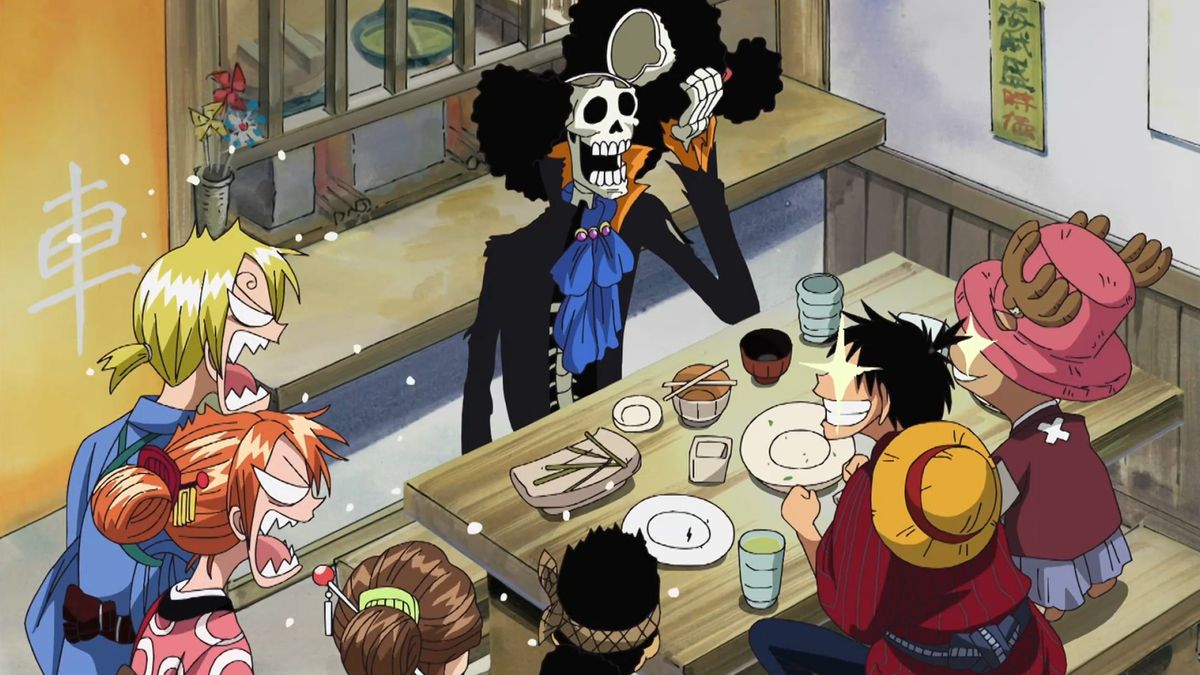
In the alternate Grand Jipang setting, Usopp tells Boss Luffy and the Pinwheel Eatery crew about a portable-shrine race whose winner may receive a wish and one million berries. Franky builds their mikoshi while Thriller Company sabotages the Flying Fish Riders and Rolling Express. Usopp fishes an amnesiac Brook from the river. Brook helps expose another attack, then remembers that Hogback, Perona, and Absalom threw him away after he rejected their methods. He leaves to confront them alone.
RaeRae’s opening receipt
Placing a goofy historical special after the crew’s complete defeat is emotional whiplash with purpose. Episode 406 does not answer where anybody landed. The broadcast schedule gives viewers familiar faces in a world where separation cannot touch them yet.
Grand Jipang becomes a pressure-release valve without pretending to continue canon.
The alternate setting must be named clearly
This episode belongs to the numbered television run and remains an episode React. The Grand Jipang story does not continue Sabaody continuity.
Classification protects viewers from treating festival comedy as an unexplained reunion.
Boss Luffy carries the same appetite into another genre
A race, a wish, and a million berries require almost no persuasion. Opportunity becomes adventure before caution can enter the room.
Character survives costume and setting through instinct.
Usopp brings the story through local gossip
His excitement turns festival information into a crew mission. He understands the value of a challenge large enough to become legend.
Community news replaces pirate intelligence without changing his storytelling role.
The once-a-century race gives nonsense ceremonial weight
A portable shrine contest becomes historic because generations rarely see the event. Everyone can justify enormous effort through tradition.
Comedy grows when serious ritual surrounds chaotic competitors.
The wish prize makes every participant reveal desire
A sacred treasure allegedly grants any request. Characters approach the race with greed, hope, curiosity, or competitive hunger.
Uncertain magic works because wanting becomes more important than proof.
The million berries keeps Luffy interested in ordinary terms
Spiritual mystery receives a practical bonus. The combination fits a world where sacred festivals and cash rewards share one announcement.
Grand Jipang never forces whimsy into purity.
The Pinwheel Eatery functions as found family headquarters
Onami, Sanji, Luffy, Chopper, Usopp, and newcomer Mao share work, food, gossip, and responsibility.
A restaurant replaces the Sunny while preserving the warmth of a crew space.
Mao enters through labor rather than prophecy
She joins the eatery as an employee and becomes part of the festival problem. Ordinary work gives an original character immediate relationship to the ensemble.
Belonging starts through participation.
Franky is the obvious mikoshi builder
Grand Jipang translates shipwright genius into festival craftsmanship. His pride requires a shrine nobody else could construct.
The alternate universe remixes vocation rather than abandoning identity.
The workshop comedy introduces competence sideways
Franky’s contraptions can misfire into embarrassment before producing a magnificent build. Technical genius remains inseparable from chaotic presentation.
Comedy humanizes expertise without shrinking the result.
A mikoshi becomes a temporary ship
The team will carry a crafted object together toward a destination while rivals attack. Franky’s shrine gathers movement, identity, and collective effort.
Festival architecture quietly echoes the crew’s ordinary voyage.
Thriller Company enters already treating competition as control
Hogback, Perona, Absalom, Kumashi, and zombies do not trust a fair race. They want every other shrine destroyed before the start.
Victory becomes ownership of the field rather than performance within the field.
Hogback brings vanity into organized sabotage
He laughs at competitors and assumes a company name makes wrongdoing respectable.
Grand Jipang turns Thriller Bark horror into broad corporate farce.
Perona weaponizes discouragement perfectly
Her Negative Hollows do not need to smash a mikoshi directly. They convince strong people to destroy their own confidence and work.
Sabotage becomes most efficient when victims complete the damage.
Duval’s vanity becomes the Flying Fish Riders’ weakness
The handsome self-image rebuilt after Sanji remains vulnerable to humiliation. Negative despair redirects his strength toward his own team’s shrine.
Comedy preserves the strange continuity of personality across universes.
Robin observes sabotage instead of announcing herself
She gathers information while the company assumes nobody understands the pattern. Quiet witnessing prepares later intervention.
Knowledge enters through patience.
Absalom’s invisibility makes destruction look supernatural
A shrine appears to move without hands while racers chase in confusion. Concealed labor lets Thriller Company deny responsibility.
Invisible power becomes a joke about corporate innocence.
The Rolling Express falls through engineered confusion
Another rival loses months of effort before race day. Thriller Company converts preparation into vulnerability.
A crooked contest starts long before the official starting signal.
Usopp fishes Brook from a river
The introduction takes the ordinary impossibility of a living skeleton and makes discovery almost domestic. A fishing line retrieves a new mystery.
Grand Jipang welcomes absurdity without needing scientific explanation.
Brook remembers his name and little else
Amnesia removes affiliation while leaving manners, music, and skeleton jokes intact.
Identity survives in habits even when history disappears.
The flute inside his skull restores familiar comedy
Brook’s body remains storage, instrument case, and punchline. The alternate setting needs only a small object to reactivate his musical role.
Physical absurdity becomes comforting after Sabaody’s empty grove.
The village accepts a talking skeleton quickly
Shock lasts only as long as the next practical need. Brook receives food, conversation, and company rather than prolonged suspicion.
Community can make strangeness ordinary through hospitality.
Brook’s blank past creates vulnerability beneath jokes
He can laugh without knowing who hurt him or why he entered the river. Cheerfulness shares space with missing context.
The skeleton carries melancholy even in a festival special.
He joins Luffy because friendship arrives before memory
Luffy does not require a background check. Present behavior and shared fun matter enough.
The alternate Boss preserves the captain’s instinct for choosing people.
The floating mikoshi reveals another attack
Luffy, Usopp, and Brook notice movement that ordinary explanation cannot support. Curiosity turns into pursuit.
Comedy investigation begins from watching the impossible carefully.
Brook helps fight the zombies before knowing his connection
His body remembers combat and his conscience rejects sabotage. Action supplies character where memory cannot.
Ethics can survive missing biography.
The Rolling Express shrine still breaks
Intervention arrives but cannot protect every piece of work. The failure points directly toward Franky’s workshop as the next target.
Partial rescue moves the plot without manufacturing a clean win.
Mao reaches the workshop during escalating danger
Her ordinary errand places her beside the final sabotage attempt. Thriller Company’s plan threatens people as well as festival objects.
Stakes grow through proximity rather than gore.
Luffy’s attack protects a person before protecting the race
Zombies near Mao become the immediate target. Prize money and prestige can wait.
Across universes, Luffy’s priorities remain legible through whom he protects first.
The Pinwheel mikoshi lies destroyed
Franky’s skill and the team’s excitement become wreckage before the contest. The villains want despair to finish what zombies began.
Sabotage attacks morale as deliberately as wood.
Franky is injured beside his work
The builder cannot separate harm to the shrine from harm to the community gathered around the build.
Craftsmanship creates emotional stakes because labor carries the maker.
Brook’s memory returns through the scene of betrayal
Destroyed work and familiar attackers reconnect him to Thriller Company. He remembers leaving because their methods violated his conscience.
Memory arrives through moral recognition.
Hogback, Perona, and Absalom threw him away
Brook’s former colleagues treated dissent as disposable. The river erased memory but did not erase the reason he resisted them.
Corporate belonging ends when obedience becomes the only acceptable identity.
Brook leaves alone because guilt distorts responsibility
He sees ruined shrines and assumes his past makes the damage his burden. Protecting new friends becomes self-isolation.
Remorse can repeat an enemy’s work by separating somebody from support.
The two-part structure refuses a quick reset
Unlike earlier Boss Luffy one-offs, this story ends with Brook walking toward danger and the shrine broken.
Continuation gives the alternate setting room for loyalty rather than only parody.
The special offers relief without becoming empty filler
Familiar personalities receive new jobs and costumes, but exploitation, friendship, guilt, and collective labor still matter.
Play can reveal character through rearrangement.
This remains a numbered episode React
Episode 406 is an alternate-setting television special inside the numbered broadcast run. This page responds to its exact mikoshi-race story rather than reviewing a film or OVA.
React classification preserves chronology and keeps Anime Reviews clean.
The official local still remains canonical
The Episode 406 official still serves as featured image, hero, directory card, and social preview through one local attachment.
Complete metadata names the alternate setting and prevents visual confusion with canon-era episodes.
RaeRae’s final receipt
Episode 406 arrives after emotional annihilation and offers a town where the crew can share a restaurant, build something ridiculous, and chase a wish. I needed that breath. The special understands relief should still contain a story worth caring about.
Franky’s mikoshi holds everybody’s labor. Thriller Company attacks that labor because fair competition would require accepting other people’s right to exist on the same road. Brook recognizes the rot before memory supplies the names. That detail gives the comedy a real spine.
Then memory returns, guilt arrives, and Brook walks away alone. Grand Jipang has changed costumes, not the central One Piece argument. Bad systems isolate people. Friends rebuild what those systems break. The race can wait one more episode. First, Boss Luffy has to remind a skeleton that conscience did not make him guilty.
The festival transforms rivalry into public memory
Teams do not merely seek money. A once-a-century race offers families and neighborhoods a story that may outlive every current participant.
Thriller Company wants to own that memory by preventing alternatives from reaching the starting line.
Sabotage reveals fear beneath Hogback’s confidence
A company certain of superior skill would welcome visible competition. Destroying shrines early admits that another team’s honest effort might win.
Arrogance becomes camouflage for insecurity.
Perona attacks community through individual shame
Negative Hollows isolate racers inside self-loathing until shared preparation feels worthless. The power breaks a team by making each person distrust personal value.
Rebuilding must restore relationship as well as wood.
Robin’s quiet surveillance protects evidence
Thriller Company relies on hidden attacks and confused witnesses. Robin sees enough to connect events before the villains can rewrite the story.
Observation becomes community defense.
Franky’s craftsmanship deserves grief when destroyed
The mikoshi contains planning, skill, humor, and hours given freely to friends. Calling the wreckage only a prop would erase labor.
The episode lets a festival object carry real emotional value.
Brook’s memory returns as accountability rather than nostalgia
He remembers the people who hurt him and the wrongdoing he rejected. The past asks what he will do now.
Identity reconnects through values before every biographical detail settles.
Leaving alone repeats the company’s isolation strategy
Thriller Company discarded Brook for dissent. His guilt now persuades him to separate from people prepared to help.
Abuse can keep directing behavior after the abuser leaves the room.
Boss Luffy will reject guilt as a reason for abandonment
The captain’s alternate-setting instinct remains familiar: a friend does not lose support because enemies targeted everyone nearby.
Responsibility should produce collective action, not solitary punishment.
The numbered directory must show the special visibly
Episode 406 belongs between Sabaody and Amazon Lily in broadcast order. A static card lets viewers recognize the alternate-setting break before opening.
Clear labeling preserves chronology without disguising canon status.
RaeRae’s extra receipt
Grand Jipang gives us Luffy, Nami, Sanji, Usopp, Chopper, Robin, Franky, and Brook close enough to share one festival problem immediately after canon tore the crew apart. The placement feels like kindness from the broadcast schedule.
Kindness does not mean emptiness. Brook’s lost memory, Franky’s ruined work, and Thriller Company’s sabotage build a small argument about community. A company wins by isolating competitors. Friends answer by noticing, believing, and rebuilding. That argument belongs anywhere One Piece puts these faces.
The alternate world preserves a needed image of togetherness
After Sabaody, seeing familiar people share food, work, and one town has emotional value beyond continuity. Clear labeling lets viewers receive that comfort without mistaking the special for the crew’s reunion.
Grand Jipang offers play while Brook’s conscience keeps the story connected to One Piece values.
The special earns its broadcast place by giving familiar bonds one playful, clearly separated stage.