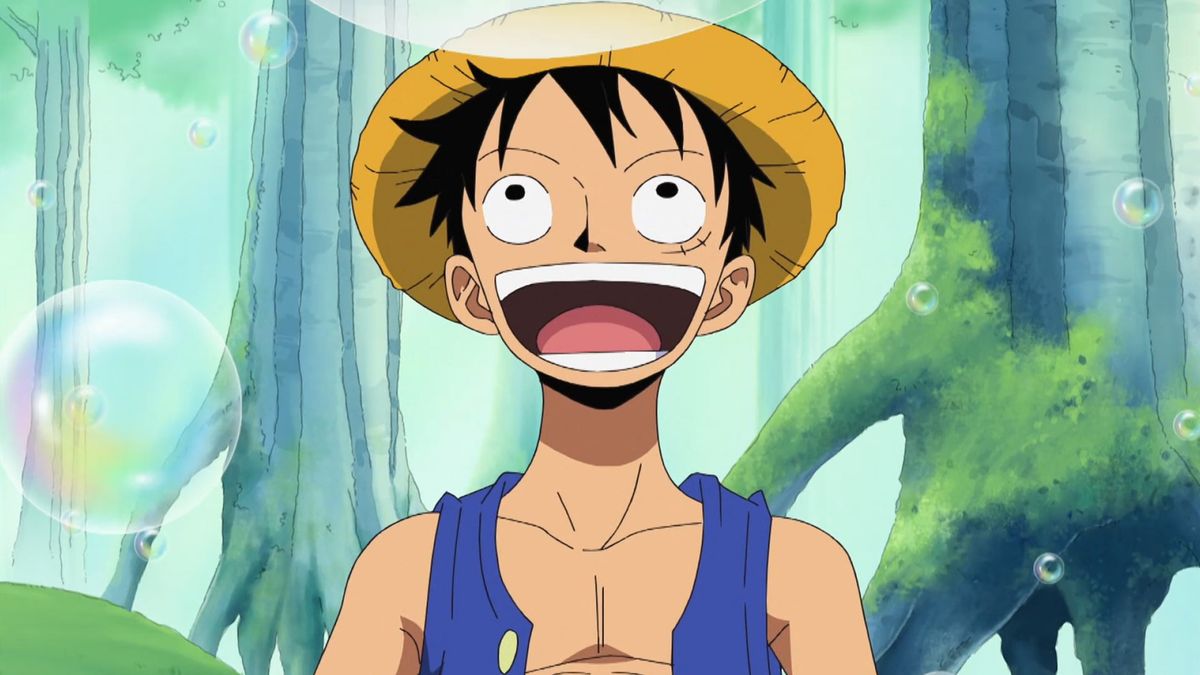
RaeRae Reacts · One Piece Episode 390
The Straw Hats Land at Sabaody to Find a Coating Route Below the Red Line
One Piece Episode 390 React follows Hatchan explaining ship coating as the crew reaches the mangrove archipelago and enters its beautiful, dangerous groves.
One Piece Episode 390 React: Hatchan explains why the Sunny needs coating, the crew reaches Sabaody, and a gorgeous archipelago built from mangrove resin opens as the gateway to a much uglier economy.
What happened in Episode 390
After Duval’s defeat, Hatchan explains that ships heading to Fish-Man Island need a special coating to survive the underwater route beneath the Red Line. He knows a skilled coating mechanic on the Sabaody Archipelago. The Straw Hats approach the enormous mangroves, learn how resin creates bubbles across the islands, secure the Sunny, and split responsibilities before entering the groves to find Hatchan’s contact.
RaeRae’s opening receipt
Sabaody arrives looking like a theme park designed by a botanist with no restraint. Giant roots, floating bubbles, bright attractions, and impossible technology fill the frame. Then Hatchan starts listing pirates, bounty hunters, kidnappers, and rules protecting powerful visitors. Pretty scenery has never promised safe politics.
Coating turns a destination into a technical problem
The Sunny cannot sail through deep water by courage alone. A resin membrane must hold air around the ship while allowing movement below the surface.
The route requires specialized labor whose value the crew could not reproduce through improvisation.
Hatchan becomes a guide through knowledge rather than debt
He knows where coating happens and whom to ask. The rescue creates an opportunity for reciprocal help, but his guidance also grows from Camie’s friendship and his own desire to assist.
Relationship moves the voyage farther than coercion ever could.
The Red Line forces pirates toward a shared bottleneck
Crews headed for the New World must pass above through government territory or below through Fish-Man Island. Sabaody gathers ambitious people because geography narrows their choices.
A bottleneck attracts services, predators, officials, and markets designed around travelers.
The archipelago is not made of ordinary islands
Massive Yarukiman Mangroves root into the ocean floor and form groves around exposed trunks. Naming the land as living structure changes how the setting feels.
Sabaody grows, secretes, and breathes instead of sitting as inert rock.
Resin bubbles shape daily culture
Residents use bubbles for transport, storage, helmets, architecture, and entertainment. A natural material becomes the basis of local technology.
Worldbuilding works best when one environmental fact affects dozens of ordinary choices.
Luffy loves the bubbles before learning the rules
His delight gives Sabaody immediate wonder. He wants to touch, ride, and test everything because novelty remains part of why the voyage matters.
The joy will make later cruelty feel more obscene rather than less.
The numbered groves provide a map with dangerous gaps
Tree markings organize the archipelago, but different zones carry different levels of risk and authority. A number can locate a crew without explaining what kind of world operates there.
Navigation still needs social knowledge.
Hatchan warns the crew because behavior has consequences here
Famous pirates, Marine attention, bounty hunters, and traffickers occupy the same space. Luffy’s usual direct response to cruelty could summon overwhelming force.
The warning is not cowardice. Hatchan understands a system designed to punish challenges from below.
The Sunny needs protection while the crew explores
A legendary ship left unattended near criminals and authorities would become a target. Splitting the crew creates a practical guard while others search for the coater.
Adventure requires somebody to stay with the valuables.
Franky remains closest to the coating problem
As shipwright, he understands why a specialist must alter the Sunny carefully. Trusting another craftsperson with the ship requires professional respect.
Expertise recognizes expertise rather than treating every outside hand as competition.
Usopp’s repair role keeps him near the vessel
The recent attack and cannon use leave work to inspect. His practical presence beside Franky grounds the crew’s arrival in maintenance.
Ships survive impossible voyages because somebody checks what spectacle damaged.
Sanji guards Nami’s treasure with predictable intensity
His willingness mixes real responsibility with his devotion to Nami. The joke does not erase the importance of keeping funds and supplies secure.
Motives can be ridiculous while the task remains necessary.
Zoro walking alone creates instant danger
He believes numbered groves will solve his navigation problem. Everybody familiar with Zoro understands why confidence provides no reassurance.
Sabaody is exactly the wrong place for the crew’s worst navigator to trust one partially obscured sign.
Camie’s presence changes which dangers matter
A mermaid can be sold for an enormous price. Every crowded street and curious stranger carries a threat the crew may not recognize quickly enough.
Hatchan’s warnings concern more than general pirate caution.
Pappag understands commerce from inside local culture
His fashion career and social knowledge make him more than comic explanation. He knows how status, shopping, and movement work across the groves.
The crew arrives with strength. Camie, Pappag, and Hatchan arrive with context.
Coating labor sits beside exploitation labor
Sabaody provides a legitimate craft essential for dangerous travel while supporting kidnappers who sell people. Economies can contain skilled care and organized cruelty in neighboring districts.
The island’s beauty does not decide which economy wins.
The gateway to the New World is controlled by access
Crews with money, contacts, and enough protection can seek coating. Vulnerable travelers may become merchandise before reaching a craftsperson.
Movement depends on class, race, reputation, and power as much as navigation.
The episode lets wonder arrive before horror
Bubbles and mangroves deserve genuine awe. Knowing later events does not require treating every beautiful frame as false.
The cruelty becomes sharper because a place capable of delight chooses to tolerate suffering.
Hatchan’s contact promises another relationship-based solution
The crew cannot purchase generic coating from a machine. They need a particular craftsperson trusted by somebody who knows him.
Networks of trust become survival equipment.
The Straw Hats enter as famous pirates without understanding local rank
Their bounties matter, but Sabaody collects captains with even larger reputations and institutions capable of crushing all of them.
Past victories cannot define the hierarchy of a new place.
The New World feels close and deliberately inaccessible
Fish-Man Island lies on the route, and the Red Line marks the boundary. Physical proximity makes every missing requirement more frustrating.
The story uses delay to reveal the systems surrounding passage.
The arrival expands One Piece beyond island adventure
Sabaody functions as an international transit point where pirates, nobles, Marines, merchants, and enslaved people cross paths.
The setting connects local action to global structure before the crew understands the full scale.
Duval’s aftermath offers a temporary ally nearby
His gang no longer needs to hunt Sanji once the facial resemblance disappears. Their mobility and knowledge may become useful, though cooperation cannot erase the operation they ran.
Changed alignment should remain accountable to changed behavior.
The coating requirement protects Fish-Man Island’s physical difference
Humans cannot simply sail into an undersea homeland using ordinary methods. Reaching the community requires adaptation.
That barrier reminds visitors that their bodies and technology are not the default for every world.
Episode 390 performs necessary orientation
The story explains trees, bubbles, zones, coating, risks, and crew assignments without losing the excitement of arrival. Information feels attached to movement rather than delivered as a lecture.
Clear setup gives later chaos a readable map.
The groves make one island feel like many neighborhoods
Numbered roots separate shipyards, amusement areas, commerce, lawless zones, and official traffic. Movement between nearby groves can change which rules appear to matter.
Local geography organizes inequality instead of distributing safety evenly.
Coating requires time the crew cannot rush
Even after finding the right craftsperson, resin must be applied carefully around the Sunny. Waiting creates vulnerability in a place full of hunters and Marines.
Preparation becomes part of the arc rather than an instant transaction.
Hatchan’s warning contains knowledge earned under prejudice
He understands which people can move openly, which bodies attract buyers, and which nobles cannot be challenged without military response. The crew hears rules that sound absurd because they have not paid the same cost for learning them.
Listening becomes a safety practice.
Camie’s excitement does not mean she misunderstands danger
She enjoys shopping and local attractions while knowing mermaids are targeted. Joy under threat should not be mistaken for ignorance.
Vulnerable people still deserve ordinary pleasure without danger becoming their entire characterization.
The Sunny’s arrival announces wealth and notoriety
A distinctive new ship attracts attention from thieves, bounty hunters, and anyone tracking the Straw Hat crew. Guard duty protects more than wood and sails.
The vessel is home, evidence, transport, and a public signal at once.
Finding Rayleigh will require navigating reputation
Hatchan knows the coater through a history the Straw Hats have not heard. The contact’s skill and identity sit behind local relationships rather than an advertisement.
The series prepares a major meeting through trust instead of coincidence alone.
Sabaody sells fantasy to visitors while hiding cost
Bubble rides and shops encourage newcomers to see entertainment. Nearby lawless zones support kidnappers who feed human auctions.
Tourism can make selective blindness feel like part of the package.
The crew split creates several moral viewpoints
Some members stay with the ship, some shop, some explore, and Zoro wanders independently. Each group will learn different pieces of Sabaody’s structure.
The audience assembles the island through uneven encounters rather than one guided lecture.
The route below the Red Line depends on accepting vulnerability
Coated ships descend where pressure, currents, and membrane failure can kill everyone aboard. The crew must trust material they cannot repair through brute force during every crisis.
Entering the New World begins with surrendering the illusion of total control.
The island’s temporary nature fits crews between seas
Many visitors arrive only long enough to coat a ship, find supplies, recruit help, or disappear into the next route. Sabaody thrives on people in transition.
Temporary populations create opportunity for honest tradespeople and predators hunting anyone without protection.
Numbered roots cannot guarantee Zoro will read the full number
A bubble obscures part of a marking, and he confidently records the wrong grove. The joke remains completely in character while setting up a dangerous separation.
Navigation tools only help when users perceive the tool accurately.
Luffy’s delight keeps wonder morally important
The coming cruelty could make viewers dismiss every attraction as superficial. Joy on the bubble bike proves the place contains experiences worth protecting from the hierarchy poisoning public life.
Condemning injustice should not require surrendering beauty to unjust rulers.
Hatchan carries both guide status and social vulnerability
He knows the route better than the Straw Hats, yet humans around Sabaody may still treat his body as lesser or saleable. Knowledge does not automatically produce safety.
The crew must learn to follow expertise while providing protection the expert unfairly needs.
That relationship reverses the easy fantasy of outsiders arriving to save locals. Hatchan supplies essential knowledge the pirates lack. The Straw Hats supply force a prejudiced market makes necessary. Neither contribution replaces the other, and both depend on trust still being negotiated after Arlong Park.
This remains an episode React
This page responds to the coating requirement, Hatchan’s contact, the mangrove archipelago, bubble culture, and the crew’s landing. A complete Sabaody Review belongs on the arc-level record.
React classification keeps arrival-worldbuilding visible without replacing a whole-arc evaluation.
The official local still remains canonical
The Episode 390 still serves as featured image, hero, bounded-directory card, and social preview. One local attachment provides consistent recognition.
Complete source, descriptive, accessibility, and filing metadata remain attached. No other record reuses the still.
RaeRae’s final receipt
Sabaody looks magical because Sabaody is magical. Giant living roots fill the ocean with resin bubbles that support transport, architecture, helmets, shopping, and play. The crew has reached one of the most visually inventive places in the series, and Luffy’s joy belongs there.
The same groves funnel travelers through a marketplace where people can become products. Coating requires craft, trust, and time. Camie requires protection from buyers who would price her body. Hatchan knows the rules because he knows what humans permit here. The gateway to the New World is not merely a technological checkpoint. The gateway is a test of what everybody will tolerate while waiting to pass through.
The crew enters with enough confidence to enjoy the wonder and not enough context to recognize every threat. Hatchan’s instructions become as necessary as Nami’s navigation. Following local knowledge will determine whether the Sunny receives coating and whether Camie survives a marketplace designed to hide predation behind bright attractions.
The bright route carries sharp warnings.