RaeRae Reacts · One Piece Episode 389
The Gaon Cannon Roars Before Sanji Kicks Duval Into a Different Face
One Piece Episode 389 React follows Duval’s mistaken-identity story, Camie rescuing Sanji, the Sunny firing the Gaon Cannon, and Luffy stopping Motobaro.
One Piece Episode 389 React: Duval explains how Sanji’s bounty portrait wrecked his life, the riders try to sink the Sunny, Franky fires the Gaon Cannon, and Sanji rearranges the face at the center of the grudge.
What happened in Episode 389
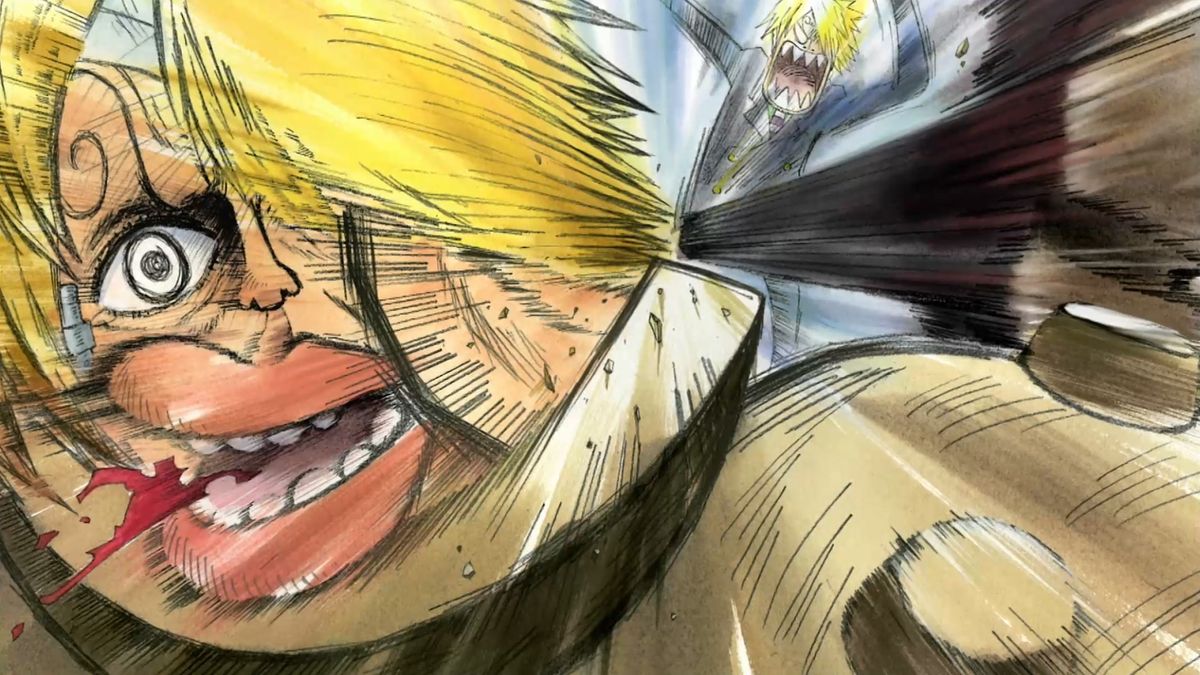
Duval reveals that Marines and bounty hunters mistook him for Sanji after the wanted poster appeared. He attacks Sanji with steel nets while the Flying Fish Riders drop an anchor toward the Sunny. Franky uses Chicken Voyage and unveils the cola-powered Gaon Cannon. Camie rescues Sanji, Luffy stops Motobaro through an unexplained burst of will, and Sanji finishes Duval with a face-altering barrage of kicks.
RaeRae’s opening receipt
Sanji fixes a government identification failure by kicking Duval into a new face. Medical ethics have left the building, but so has the bounty-poster resemblance. Somewhere, a Marine clerk remains employed after causing this entire mess.
Duval’s backstory identifies a real wrong
Authorities distributed Sanji’s crude portrait as actionable identification. Duval resembled the sketch closely enough that armed people hunted him.
Official incompetence becomes violence once money and arrest power attach to the error.
Sanji did not commission the portrait
He hated the image from the moment the poster appeared. Duval nevertheless imagines Sanji as the author of every consequence.
Misplaced blame offers a visible target when the institution responsible remains distant.
Duval’s former life was hardly innocent
He admits to petty banditry and intimidation before the poster. Losing that life does not mean society lost a harmless citizen.
The government can wrong somebody who was already doing wrong. Those truths do not cancel each other.
Revenge lets Duval avoid grieving what changed
He cannot restore anonymity, recover lost time, or make every hunter forget the image. Blaming Sanji gives him a task that feels more active than accepting irreversibility.
The task remains morally useless because the selected target did not create the injury.
Sanji’s anger contains humiliation and disbelief
His poster mocked the face he values, denied him the dignified notoriety he wanted, and now produced a living double demanding compensation.
The absurdity strikes every vanity at once.
The steel net turns the sea into a weapon
Duval does not need to overpower Sanji on land if a weighted net can drag him beneath the surface. The attack uses environment and restricted movement rather than honorable combat.
Camie understands underwater danger better than anybody on the shore.
Camie rescues Sanji without becoming his fantasy
She dives because a person is drowning. Sanji’s overwhelmed reaction adds comedy, but her action remains competent and decisive.
A mermaid saves the cook through skill, not romantic destiny.
The riders attack the Sunny to drown the whole crew
A massive anchor threatens the ship and every Devil Fruit user aboard. The plan treats collateral death as efficient pressure against Sanji.
Duval’s grievance has expanded far beyond the person he blames.
Franky knows exactly what his ship can do
The Sunny is not only beautiful transport. Hidden systems answer specific threats with maneuverability and force.
Franky’s confidence comes from design knowledge rather than empty boasting.
Chicken Voyage turns escape into engineering
The ship shifts backward rapidly to evade the falling anchor. A maneuver that sounds ridiculous protects everybody before the weapon fires.
Defense receives priority over spectacle.
The Gaon Cannon announces the Sunny’s offensive scale
Usopp activates a blast from the lion figurehead strong enough to devastate the riders’ base. The ship itself can now answer enemies at range.
Merry carried the crew through impossible danger. Sunny enters the next sea with a different level of designed power.
Cola keeps extraordinary technology grounded in Franky logic
The cannon consumes a huge portion of the ship’s fuel reserve. Massive force carries a measurable cost.
Limits prevent the weapon from becoming an easy answer to every future obstacle.
Usopp becomes part of the weapon system
Franky built the mechanism, but Usopp operates the targeting position. Their skills combine across design and marksmanship.
The Sunny grows stronger through shared use rather than one inventor controlling every feature.
The destroyed base is consequence, not complete reform
The riders lose infrastructure and immediate combat advantage. A blast cannot dismantle the larger market that made kidnapping profitable.
The victory clears this route while Sabaody’s deeper system waits ahead.
Motobaro reacts to Luffy before Luffy attacks
The giant bull charges until Luffy’s will overwhelms the animal. Motobaro collapses despite no visible strike.
The moment previews a form of power the crew cannot yet name or control.
Luffy’s will protects without explanation
He does not pause to analyze technique. His refusal becomes pressure strong enough to stop the charge.
The series plants future power through behavior already central to his character.
The animal is not the true enemy
Motobaro acts under Duval’s command. Luffy halts the creature without beating a controlled animal for serving its handler.
The restraint fits a captain who often reads creatures more clearly than people expect.
Sanji’s final attack becomes involuntary reconstructive surgery
He uses precise kicks to alter Duval’s facial structure. The scene applies combat logic to cosmetic transformation with complete shamelessness.
Only One Piece could make the solution horrifying, useful, and funny at once.
Duval receives the face he believes he deserved
The new appearance separates him from Sanji’s poster and sends his self-confidence into orbit. External change cannot repair every internal choice, but the mistaken-identity problem loses its visual anchor.
Sanji solves the symptom through force because the government remains unavailable for correction.
Beauty does not equal redemption
Duval becoming conventionally handsome does not erase trafficking, attacks, or captives. The gag risks treating appearance as moral transformation.
The better reading keeps behavior and face on separate ledgers.
Sanji’s “full course” returns cooking language to combat
He names the kick sequence like a meal, turning professional identity into fighting rhythm. Duval demanded his old life back and receives an unsolicited makeover instead.
The verbal flourish lets Sanji reclaim the joke surrounding his face.
The crew wins through three different strengths
Franky and Usopp save the Sunny. Camie saves Sanji underwater. Luffy stops Motobaro. Sanji defeats Duval.
No single hero absorbs every problem, which makes the victory feel like a functioning ensemble.
Hatchan’s rescue remains the reason they arrived
The face reveal and cannon could overwhelm the original mission. Hatchan is free because Nami chose rescue and the crew followed through.
Comedy never needs to erase the captive at the center of the approach.
Duval’s changed face creates space for changed direction
Without constant mistaken pursuit, he could leave revenge behind. Whether he changes behavior remains a choice rather than a cosmetic guarantee.
Removing one pressure gives responsibility more room, not less.
Sanji’s kicks resolve recognition without resolving responsibility
Bounty hunters may stop mistaking Duval for the poster after his face changes. Former captives and targets still carry consequences from the gang he led.
A makeover can close the mistaken-identity plot while moral repair remains unfinished.
Franky built force into the figurehead
The Sunny’s lion face looks playful until the mouth opens around the Gaon Cannon. Design refuses the assumption that beauty and defensive power must occupy separate objects.
The ship expresses Franky’s entire personality through one impossible reveal.
The cannon protects a crew full of Devil Fruit users
An anchor sinking the ship would turn seawater into a mass execution method. Long-range force prevents the enemy from controlling that vulnerability.
Engineering compensates for limits raw strength cannot remove.
Cola consumption prevents careless repetition
Franky explains that firing the cannon uses several barrels of fuel. The crew cannot celebrate the blast without recognizing reduced reserves.
A spectacular answer becomes strategic because scarcity follows the noise.
Camie enters danger for somebody she barely knows
Sanji has spent the meeting idealizing her, yet she does not rescue him as reward for admiration. She acts because drowning is immediate and her body can reach him.
Competence replaces the fantasy he projected onto her.
Luffy’s pressure on Motobaro previews leadership as force
The animal senses something the humans cannot name. Luffy’s will crosses the space without contact and makes violence unnecessary.
Future explanation will label the power, but the scene first establishes purpose through protection.
Duval’s handsome reaction reveals how deeply shame governed him
He sees the new face and immediately rebuilds confidence around appearance. Relief makes sense after forced concealment, though vanity threatens to become another identity prison.
Freedom requires more than receiving a face strangers praise.
The Flying Fish Riders survive their own branding collapse
Their hideout, formation, and leader’s menace all fail within one encounter. What remains is a group forced to decide whether loyalty means repeating Duval’s revenge or finding another direction.
Defeat creates an opening for changed behavior that victory never offered.
The crew leaves stronger knowledge behind
Franky and Usopp now understand the cannon under combat conditions. Luffy has manifested an unfamiliar power. Sanji has seen how his public image affected a stranger.
Every comic victory adds information the voyage will need later.
The episode lets absurdity expose institutional harm
A man resembling bad artwork sounds like pure nonsense. Bounty systems, official records, and profit-seeking hunters turn the nonsense into a credible danger.
Comedy becomes a route toward critique rather than an escape from consequence.
The crew does not need Duval’s gratitude before leaving
Sanji removes the resemblance while defeating the man attacking them. Any future cooperation must grow from Duval changing conduct rather than the Straw Hats collecting praise.
Help delivered during conflict does not create ownership over the person helped.
The cannon gives the Sunny a voice beyond transportation
Merry often expressed personality through endurance and care. Sunny announces capability through a literal roar of concentrated force.
The ships carry different emotional languages without one replacing the other’s place in the crew’s history.
Franky’s pride includes responsibility for everyone aboard
He does not unveil the cannon merely to show off. The anchor threatens friends, home, and every dream the Sunny carries.
Technical spectacle earns emotional weight because protection drives deployment.
Sanji redirects anger into a solution only his fighting style could produce
A swordsman could defeat Duval. Luffy could launch him across the base. Sanji’s precise kicks alter the face causing the mistaken identity.
The absurd resolution grows directly from character-specific skill rather than random magic.
Motobaro’s collapse leaves a question for later
Robin senses that Luffy did something unusual, but nobody turns the moment into a premature lecture. Mystery preserves the experience before terminology arrives.
Power development feels earned when clues appear long before formal mastery.
The crew sees another example of Luffy protecting life through presence alone. That unexplained moment belongs beside the visible cannon blast and Sanji’s loud kicks as a quieter warning that the captain’s strength keeps expanding beyond techniques everybody can already name.
The Gaon Cannon also creates a repair bill
Enormous weapons consume fuel and can damage surroundings. Franky’s pride remains justified, yet future use will require judgment.
Power becomes credible when consequences travel with deployment.
This remains an episode React
This page responds to Duval’s backstory, Sanji’s netting, Camie’s rescue, the Gaon Cannon, Luffy’s unexplained will, and Sanji’s final kicks. A complete Sabaody Review belongs on the arc-level record.
React classification preserves the episode’s comedy and institutional critique inside the exact broadcast turn.
The official local still remains canonical
The Episode 389 still serves as featured image, hero, bounded-directory card, and social preview. One local attachment keeps visual recognition consistent.
Complete source, descriptive, accessibility, and filing metadata stay attached. No other record reuses the still.
RaeRae’s final receipt
Duval deserved correction from the institution that placed another man’s crimes on his face. He chose revenge against Sanji and financed that revenge through a trafficking gang. Sympathy can explain the mask. Sympathy cannot clean the cage, steel net, anchor, or people treated as merchandise.
The crew answers across specialties. Camie owns the water rescue. Franky and Usopp reveal that the Sunny can roar. Luffy drops a charging bull through pure will before anybody has language for the power. Sanji closes the account by kicking Duval into a face bounty hunters will not confuse with that cursed poster. The solution makes no medical sense. The government error made no moral sense. At least one of those failures receives immediate correction.
Duval leaves the fight with a new appearance and a genuine opportunity to choose a different life. The opportunity does not arrive as proof of redemption. Future conduct must provide that proof. A changed face stops mistaken hunters; changed behavior must stop the harm his own riders helped deliver.