RaeRae Reacts · One Piece Episode 368
Kuma Arrives Without Footsteps While Perona Tries to Leave Thriller Bark With the Treasure
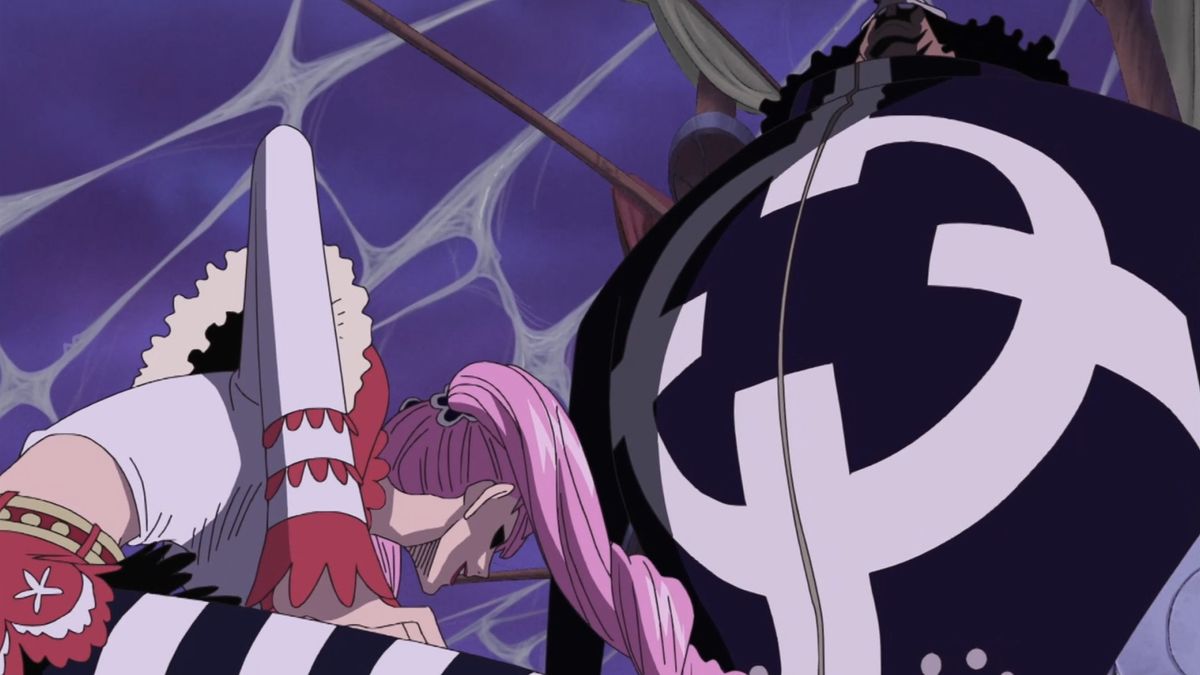
One Piece Episode 368 React follows the crew’s three-person docking attempt, Perona loading the Sunny, and Bartholomew Kuma’s silent arrival.
One Piece Episode 368 React: the crew earns one knockdown against Oars, Franky keeps pitching his docking dream, and Perona tries to move Thriller Bark’s treasure onto the Sunny before Kuma arrives.
What happened in Episode 368
Robin refuses the six-person combination again, so Usopp and Chopper join Franky in a smaller charge. Elsewhere, Perona prepares to abandon the island with stolen wealth when a silent visitor changes the threat.
RaeRae’s opening receipt
Kuma’s arrival has weight because the episode lets ordinary crew comedy continue beside a world-level power nobody invited into the room.
The first knockdown proves Oars can be moved
Episode 368 gives the Straw Hats something more useful than a clean victory: evidence. Oars has looked less like an opponent than a moving disaster, but coordinated pressure finally sends the giant down. The fall does not end the battle. The fall changes what the crew knows about the battle.
A body that can be knocked down can be studied, redirected, and eventually stopped. Hope arrives as tactical information rather than a speech.
One successful hit does not become false certainty
The crew earns a moment, not control. Oars remains enormous, animated by Luffy’s shadow, and backed by Moria’s system. Episode 368 lets everybody celebrate the result without pretending the larger danger vanished.
That balance keeps the fight honest. Progress matters precisely because the danger remains.
The Straw Hats turn failure into field research
Every earlier attempt taught the crew something about Oars’s reach, balance, reactions, and borrowed habits. Their first knockdown gathers those lessons into a visible result. One Piece understands teamwork as revision under pressure.
The crew does not wait for perfect instructions. They test, fail, argue, notice, and test again.
Franky still believes the answer should look spectacular
Most people would accept that the human docking proposal failed. Franky sees an unfinished engineering problem. His enthusiasm remains gloriously immune to embarrassment, battlefield scale, and Robin’s complete lack of interest.
The joke works because Franky’s sincerity is real. He genuinely believes a larger pose would improve morale and combat efficiency.
Robin’s second refusal confirms the first was not a mood
Robin does not reconsider simply because the emergency continues. Pressure does not transform a declined request into an obligation. Her answer remains stable, and the crew again has to plan around the person who said no.
Repeated consent is still consent. Yesterday’s relationship and today’s danger do not preauthorize participation.
The crew adapts without punishing the boundary
Usopp, Chopper, and Franky assemble a smaller formation. Nobody forces Robin into the missing position, and nobody treats her refusal as betrayal. The plan changes shape because one participant chose not to join.
That is chosen family behaving like a community instead of a claim. A boundary becomes design information.
The smaller docking formation is funnier and more revealing
The reduced version cannot deliver Franky’s grand fantasy, but the trio commits with enough confidence to make the attempt memorable. Their willingness creates the comedy. Robin’s unwillingness creates the limit.
Both truths can share the scene. Voluntary foolishness remains one of the Straw Hats’ purest forms of affection.
Usopp participates through courage that still contains fear
Usopp rarely stops being afraid, which makes his choices more interesting than effortless bravery. Joining Franky and Chopper places his body near a giant who can crush buildings. The absurd pose does not cancel the risk.
His courage lives in acting while every survival instinct supplies objections.
Chopper understands bodies but still joins the bit
As a doctor, Chopper knows how fragile his friends are beside Oars. As Franky’s excitable younger crewmate, he also understands the emotional necessity of a ridiculous combined attack. Knowledge and play coexist.
Chopper’s participation shows why the crew’s comedy never sits completely outside character. Wonder is one of his working instincts.
Franky turns morale into a piece of battlefield engineering
The docking formation may not be sensible machinery, yet Franky grasps that frightened people need a shared action. A pose, a name, and a collective charge can synchronize bodies that have been reacting separately.
Morale does not replace strategy. Morale helps people execute strategy while exhausted.
Oars carries Luffy’s energy without Luffy’s relationships
The giant moves with appetite, invention, and elastic confidence borrowed from Luffy’s shadow. What Oars lacks is the web of promises that gives Luffy’s recklessness direction. Familiar behavior therefore lands without familiar care.
A personality cannot be reduced to recognizable gestures. Relationship is part of identity.
The knockdown belongs to the crew rather than the captain
Luffy remains away from this portion of the fight, but his absence does not freeze everybody else. The Straw Hats generate their own approach and earn their own result. Their competence is collective, not borrowed from proximity to the protagonist.
The captain built a crew capable of acting when he cannot lead the room.
Thriller Bark keeps comedy inside danger
A giant zombie is trying to destroy the crew while Franky campaigns for human robot assembly. The tones do not cancel one another. Comedy shows how these people preserve personality while terror tries to reduce them to targets.
The laugh becomes evidence that Moria has not authored their inner lives.
Perona prepares a very different kind of survival plan
While the Straw Hats stay together against Oars, Perona begins loading Thriller Bark’s treasure onto the Thousand Sunny. She reads the collapsing organization and chooses departure. Her instinct is not rescue, repair, or loyalty. Her instinct is extraction.
The contrast places two responses to institutional failure side by side: collective resistance and private escape.
Perona treats the Sunny as an available exit
The ship means home to the Straw Hats, but Perona sees transport and storage. Her plan strips the vessel of relationship and turns the crew’s future into somebody else’s getaway vehicle.
Objects can hold different meanings depending on who controls access. Theft attempts to impose the thief’s meaning over the owner’s.
The treasure reveals what Perona believes can survive collapse
Moria’s command may be failing, zombies may be losing shadows, and Oars may be tearing through the island. Perona still believes wealth can cross the disaster intact. Packing treasure becomes her wager on portable power.
She does not try to preserve Thriller Bark. She tries to preserve advantage after Thriller Bark.
Abandonment exposes the limits of Moria’s loyalty system
Moria built an army through stolen shadows and enforced obedience. Such a structure can produce service, but service is not devotion. When danger reaches the leadership, Perona calculates her own exit.
Control may keep subordinates present during stability. Control cannot guarantee solidarity during collapse.
Perona’s escape is practical and deeply selfish
Her decision makes tactical sense. Remaining on a failing island beside Oars is dangerous. The selfishness enters through the Sunny, the stolen treasure, and the willingness to leave everyone else inside the consequences.
Competence deserves acknowledgment without turning exploitation into virtue.
The Sunny becomes contested territory
Until this point, the ship has waited beyond the central fight as the crew’s route forward. Perona’s loading operation brings the conflict onto that promise. Home can be endangered even when nobody is attacking the walls.
Unauthorized use threatens continuity. Losing the Sunny would mean losing the future the crew built together.
Kuma arrives without needing spectacle
Then Bartholomew Kuma appears. Episode 368 does not need frantic movement to establish his importance. Silence, scale, and sudden presence accomplish the work.
Perona has been planning around a familiar crisis. Kuma announces that the world outside Thriller Bark has entered the room.
Stillness becomes Kuma’s first display of power
Oars dominates through noise and destruction. Kuma creates pressure by refusing to explain himself. A character who does not hurry can feel more dangerous than one already swinging.
Control over tempo reads as control over the encounter. Everybody else must adjust to his arrival.
The visitor changes the meaning of Perona’s escape
Before Kuma appears, Perona looks like somebody exploiting chaos with a workable plan. After his arrival, her confidence belongs to an outdated version of the scene. She no longer knows every major power on the board.
A good entrance does more than introduce a person. A good entrance rewrites every nearby calculation.
Kuma connects Thriller Bark to the wider government system
Moria is not merely a local tyrant with a private zombie operation. His Warlord status places Thriller Bark inside a bargain with the World Government. Kuma’s presence makes that political structure physically visible.
The island’s horror was never fully isolated. Official power has always been part of the weather.
Two Warlords on one island changes the scale
The Straw Hats have spent the arc learning how Moria’s power works. Kuma arrives with another title, another body of knowledge, and another unknown ability. Familiar threat does not prepare them for every person carrying the same institutional rank.
Categories promise equivalence while individuals preserve terrifying differences.
The crew does not know another crisis has opened
Most Straw Hats remain occupied with Oars. Perona encounters Kuma elsewhere, creating an information gap across the island. Viewers can feel the danger spreading before the crew can respond.
Distributed knowledge makes Thriller Bark larger than any single fight. Nobody can see the complete board.
Victory against Oars would no longer settle the night
Kuma’s arrival changes the endpoint. Even if the crew stops Oars and defeats Moria, another government-aligned power now stands nearby. The original win condition has become insufficient.
One Piece often deepens suspense by moving the horizon rather than erasing progress already earned.
The first knockdown and Kuma’s entrance form opposite turns
Oars falling tells the crew that the impossible enemy can be moved. Kuma appearing tells viewers that the available map was incomplete. Hope rises in one location while uncertainty expands in another.
The episode refuses a single emotional direction. Momentum and dread arrive together.
Episode 368 remains an episode React
This page responds to the first successful knockdown of Oars, Robin’s repeated refusal, the smaller docking charge, Perona’s attempted theft, and Kuma’s arrival. A complete Thriller Bark Review belongs after the arc resolves those systems and consequences.
React classification preserves broadcast-level close reading while keeping whole-work Reviews reserved for a complete series, season, arc, or film.
The official local still remains canonical
The Episode 368 still serves as featured image, hero, bounded-directory card, and social preview. One local attachment preserves recognition across every discovery route.
Complete source, descriptive, accessibility, and filing metadata remain attached. No other record reuses this image.
RaeRae’s final receipt
Episode 368 lets the Straw Hats earn one beautiful, necessary fact: Oars can fall. Nobody mistakes the knockdown for a finished job, but exhausted people finally have proof that coordination changes the battlefield. Franky immediately responds by trying to revive his human robot dream, because shame has never once interfered with his engineering process. Robin refuses again. The crew adapts again. Usopp, Chopper, and Franky build the smaller version and charge anyway.
Across the island, Perona has already decided that loyalty is for people without access to a getaway ship. She loads Moria’s treasure onto the Sunny and prepares to carry her advantage beyond the collapse. Then Kuma arrives with the calm of a man who does not need anybody’s permission to change the chapter. Oars creates terror through motion. Kuma creates terror by standing still. The crew has learned that one impossible body can be moved, while viewers learn that another has quietly entered range. That final exchange is One Piece suspense at full strength: give us a foothold, then reveal the mountain behind the fog.
The episode changes scale without abandoning character
Episode 368 begins with bodies collaborating at the smallest practical level. Franky needs willing crewmates, Robin maintains her limit, and the reduced team makes a flawed idea usable. The ending expands toward government power, Warlord politics, and an outsider whose purpose nobody understands. Those scales remain connected by choice. The Straw Hats improvise through trust. Perona abandons a failing master through self-interest. Kuma arrives carrying obligations still hidden from everyone nearby.
That construction keeps exposition from becoming a pause. Kuma’s title matters because his body has entered an already unstable network of decisions. Perona’s treasure scheme matters because his arrival interrupts a concrete plan. The crew’s knockdown matters because viewers now know their hard-earned opening may lead into another threat. Every revelation changes what somebody can do next.
The quiet cliffhanger earns the next click
No frantic promise is needed after Kuma appears. The unanswered questions are specific: why has another Warlord come, what does he want from Moria, and what happens when Perona’s escape route crosses his path? Episode 368 closes by making stillness feel active. The next episode carries urgency because the world has widened, not because a narrator demands excitement.