RaeRae Reacts · One Piece Episode 361
Usopp Finds the Body Behind Perona’s Projection and Turns a Missed Shot Into a Better Lie
One Piece Episode 361 React follows Usopp’s deduction that the airborne Perona is a projection and the vulnerable body must be hiding somewhere else.
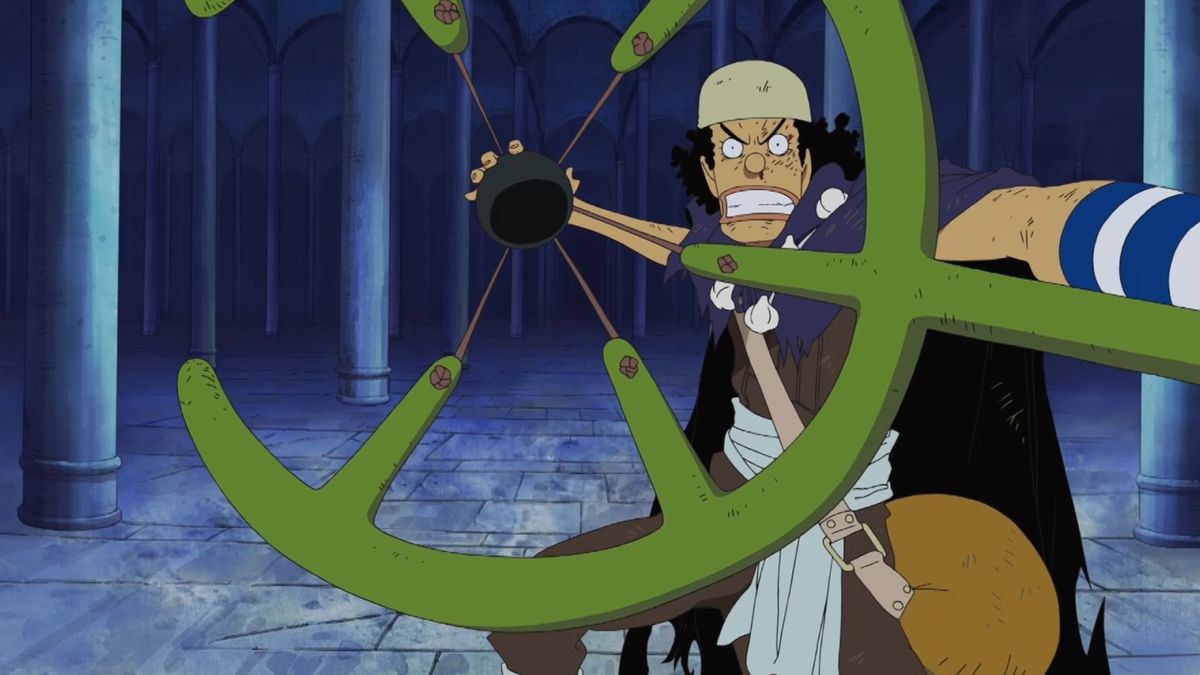
One Piece Episode 361 React: Usopp deduces that the Perona flying through the halls is a projection and directs his attack toward the hidden body left behind during astral separation.
What happened in Episode 361
Usopp locates the logic behind Perona’s apparent invulnerability and fires the Exploding Star toward her real body. Chopper and Robin remain pursued by the dog penguin and Jigoro as another intervention approaches.
RaeRae’s opening receipt
A liar recognizes a performance because he knows how much work illusion requires. Usopp stops aiming at the largest image and starts asking what the image needs hidden.
Usopp stops firing at the image Perona wants him to believe
The airborne Perona can expand, pass through matter, and evade physical attack because the figure confronting Usopp is not her ordinary body. Once he accepts that distinction, the giant projection loses control of his attention.
He begins searching for the vulnerable body required to sustain the performance.
Deduction turns an impossible enemy into two connected targets
Perona presented one invincible figure. Usopp recognizes a spirit moving through the halls and a body left somewhere else. Dividing the effect from the source gives each form a different set of limits.
The fight becomes solvable because he refuses the opponent’s preferred description of the problem.
A sniper must locate truth before launching force
Accuracy means little when the chosen target cannot be harmed. Usopp’s real work occurs before the projectile leaves his hand: observe, infer, identify the vulnerable position, and select the tool that can reach the vulnerable position.
Episode 361 treats interpretation as part of marksmanship rather than a pause between attacks.
The Exploding Star tests more than distance
Usopp fires toward the body he believes Perona has hidden. The shot tests his theory about astral separation and tests whether he can make her react to danger outside the projection.
A miss does not automatically make the reasoning worthless. Response can provide evidence even when impact fails.
Perona’s reaction can reveal what the projectile did not hit
A frightened response tells Usopp that the hidden body matters. The opponent’s attempt to conceal vulnerability becomes harder once protecting that vulnerability changes her behavior.
Combat information includes movement, hesitation, anger, and relief, not only visible damage.
Usopp knows how to make a missed shot continue working
His weapons rarely operate as simple contests of force. A projectile can distract, frame the next threat, establish a pattern, or make an opponent imagine consequences not yet present.
The missed attack remains part of a sequence because Usopp can convert uncertainty into pressure.
The lie becomes tactical when the target controls the battlefield
Perona controls scale, visibility, mobility, and supernatural access. Usopp cannot win by accepting every condition she establishes. Deception lets him alter what she expects and force her to spend attention defensively.
The lie creates room for action from a weaker position.
Not every deception carries the same ethics
Perona’s projection is designed to make another person feel powerless and to hide the body benefiting from that power. Usopp’s tactical lies aim to interrupt an aggressor already attacking him and his friends.
Method alone does not settle morality. Purpose, consent, power, and consequence shape the difference.
Usopp’s lies are strongest when they expose an existing fear
He cannot manufacture any reaction he wants from any person. He observes what Perona values, what she has hidden, and which possibility would threaten her sense of control. Then he builds language around that vulnerability.
The best lie works because truth has already supplied the pressure point.
Perona discovers that intangibility is not safety
The spirit can avoid physical harm while the body remains exposed elsewhere. Separating consciousness from ordinary limits does not erase dependency on the unattended form.
Usopp attacks the relationship between the forms rather than wasting force on the benefit alone.
The body behind the projection restores proportion
Giant Perona appears beyond every scale Usopp can answer. The hidden body remains finite, local, and vulnerable. Finding that body does not make Perona harmless, but the discovery returns her to conditions strategy can address.
Proportion is a form of resistance when spectacle depends on appearing limitless.
Fear taught Usopp to distrust the first story danger tells
He assumes threats may be worse than they appear, yet that same anxiety encourages him to examine contradictions. When attacks pass through Perona, he does not simply conclude that she is unbeatable forever.
He keeps worrying until worry produces a better question.
Cowardice and courage continue sharing one body
Usopp remains frightened while following his deduction. The series does not require fear to leave before useful action begins. His body can shake and still aim.
Courage becomes the practice of giving responsibility a vote alongside fear.
Perona underestimated the intelligence inside self-doubt
She expected a negative man to be easy to control. His existing pessimism blocked the Hollows, and his habit of questioning himself now helps him question her display.
The characteristic used to rank Usopp lowest keeps producing the exact skills this battle demands.
The matchup belongs to Usopp because strength would misread the task
A physically stronger crewmate might keep striking the projection, assuming greater impact could eventually overcome intangibility. Usopp has survived by looking for mechanisms, traps, and indirect routes.
His limitations trained the strategic flexibility Perona’s power requires.
Deception gives a weaker person temporary control of tempo
Perona has dictated when ghosts appear, where the projection moves, and which emotional state Usopp should inhabit. A convincing threat forces her to react on his schedule.
Tempo changes before power changes. For a sniper, that opening can become decisive.
The episode makes language part of the arsenal
Usopp’s ammunition includes stars, gadgets, timing, and stories. Words can direct an opponent’s eyes, make a safe space feel dangerous, or create hesitation where no physical wall exists.
His title as a liar becomes less a confession of fraud and more a description of tactical craft.
A useful lie still needs accountability
Usopp’s talent should not grant permission to manipulate friends without consequence. The ethical defense here comes from context: Perona is attacking, controlling, and protecting a larger operation built on stolen bodies and shadows.
Deception serves immediate resistance rather than private entitlement.
Perona’s projection resembles institutional image management
The largest visible form looks powerful, polished, and untouchable while vulnerability and dependency remain out of sight. Attention becomes a resource the image consumes.
Usopp’s counter is investigative. He follows the display backward until the concealed support becomes visible.
Chopper and Robin face bodies weaponized by Hogback
While Usopp separates Perona’s projection from her body, Chopper and Robin are pursued by the dog penguin and Jigoro. Those zombies embody another forced union of stolen shadow and corpse.
Both routes require the crew to distinguish the person, body, shadow, and authority that assembled them.
The dog penguin carries Sanji’s traits without Sanji’s choice
Recognizable behavior can surface through a stolen shadow while the body serves Hogback and Moria. Familiarity does not make the composite consensual or whole.
The crew confronts echoes of friends placed inside enemies, another version of appearance trying to overwrite origin.
Jigoro’s swordsmanship is also appropriated labor
A corpse and shadow become a fighter useful to the operation. Skill developed in one life is detached and reassigned through coercion.
Thriller Bark’s power depends upon refusing the histories that made each movement possible.
Usopp’s fight shares the arc’s central question
Who controls the meaning of a body, image, or trait after power separates parts from their owner? Perona wants the projection to define reality. Moria wants possession to define ownership.
Usopp responds by tracing the visible effect back toward the person and mechanism responsible.
The hidden body is not weakness in a moral sense
Every embodied person has limits. Perona’s mistake is not having a vulnerable body; her mistake is using the projection to dominate others while pretending the supporting vulnerability does not exist.
Accountability begins when power can no longer erase its own dependence.
Usopp wins ground through evidence, not sudden perfection
He does not transform into a fearless marksman who never misses. A shot can miss, a theory can need refinement, and a lie can become the next tool. Progress accumulates through correction.
That process resembles real competence more than a miraculous personality replacement.
The fight rewards persistence after embarrassment
A missed attack can feel like public proof of inadequacy, especially for somebody already expecting failure. Usopp refuses to let one outcome end the investigation.
He keeps converting results into information, which denies embarrassment the final word.
Perona’s fear makes her legible
Her giant form tried to make Usopp’s fear the only emotion that mattered. Once the hidden body is threatened, her own fear enters the exchange. The person behind the performance becomes visible through reaction.
Mutual vulnerability replaces the illusion of one untouchable controller and one helpless target.
Episode 361 remains an episode React
This page responds to Usopp identifying Perona’s astral projection, targeting the hidden body, and using deception after a shot appears to miss while Chopper and Robin remain pursued. A complete Thriller Bark Review belongs after the arc resolves those systems.
React classification preserves broadcast-level close reading and keeps whole-work Reviews distinct.
The official local still remains canonical
The Episode 361 still serves as featured image, hero, bounded-directory card, and social preview. One local attachment provides consistent recognition across every discovery route.
Complete source and accessibility metadata remain attached, and no other record reuses the image.
RaeRae’s final receipt
Episode 361 lets Usopp stop fighting the version of Perona she designed for his panic. The giant spirit can fly, expand, pass through walls, and reach through his chest because the spirit is a projection. Somewhere else, a finite body has been left behind. Once Usopp names that dependency, the performance no longer gets to define the entire battlefield.
His Exploding Star does not need a clean hit to matter. A reaction can confirm the theory, a miss can redirect attention, and a lie can make Perona protect what she wanted hidden. That is not the same deception she uses to impose helplessness. Usopp lies from the weaker position to interrupt an attacker controlling the rules. He remains scared, imperfect, and capable of adjustment. Perona made herself enormous so he would feel small. Usopp answers by following the image back to the body and making the truth beneath the spectacle vulnerable again.
A bluff becomes evidence when Perona changes behavior
Usopp does not need Perona to confess the rules of astral projection. He can present danger near the suspected body and watch whether her confidence breaks. A defensive response connects the projection to the hidden form more convincingly than another failed attack against the spirit.
The lie therefore works as a field test. He introduces a possibility, observes the reaction, and revises his understanding from what Perona chooses to protect.
Perona controls perception while Usopp interrogates perception
Her giant form gives viewers an answer before they can ask a question: she is enormous, untouchable, and everywhere. Usopp’s method moves in the opposite direction. He treats the answer as a claim and looks for the condition the claim omits.
That difference separates domination from inquiry. Perona wants the image accepted because acceptance keeps her safe. Usopp wants the image tested because testing can return agency to the person being frightened.
A miss can still narrow the truth
Battle stories often treat impact as the only meaningful result. Episode 361 gives Usopp another route. Where a shot travels, how Perona reacts, and which space she suddenly values can eliminate false possibilities.
Failure becomes useful when the fighter remains willing to read the result. Usopp does not need to pretend the projectile hit; he needs to understand what the attempt revealed.
The vulnerable body makes Perona a participant rather than a force of nature
As long as the projection fills the frame, Perona resembles an unavoidable condition imposed on Usopp. Locating her body returns choice and responsibility. A person decided to attack him and can be made to answer.
That shift matters across Thriller Bark. Moria’s officers repeatedly disguise decisions as supernatural inevitability. The Straw Hats keep tracing effects back to decision-makers.
Usopp’s imperfection keeps the victory recognizably his
He misses, panics, improvises, and uses words because overwhelming force is unavailable. The method does not resemble Zoro’s discipline or Luffy’s directness. The method belongs to the man who survives by turning incomplete information into traps and stories.
Episode 361 values contribution without demanding imitation. Usopp becomes essential through the skills his own difficult history produced.