RaeRae Reacts · One Piece Episode 360
Usopp Hunts Perona’s Hidden Body While Her Giant Projection Performs Invincibility
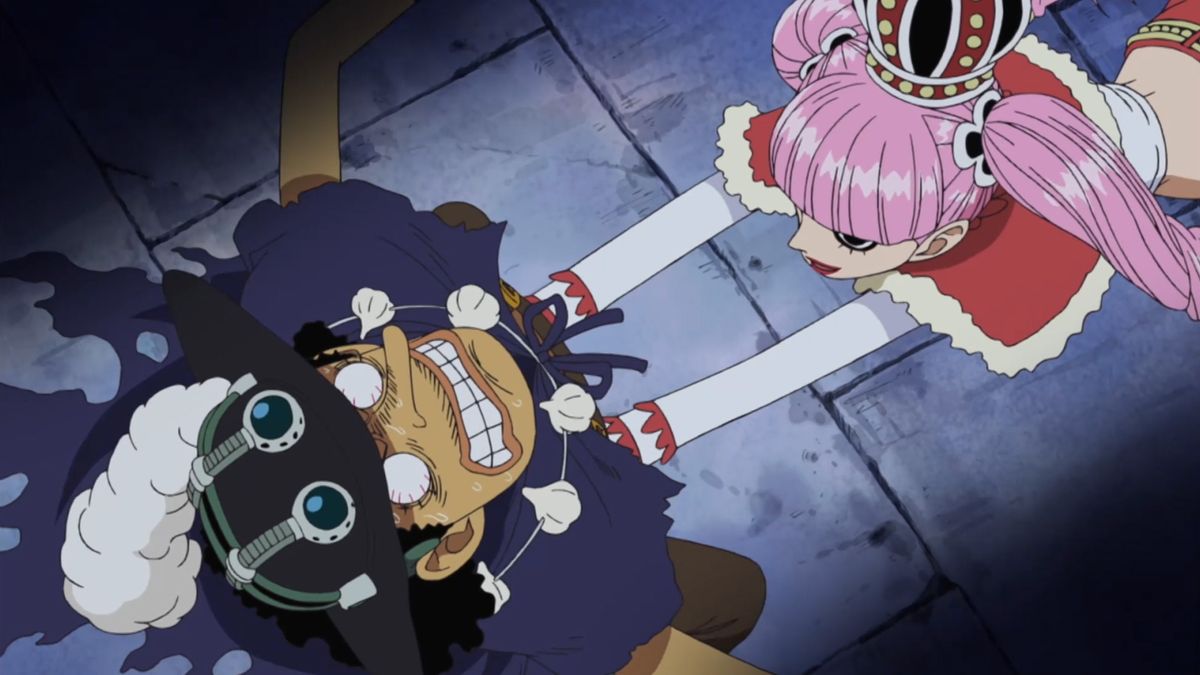
One Piece Episode 360 React follows Usopp past animal zombies and into the trick behind Perona’s airborne giant form while Luffy remains blocked by Doppelman.
One Piece Episode 360 React: Usopp recognizes that Perona’s airborne giant form cannot be her ordinary body and begins looking for the vulnerable person behind the projection.
What happened in Episode 360
Usopp survives the animal zombies, pursues Perona, and faces a giant version that can evade his shots and reach through his chest. Luffy still cannot solve Moria’s Doppelman defense.
RaeRae’s opening receipt
Perona performs invincibility at enormous scale, but Usopp’s greatest weapon has always been noticing where a frightening story fails to add up.
Perona performs invincibility at giant scale
Usopp follows Perona and finds a version of her floating beyond ordinary reach. The enormous projection evades his shots, passes through barriers, and reaches into his chest. Every visual signal tells him that direct attack is useless.
The performance gains power because Usopp initially accepts the visible figure as the whole opponent.
The giant body is an argument before the giant body is an attack
Scale announces superiority. Perona makes herself appear too large, too mobile, and too intangible for Usopp’s ordinary tools. The image is meant to settle the fight psychologically before strategy can begin.
Her projection says that resistance is ridiculous. Usopp’s task is to question the statement embedded in the spectacle.
Usopp recognizes that power still needs a mechanism
He may be frightened, but he understands that impossible effects usually have conditions. A floating Perona who passes through matter cannot simply be the same physical body he was chasing through the castle.
Curiosity creates a crack in fear. Once he asks how the image works, invincibility becomes a problem with parts.
A projection requires something to remain elsewhere
Perona’s astral form can travel because her ordinary body has been left behind. Freedom in one location creates vulnerability in another. The spectacular ability depends upon a hidden cost.
Her advantage lasts while the opponent keeps aiming at the performance instead of searching for the source.
Information is the real distance between them
Perona knows which form can be harmed and assumes Usopp does not. Usopp sees attacks fail and receives no immediate explanation. The fight is unequal because one participant understands the rules.
Deduction narrows that inequality. Knowledge brings his limited physical tools back into relevance.
Usopp’s profession begins with trajectories
A sniper studies where something appears, where force travels, and what position must exist beyond the visible line. Perona’s projection invites him to fire at the largest target. His deeper skill asks where the vulnerable target must be.
Marksmanship is not only accuracy. Marksmanship is choosing the truthful destination for a shot.
The liar becomes sensitive to constructed appearances
Usopp knows how to make a frightening story feel larger than the person telling the story. He has exaggerated armies, illnesses, weapons, and certainty. That experience helps him notice when Perona’s giant image is also a story designed to control response.
Knowing performance from the inside gives him a route through somebody else’s performance.
His lies and Perona’s projection do not carry the same power
Usopp’s deceptions can still hurt people, but he often lies from weakness to create space for survival. Perona projects strength from a position of control and uses the illusion to deepen another person’s helplessness.
Similar techniques acquire different meanings through purpose, target, and consequence.
Negative Hollows were only one layer of control
Usopp’s unusual pessimism protected him from imposed despair. Perona can still command zombies, separate spirit from body, change apparent scale, and exploit intangibility. Immunity to one mechanism does not finish the confrontation.
The episode respects a counter by refusing to turn the counter into total superiority.
The animal zombies test courage after the joke
Usopp can boast that negativity is his specialty while remaining honestly afraid of teeth and numbers. Physical danger strips away any fantasy that emotional resistance solved the room.
He keeps moving anyway. Courage survives as behavior rather than a stable feeling.
Perona reaches through his chest to reclaim psychological control
The gesture appears intimate and impossible, bypassing armor and distance. Her power turns the body’s boundary into another surface she can ignore.
Usopp’s fear is reasonable because the attack dramatizes total access. His response must restore a boundary through understanding rather than strength.
Intangibility can hide dependency
The projection cannot be struck, but the projection also cannot exist without the abandoned body. Perona displays the benefit and hides the requirement.
Systems often advertise what power can do while concealing the labor, risk, or vulnerability supporting the display. Usopp wins information by looking for the concealed half.
Perona’s room resembles Absalom’s invisibility problem
Both powers create asymmetrical knowledge. Absalom can occupy space without being perceived. Perona can appear where her vulnerable body is not. Their targets must act with incomplete information.
Thriller Bark repeatedly makes secrecy a weapon and observation a form of resistance.
Usopp does not need confidence to form a theory
Fear can coexist with careful reasoning. He notices contradictions while panicking, which means emotional distress does not erase intellectual agency.
The episode refuses a shallow rule that calm people think and frightened people merely react. Usopp thinks from inside reaction.
A theory becomes useful when a shot can test the theory
Usopp’s deduction must eventually direct action toward the hidden body. Guessing correctly in private cannot protect him or the crew. He needs evidence capable of changing the fight.
His arsenal gives thought a physical route. Every projectile can become a question sent toward a specific answer.
Perona underestimates the practical intelligence behind cowardice
She sees a man easy to frighten and assumes fear prevents analysis. Usopp’s history says otherwise. He survives partly because fear makes him inventory exits, traps, motives, and inconsistencies.
The trait used to dismiss him becomes the reason he keeps searching for the mechanism.
The matchup rewards knowledge no stronger crewmate needed to develop
Zoro and Sanji often meet danger through direct physical confidence. Usopp has learned to compensate for weaker force by understanding conditions and constructing alternatives.
Perona’s projection creates exactly the kind of problem compensation can solve.
Being uniquely suited does not make the work easy
Usopp’s negativity counters the Hollows, and his deceptive mind recognizes performance. He still faces an opponent with range, mobility, minions, and hidden information.
The match respects his strengths because those strengths must be applied under real pressure.
Perona’s apparent freedom depends on leaving herself defenseless
A spirit able to fly and expand looks liberated from bodily limitation. The abandoned body remains unable to protect itself. The ability divides mobility from safety.
Usopp’s insight reconnects the two. Freedom in the projection cannot erase responsibility for the body sustaining the projection.
The giant image externalizes how fear distorts scale
A threat can feel larger than every available answer. Perona literally occupies that emotional perspective, towering over the sniper who already expects catastrophe.
Usopp reduces the threat by changing the question. He stops asking how to overpower the giant and asks what the giant image is hiding.
Strategy begins when the frame changes
Inside Perona’s chosen frame, Usopp has to hit an intangible giant. Inside his revised frame, he has to locate an unattended body. The facts remain, but their organization changes.
A weaker fighter often survives by refusing the problem definition offered by the stronger opponent.
Luffy faces a parallel decoy in Doppelman
Moria’s shadow double catches blows while the person responsible remains beyond consequence. Perona’s projection catches attention while her vulnerable body remains elsewhere. Both officers place a substitute between action and accountability.
Usopp and Luffy need to identify where the real authority is hiding.
Thriller Bark’s leaders keep outsourcing exposure
Moria uses shadows and zombies. Perona uses spirits and animal zombies. Hogback uses corpses. Absalom uses invisibility. Each officer wants the benefit of action without equal bodily risk.
The Straw Hats advance by forcing consequence back toward the person making choices.
Usopp’s fear keeps other people present in the calculation
He worries about what happens if he fails because failure affects more than pride. Perona can pursue his friends, and dawn continues approaching for shadowless crewmates.
Fear becomes socially useful when concern for consequence supports rather than stops action.
The projection also reflects Perona’s desired self-image
She appears enormous, untouchable, airborne, and capable of entering another body without permission. The form expresses a fantasy of control larger than her ordinary physical presence.
Finding the body means encountering the person beneath the image she authored for the fight.
Usopp’s counterattack restores proportion
Once he understands the astral separation, the giant is no longer evidence that Perona herself has become physically enormous. The threat can be divided into projection, body, minions, and rules.
Proportion does not eliminate danger. Proportion makes danger addressable.
The episode makes deduction part of action spectacle
No single explosion carries the full excitement. The turn arrives when Usopp’s interpretation catches up with the visual trick. Thinking changes which future attacks can matter.
One Piece gives tactical intelligence the emotional force often reserved for a new transformation.
Episode 360 remains an episode React
This page responds to Usopp surviving the animal zombies, confronting Perona’s giant projection, and recognizing that an intangible spirit implies a hidden physical body. A complete Thriller Bark Review belongs after the arc resolves those systems.
React classification preserves broadcast-level close reading and keeps whole-work Reviews distinct.
The official local still remains canonical
The Episode 360 still serves as featured image, hero, bounded-directory card, and social preview. One local attachment provides consistent recognition across every discovery route.
Complete source and accessibility metadata remain attached, and no other record reuses the image.
RaeRae’s final receipt
Episode 360 lets Perona build the perfect nightmare for somebody who already expects disaster. She floats, expands, slips past every shot, and reaches through Usopp’s chest as though bodies and boundaries are optional. The giant projection does not merely attack him. The projection tells him that resistance is too small to count.
Usopp survives by refusing the problem Perona handed him. A body cannot be intangible, airborne, enormous, and ordinary in the same way at the same time. If the figure is a projection, a vulnerable body has to remain somewhere else. That deduction is sniper work and liar work together: trace the trajectory, recognize the performance, and locate the truth supporting the image. Usopp is still scared. The animal zombies are still dangerous. His fear never becomes proof that he cannot think. Perona performs invincibility; Usopp starts asking what the performance needs hidden.
The hidden body turns spectacle back into evidence
Perona wants Usopp responding to scale, motion, and supernatural access. Those features produce panic but reveal little about where the actual risk resides. The abandoned body supplies evidence connecting every effect to a material condition.
Once Usopp identifies that condition, the fight stops being a referendum on whether he feels brave enough to shoot a ghost. The question becomes whether he can locate and reach the body that makes the ghost possible.
Dependence does not disappear because power hides dependence well
The projection looks liberated from gravity, size, walls, and ordinary injury. Perona’s body remains subject to all of them while unattended. Her spectacular freedom is borrowed from temporary vulnerability elsewhere.
Usopp’s deduction restores the missing half of the image. Any power presented as limitless should invite questions about the support, cost, or exposed condition kept outside the frame.
Fear makes Usopp verify what confidence might assume
A more confident fighter might continue attacking the visible enemy harder, trusting force to solve the contradiction. Usopp expects his first interpretation to fail. That insecurity pushes him to review what happened and search for another explanation.
The habit can be painful in ordinary life, yet Episode 360 turns doubt into quality control. He does not treat an intimidating appearance as proof merely because the appearance is loud.
Perona loses control of the frame before she loses the fight
Her greatest advantage is the ability to decide what Usopp considers real, dangerous, and worth targeting. Once he suspects astral projection, she no longer owns that decision completely.
The balance changes through interpretation before any decisive hit lands. Usopp’s mind exits the giant ghost’s stage and begins mapping the room Perona hoped he would ignore.
The sniper aims at the relationship between image and source
Ordinary marksmanship asks where a target will move. This confrontation asks where an apparent target came from and what stationary vulnerability must accompany that movement. Usopp follows causation as carefully as trajectory.
That skill explains why his weapons are varied rather than merely powerful. He builds answers for conditions, and correct diagnosis determines which answer deserves to leave the slingshot.