RaeRae Reacts · One Piece Episode 362
Zoro and Ryuma Finish Their Rooftop Duel While Brook Watches a Stolen Shadow Meet a New Swordsman
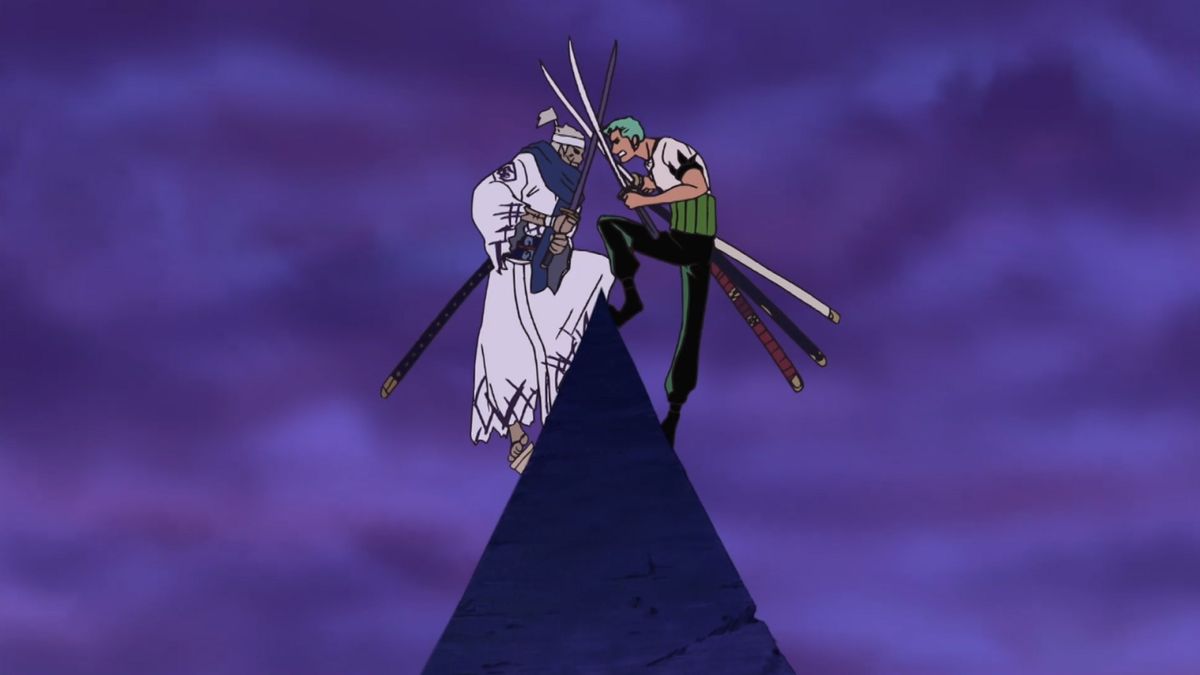
One Piece Episode 362 React rewinds five minutes to Zoro and Ryuma’s rooftop duel, where swordsmanship, a legendary corpse, and Brook’s stolen shadow collide.
One Piece Episode 362 React: the laboratory roof falls with Zoro and Ryuma’s duel apparently decided, then the episode rewinds to show the five minutes of swordsmanship Brook and Franky struggled to follow.
What happened in Episode 362
Zoro confronts the legendary samurai corpse carrying Brook’s stolen shadow. Speed, technique, and respect collide above a system that forced both histories into one zombie.
RaeRae’s opening receipt
A beautiful duel cannot make Moria’s theft legitimate. Zoro can honor Ryuma’s strength while fighting to return what belongs to Brook.
The roof falls before the episode explains the duel
Episode 362 opens on consequence: a severed roof, blue flame, falling bodies, and Brook and Franky unable to determine who won. The episode then returns five minutes to recover the decisions hidden inside the spectacle.
That structure makes outcome less important than the swordsmanship that produced the outcome.
Zoro enters a fight Brook has carried for years
Brook challenged Ryuma before the Straw Hats arrived and lost his shadow, access to sunlight, and years of movement. Zoro’s duel does not invent the claim against Ryuma. The duel joins a restoration Brook already pursued.
Support becomes ethical when a stronger ally honors the original victim’s demand rather than replacing the victim’s history.
Ryuma is not only the zombie holding Brook’s shadow
The corpse belonged to a legendary samurai whose body carries its own cultural memory. Moria and Hogback combine that body with Brook’s shadow and force the resulting fighter into service.
The zombie is built from two appropriated histories. Neither source consented to becoming the weapon Zoro now faces.
Brook’s technique sounds different through Ryuma’s body
The stolen shadow supplies habits and movement, while the samurai corpse supplies reach, strength, durability, and physical history. Familiar attacks emerge with capabilities Brook’s skeleton cannot reproduce.
Moria’s system makes appropriation crueler by using a person’s skill to demonstrate supposed inferiority to the person who developed the skill.
Zoro recognizes strength without legitimizing possession
A worthy opponent can exist inside an illegitimate arrangement. Zoro takes Ryuma’s ability seriously because underestimating the duel would insult the craft both fighters bring.
Respect for skill does not require accepting Moria’s ownership of corpse or shadow.
The duel refuses a simple rescue fantasy
Zoro cannot merely announce Brook’s rights and receive the shadow back. Moria’s violence has created a dangerous body capable of resisting restoration. The victim’s claim remains morally complete even when enforcement becomes difficult.
Justice should not depend on whether the harmed person can overpower the beneficiary of theft.
Speed makes spectators unreliable
Brook and Franky witness the duel while struggling to follow the exchange. Their confusion reminds viewers that visible outcome does not reveal every decision made at combat speed.
The rewind becomes a form of respect for craft. The episode slows interpretation without slowing the swordsmen.
Zoro’s discipline meets movement borrowed from another life
He has built technique through training, injury, failure, and promises. Ryuma’s zombie form carries technique severed from the life that learned the technique. Their blades place cultivated ownership beside forced transfer.
The clash asks whether movement can retain identity after power detaches movement from the mover.
Brook remains present even when Zoro holds the sword
His stolen shadow shapes Ryuma’s gestures, and his need for restoration gives the duel moral direction. The camera can center Zoro without making Brook irrelevant.
RaeRae’s reading keeps the rescue attached to the person who must live with the outcome.
Franky witnesses what practical support cannot solve alone
A shipwright can build routes, reinforce structures, and move people through danger. The rooftop confrontation requires swordsmanship Franky does not pretend to possess.
Teamwork includes recognizing when another person’s specialized labor must take the lead.
The blue flame makes victory look like disappearance
Fire consumes the zombie form as the roof collapses, leaving observers to interpret fragments. The image is beautiful and unsettling because the body already belonged to somebody whose life ended long ago.
Destruction can free a stolen shadow while also ending Moria’s use of another person’s remains.
A corpse does not become ownerless material
Death removes the ability to give present consent; death does not erase the dignity attached to a body and history. Hogback treats that silence as permission.
Ryuma’s legendary status makes the violation visible, but the same principle applies to every unnamed corpse in the zombie army.
Legend cannot consent on behalf of the dead
Moria might value Ryuma because his reputation promises useful force. Cultural admiration still cannot justify reanimating the body for private military labor.
Celebrating a legend and exploiting a legend can occupy the same language unless consent and purpose remain explicit.
Zoro’s seriousness protects the opponent from spectacle alone
He does not treat Ryuma as a novelty to be collected. The fight demands precision, adaptation, and acceptance of risk. Serious engagement acknowledges that the person-shaped weapon carries real capability.
That acknowledgment never makes the creation process honorable.
The swords collide across three promises
Zoro carries the promise tied to Kuina and his path toward becoming the greatest swordsman. Brook carries the promise to return to Laboon. Ryuma’s body carries the memory of a samurai whose legend belongs to Wano.
Moria’s system forces those histories together without understanding any of them.
A sword can carry history without carrying ownership automatically
Weapons in One Piece accumulate names, reputations, prior wielders, and cultural meaning. Possession alone does not settle whether a transfer is respectful, coerced, inherited, or stolen.
Episode 362 places that question beside a corpse and shadow already taken without permission.
Zoro fights the composite rather than pretending the parts are simple
Ryuma’s physical capacity matters. Brook’s shadow habits matter. Moria’s command matters. Treating the zombie as only one of those pieces would misread the threat.
Good strategy begins by acknowledging the forced relationship power created among all three.
The fight restores consequence to Moria’s experiment
Moria designed a superior soldier from resources stolen elsewhere. Zoro’s challenge makes that design vulnerable and forces the creation to answer another person rather than merely enforce commands.
Resistance interrupts the assumption that successful engineering proves rightful use.
Brook’s earlier defeat remains meaningful after Zoro wins ground
Five years of failed attempts taught Brook the enemy’s strength, the value of salt, and the stakes attached to his afro. Zoro’s intervention does not retroactively make those years foolish.
Community changes what can happen next without erasing what survival required before community arrived.
Victory should return the shadow rather than award the shadow
Zoro has no claim to Brook’s movement merely because he defeats the body using that movement. The rightful destination stays Brook.
Restoration differs from spoils. A rescuer does not inherit stolen property by overcoming the thief’s weapon.
Ryuma’s skill deserves a goodbye separate from Moria
The samurai’s body demonstrates extraordinary ability despite coercive reanimation. Recognizing that ability allows the end of the duel to carry gravity rather than simple monster disposal.
Moria’s ownership claim can be rejected while Ryuma’s historical dignity remains visible.
The laboratory roof becomes collateral evidence
Swordsmanship literally cuts through the structure housing Hogback’s work. The falling architecture exposes how every personal duel is connected to the institution assembling corpses and shadows below.
The building cannot contain the consequences of the exploitation practiced inside.
Five minutes can hold years of inherited conflict
The duel itself is brief. Brook’s isolation, Ryuma’s legend, Zoro’s training, and Moria’s extraction system give each exchange a much longer history.
Runtime does not determine narrative weight when a scene concentrates several lives into one confrontation.
The episode lets technique speak before explanation
Viewers see cuts, movement, fire, and collapsed structure before fully understanding the sequence. Physical storytelling invites attention to rhythm and position.
The rewind then gives analysis a second pass through images that first arrived as shock.
Respect is most honest when paired with restitution
Zoro can admire the opponent’s swordsmanship, but admiration alone would leave Brook shadowless and the corpse conscripted. The duel must change the material arrangement.
Respect without restitution risks becoming appreciation of what exploitation produced.
The fight shows why Moria’s collection cannot create lineage
He can gather bodies, shadows, blades, and reputations. A lineage requires acknowledged transmission, teaching, consent, and responsibility between people.
Ryuma’s zombie form contains historical fragments without the relationships that would make inheritance legitimate.
Episode 362 remains an episode React
This page responds to Zoro and Ryuma’s rooftop duel, Brook’s stolen shadow, the legendary corpse, and the five-minute rewind revealing the exchange. A complete Thriller Bark Review belongs after the arc resolves those systems.
React classification preserves broadcast-level close reading and keeps whole-work Reviews distinct.
The official local still remains canonical
The Episode 362 still serves as featured image, hero, bounded-directory card, and social preview. One local attachment provides consistent recognition across every discovery route.
Complete source and accessibility metadata remain attached, and no other record reuses the image.
RaeRae’s final receipt
Episode 362 gives Zoro a gorgeous duel and refuses to make beauty proof that the arrangement was ever rightful. Ryuma’s legendary corpse did not volunteer for Hogback’s laboratory. Brook did not volunteer his shadow, sword habits, voice, or years away from sunlight. Moria forced both histories together and called the result a soldier.
Zoro can respect the strength in front of him while fighting to end that possession. Brook’s claim does not weaken because he lost an earlier duel, and Zoro does not become owner of the shadow because he can win. Restoration means the shadow goes home. The collapsing roof and blue flame give spectacle to a precise moral outcome: honor the craft, return what was stolen, and stop treating dead bodies or living memory as parts available to the strongest collector.
Restitution keeps admiration from becoming another appropriation
Zoro’s respect for Ryuma could become self-serving if the duel ended only with a new story about Zoro defeating a legend. Brook would remain the person whose shadow and daylight paid for that encounter. The meaningful result has to include returning what Moria took.
Admiration becomes ethical when the admirer refuses to profit from the conditions that made the admired performance available. Zoro can value the swordsmanship while helping dismantle the forced arrangement.
Brook does not need to win the rematch to prove the original theft
His prior defeats describe a mismatch in physical capacity, not a failure of ownership. Ryuma’s corpse can execute Brook’s shadow habits with strength Brook no longer possesses. Moria designed that imbalance deliberately.
Requiring Brook to win before deserving restoration would let exploitation define justice. His shadow belongs to him because his life formed the shadow, regardless of which body can use the movement more efficiently.
Zoro’s role is strongest when he becomes a bridge rather than a replacement
He has the specialized skill to meet Ryuma on the rooftop, while Brook has the history explaining why the meeting matters. Neither contribution needs to erase the other. Zoro’s blade can create the opening through which Brook’s life becomes whole again.
Chosen family works through that division of labor. A friend may finish the fight another person could not finish alone while preserving the harmed person as author of the demand.
Ryuma’s legend survives without requiring continued possession of his corpse
Moria treats physical access as the only way to keep a famous warrior useful. Cultural memory offers another relationship to the dead: tell the history, respect the craft, preserve the name, and allow the body to remain outside forced service.
Ending the zombie does not erase Ryuma. Ending the zombie removes Moria’s claim that admiration grants the right to operate Ryuma’s remains.
The collapsing laboratory joins symbolic and material consequence
Hogback’s architecture sheltered a process that separated bodies from dignity and shadows from owners. Zoro and Ryuma’s duel cuts through the roof itself. The institution can no longer keep its violence neatly contained below a spectacular fight.
Falling structure makes the connection visible. Personal mastery, stolen identity, medical exploitation, and Moria’s military project all occupy the same building because every confrontation belongs to the same system.
The blue flame closes one forced composite without simplifying either source
Brook can reclaim his shadow, and Ryuma’s body can leave Moria’s service. Those outcomes do not make the years of theft disappear. Restoration ends the ongoing violation and opens space for both histories to be remembered accurately.
Episode 362 earns the beauty of its finish because the image can hold admiration, grief, restitution, and refusal at once.