RaeRae Reacts · One Piece Episode 354
Brook Protects His Afro Because Laboon Is Still Waiting at the Promised Cape
One Piece Episode 354 React connects Brook’s fifty-year promise to Laboon and the Straw Hats’ own meeting with the whale at Reverse Mountain.
What happens
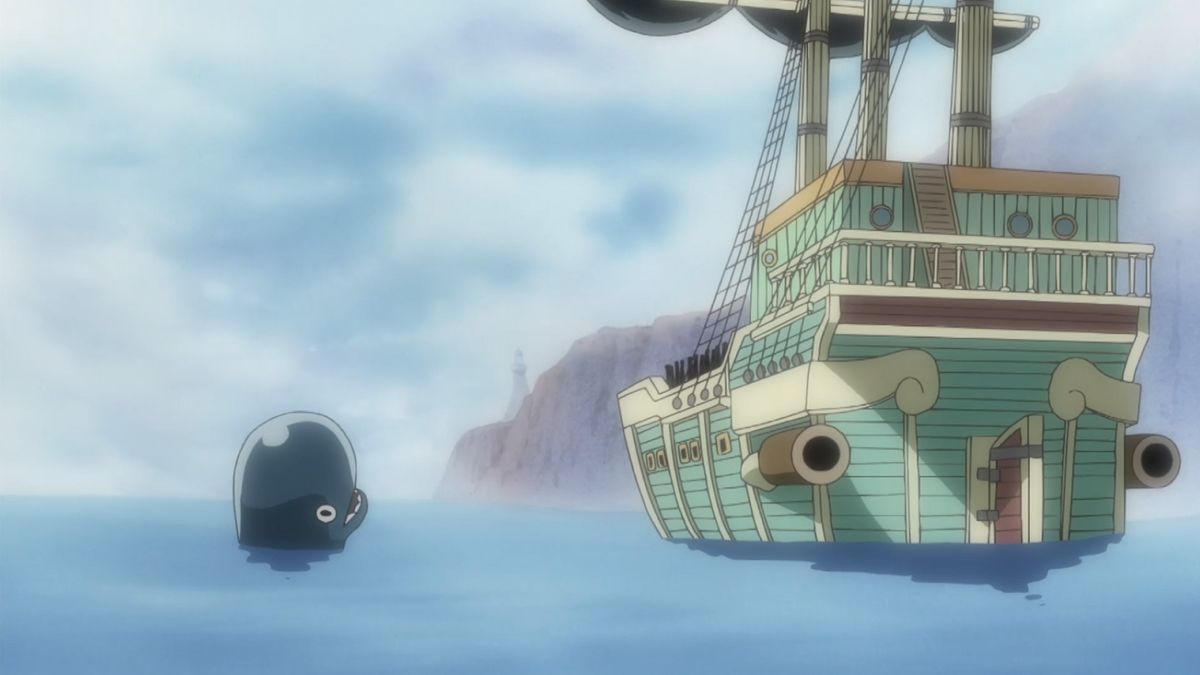
Brook explains that the afro must survive because one former crewmate is still waiting after fifty years: Laboon. The Straw Hats know the whale from Reverse Mountain, where Luffy fought him, promised to return, and left the Jolly Roger mark as proof.
RaeRae reacts
The afro is memory made visible across impossible time. Laboon cannot compare Brook’s bones to the musician who left, but the hair can carry recognition toward the cape. Two promises made decades apart suddenly occupy the same crew.
Canon note
Episode 354 continues the manga-canon Thriller Bark Arc.
Laboon changes the meaning of Brook before the crew can recruit him
Episode 354 gives the Straw Hats a name they already carry in their own history. Brook is not talking about an abstract whale waiting somewhere beyond the fog. He is talking about Laboon, the enormous friend Luffy met at Reverse Mountain and promised to see again.
Recognition folds two journeys together before Brook understands how close those journeys have come. The crew now knows that his impossible promise has a living witness.
The afro is a bridge between two versions of Brook
Laboon last knew a living musician with skin, a face, and a familiar silhouette. Reviving as a skeleton erased nearly every visible detail that could announce Brook’s identity from a distance. The afro remained.
Brook protects the hair because recognition matters after fifty years of separation. The afro connects the body Laboon remembers to the body capable of returning.
A visual gag becomes continuity evidence
Brook’s design invites laughter from the moment he appears. Episode 354 does not discard that comedy when grief arrives. The story reveals that the funniest, loudest feature also carries the most private burden.
One Piece excels when a joke survives emotional reinterpretation. The afro stays absurd and becomes sacred at the same time.
Laboon has been waiting inside another story
The audience met Laboon long before Brook appeared. Crocus, the scarred head, the painted Straw Hat symbol, and Luffy’s promise seemed complete as a moving early adventure. Brook’s history reopens that memory and shows that another person has been traveling toward the same whale.
The world feels connected because old compassion develops consequences rather than serving as disposable sentiment.
Fifty years makes hope look unreasonable
Brook has no evidence that Laboon survived, remembers, or still waits. Time has consumed his crew, his body, and almost every recognizable part of his former life. Practical thinking would permit surrender.
He refuses practical permission. Hope becomes meaningful precisely because the available evidence cannot guarantee a reward.
The promise survived the people who made the promise together
The Rumbar Pirates intended to circle the Grand Line and return as a crew. Brook carries that collective vow alone after every companion dies. Survival gives him custody of words spoken by many voices.
That custody is heavy. Returning to Laboon means representing friends who can no longer complete the route themselves.
Brook’s solitude has always had a destination
Decades on a ghost ship could have reduced survival to empty continuation. Laboon gives Brook’s endurance direction. Each year endured remains part of a journey toward somebody rather than mere refusal to die.
A destination cannot erase loneliness, but a destination can keep loneliness from becoming the only meaning left.
The Straw Hats can verify one half of Brook’s faith
Luffy and the others know Laboon is alive. They know the whale remembers pirates, mourns absence, and still occupies the cape where promises entered the Grand Line. Their knowledge cannot recover Brook’s lost years, yet that knowledge changes the emotional weather around his mission.
For the first time, Brook’s hope can receive confirmation from witnesses who have stood beside the friend awaiting him.
Luffy already challenged Laboon to keep living
Luffy’s earlier promise to fight Laboon again was a strange act of care. He gave the whale a future contest so grief would no longer require self-destruction against the Red Line. Brook now reveals the older promise beneath that intervention.
Luffy did not know whose place he was temporarily holding. Compassion connected him to Brook before either man knew the other existed.
The Straw Hat mark on Laboon becomes borrowed reassurance
Luffy painted his emblem across Laboon’s scarred head and asked the whale to preserve the mark until their rematch. That symbol offered a visible commitment from a passing crew. Brook’s afro holds a parallel function from the opposite direction.
Both images tell separated friends that memory still has a body. One waits at the cape, and one travels through darkness.
Recognition matters without reducing love to appearance
Laboon’s bond with Brook is not shallow because the afro may help recognition. Fifty years and death have transformed the person returning. A familiar outline can open the door through which voice, music, memory, and affection complete recognition.
The afro is not the whole relationship. The afro is the first surviving signal across an almost unimaginable distance.
Ryuma’s blade threatens more than hair
Cutting the afro would not cancel Brook’s identity or invalidate his promise, but Brook experiences the threat as the destruction of his last visible continuity. Trauma does not calculate symbolic loss according to an outsider’s scale.
The blade lands near the one physical feature Brook has organized hope around. His desperation deserves to be understood on those terms.
Brook’s plea is an act of loyalty
Begging Ryuma to spare the afro costs Brook pride in the middle of a duel. He accepts that cost immediately. Loyalty determines which humiliation is survivable and which loss is intolerable.
Courage does not always look like refusing to kneel. Sometimes courage means kneeling to protect the promise that must outlive the fight.
Defeat cannot transfer ownership of Brook’s history
Ryuma has Brook’s shadow and can outperform Brook with techniques derived from that stolen shadow. Victory still does not make the history behind those movements Ryuma’s property. Power proves capability, not rightful possession.
Brook’s claim remains whole while he lies defeated. Restoration is owed because theft occurred, not because the victim can win a rematch.
Ryuma’s corpse carries a history deserving separate respect
The zombie is also built from the body of a legendary samurai whose own life cannot consent to Moria’s use. Brook’s shadow and Ryuma’s corpse have been forced into a composite serving a third man’s orders.
Recognizing Brook’s victimization need not erase the indignity done to Ryuma. Moria profits by treating both histories as components.
Moria turns memory into equipment
Shadows contain habits, voices, and skills shaped through lived experience. Moria extracts those qualities and treats them as upgrades for obedient bodies. Personhood becomes a parts catalog.
Brook’s fight exposes the violence of that reduction. The shadow carries intimate expression even while the system denies the person who created that expression.
Music will eventually identify what appearance begins
Brook and Laboon share songs, performances, and the sound of the Rumbar Pirates living together. The afro may announce possibility, but music holds the fuller proof. A recording and a remembered song can carry voices across death.
That musical inheritance makes Brook’s return larger than a reunion between two survivors. He carries an absent crew’s final presence toward their friend.
The crew hears recruitment differently after Laboon
Brook was already charming, strange, talented, and painfully alone. Learning about Laboon gives his desired future a specific route. Joining the Straw Hats would not merely end solitude; joining could help him finish the voyage that solitude interrupted.
A place on the ship can respect his existing purpose instead of asking him to abandon the past for a new identity.
Chosen family does not replace the Rumbar Pirates
New companionship cannot make Brook’s first crew interchangeable or heal grief by substitution. The Straw Hats matter because they can travel beside the person his earlier bonds shaped.
Healthy chosen family creates room for old love. Nobody aboard the Sunny needs Brook to forget the dead before he can belong among the living.
Laboon joins the crew’s map without boarding the ship
The whale becomes a shared destination. Luffy has a rematch to honor, and Brook has a reunion carrying fifty years of music and loss. Reverse Mountain now holds promises from two directions.
A crew map includes more than treasure coordinates. The map records people whose waiting gives the voyage moral shape.
The revelation rewards readers who remember
One Piece trusts an early emotional encounter to remain available hundreds of episodes later. The reward is not trivia recognition. Memory allows the viewer to feel the precise shock of realizing that Brook’s unnamed listener has already been loved by this crew.
Long serialization becomes meaningful when duration deepens responsibility instead of merely increasing volume.
Episode 354 centers a promise rather than a twist
Laboon’s identity is a thrilling connection, but the episode’s deeper work concerns what Brook has done with the promise during decades when fulfillment looked impossible. The reveal validates endurance without pretending endurance was painless.
Brook’s survival remains scarred, eccentric, lonely, and purposeful. Every part belongs in the same portrait.
The crew receives knowledge Brook desperately needs
The Straw Hats can tell Brook that Laboon lives, yet timing and danger keep the revelation inside an active crisis. Information this powerful cannot immediately solve shadow theft, Ryuma, or the approaching dawn.
Hope arrives as fuel, not a shortcut. Brook still needs restoration before the shared destination can become reachable.
The episode protects emotional specificity
Brook is not simply sad about a generic friend. He remembers the whale left at Reverse Mountain, the crew that promised to return, the appearance Laboon knew, and the music intended for delivery. Specific details keep grief from becoming decorative melancholy.
RaeRae editorial voice works best when those details remain attached to the analysis instead of being replaced by vague praise.
This page remains an episode React
The article responds to Episode 354’s Laboon connection, the meaning of the afro, and the crew’s recognition of Brook’s destination. A complete Thriller Bark Review belongs after shadow restoration and the arc’s other arguments reach resolution.
Correct classification keeps broadcast close reading inside Reacts and reserves Reviews for whole series, films, or completed narrative units.
The official local still remains canonical
The Episode 354 still serves as featured image, hero, bounded-directory card, and social preview. The same local attachment gives the post one consistent identity across every discovery path.
Source, title, caption, description, and accessibility metadata remain complete, and the asset is not reused by another One Piece record.
RaeRae’s final receipt
Episode 354 says Laboon’s name, and suddenly Brook’s afro stops being a skeleton joke the audience can treat as disposable. That hair is the last visible bridge between the musician who sailed away and the body death sent back. Brook believes a whale has waited fifty years at Reverse Mountain, and he wants one familiar shape to cross the final distance before music and memory explain everything else.
The Straw Hats know the waiting friend is real. They have seen Laboon’s scars, heard Crocus tell the story, painted a promise on his head, and asked him to keep living. Brook does not need a replacement family that erases the Rumbar Pirates. He needs companions willing to carry their dead friend’s unfinished route beside him. Ryuma can defeat Brook, threaten the afro, and wield stolen technique through a stronger corpse. None of that transfers ownership of Brook’s history. The promise remains his responsibility because love survived every practical reason to surrender. An afro, a song, and two vows aimed at the same cape now hold a future open.
Reverse Mountain now holds two living commitments
Brook approaches the cape carrying the Rumbar Pirates’ original promise, while Luffy approaches from the opposite direction carrying a newer promise of reunion and another fight. Neither commitment competes with the other. Together they show how care can keep a waiting life connected to more than one future.
Laboon is not frozen as an object in Brook’s memory. The whale has continued meeting people, forming attachments, suffering, and accepting reasons to survive. Brook has also changed through death and isolation. Their eventual reunion matters because both friends lived beyond the moment of separation.
Keeping the afro protects the right to introduce himself again
Brook cannot control whether Laboon recognizes him immediately. He can protect the surviving cue, bring the music, speak the shared history, and offer the truth of what happened. The afro preserves a chance rather than guaranteeing an outcome.
That modest distinction makes Brook’s devotion stronger. He is fighting for the opportunity to return honestly, not demanding that fifty years disappear on arrival.