RaeRae Reacts · One Piece Episode 355
Luffy Chooses Moria as the Target Before Sunrise Erases Every Shadowless Body
One Piece Episode 355 React turns the stolen-shadow search into a direct attack on Moria while Sanji pursues Nami and dawn becomes the deadline.
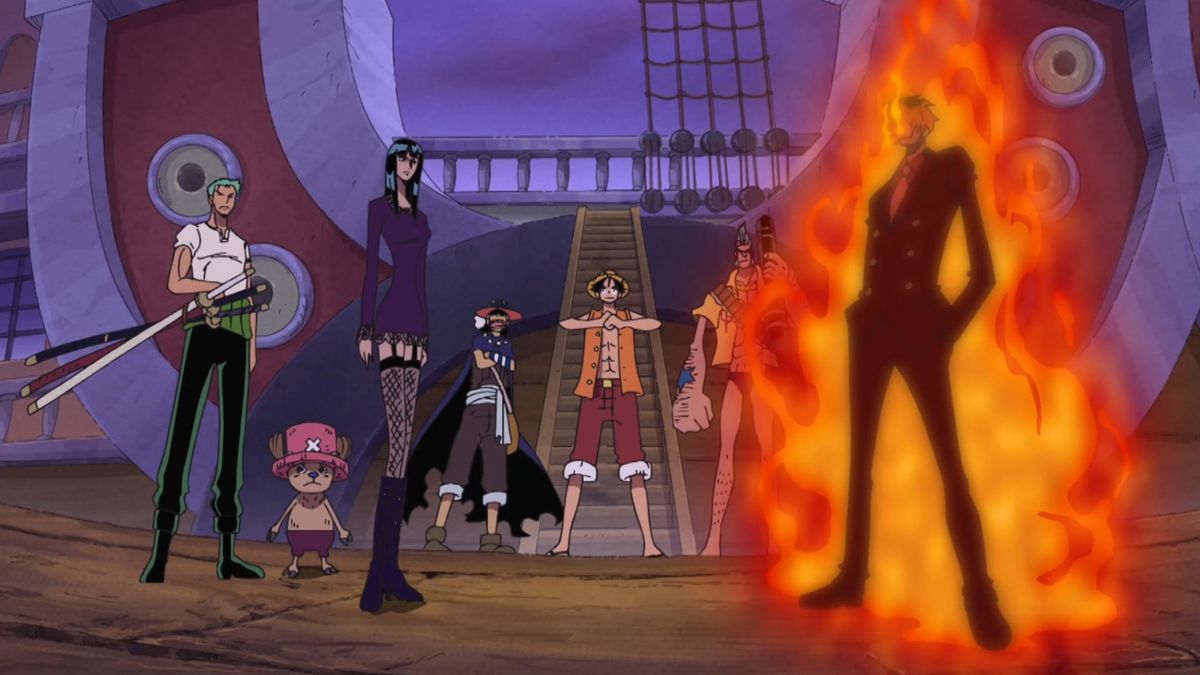
What happens
The crew considers finding the zombies carrying Luffy, Zoro, and Sanji’s shadows. Luffy identifies a simpler target: defeating Moria should release every stolen shadow. Sanji leaves to rescue Nami, Franky and Zoro head toward Brook, and sunrise establishes the deadline before shadowless bodies disappear.
RaeRae reacts
Luffy refuses to solve only the thefts closest to him. Defeating Moria can restore an entire hidden community. Dawn turns strategy into navigation, rescue, and accountability measured against every person waiting for daylight.
Canon note
Episode 355 continues the manga-canon Thriller Bark Arc.
Luffy chooses the source instead of chasing every symptom
Once Luffy understands that Moria controls the stolen shadows, his strategy becomes direct: defeat the person maintaining the system. Thriller Bark offers countless zombies and corridors designed to scatter attention, but the captain identifies the relationship connecting every smaller threat.
The decision is simple without being thoughtless. Removing Moria’s control can restore many victims at once.
A captain turns information into direction
The crew has gathered facts while Luffy was unconscious. He listens, accepts the urgency, and converts their findings into a target. Leadership here depends on other people having observed well.
Luffy does not need to originate every useful idea. He gives shared knowledge momentum and accepts responsibility for the most dangerous destination.
Shadow restoration is larger than the Straw Hats
Luffy, Zoro, Sanji, and Brook provide the immediate emotional stakes, but Moria has accumulated victims far beyond this crew. Defeating him can return stolen lives to people scattered outside the current frame.
The captain’s personal anger therefore aligns with collective liberation. One confrontation may break the rule holding an entire population away from sunlight.
Sunrise converts delay into a fatal choice
A shadowless body cannot survive direct sunlight. Dawn is not a vague reason to hurry; dawn is the moment imprisonment becomes annihilation. Every detour consumes part of the remaining night.
The deadline strips comfort from planning. The crew must distribute imperfectly and move before certainty arrives.
Moria weaponizes a natural rhythm
Morning usually offers safety after horror. Moria turns the same light into an execution mechanism for anyone he has robbed. His power forces nature to enforce his property claim.
Restoring a shadow means reclaiming the right to inhabit ordinary time. Victims should not need permission to stand beneath the sun.
Luffy’s body carries proof of the deadline
The danger is not theoretical while his own shadow remains missing. His survival depends upon reaching Moria before morning, yet he does not retreat into self-protection. He advances toward the person responsible.
That choice keeps courage attached to vulnerability. Luffy is endangered, not magically exempt from the rules confronting everyone else.
Sanji claims the route toward Nami
Once awake, Sanji moves toward Absalom and the coerced wedding. The mission fits his devotion to Nami, but the ethical center must remain her stolen choice rather than his romantic rivalry.
Rescue succeeds when Nami regains agency. Beating Absalom matters because captivity must end, not because one man wins possession from another.
Nami is a navigator, not a prize
Absalom has staged her as an object inside his fantasy. The crew’s plan answers by treating her absence as damage to a person and to the family she chose. She is the one who charts their movement through the world.
The wedding costume cannot overwrite her role, desires, or refusal. Her own voice remains the authority the scene must restore.
Zoro and Franky move toward Brook
Brook has fought Ryuma alone before and lost to a stronger body carrying his stolen technique. Sending Zoro and Franky changes the conditions without erasing Brook’s original claim.
Community does not make his five years of effort irrelevant. Community ensures that effort no longer has to remain solitary.
Zoro is the right witness for a sword-bound theft
As a swordsman, Zoro understands that technique carries discipline, history, and identity. Ryuma’s zombie form complicates every category: legendary corpse, stolen shadow, and coerced service exist in one opponent.
Zoro can respect strength while refusing Moria’s ownership. Respect for a fighter does not require respect for the system exploiting that fighter’s remains.
Franky brings practical support to an emotional duel
Franky knows how to build passage through impossible terrain and how to see a broken structure as a set of solvable pressures. Brook’s struggle needs that grounded usefulness beside swordsmanship.
The partnership suggests that rescue is rarely one dramatic strike. Access, protection, timing, and witness all matter.
The crew divides without fragmenting
Separate destinations could make the Straw Hats look scattered, yet every route serves the same restoration. Moria, Absalom, Ryuma, and Hogback represent connected parts of one exploitative operation.
Division becomes evidence of trust. Each group can act because everybody understands the shared reason behind different tasks.
Urgency clarifies existing roles
Luffy takes the central oppressor. Sanji pursues the kidnapped crewmate. Zoro and Franky answer Brook’s stolen shadow. Chopper moves toward the doctor who corrupted medicine. The plan grows from relationships already established.
No assignment feels like a random matchup board. Character history determines what each confrontation means.
Chopper’s route carries professional betrayal
Hogback once represented medical brilliance to Chopper. Thriller Bark reveals ability emptied of care and placed in service of domination. Confronting that betrayal asks what makes healing honorable.
Technique alone cannot define a doctor. The treatment of bodies, consent, death, and suffering defines the difference between medicine and exploitation.
Robin supports a crew moving through systems
Robin reads the architecture behind individual horrors. Her calm helps keep zombie attacks, shadow theft, coerced marriage, and corpse manipulation connected to the organization enabling all four.
The crew needs fighters, but the crew also needs somebody who recognizes how power arranges evidence and hides responsibility.
Usopp remains useful before his impossible matchup
Fear has kept Usopp attentive rather than absent. He brings information forward, survives encounters, and occupies a plan that will soon reveal an unusual resistance to Perona.
Thriller Bark repeatedly rewards the quality he is most ashamed of. A frightened person can still be exactly the person a crisis requires.
The deadline prevents heroic perfection
Nobody can wait until every crewmate is recovered, every enemy understood, and every route safe. Sunrise makes action under uncertainty unavoidable. The plan must be good enough to begin and flexible enough to survive contact.
That pressure gives teamwork credibility. Coordination is not flawless; coordination is the practice of continuing while conditions change.
Luffy’s confidence rests on delegated trust
Charging toward Moria would be reckless if Luffy believed he also needed to supervise every rescue. He can move directly because he expects his friends to carry their assignments.
The captain’s freedom is produced by confidence in the crew, just as their freedom to split routes depends on confidence in his purpose.
Defeating Moria is restoration, not conquest
Luffy does not seek Moria’s territory, title, or army. The desired outcome is the return of what was taken. Victory should dissolve an illegitimate arrangement rather than transfer that arrangement to a new ruler.
That distinction keeps the conflict aligned with freedom. The Straw Hats break cages; they do not inherit the right to operate them.
Brook’s fight gains allies without losing authorship
Brook named the injustice, researched the weakness, challenged Ryuma, and protected the promise attached to his afro. Zoro and Franky enter after that history has already defined the stakes.
Their support respects authorship when they help fulfill Brook’s demand instead of recasting him as a passive reason for their heroism.
Sanji’s anger must point toward coercion
Jealous jokes can crowd the scene, but Absalom’s central offense remains the abduction and attempted marriage of an unconscious woman. Sanji is most defensible when his rage protects Nami’s right to answer for herself.
The episode works better when viewers refuse to let masculine competition become the frame around her violation.
The night becomes a shared resource
Every remaining minute protects the shadowless victims from sunlight and gives the crew another chance to reach the source. Time belongs to all fronts at once.
A delay near Absalom affects the rescue from Moria. A delay near Ryuma affects Brook’s return. Coordination matters because every route spends the same darkness.
Thriller Bark’s scale finally becomes legible
The island first appeared as a collection of jokes, ghosts, stitched bodies, and bizarre rooms. Episode 355 reveals a structured crisis with a central authority, specialized enforcers, stolen labor, and a deadline.
Once the structure becomes legible, the crew can replace wandering reaction with purposeful movement.
The plan protects different forms of personhood
Shadows carry lived movement. Bodies deserve consent. Nami’s future cannot be assigned. Brook’s promise cannot be appropriated. Chopper’s medical ethics cannot be separated from care.
Each route defends a different boundary, while all boundaries answer the same question: who has the right to decide what a person is for?
Episode 355 remains a React
This page responds to Luffy’s decision to target Moria, Sanji’s route toward Nami, Zoro and Franky’s support for Brook, and dawn’s fatal deadline. A completed Thriller Bark Review belongs after the arc resolves those movements.
React classification preserves close episode analysis and keeps whole-work Reviews distinct in the shared directories.
The local still remains the canonical image
The Episode 355 image serves as featured image, hero, bounded-directory card, and social preview. One local attachment provides consistent recognition across the hub, search, Reacts directory, and shared links.
Complete metadata records source and accessibility context, and no neighboring post reuses the asset.
RaeRae’s final receipt
Episode 355 stops letting Thriller Bark behave like a haunted maze and draws routes through the abuse. Luffy goes toward Moria because every stolen shadow points back to him. Sanji goes toward Nami because Absalom has mistaken unconsciousness for permission. Zoro and Franky go toward Brook because five years of solitary resistance deserve support. Chopper’s path carries the question Hogback betrayed: whether skill without care deserves to call itself medicine.
Sunrise makes every choice expensive. The same morning that should end a nightmare will erase shadowless bodies if the crew fails. Luffy cannot supervise every rescue, and nobody can wait for a perfect plan. They divide because they trust one another to understand the difference between rescue and possession, strength and ownership, treatment and exploitation. Defeating Moria is not conquest. The point is to return what never belonged to him and give people back the ordinary right to stand in daylight. That destination makes the crew’s scattered movement one coherent act.
Delegation proves the crew has grown beyond one hero
Luffy’s decision works because the Straw Hats are not waiting for their captain to perform every act of courage. Franky and Zoro can understand what Brook’s stolen shadow demands. Sanji can move toward Nami. Chopper can confront the corruption behind Hogback’s reputation. Robin and Usopp can continue making knowledge useful. Luffy chooses Moria without diminishing any of those routes.
A weaker version of leadership would make every crisis a stage for the captain. Episode 355 presents leadership as permission for capable friends to carry responsibility at the same time. The plan is decentralized, but the purpose remains shared.
The coming sun reveals what restoration actually means
Returning a shadow sounds supernatural until the deadline translates the loss into ordinary freedoms. Luffy, Zoro, Sanji, and Brook need to feel daylight without dying. They need to travel without hiding, choose their schedules, and inhabit a world larger than Moria’s night. Restoration returns those unremarkable rights.
The scale matters because liberation is not complete when a villain merely loses a fight. The stolen material must go home, the environmental sentence must end, and every victim must regain control over where life can continue.
Several rescues can share one moral center
Nami’s consent, Brook’s promise, the shadowless crew’s survival, and the bodies Hogback exploits may look like separate storylines. Each storyline rejects somebody powerful deciding that another person’s body, history, or future exists for use.
The divided team therefore does not dilute the episode. Every route tests whether the Straw Hats will recognize personhood even when Thriller Bark disguises violation as science, romance, military order, or supernatural ownership.
The plan begins before fear disappears
Nobody has stopped being frightened, angry, injured, or confused. The crew moves with those feelings still present because the deadline will not wait for emotional neatness. Courage becomes coordinated action under unresolved pressure.
That texture keeps the episode human beneath the fantasy. People rarely receive perfect readiness before responsibility arrives. They choose a direction, trust the people beside them, and make the next necessary decision.