RaeRae Reacts · One Piece Episode 350
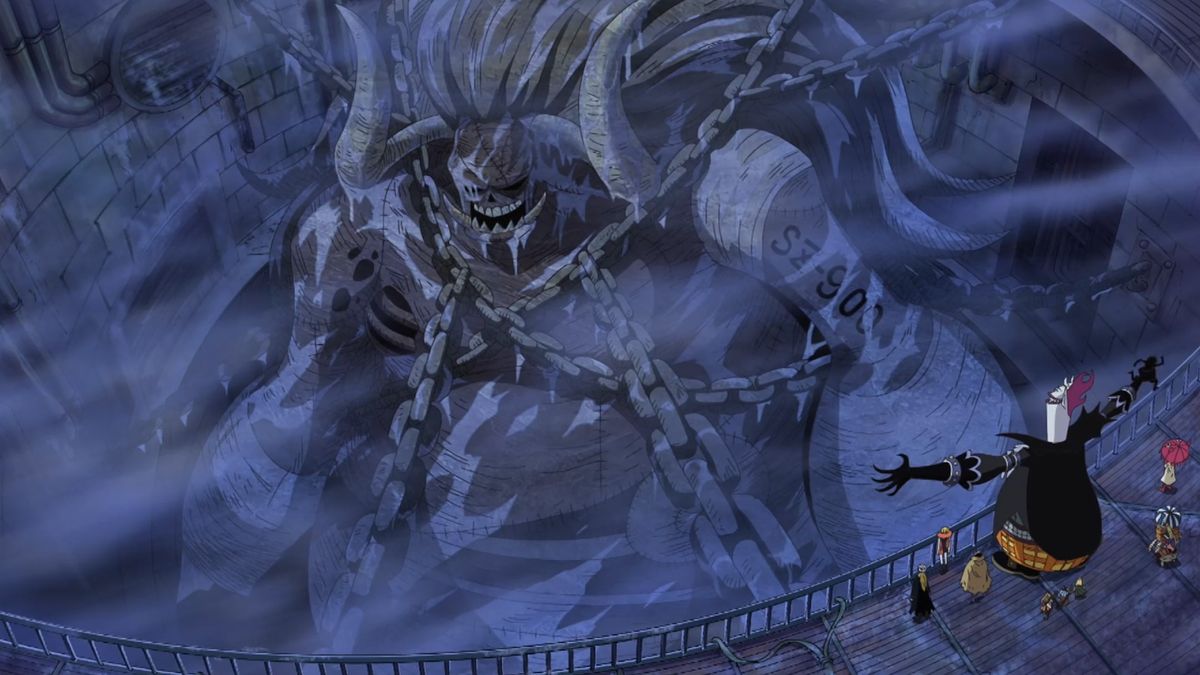
Moria Cuts Luffy’s Shadow and Turns Oars Into Zombie Number 900
One Piece Episode 350 React witnesses Moria cut Luffy’s shadow and place the captain’s identity and strength inside Hogback’s giant Oars body.
What happens
Moria cuts Luffy’s shadow away while Nami, Usopp, and Chopper witness the extraction from inside Kumacy. Hogback’s zombie number 900 receives the shadow, turning the ancient giant Oars into Moria’s most powerful constructed soldier.
RaeRae reacts
Luffy’s strength came from a life organized around freedom and chosen friendship. Moria treats that strength as portable inventory. Oars is frightening because the body magnifies Luffy’s habits while removing Luffy’s right to decide what those habits protect.
Canon note
Episode 350 continues the manga-canon Thriller Bark Arc.
Moria cuts Luffy’s shadow while the captain cannot consent
The extraction is performed on a captive whose body has been delivered into a prepared system. Luffy receives no meaningful opportunity to refuse or defend the part being removed.
Moria treats incapacitation as permission because the process was designed to make permission irrelevant.
The scissors make identity theft look administrative
A familiar tool performs an impossible separation with almost casual efficiency. The visual avoids a grand magical ritual and makes the act resemble routine processing.
That calmness is part of the horror. Moria has done this often enough that another person’s future becomes a standard operation.
Luffy’s shadow is valuable because his life made the shadow powerful
Training, hunger, defeats, promises, friendship, and stubborn movement shaped the habits Moria wants. The Warlord sees only the finished resource.
Extraction erases the history through which strength became meaningful.
The shadow carries energy without carrying Luffy’s authority
Oars may move with familiar impulses once animated, but Luffy does not choose the body, orders, or target. Behavioral resemblance cannot substitute for authorship.
A copied drive becomes coercive when another person decides what the drive will serve.
Nami, Usopp, and Chopper witness the theft from inside Kumacy
Their hiding place gives them access to evidence while denying easy intervention. They see the method, the victim, and the destination for the shadow.
Witnessing creates responsibility and terror at the same time because knowledge arrives before power to stop the procedure.
Kumacy becomes shelter inside the enemy’s own army
The trio hides within a zombie constructed by the same system threatening them. Moria’s body hierarchy contains spaces its commanders do not fully control.
Survival depends on using a flaw inside the infrastructure rather than escaping the infrastructure entirely.
Silence protects the witnesses while the victim cannot speak
Nami, Usopp, and Chopper must suppress reaction to avoid discovery. Luffy’s own silence comes from capture. The room is full of people whose voices have been constrained for different reasons.
Moria’s confidence grows in an environment where objection cannot interrupt the workflow.
Hogback presents Oars as the masterpiece of bodily production
Zombie number 900 represents years of preparation, preservation, and surgical work. The scale invites admiration for technical achievement.
The same scale magnifies the ethical failure because an ancient body has been transformed into a platform for stolen identity.
Calling Oars a doll reveals the intended ownership
The label reduces a legendary warrior’s corpse to an object awaiting activation. Moria and Hogback can admire dimensions and capability without acknowledging the body as remains from a life.
Language clears the way for possession by removing personhood from the description.
The number 900 turns a body into inventory
Serial numbering places Oars inside a production sequence rather than a singular miracle. Hundreds of earlier bodies become implied predecessors.
The masterpiece stands on a history of normalized extraction, not one exceptional decision.
Oars carries five hundred years of silence
The giant lived in another era and cannot explain what his body meant to him. Moria interprets that silence as availability.
Respect for the dead should not depend on whether the dead can physically defend a boundary.
The freezer preserves usefulness rather than dignity
Ice keeps the giant body viable for Hogback’s project. Preservation sounds respectful until the purpose is revealed as future military service.
A body can be meticulously maintained and profoundly dishonored at the same time.
Luffy becomes shadowless before understanding what was taken
The captain may awaken separated from a visible part of himself and unable to survive sunlight. Moria changes the conditions of his life while Luffy remains absent from the decision.
The consequence follows the victim beyond the extraction room.
Sunlight turns escape into another deadline
Leaving Thriller Bark would not automatically restore safety. A shadowless Luffy must remain out of daylight or risk destruction.
Moria’s theft controls geography and time even after physical captivity ends.
The giant body multiplies the danger of familiar impulses
Luffy’s appetite, curiosity, stubbornness, and combat reflex will operate through Oars’s scale. Traits charming inside a chosen life become terrifying inside a weapon.
The body magnifies behavior while Moria attempts to own direction.
Strength without relationship becomes unstable
Luffy’s crew gives his recklessness context, correction, and purpose. Oars receives impulses without the same social history.
Moria wants power stripped of the people who taught that power whom to protect.
The operation converts a captain into his crew’s future opponent
Shadow extraction harms Luffy and manufactures a zombie capable of attacking the people he loves. Moria makes the crew confront an imitation assembled from their captain’s recognizable traits.
The violence targets trust as well as bodies.
The crew must separate Luffy from Luffy-like behavior
Oars may sound or move familiar enough to provoke recognition. The Straw Hats know the real Luffy through choices made together.
Relationship gives them a standard deeper than resemblance for identifying their captain.
Moria sees efficiency where victims see multiplication of harm
One extraction produces a shadowless survivor and a stronger soldier. The Warlord counts increased capacity.
A person-first accounting counts two bodies denied autonomy and a community placed in greater danger.
Brook’s salt knowledge arrives at exactly the right narrative moment
The audience now knows a stolen shadow can be released while watching the most dangerous implantation occur. Hope and escalation meet.
The method exists, but Oars’s size turns delivery into an enormous tactical challenge.
Purification remains the correct goal even when force becomes necessary
The crew may need overwhelming attacks to create access, yet the desired outcome is not merely destroying Oars. Luffy needs the shadow returned.
Strategy must keep restoration visible inside the spectacle of fighting a giant.
Chopper sees medicine used to manufacture obedience
Hogback’s skill has prepared an extraordinary body for Moria’s command. The work demonstrates technical success and professional betrayal simultaneously.
Chopper’s dream of healing cannot accept movement as proof of care.
Usopp sees why information may become the crew’s strongest weapon
He cannot overpower Oars through ordinary means, but he knows about salt, the extraction, and the hidden witnesses. His value grows through communication and application.
Thriller Bark rewards people who can turn frightening facts into usable plans.
Nami understands the approaching environmental deadline
She reads time, route, and weather as survival conditions. Luffy’s missing shadow adds sunrise to the list of dangers she must calculate.
Navigation now includes getting a person back inside his own relationship with light.
The scene turns ambition into theft rather than achievement
Moria wants the strongest zombie, but the strength comes from appropriated lives. Hogback wants a masterpiece, but the materials never chose the project.
Scale cannot convert stolen contributions into legitimate accomplishment.
Episode 350 is an individual React
The page responds to Luffy’s extraction, the hidden witnesses, zombie 900, and Oars receiving the shadow. A full Thriller Bark Review belongs after the arc resolves these consequences.
Correct classification preserves Reviews for whole-work judgment.
The official local still remains the canonical visual
The Episode 350 story image serves as featured image, hero, directory card, and social preview. One visual identity follows readers through every entry point.
Complete metadata records the source, and no neighboring post reuses the asset.
RaeRae’s final receipt
Episode 350 puts a pair of scissors against Luffy’s shadow and turns a captain into inventory. Moria does not create Luffy’s strength. He waits until Luffy cannot resist, cuts away the result of an entire life, and inserts that result into a body Hogback has numbered 900. Oars is called a doll because the men running the room need a word that makes an ancient warrior’s remains sound available.
Nami, Usopp, and Chopper see the theft from inside Kumacy and learn exactly what the crew will have to reverse. Luffy is now endangered twice: sunlight can destroy the shadowless original, and Oars can use familiar energy against the people who know where that energy came from. Moria can copy appetite, force, and motion. He cannot copy the chosen relationships that made Luffy a captain. Brook’s salt method gives the crew a route toward restoration, but Oars turns one precise answer into a giant delivery problem. The spectacle is enormous. The moral receipt remains simple. Neither body volunteered, neither history belonged to Moria, and a masterpiece built from stolen people is still theft.
Witnesses carry facts the extraction room cannot contain
Moria controls the procedure, but Nami, Usopp, and Chopper now know the location, method, intended recipient, and immediate consequence. Information leaves the room with them if they escape.
The hidden trio turns secrecy from absolute protection into a temporary advantage the villain does not realize he has lost.
The shadow links Luffy and Oars without making them one person
Behavioral material crosses from a living captain into an ancient corpse, but identity does not become a simple transfer. Luffy remains the shadow’s rightful owner. Oars’s body retains another history. The zombie emerges as a forced composite.
Ethical analysis must resist the shortcut of treating resemblance as continuity.
Oars becomes a weaponized archive of two stolen lives
The body records a warrior from five centuries earlier. The shadow records habits shaped through Luffy’s present voyage. Moria combines both records while discarding the relationships that made either life coherent.
The strongest zombie is built by preserving fragments and destroying context.
Sunrise gives Moria control without requiring a prison guard
A shadowless Luffy may physically leave a room, yet daylight can enforce confinement across the entire outside world. Environmental coercion follows him where walls cannot.
The theft transforms nature into part of Moria’s security system.
The crew’s deadline belongs to Nami’s navigation work
She must understand how long remains before dawn, where the trapped groups are, and how the island’s movement affects escape. Restoring Luffy is inseparable from managing time.
Her expertise turns a supernatural curse into a route-planning emergency the crew can act upon.
Usopp can translate witness knowledge into tools
Salt is ordinary enough to gather and adaptable enough for his inventive fighting style. Knowing Oars carries Luffy’s shadow gives him a target and purpose beyond generic damage.
The crew’s perceived weakling may become essential because precision matters more than raw scale.
Chopper must confront a medical feat that harms every person involved
Hogback preserved tissue, engineered function, and achieved movement. The patient-centered outcome remains catastrophic. Luffy loses safety, Oars loses rest, and the resulting body enters compulsory military service.
Medicine measured only by technical success becomes capable of celebrating organized abuse.
Moria’s confidence depends on believing relationships are disposable
He assumes strength can be separated from the people surrounding strength and remain equally useful. The Straw Hats repeatedly prove the opposite. Their abilities gain direction through loyalty, correction, and shared purpose.
Oars may possess force, but Moria cannot install the crew that taught Luffy what freedom means.
The crew’s victory condition remains restoration
Oars may demand enormous force, but defeating the giant without recovering Luffy’s shadow would leave the captain barred from daylight. The battle must create access to the animating bond and return what Moria removed.
Success belongs to Luffy’s restored life, not to the size of the crater left behind.
The witnesses preserve Luffy’s claim when he cannot speak
Nami, Usopp, and Chopper know the shadow was taken, where the shadow went, and that the procedure happened without consent. Their testimony prevents Moria from defining Oars as a legitimate creation.
Friends can defend a person’s rights during incapacitation without pretending to own those rights themselves.
Oars proves why stolen power never becomes neutral
The giant’s strength will operate inside Moria’s hierarchy, reinforcing the same system that performed the extraction. Power detached from its owner does not enter an empty space.
Somebody else supplies purpose, targets, and rewards, turning appropriation into continued harm until the shadow is returned.
Returning Luffy’s shadow restores the captain’s authority over the strength, movement, and future Moria tried to claim as military property.
That restoration is the real victory.