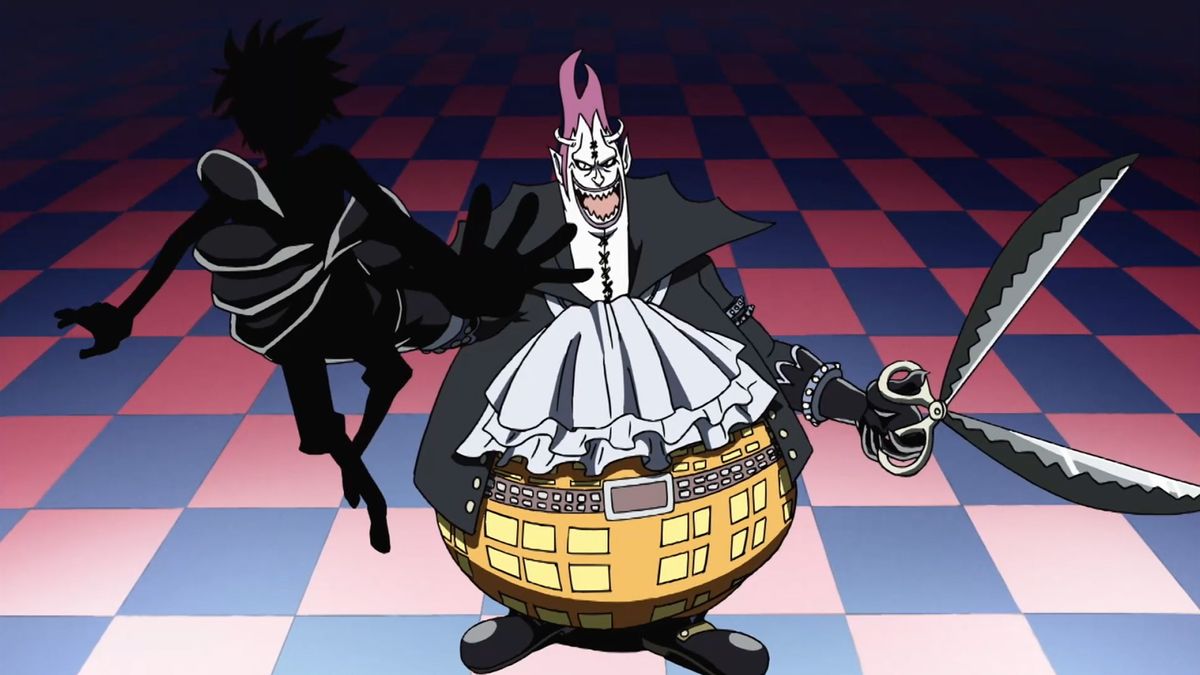
RaeRae Reacts · One Piece Episode 349
Brook Uses Salt to Free Tararan’s Shadow Before Moria Can Take Luffy’s
One Piece Episode 349 React reveals Brook’s zombie-purifying technique and the weakness capable of returning stolen shadows to their owners.
What happens
Brook defeats Tararan with Three-Verse Humming: Arrow-Notch Slash, then uses salt to force the stolen shadow from the zombie’s body. The skeleton who attacked Thriller Bark five years earlier explains the weakness behind Moria’s army.
RaeRae reacts
Salt transforms the fight from endless damage into restoration. Brook knows the difference because he spent years fighting for his own missing shadow. The answer does not destroy a body for spectacle. The answer returns stolen identity toward its living owner.
Canon note
Episode 349 continues the manga-canon Thriller Bark Arc.
Brook enters the fight with five years of unfinished work
He has attacked Thriller Bark before and survived long enough to learn what ordinary sword strikes cannot accomplish. His return carries experience earned through failure, isolation, and repeated attempts to reclaim his shadow.
The crew meets a fighter whose knowledge matters more than the surprise of his body.
Three-Verse Humming: Arrow-Notch Slash ends the visible attack
Brook moves so quickly that Tararan appears intact before the result registers. The technique gives the episode elegance without confusing spectacle for a permanent solution.
Cutting the zombie creates an opening. Brook still needs a method that reaches the shadow animating the body.
Tararan would rise again under ordinary conditions
Moria’s zombies make conventional victory temporary. Damage can interrupt movement while the stolen shadow remains attached.
The system survives by turning every knockout into delay, exhausting opponents who mistake a fallen body for a completed rescue.
Brook knows the difference between defeating and purifying
His response focuses on removing the stolen shadow rather than repeatedly damaging the corpse. That distinction centers restoration.
A fight ends ethically when the living donor recovers what was taken, not merely when the constructed body stops threatening the hero.
Salt becomes the smallest tool capable of changing the whole war
The ingredient looks ordinary beside giant zombies, Devil Fruits, and master swordsmanship. Brook understands that compatibility matters more than scale.
Power is not always the largest attack. Power can be precise knowledge applied to the dependency holding a system together.
The sea returns through salt even inside a closed island
Devil Fruit power animated Moria’s zombie operation, and salt carries the sea’s purifying relationship into the body. The weakness reminds viewers that supernatural control still belongs to a world with material rules.
Thriller Bark’s machinery can be understood, tested, and disrupted.
The shadow leaving Tararan makes absence visible
A black shape rises from the zombie and travels toward its rightful owner. Viewers finally see the stolen component separate from the body using the stolen shadow.
The visual gives victims a direction of return rather than leaving shadow theft as an abstract curse.
Purification restores a relationship between shadow and owner
The shadow is not destroyed when expelled. The goal is reunion. Brook’s method respects that the missing part belongs somewhere beyond the battlefield.
Removal from the zombie becomes recovery for a living person the crew may never meet.
One freed shadow represents an unseen survivor
Tararan’s donor does not need to stand beside the fight for the rescue to matter. Somewhere, a person regains access to sunlight and a stolen piece of identity.
The episode allows action to benefit somebody outside the heroes’ immediate social circle.
Brook’s knowledge grew from being one of those unseen people
He understands the stakes because daylight became lethal after Moria took his shadow. Research was never academic curiosity.
Every successful purification tests a route toward his own freedom while returning freedom to others first.
Expertise belongs to the survivor who kept investigating
Moria’s officers possess institutional knowledge of how zombies are made. Brook developed counter-knowledge from the harmed side of the process.
The episode treats lived experience as a source capable of dismantling systems experts built to appear permanent.
Robin and Franky receive the answer they needed
Their attacks could restrain Tararan, but Brook supplies the mechanism for lasting change. Combat, analysis, and survivor expertise finally meet in one place.
Collaboration turns separate strengths into a viable rescue strategy.
Robin recognizes a repeatable weakness
One successful salt purification can become a method for the larger army. The value lies in reproducibility, not only in saving the current fight.
Her analytical attention helps convert Brook’s act into knowledge the crew can distribute.
Franky sees a system reverse through the correct component
As a builder, he knows structures fail when a key dependency is removed. Salt does not need to overpower the entire zombie body.
The method interrupts the relationship between corpse and stolen shadow, collapsing the function Moria wanted.
The answer reframes every previous zombie battle
Luffy pushing bodies into graves and the crew knocking enemies down looked successful for a moment. Episode 349 reveals why those victories could not last.
New knowledge does not make the earlier effort foolish. New knowledge changes what the next effort should target.
Brook’s five-year campaign gains collective reach
He once fought the island largely alone. Now his method can travel through a crew capable of acting across multiple fronts.
Belonging does not merely comfort him. Belonging scales his hard-won knowledge into shared resistance.
Moria’s greatest protection was not secrecy alone
The operation also relied on victims believing recovery was impossible or too difficult to repeat. A common ingredient threatens that psychological control.
Once people know a stolen shadow can return, fear becomes planning.
Salt does not solve capture, command, or sunlight by itself
The crew still must reach each zombie, protect unconscious friends, escape the island, and confront Moria. A weakness creates possibility rather than automatic victory.
The episode earns hope without pretending one discovery erases the system’s scale.
Luffy’s shadow remains in immediate danger
Brook explains purification while Moria prepares to extract the captain’s most valuable resource. Knowledge and threat advance at the same time.
The crew gains an answer just as the enemy creates a problem large enough to test whether the answer can arrive in time.
A powerful shadow inside a giant body changes the application problem
Salt may release a shadow, but somebody must get close enough and deliver enough under combat pressure. Oars will not resemble an ordinary zombie target.
The method stays valid while the physical challenge expands dramatically.
Brook reveals why he became feared on Thriller Bark
The officers remember a skeleton who disrupted the zombie army years earlier. His threat came from understanding the system rather than possessing the largest body.
Knowledge made one isolated survivor capable of returning shadows the hierarchy considered captured forever.
The episode restores agency to Brook’s introduction
He was first presented as lonely, strange, and restricted by a missing shadow. Episode 349 shows the work he performed within those constraints.
Brook is not waiting passively for Luffy to rescue him. He arrives carrying the key that may rescue everyone.
Music and swordsmanship combine into a personal method
The humming technique reflects Brook’s identity as both musician and fighter. Moria may have stolen his shadow, but Brook continued developing a style the thief did not author.
Creation becomes one way he protects selfhood after extraction.
Purification refuses Moria’s definition of the zombie
Moria sees a durable soldier. Brook sees a stolen shadow attached to a body and understands that the attachment can end.
Changing the description changes the strategic objective from destruction to release.
The shadow’s upward movement resembles testimony escaping
The black form exits visibly, proving that Moria’s army contains other people’s stolen lives. Every purification exposes what the zombie design attempted to conceal.
The battlefield begins producing evidence against its owner.
The injured survivors now have a practical path toward daylight
Episode 343 established what they lost. Episode 349 supplies a repeatable mechanism capable of returning that loss.
Hope becomes material because restoration no longer depends only on defeating a Warlord in the abstract.
This page remains an episode React
The article responds to Brook defeating Tararan, using salt, freeing the shadow, and explaining the zombie weakness. A whole Thriller Bark Review belongs after the arc resolves the operation.
Correct classification keeps individual broadcast analysis in Reacts.
The official local image remains the visual receipt
The Episode 349 story still serves as featured image, hero, directory card, and social preview. The same episode identity follows readers through every entry point.
Complete metadata records the source, and no other post reuses the asset.
RaeRae’s final receipt
Episode 349 gives Brook the entrance he deserves because the important thing is not that a skeleton can move faster than Tararan can see. The important thing is that Brook knows how to make the victory last. He spent five years learning that zombies rise after ordinary damage, that stolen shadows remain the real dependency, and that salt can send a shadow home. Survivor knowledge turns one elegant sword strike into restoration.
That black shape leaving Tararan is somebody’s future returning. Somewhere beyond the fight, a shadowless person can face daylight again. Brook does not need to know the victim’s name before the rescue counts. Robin and Franky can help carry the method across a crew, transforming one lonely campaign into collective strategy. Salt looks tiny beside Moria, Oars, and an army of stitched bodies, but precision embarrasses spectacle when precision reaches the correct wound. Moria calls the zombie durable. Brook calls the shadow stolen. The entire arc changes depending on which description guides the next action.
Counter-knowledge changes who holds authority in the scene
Hogback and Moria built the process, but Brook knows how to reverse one of its essential bonds. Expertise no longer belongs exclusively to the people with laboratories, titles, and subordinates.
The survivor becomes the teacher, and the crew’s strongest next move begins by listening.
Salt creates a method ordinary people can carry
The countermeasure does not require Brook’s Devil Fruit or a legendary blade. Once the crew understands the rule, bags of salt can travel across separate fights.
Accessible knowledge threatens centralized power because resistance no longer depends on one irreplaceable hero.
Distribution matters as much as discovery
Brook can purify the zombie in front of him. The larger army requires the crew to share the method, gather supplies, and reach bodies across hostile territory.
A solution becomes systemic only when information and tools reach everyone capable of applying them.
The corpse deserves release alongside the shadow
Expelling the shadow stops Moria from using a dead body as a soldier. The living donor regains a stolen part, and the corpse can leave compulsory service.
Purification resolves two forms of possession without pretending either history never happened.
Tararan’s defeat becomes a model rather than a trophy
The important result is not that Brook looked impressive. The fight teaches a procedure the crew can repeat: create an opening, deliver salt, release the shadow, and prevent reanimation.
Strategy grows from treating one success as evidence rather than personal glory.
Brook’s loneliness produced knowledge that now protects community
Years spent fighting alone should never have been required, yet Brook refused to let those years become empty. He learned the island’s rules closely enough to help people he had not met.
The crew can honor that labor by ensuring he no longer carries the entire counterattack alone.
The method restores sunlight as a shared public good
Every returned shadow gives somebody access to morning, travel, and ordinary life. Salt therefore does more than win a supernatural contest.
The countermeasure reopens a world from which Moria excluded victims through theft.
Victory must now be counted in returned shadows
The crew can no longer measure progress by how many zombies fall. A body may rise again until the stolen shadow leaves, and a fallen zombie may still represent a living person waiting in darkness. Brook gives them a better metric.
Each release reduces Moria’s army and restores one victim’s access to life beyond the island.
The discovery turns rescue into logistics
Salt must be gathered, carried, protected, and delivered across separate battlefields. Knowledge creates a path, but coordination determines how many people can travel that path.
The Straw Hats’ next challenge is not proving Brook correct. The next challenge is scaling his method before Moria converts their strongest shadows into new obstacles.
Brook’s answer gives hope a procedure
Hope can sound sentimental when a Warlord controls an undead army. Episode 349 makes hope practical: identify the animating bond, open the mouth, apply salt, and watch the shadow return.
A repeatable act gives survivors something stronger than reassurance. The island’s power can be reversed one stolen life at a time.