RaeRae Reacts · One Piece Episode 348
Nami’s Desperate Lie Stops Lola While Moria Prepares to Cut Luffy’s Shadow
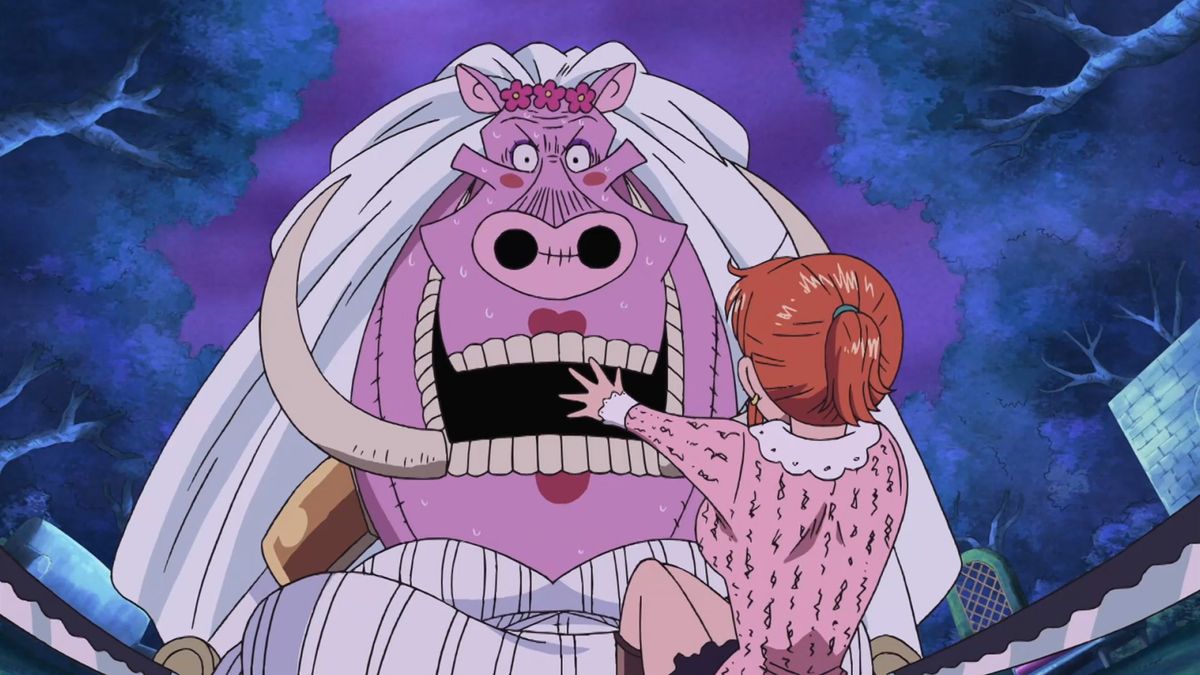
One Piece Episode 348 React lets Nami improvise her way past Lola while a captured Luffy is carried from his coffin toward Gecko Moria.
What happens
Lola corners Nami with drawn blades, and Nami stops the attack by claiming she is actually a man. Elsewhere, Luffy is removed from a coffin and delivered toward Moria, who is ready to use the captain’s shadow.
RaeRae reacts
Nami survives by reading the story Lola has been taught and changing one fact inside that story. The lie is not consent to Absalom’s claim. The lie is emergency strategy while the man responsible remains protected by distance and power.
Canon note
Episode 348 continues the manga-canon Thriller Bark Arc.
Lola corners Nami inside a story Nami never agreed to enter
The blades, pursuit, and jealousy all arise from Absalom’s claim that Nami will become his bride. Nami did not choose him or compete for him.
She is defending herself from consequences attached to a coerced role.
Nami’s lie is emergency strategy
Claiming to be a man interrupts Lola’s attack because Nami understands the rule driving her pursuer. She does not have time to dismantle the entire fiction politely.
A survival lie under threat carries no moral equivalence to Absalom’s manipulative claims.
Reading Lola quickly becomes Nami’s weapon
Nami notices that Lola’s aggression depends on a specific idea of romantic competition. Changing one premise changes the immediate threat.
Her intelligence operates through social analysis rather than brute force, and the split-second improvisation preserves her life.
The absurdity of the lie does not make the danger imaginary
Lola believes an explanation that viewers know is false, creating comedy at the last possible instant. The swords remain real, and Nami’s lack of consent remains real.
Humor arrives through tactical escape rather than proof that nobody was endangered.
Nami should not need to alter her identity to receive safety
The lie works because Lola’s system assigns different treatment according to gender and presumed access to Absalom. Nami gains a pause only by removing herself from the category Lola targets.
Safety built on misrecognition exposes the injustice of the original category.
Lola stops because rivalry mattered more than evidence
She never had proof that Nami wanted Absalom. His announcement supplied enough narrative for violence. Nami’s counterclaim supplies enough narrative to halt violence.
The speed of both shifts shows how little Nami’s actual desires mattered to the conflict.
Absalom controls the situation without standing in the room
His claim organizes Lola’s behavior and Nami’s emergency response from a distance. Power works through stories repeated by others.
The offender does not need to swing the blade when his entitlement has already directed the person holding the blade.
The episode lets Nami author the next moment
Absalom tried to assign her a future. Nami creates a lie that changes the immediate present and opens a route away from Lola.
Improvisation becomes a small restoration of narrative control.
Luffy emerges from a coffin as a living person treated like a corpse
His captors transport him in a container associated with death, preparing a living body for extraction. The imagery anticipates how Moria separates life from one of its defining signs.
Luffy remains alive while the system handles him as material.
The coffin makes capture resemble processing
Moving Luffy from one station to another suggests a workflow rather than a duel. He has been packaged, delivered, and positioned before Moria.
Thriller Bark’s theatrical horror hides industrial efficiency.
Moria approaches the strongest shadow as inventory
Luffy’s personality, combat instinct, and stubborn drive make his shadow valuable. The Warlord does not care how those qualities developed or what Luffy chooses to protect.
Strength becomes a resource precisely because extraction removes authorship.
A captain’s shadow threatens the crew twice
Luffy will become unable to face sunlight, and a prepared zombie may gain recognizable pieces of his power. One act harms the original while manufacturing a new opponent.
Moria converts a victim into both absence and weapon.
The crew cannot consent on Luffy’s behalf
Even a captain who takes enormous risks retains authority over his own body and shadow. Moria’s process does not become legitimate because Luffy often volunteers for danger.
Adventure chosen freely is different from extraction performed while restrained.
Capture removes the conditions Luffy normally uses to fight
He cannot confront Moria on equal footing if immobilized and delivered unconscious or restrained. The operation depends on preventing the victim from exercising the very strength being harvested.
Theft succeeds by separating capacity from opportunity.
Nami and Luffy face parallel losses of narrative control
Nami is assigned a marriage she never chose. Luffy is assigned a military use for his shadow. Both villains write futures around another person’s body.
The arc’s gendered and supernatural violations share an ethic of possession.
The episode crosscuts survival and extraction
Nami talks her way out of immediate death while Luffy moves closer to losing his shadow. One crewmate gains seconds; another loses access to his own future.
The parallel keeps suspense tied to agency rather than spectacle alone.
Lola becomes briefly reachable through her own assumptions
Nami cannot solve the zombie hierarchy during one confrontation. She can identify a lever inside Lola’s belief system and use that lever.
Survival sometimes requires working within a harmful story long enough to escape its sharpest consequence.
The lie does not validate Lola’s claim on Absalom
Nami says what will stop the blades, not what represents a considered moral judgment about Lola’s pursuit. Emergency speech should not be treated as endorsement.
The responsibility for honest boundaries still belongs to Absalom.
Moria’s confidence comes from controlling every stage
His island locates ships, closes gates, separates crews, captures strong people, prepares corpses, and transports victims. By the time Luffy reaches him, resistance has been systematically narrowed.
The Warlord’s power includes infrastructure as much as Devil Fruit ability.
The coffin also mocks Luffy’s appetite for freedom
A captain defined by open horizons is placed inside the smallest possible transport space. Moria compresses movement before trying to detach the shadow that carries Luffy’s restless drive.
The visual conflict makes captivity feel personal.
The threat against Luffy extends beyond the current night
If the shadow enters a powerful corpse, Moria gains a fighter capable of carrying Luffy-like behavior into future raids. The theft could outlast the original encounter.
Identity becomes a weaponized legacy the owner never approved.
Nami’s tactical brilliance deserves more attention than the body joke
The scene may invite laughter at an implausible claim, but her rapid assessment is the real achievement. She recognizes motive, selects a disruptive fact, and delivers the fact with enough confidence to pause a lethal attack.
She survives by reading power faster than power reads her.
The episode shows why victims cannot always tell the whole truth immediately
Truth may not persuade an attacker committed to another narrative. Nami chooses the statement most likely to create safety.
Demanding perfect disclosure during violence would prioritize moral neatness over survival.
Episode 348 remains an episode React
The page responds to Nami’s lie, Lola’s halted attack, Luffy’s coffin, and Moria preparing extraction. A complete Thriller Bark Review belongs after the shadow crisis resolves.
Accurate content type keeps the Reviews directory reserved for whole-work judgment.
The official image remains the local visual receipt
The Episode 348 story still serves as featured image, hero, directory card, and social preview. Readers receive one consistent episode identity across every entry point.
The asset has complete metadata and remains unique to this post.
RaeRae’s final receipt
Episode 348 gives Nami seconds to survive and lets her spend those seconds brilliantly. Lola has two swords, a jealous script, and Absalom’s lie telling her Nami is romantic competition. Nami changes one premise. “I am actually a man” is outrageous enough to stop the blades because she understands that Lola is attacking a category, not listening to a person. The lie is not consent, endorsement, or surrender. The lie becomes an emergency exit built out of the attacker’s assumptions.
Across the island, Luffy is carried from a coffin toward Moria like a living person already converted into inventory. The parallel is ugly and precise. Nami has been assigned the role of bride. Luffy’s shadow is about to be assigned the role of soldier. Neither future belongs to the man making the assignment. Moria wants the captain’s power without the captain’s choice, just as Absalom wants Nami’s body without Nami’s choice. Nami steals one moment of authorship back through improvisation. Luffy is moving toward the machine that will steal Luffy’s shadow. Thriller Bark keeps dressing possession as romance, resurrection, or military genius. Episode 348 keeps the receipt where the euphemisms cannot reach the truth.
Survival speech belongs to the person under threat
Nami chooses what to reveal, conceal, or invent because she is the person facing Lola’s swords. Outsiders do not get to demand a more educational response while she is trying to stay alive.
The immediate ethical standard is whether her words create safety, not whether the attacker receives a perfect explanation.
Lola’s belief changes faster than her commitment to consent
She pauses when Nami exits the category of romantic rival, not because she suddenly recognizes Nami’s right to refuse Absalom. The underlying system remains intact.
Temporary safety therefore depends on preserving the lie until Nami can reach a position where her actual wishes carry force.
Moria turns unconsciousness into administrative convenience
Luffy’s inability to resist lets the Warlord perform extraction like routine processing. The calm workflow hides violence by removing the struggle from view.
Consent cannot be inferred from silence produced through restraint, incapacitation, or capture.
The coffin foreshadows social death as well as physical danger
A shadowless Luffy would be barred from daylight and separated from ordinary movement with his crew. He could remain alive while losing access to the public world his adventure requires.
Moria’s theft creates a living disappearance, making the coffin imagery more than gothic decoration.
The captain’s shadow carries collective investment
Luffy’s strength is his own, yet the crew’s trust, rescues, meals, arguments, and promises shaped how that strength operates. Moria treats the result as an individual asset available for removal.
The extraction steals from Luffy directly and threatens every relationship relying on his chosen leadership.
Nami’s improvisation and Luffy’s capture reveal opposite access to choice
She finds one narrow decision inside danger and uses the opening. Luffy is transported toward a procedure designed to eliminate every decision.
Crosscutting between them makes agency measurable: one character gains a sentence, while another is denied even the chance to speak.
Both storylines demand restoration rather than romantic or heroic shorthand
Nami needs Absalom’s claim rejected, not a prettier proposal. Luffy needs his shadow left attached or returned, not admiration for the powerful zombie created through theft.
The desired outcomes belong to the victims, and the episode becomes clear once their choices define success.
Nami’s lie exposes how little Absalom’s plan knows her
A single false statement can destabilize the pursuit because the villains have built their decisions around categories rather than Nami’s actual self. They know the body Absalom wants and the role he assigned. They do not know the woman making choices inside danger.
Her survival depends on using their shallow story against them.
The extraction room represents the opposite of improvisation
Nami creates options through language. Moria’s process removes options through restraint, specialized tools, and prepared bodies. One person works inside uncertainty; the other relies on infrastructure designed to make refusal irrelevant.
The contrast clarifies why clever survival and organized coercion cannot be judged by the same standard.
Luffy’s shadow is valuable because Luffy cannot be separated from movement
He crosses boundaries, challenges rulers, and treats blocked paths as invitations to act. Moria wants that kinetic identity inside a body loyal to the Warlord.
The theft aims to turn freedom’s habits into enforcement for a prison island.
The episode leaves both escapes unfinished
Nami has delayed Lola rather than dismantled Absalom’s claim. Luffy has not yet lost his shadow, but the machinery is ready. Temporary outcomes keep the moral objective clear.
Safety requires more than one clever sentence, and rescue requires stopping the extraction system at its source.
Nami and Luffy both deserve futures authored from inside their own lives. Her lie protects that right for another moment. Stopping Moria will require the crew to protect the same right before Luffy’s shadow becomes the engine of a body designed to obey somebody else.
Choice remains the line separating adventure from every violation Thriller Bark disguises.
Always.
That boundary must remain visible.