RaeRae Reacts · One Piece Episode 347
Inuppe Protects Nami While Jigoro Turns Zoro’s Swordsmanship Against Luffy
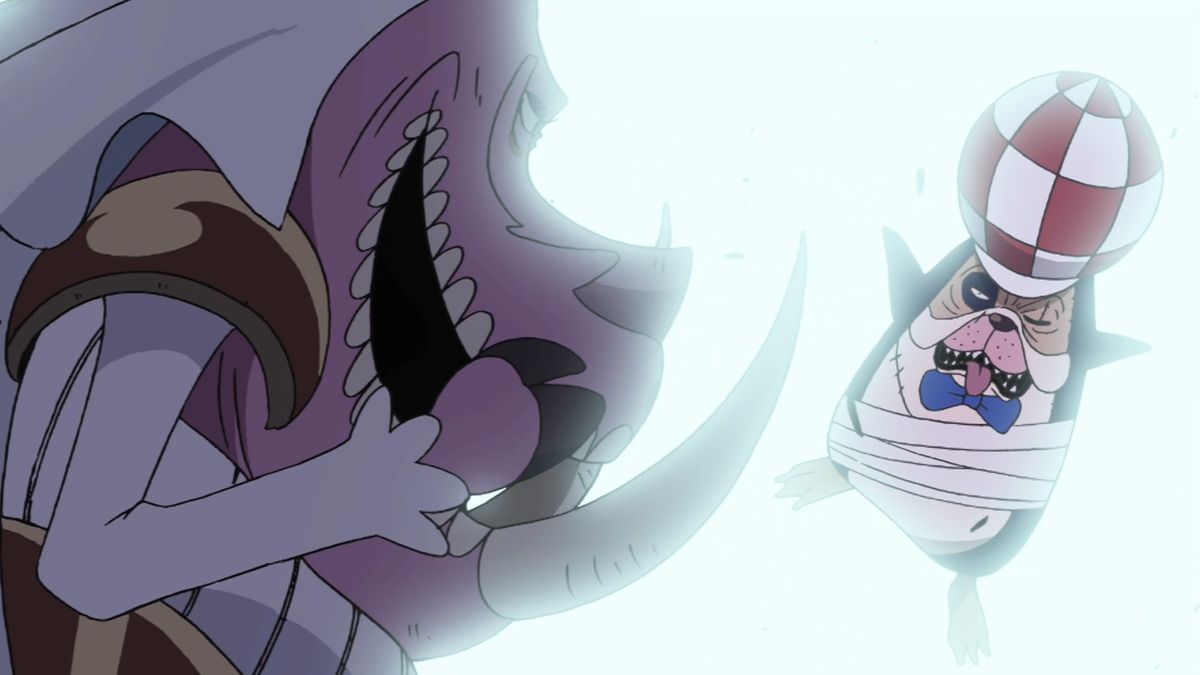
One Piece Episode 347 React follows Sanji-like Inuppe protecting Nami, Zoro-like Jigoro attacking Luffy, Tararan blocking Robin and Franky, and Lola charging.
What happens
Inuppe, a dog-penguin zombie carrying Sanji’s shadow, protects Nami while Jigoro uses Zoro-like swordsmanship against Luffy. Tararan blocks Robin and Franky, and Lola charges Nami over Absalom’s coerced marriage claim.
RaeRae reacts
The shadows preserve recognizable loyalties and skills, but Moria decides where those pieces perform. Inuppe protecting Nami shows Sanji’s habits resisting reassignment even inside an enemy body. Identity leaks through the system without making the system consensual.
Canon note
Episode 347 continues the manga-canon Thriller Bark Arc.
Inuppe carries Sanji’s reflex before carrying Sanji’s name
The dog-penguin zombie moves to protect Nami because Sanji’s shadow brought recognizable priorities into a body he never chose. The impulse survives extraction even while Moria controls the larger assignment.
Identity leaks through the system in ways the commanders cannot completely standardize.
Protecting Nami becomes evidence rather than proof of consent
Inuppe’s intervention helps her, but the zombie still exists through a corpse and stolen shadow combined without permission. A good action inside coercion does not make the coercive arrangement ethical.
The moment reveals resistance within the system rather than approval of the system.
Sanji’s loyalty remains legible across an impossible body
The body looks nothing like him, yet the priority feels unmistakable. Habits shaped through chosen relationships retain direction after Moria attempts to repurpose them.
The episode suggests that strength includes the people a fighter has learned to protect, not only techniques a shadow can reproduce.
Inuppe also exposes the limits of Sanji’s gendered code
His instinct to defend women can be brave, reliable, and wrapped in exaggerated ideas about chivalry. The shadow transfers that code without the full person available to examine or revise that code.
Moria harvests behavior as a fixed asset, freezing contradictions alongside virtues.
Jigoro turns Zoro’s swordsmanship toward Luffy
Zoro’s skill grew beside a promise, a captain, and a crew. Inside Jigoro, recognizable technique attacks the person Zoro chose to follow.
The reversal shows what extraction destroys: ability can survive while purpose is severed.
The swords look familiar while the loyalty does not
Luffy faces movement shaped by his own crewmate without the relationship that normally tells that movement whom to protect. Combat recognition becomes emotionally disorienting.
Moria’s army uses stolen familiarity as another layer of force.
Jigoro is not Zoro even when the shadow remembers technique
A copied stance cannot carry Zoro’s complete memory, judgment, or authorship. The corpse has another history, and the zombie acts under another command.
Calling the composite “Zoro” would erase every person whose parts were forced together.
Luffy must fight a fragment without treating his friend as the enemy
The captain knows Zoro would not choose this attack. Trust separates the crewmate from the behavior being performed in front of him.
That distinction protects the relationship while still allowing Luffy to defend himself.
Moria’s process preserves utility and discards context
Sanji’s protective reflex and Zoro’s swordsmanship become tools because both are useful. Their personal reasons, relationships, and right to direct those abilities do not interest the Warlord.
The zombie system edits identity according to military value.
The shadows resist perfect obedience through personality
Inuppe’s behavior toward Nami conflicts with the officers’ plans. Moria can relocate a shadow but cannot guarantee every habit will support the new command.
Human complexity becomes a flaw in an extraction system designed to treat people as predictable material.
Residual loyalty is not enough to free either victim
Inuppe may protect Nami during one attack, yet Sanji remains shadowless and the corpse remains enlisted. A helpful impulse does not reverse the underlying theft.
Restoration still requires returning the shadow to its living owner.
Lola charges because Absalom’s story reached her first
She believes Nami threatens the marriage she desires. Nami never entered that competition. Absalom assigned her a role and allowed Lola to carry the consequences.
The attack is real, and the narrative creating the attack remains coercive.
Nami faces violence from a woman she did not choose as a rival
Her problem is not winning Absalom. Her problem is surviving people who keep treating his claim as a relationship. Every charge forces her to respond to a fiction written without her consent.
The episode works better when that asymmetry stays visible.
Lola’s own shadow complicates the aggression
The boar zombie carries personality from a living donor while operating inside Moria’s hierarchy. Desire, jealousy, and assigned purpose meet inside one constructed body.
Complex origins explain the situation without making Nami responsible for absorbing the danger.
Absalom benefits while women are pushed toward each other
Lola spends energy attacking Nami instead of challenging the man who dismissed and manipulated her. Nami must defend herself instead of confronting her attacker directly.
Displaced conflict protects the person with the most institutional power.
Tararan blocks Robin and Franky with scale and persistence
The spider-monkey zombie creates another front, preventing the crew’s analytical and engineering strengths from reaching friends quickly. Size becomes delay rather than the whole threat.
Every minute spent on a regenerating body gives officers time to process captives elsewhere.
Robin sees an assembled creature rather than a natural monster
Tararan’s hybrid form points toward Hogback’s work and Moria’s shadow supply. The creature is not random folklore. The body belongs to production.
Understanding construction helps identify the dependency that ordinary attacks cannot solve.
Franky confronts a corrupted version of building
He creates machines and bodies to expand chosen life. Hogback constructs zombies to expand Moria’s ownership. Technical ingenuity appears on both sides, but agency separates care from exploitation.
Franky’s presence makes that contrast impossible to miss.
The separated fights serve one centralized plan
Nami faces Lola, Luffy faces Jigoro, and Robin with Franky face Tararan. Different designs and tones can make the encounters look independent.
The missing shadows and coordinated raid prove every fight belongs to Moria’s system.
The crew’s strengths return as hostile reflections
Sanji’s chivalry and Zoro’s swordsmanship appear outside the people who earned them. Thriller Bark turns the crew’s identity into environmental danger.
The enemy does not invent equal strength. The enemy steals the crew’s own history and points pieces backward.
Chosen loyalty remains the part Moria cannot transplant cleanly
A shadow carries habits, but the relationships surrounding those habits continue developing elsewhere. Zoro’s promise to Luffy and Sanji’s life with the crew involve memory and choice beyond a transferable silhouette.
Moria can copy performance without recreating belonging.
The episode asks where responsibility sits inside forced composites
Zombie actions harm people. Corpses, shadows, commanders, and surgeons each contribute differently to the event. Responsibility cannot be assigned as though every component consented equally.
The clearest accountability belongs to the people who created and direct the system.
Nami needs protection without being reduced to a protection object
Inuppe’s intervention matters, and Nami remains a strategist making her own choices. Her role is not to stand still while versions of chivalry compete around her.
Editorial attention belongs to her survival decisions as much as to the shadow’s familiar reflex.
Strength without authorship becomes another kind of captivity
Jigoro can execute impressive swordsmanship, but the body and shadow do not jointly choose the mission. Performance becomes compulsory.
The episode reveals why a powerful zombie can still embody victimhood alongside danger.
Episode 347 is an individual React
The page responds to Inuppe protecting Nami, Jigoro attacking Luffy, Tararan delaying Robin and Franky, and Lola’s charge. A full Thriller Bark Review belongs after the arc resolves the shadow system.
Correct classification preserves Reviews for whole-work judgment.
The official local image keeps every entry point aligned
The Episode 347 story still serves as featured image, hero, directory card, and social preview. Readers receive one consistent visual identity from shelf to article.
Complete metadata records the episode and source, and no neighboring post reuses the asset.
RaeRae’s final receipt
Episode 347 takes Sanji’s loyalty and Zoro’s swordsmanship, pulls both away from the men who shaped them, and asks what survives after purpose is stolen. Inuppe protects Nami because Sanji’s shadow still recognizes a priority. Jigoro attacks Luffy with technique that looks like Zoro while serving the opposite of Zoro’s chosen promise. Moria can transfer reflex, skill, and comedy. He cannot transfer belonging cleanly enough to make the theft stable.
Nami still should not be reduced to a prize protected by one zombie and attacked by another. Lola charges because Absalom assigned Nami the role of bride without consent and let his fiction redirect another woman’s anger. Tararan keeps Robin and Franky away while every separated fight buys Moria more time. That is the real organization of the episode: familiar traits turned into delay, conflict, and inventory. Inuppe’s chivalry is a crack in the system, not proof that the system works. Jigoro’s swords are a warning, not Zoro’s betrayal. The shadows remember pieces of the crew, and those pieces keep pointing toward relationships Moria never owned.
Inuppe proves that conditioning cannot erase every attachment
Moria expects a transplanted shadow to animate a useful subordinate. Sanji’s attachment to Nami interrupts that expectation. The resulting behavior is not full liberation, but the interruption reveals a limit in the command structure.
A person shaped through relationship may carry priorities that refuse clean conversion into somebody else’s property.
Jigoro shows the darker side of the same persistence
Zoro’s technique survives extraction with enough force to endanger Luffy. Skill remains legible even when loyalty cannot govern the target. Moria benefits from the part of identity easiest to weaponize.
The contrast between Inuppe and Jigoro demonstrates that residual personality can resist, comply, or collide depending on the body and order.
The crew must recover shadows without dehumanizing zombies
Inuppe and Jigoro are dangerous composites, not empty props. A corpse, a stolen shadow, and current behavior meet inside each body. Recovery should free the living donor while acknowledging that the animated figure has been used too.
Thriller Bark makes rescue ethically harder than simple destruction.
Nami’s safety cannot depend on Sanji’s shadow appearing nearby
Inuppe’s protection arrives by accident from a system built to harm the crew. Nami still needs her own route, allies she can contact, and an end to Absalom’s pursuit.
Chivalry can interrupt one blade. Collective action must dismantle the conditions producing repeated danger.
Luffy recognizes Zoro through trust rather than copied movement
Jigoro may reproduce sword patterns, but Luffy knows the person who chose to stand beside him. Relationship provides a deeper identification system than technique.
Moria can make an imitation convincing to the eye without creating the history that gives Zoro’s strength its direction.
Tararan’s delay connects every separated crisis
Robin and Franky cannot reach the others while the spider-monkey occupies them. Nami cannot access the full crew while Lola charges. Luffy confronts Jigoro while Moria’s officers continue working elsewhere.
The episode shows how a system wins time by distributing emergencies across people who would normally reinforce one another.
The stolen shadows become testimony against their thief
Every recognizable habit proves that Moria took something personal, not generic energy. Inuppe’s loyalty and Jigoro’s swordsmanship identify the living people missing those parts.
The army carries evidence of its own illegitimate construction wherever the zombies fight.
The episode makes loyalty more than a personality setting
Inuppe carries a protective tendency, but Sanji’s loyalty also depends on memory, judgment, and repeated decisions made with the crew. Moria can copy the tendency without reproducing the ethical work around that tendency.
Chosen loyalty remains alive with Sanji even while a recognizable reflex appears elsewhere.
Recovery returns the ability to revise oneself
A shadow frozen inside a zombie repeats traits under external command. Returning the shadow gives the living person control over how habits develop, which flaws are challenged, and which promises deserve continued service.
Freedom includes the right to become more than the version an extractor found useful.
The crew’s response refuses to confuse resemblance with replacement
Inuppe and Jigoro may look like evidence that Sanji and Zoro can be reproduced. Luffy’s trust and Nami’s recognition show why the copies remain incomplete.
Friends know a person through shared history, not through a checklist of recognizable behaviors.
The episode leaves those relationships visible inside bodies meant to erase them. Moria can move shadows, but the crew still recognizes the loyalties, promises, and contradictions that made those shadows personal. Recognition becomes the first step toward returning every stolen part to the life capable of choosing its direction.
Those stolen loyalties still point home toward the people who earned them.