RaeRae Reacts · One Piece Episode 345
Perona’s Garden Hides an Army While Lola Is Pointed Toward Nami
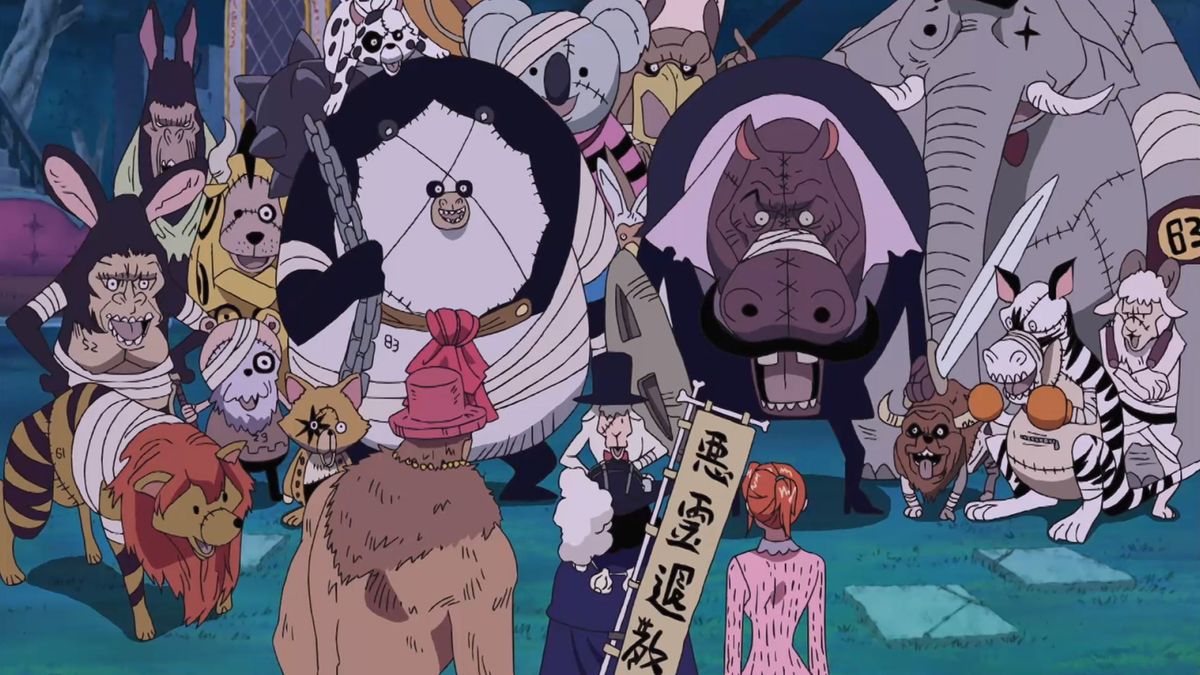
One Piece Episode 345 React opens Perona’s uncanny garden as Absalom mobilizes the General Zombies and redirects Lola’s fury toward Nami.
What happens
The midnight bell begins the zombie night raid. Absalom orders the General Zombies to capture the Straw Hats while Lola, a boar zombie determined to marry him, learns that Absalom has selected Nami as his bride and redirects her fury toward Nami.
RaeRae reacts
Absalom creates conflict between two women by treating both as pieces in his fantasy. Lola’s anger is dangerous, but Nami did not enter a romantic rivalry. She was assaulted and assigned a marriage without consent. The garden’s comedy cannot rewrite that receipt.
Canon note
Episode 345 continues the manga-canon Thriller Bark Arc.
The midnight bell converts Thriller Bark into a battlefield
The island’s hidden population mobilizes when the signal sounds. What looked like scattered horror attractions becomes a coordinated army with commands, targets, and assigned routes.
The Straw Hats did not stumble into supernatural chaos. They entered an operation prepared to process visitors after dark.
Absalom commands General Zombies as extensions of his appetite
He orders powerful bodies to capture the crew while pursuing Nami as a forced bride. Military authority and sexual entitlement emerge from the same belief: other bodies exist to carry out his desire.
The army expands one man’s coercion across an entire island.
The General Zombies expose hierarchy inside the undead
Not every animated body receives the same rank. Strong corpses and useful shadows become elite units, repeating the system’s habit of grading stolen lives by combat value.
Moria’s organization reproduces status even after stripping away original identity.
Perona’s garden looks playful because danger has been curated
Animals, colors, and strange designs create an uncanny storybook space rather than a conventional graveyard. The garden belongs to a commander who treats fear and cuteness as compatible weapons.
Visual charm does not make the creatures free or the environment safe.
Perona turns atmosphere into psychological territory
Her presence changes the texture of Thriller Bark. Moria controls shadows, Hogback controls bodies, Absalom exploits invisibility, and Perona cultivates moods capable of weakening resistance.
The island attacks identity from several directions because leadership divides the work.
The animal zombies make bodily assembly look adorable
The designs invite affection while stitches and hybrid forms still indicate manipulation. Thriller Bark repeatedly packages violation as spectacle, comedy, or charm.
A creature can be delightful to watch and still raise questions about whose corpse and shadow produced the performance.
Lola enters as a woman whose desire has also been engineered into conflict
The boar zombie passionately wants Absalom and repeatedly proposes marriage. Her pursuit can become aggressive, but the hierarchy around her decides where that aggression will be pointed.
Absalom benefits when women compete for access to a man who respects neither woman’s choice.
Absalom redirects Lola toward Nami
He announces his intention to marry Nami, knowing Lola will treat the statement as rivalry. Nami becomes a target because Absalom assigns her a relationship she never accepted.
The conflict begins with his coercive claim, not with anything Nami did.
Nami is not participating in a love triangle
She did not court Absalom, select him, or agree to marriage. He assaulted her and then narrated possession as romance. Lola’s jealousy cannot turn Nami into a willing competitor.
Accurate language keeps the victim’s refusal at the center.
Calling the situation romantic would reward Absalom’s framing
He wants desire to function as permission and “bride” to function as a title he can assign. Describing the conflict as two women fighting over him would erase the coercion creating the danger.
The editorial responsibility is to describe choices actually made, not fantasies claimed by the attacker.
Lola’s anger is dangerous without making her the architect
She threatens Nami and must be held responsible for that threat. The larger situation still comes from Absalom manipulating information and treating both women as pieces around his status.
Responsibility can have layers without disappearing from any participant.
The zombie hierarchy encourages displaced conflict
Subordinates compete, obey, and attack laterally while commanders retain control. Lola’s attention moves toward Nami instead of toward the man using her desire.
Systems protect powerful people when harmed or manipulated people are encouraged to fight one another.
Nami faces danger created before she enters the garden
Absalom’s claim travels through the island faster than her own account. Lola hears his version and acts before Nami receives a chance to speak.
Narrative control becomes another weapon: the person with authority defines the relationship first.
The episode places coerced marriage inside an army mobilization
Wedding language may sound domestic, but Absalom pursues his plan with soldiers and force. The surrounding military structure reveals what the proposal actually means.
A ceremony backed by capture cannot become consensual through decoration.
Perona’s territory shows how femininity can coexist with command
Her aesthetic does not reduce her authority. The garden, creatures, and emotional powers belong to a serious commander within Moria’s structure.
The episode avoids making darkness dependent on masculine visual codes, even while other gendered writing deserves criticism.
Cuteness can function as camouflage
Visitors may lower their guard around whimsical animals before understanding the command structure. Perona’s garden weaponizes the assumption that charming things are less dangerous.
Thriller Bark has already used hospitality, prestige, and romance language the same way.
The night raid gives every commander a target pool
Strong shadows are resources. Crew members become candidates for extraction rather than opponents respected as persons.
The command to capture rather than simply kill reflects Moria’s need to preserve useful material.
Capture threatens identity beyond physical confinement
A prisoner may lose a shadow, have that shadow implanted elsewhere, and survive under lethal sunlight restrictions. The consequences extend after escape.
The crew must prevent a theft capable of reproducing their habits and strengths under enemy command.
Lola’s own zombie condition complicates her agency
She expresses desire and anger, yet her body exists through somebody else’s corpse and stolen shadow. Moria’s hierarchy controls her environment and purpose.
Recognizing that coercive context does not make her threat toward Nami harmless. Complexity should sharpen accountability, not erase consequences.
Nami’s perspective remains the moral anchor
She has been attacked, silenced, and assigned a future. Every new consequence should be evaluated against her repeated lack of consent.
The story’s loud personalities cannot substitute for the choice Absalom refuses to request.
Absalom makes women carry the cost of his entitlement
Nami must defend herself from a claim she never invited. Lola experiences rejection and rivalry manufactured by his declarations. Absalom positions himself as the prize while others absorb the danger.
That pattern deserves more attention than the comedy of proposals.
The garden broadens Thriller Bark’s visual language
The arc can move from foggy ships to gothic mansions, graveyards, laboratories, and surreal animal gardens without losing thematic unity. Every location reorganizes bodies and perception.
Variety keeps the adventure lively while the same consent question follows underneath.
The episode gives the villains operational momentum
Earlier episodes allowed the crew to explore and gather evidence. Episode 345 lets Moria’s officers initiate their plan. The hunted become formally targeted.
That shift prepares the arc for disappearances and shadow extraction rather than isolated monster encounters.
The Straw Hats remain separated while orders circulate centrally
Moria’s side shares commands through hierarchy. The crew’s groups hold partial information and cannot easily coordinate inside fog and architecture.
The imbalance gives organized antagonists an advantage even against individually stronger fighters.
Episode 345 is a React rather than a Review
This page responds to the midnight raid, Perona’s garden, Absalom’s orders, Lola’s jealousy, and the threat directed at Nami. A finished Thriller Bark Review belongs after the arc resolves these conflicts.
Correct classification preserves the Reviews directory for whole-work judgment.
The official image remains the canonical local visual
The Episode 345 story still serves as featured image, hero, directory card, and social preview. The same visual promise follows readers through every entry point.
Complete metadata identifies the source and episode, and no neighboring post reuses the asset.
RaeRae’s final receipt
Episode 345 rings the midnight bell and lets Thriller Bark stop pretending to be a haunted attraction. Absalom mobilizes General Zombies, Perona’s strange garden reveals another command territory, and Lola’s love for Absalom becomes a weapon pointed at Nami. The island keeps converting private desire into organized danger because every officer has bodies available to enforce a personal fantasy.
Nami is not in a love triangle. She did not choose Absalom, compete for Absalom, or consent to the marriage he announced. He assaulted her, assigned her the role of bride, and then allowed that claim to redirect Lola’s anger toward the woman he targeted. Lola remains responsible for threatening Nami, but Absalom is the architect who benefits when two women absorb the consequences of his entitlement. Even the cute animal zombies carry the arc’s larger receipt: bodies and identities have been curated for somebody else’s use. Midnight begins the work shift, and the villains call capture a raid, possession a wedding, and stolen life an army. RaeRae is not signing any of those euphemisms.
Lola has been given a script that rewards competition
Her identity inside the zombie hierarchy is tied to relentless proposals and pursuit. Absalom responds by withholding respect rather than setting honest boundaries, then uses her predictable reaction when naming Nami. The conflict becomes useful entertainment and protection for him.
Women fighting one another leaves the man’s conduct less exposed.
Nami’s refusal exists even when she is absent from the conversation
Absalom cannot manufacture consent by announcing a decision where Nami cannot answer. Her earlier resistance already communicated the relevant truth. A person’s “no” does not expire when an offender changes rooms and tells somebody else a preferred version.
The episode’s information imbalance makes the coercion easier to see.
The General Zombies turn private obsession into public danger
Absalom possesses enough organizational power to send fighters after an entire crew while pursuing one woman. Personal entitlement receives institutional support through Moria’s army.
That scale matters because abuse becomes harder to escape when friends, routes, and transportation can all be targeted by subordinates.
Perona’s garden creates a second lesson about surface reading
Cute animals can be altered corpses. A playful princess aesthetic can belong to a commander. A proposal can conceal coercion. Thriller Bark repeatedly asks viewers to inspect what power does after appearance supplies the first story.
Visual delight remains available, but delight does not excuse abandoning judgment.
The raid treats every Straw Hat relationship as a vulnerability
Separated friends will search for one another, protect one another, and take risks when somebody disappears. Moria’s officers can exploit those bonds while trying to harvest the strength those bonds helped create.
The crew’s care is not a weakness to eliminate. Care is the reason rescue will remain more important than tactical convenience.
Lola deserves analysis beyond a jealous-woman joke
She is threatening Nami, animated through a stolen shadow, and operating inside a hierarchy that defines her around desire for Absalom. Those facts can coexist. Flattening her into comic jealousy would hide both the harm she may cause and the manipulation shaping her target.
A fandom site has room for the full contradiction instead of choosing the easiest gag.
The episode makes euphemism part of the villain’s strategy
“Bride” sounds celebratory. “Night raid” sounds like adventure. “General Zombies” sounds like fantasy spectacle. Beneath those labels sit assault, capture, corpse use, and shadow theft.
RaeRae’s editorial voice keeps the fun of the genre while refusing to let attractive terminology launder what characters actually experience.
The women do not owe Absalom a cleaner conflict
Nami can resist, Lola can redirect her anger, and neither response needs to preserve Absalom’s comfort. His manipulation created the collision. Accountability begins by removing his claim from the center and asking what each woman was allowed to choose.
The episode becomes stronger when viewers refuse to applaud a man for surviving danger he deliberately arranged around women.
Perona’s garden and Lola’s pursuit make the raid visually playful, but the command remains capture. Every charming creature and dramatic proposal sits inside an organization collecting shadows. The episode works best when fandom enjoys the designs while keeping the coercive machinery visible beneath them.
The garden is beautiful, Lola is funny, and the danger remains real. Holding all three truths gives fandom room to enjoy the episode without borrowing Absalom’s preferred story. Nami’s refusal still defines the relationship, regardless of how loudly anybody else announces a wedding.