RaeRae Reacts · One Piece Episode 344
Ryuma Carries Brook’s Shadow While the Midnight Bell Begins the Zombie Raid
One Piece Episode 344 React enters Hogback’s forbidden laboratory, meets samurai zombie Ryuma, and hears the midnight bell begin Thriller Bark’s night raid.
What happens
Nami, Usopp, and Chopper look inside Hogback’s forbidden laboratory and are thrown into the room with samurai zombie Ryuma. His laugh, skull humor, and request to see Nami’s underwear echo Brook because the swordsman’s body carries Brook’s stolen shadow. At midnight, Thriller Bark’s night raid begins.
RaeRae reacts
Ryuma proves that Moria steals more than combat ability. A shadow carries habits, timing, and pieces of social identity into a body the original person never chose. The copy is recognizable enough to wound Brook while remaining completely outside his control.
Canon note
Episode 344 continues the manga-canon Thriller Bark Arc.
The forbidden laboratory turns curiosity into forced entry
Nami, Usopp, and Chopper look through the space Hogback ordered them not to see, then Ryuma throws them inside. The host uses secrecy to define their observation as wrongdoing while his own system controls where their bodies go.
The episode distinguishes trespass against a room from violations committed against persons. Hogback’s privacy claim cannot outweigh evidence of stolen bodies.
Ryuma arrives wearing a history that does not belong to Brook
The samurai’s corpse carries its own legendary past, while the animating shadow carries Brook’s habits and personality fragments. Moria’s system produces a composite without permission from either source.
The result is not a clean resurrection. Two histories have been forced into one weapon.
Brook’s laugh emerges from another man’s mouth
“Yohoho” should identify the skeleton musician the crew met over dinner. Hearing the laugh from Ryuma destabilizes recognition because voice and body no longer travel together.
Shadow theft becomes audible. Moria has made personality portable and stripped Brook of control over where pieces of him appear.
The skull joke becomes a mummy joke through imperfect copying
Ryuma repeats Brook’s comedic structure while adapting the body named in the joke. The variation proves the shadow carries patterns rather than a complete recording.
Personality survives as behavior separated from memory, relationship, and consent. The resemblance is funny until the theft beneath the timing becomes visible.
Ryuma asking to see Nami’s underwear repeats Brook without context
The request links the zombie directly to Brook’s social habits, including a gag that violates Nami’s boundaries even when spoken politely. Consent still matters inside comedy. Nami owes neither man access to her body.
The copied behavior also shows how Moria can reproduce a person’s flaws alongside useful skills.
Nami recognizes the echo before understanding the mechanism
She has heard Brook’s phrasing recently enough to notice the resemblance. Observation becomes the bridge between two separated storylines.
The trio does not need a full technical briefing to conclude that Ryuma is carrying something taken from the skeleton they met.
Usopp sees imitation become evidence
A repeated laugh and repeated joke could be coincidence in a less absurd world. Thriller Bark has already presented stolen shadows and animated corpses. Usopp can place the new behavior inside an emerging system.
Fear sharpens when the monster sounds familiar for reasons nobody consented to create.
Chopper must examine a body assembled beyond medical ethics
Ryuma moves, speaks, and fights, yet the body has been paired with an unwilling living donor’s shadow. No surgical success can erase that origin.
The episode keeps pressing Chopper toward a definition of medicine that includes autonomy, not only function.
Ryuma’s legendary corpse has also been denied rest
Brook is the obvious living victim because viewers know him. The dead samurai’s body was removed from its own history and redeployed under Moria’s command.
Respect for the dead requires more than admiring combat ability. The corpse should not be reduced to equipment because the original owner can no longer object aloud.
Moria’s zombie system edits identity for utility
The shadow supplies animation and behavior. The corpse supplies physical capacity. Hogback’s modifications make the combination functional. Everything not useful to the army can be ignored.
That process resembles an archive assembled by a conqueror: pieces are preserved only after their original relationships have been destroyed.
Ryuma makes Brook’s loss visible without restoring Brook
The crew can now see how the stolen shadow operates, but the visible proof remains attached to somebody else’s body. Recognition does not equal recovery.
The encounter converts an abstract missing part into an opponent who can defend the theft with Brook’s own skills.
A copied personality is not the same as the person
Ryuma can laugh like Brook and reproduce verbal habits without carrying Brook’s full memory, commitments, or relationships. Personhood emerges from more than repeatable traits.
The episode guards against confusing a convincing performance with continuity of self.
The laboratory reveals production rather than miracle
Hogback speaks about resurrection as singular genius. The room and its occupants show a repeatable workflow serving Moria’s army. Bodies enter, shadows animate, and zombies receive assignments.
Industrial scale changes the moral meaning of every claimed breakthrough.
Midnight converts the whole island into a work shift
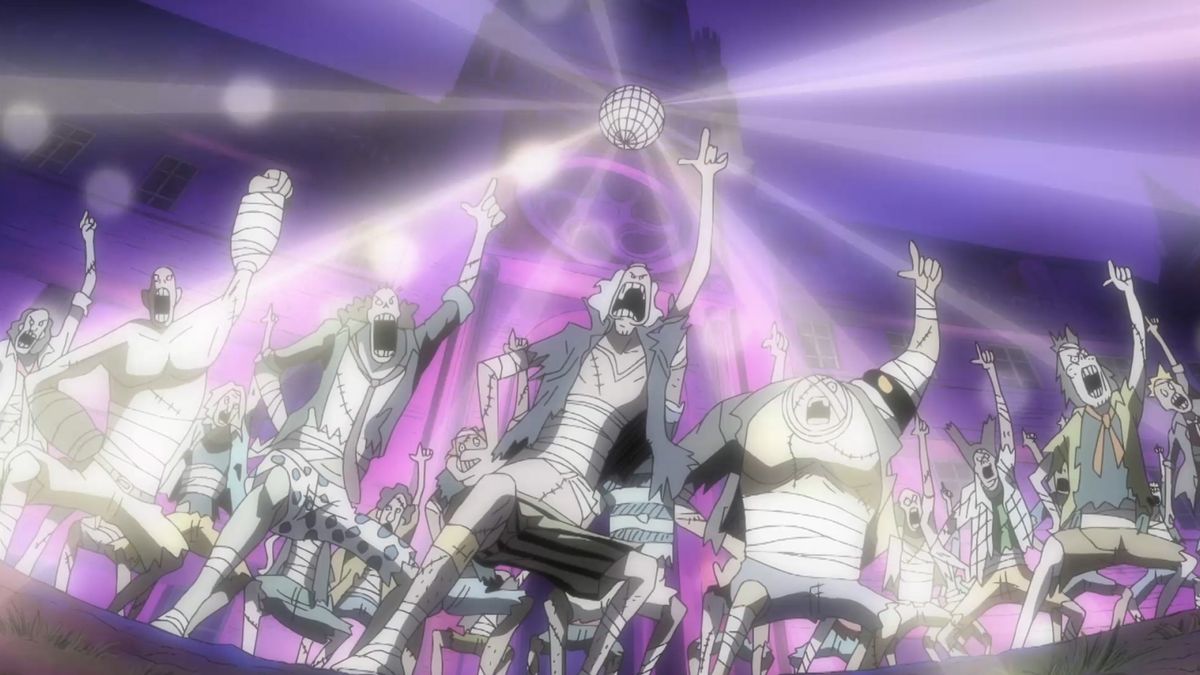
The bell signals the beginning of the night raid. Zombies do not awaken through natural mystery; they mobilize on schedule under command.
Thriller Bark’s gothic atmosphere hides a disciplined organization whose labor cycle depends on stolen bodies and shadows.
The bell gives sound to centralized control
Every subordinate can hear when Moria’s operation changes phase. The signal coordinates bodies scattered across graveyard, mansion, garden, and forest.
The crew experiences separate attacks, but the bell reminds viewers that those attacks belong to one plan.
Night protects the zombies while trapping the shadowless
Darkness gives Brook and other victims temporary protection from sunlight. The same hours allow Moria’s forces to operate at full scale.
The environment that lets victims survive also belongs to their captor’s preferred battlefield.
The raid turns arriving guests into targeted inventory
The Straw Hats are not merely trespassers wandering through a haunted island. Moria’s organization has identified them as people with strong shadows worth taking.
Threat grows from combat danger into extraction. Losing may mean the enemy continues using part of a crewmate after the body escapes.
Strong shadows make strong people valuable in the wrong way
The crew usually experiences strength as protection and freedom. Moria sees the same strength as a resource to harvest.
Power attracts a form of predation designed to detach ability from the person who earned and directs that ability.
The zombie song turns forced labor into celebration
Music and group performance make the raid feel festive for the army. The spectacle attempts to normalize a system built from violation.
One Piece often uses parties to express chosen community. Thriller Bark offers the corrupted inverse: coordinated joy under a hierarchy that stole the participants’ animating parts.
Brook’s musical identity receives a dark counterfeit
Brook values music as memory, promise, and connection. Moria’s island turns copied rhythm and personality into atmosphere for an assault.
The zombie song demonstrates what happens when expression is detached from the person and reassigned to power.
Nami’s group is inside the production site when the shift begins
The trio lacks a clean route to Sunny and stands near the evidence Moria’s people most need to protect. Midnight therefore intensifies both physical and informational danger.
They are witnesses in a system preparing to process new victims.
Ryuma is frightening because he can weaponize familiarity
A wholly unknown swordsman would present one problem. Ryuma carries gestures linked to a potential friend, forcing the crew to recognize Brook inside an enemy without confusing the two.
Moria uses stolen identity to complicate emotional judgment alongside combat.
The episode refuses a simple boundary between body and self
Ryuma’s corpse has history. Brook’s shadow has habits. The zombie has behavior emerging from the forced combination. None can be responsibly collapsed into another.
Thriller Bark makes metaphysical confusion serve a concrete ethical point: complicated identity never grants an owner permission to use every component.
The laboratory and bell expose a supply chain
Hogback supplies prepared bodies, Moria supplies shadows, commanders mobilize units, and the island captures new arrivals. Each stage depends on the previous violation.
Responsibility extends across the chain rather than stopping with the person who performs the final attack.
This page is an episode React
The article responds to Episode 344’s laboratory entry, Ryuma reveal, Brook echoes, midnight bell, and zombie raid. A full Thriller Bark Review belongs after the complete arc can be judged.
Correct classification preserves the distinction between individual broadcast response and whole-work evaluation.
The official image remains the canonical visual
The local Episode 344 story image serves as featured image, hero, directory card, and social preview. The visual identity stays consistent across every entry point.
Complete metadata identifies the episode and source, and no other post reuses the asset.
RaeRae’s final receipt
Episode 344 gives Brook the nightmare of hearing himself come out of somebody else’s body. Ryuma laughs “Yohoho,” rebuilds a skull joke around a mummy, and repeats the underwear request Nami never owed Brook in the first place. The resemblance proves Moria did not steal a battery. He stole habits, rhythm, skill, and pieces of social identity, then attached them to a legendary corpse whose own history was also taken out of context.
The midnight bell makes the operation even uglier because Thriller Bark is not improvising. Hogback prepares bodies, Moria inserts stolen shadows, commanders mobilize units, and the island opens another night shift designed to capture new inventory. A zombie song tries to make organized violation sound like a party. Brook’s music means promise and connection; Moria’s counterfeit uses personality without relationship and performance without choice. Ryuma is not Brook, even when Brook’s timing escapes through his mouth. The corpse is not equipment, the shadow is not property, and a working body is not proof of ethical resurrection. Episode 344 exposes the whole supply chain, rings the bell, and lets every stolen piece start marching.
The copied joke reveals why identity cannot be reduced to data
Moria’s process can transfer recognizable patterns, but recognition alone does not recreate the relationship that gave those patterns meaning. Brook’s laugh on the ghost ship welcomed human contact after isolation. Ryuma’s copied laugh belongs to a weapon inside the system that caused the isolation.
The same sound carries opposite moral context because agency and history matter.
Ryuma forces the crew to separate resemblance from responsibility
Brook owns his choices, including jokes that cross Nami’s boundaries. He does not own Ryuma’s actions merely because his shadow supplies behavioral material. The zombie occupies a body, chain of command, and present encounter Brook did not choose.
Moria’s theft creates resemblance without transferring moral authorship cleanly.
The night raid treats time as another controlled resource
Moria knows when shadowless victims must hide and when zombies can move without daylight. Midnight is not decorative atmosphere. The schedule exploits biological vulnerability created by the original theft.
Controlling the conditions around a victim can be as effective as controlling the victim directly.
The bell announces confidence built from repetition
This raid has happened before. Commands, units, and routes already exist because Thriller Bark has processed other crews. The Straw Hats are entering a practiced routine rather than inspiring a spontaneous defense.
That history expands the unseen victim count and explains why the operation expects fear to become compliance.
Brook will eventually need to confront a body carrying his stolen strength
Recovery cannot happen through abstract declaration. His shadow is defended by a legendary swordsman’s corpse and years of imposed separation. The coming confrontation will ask Brook to fight an externalized fragment of himself.
Episode 344 makes that future personal before swordsmanship makes the encounter spectacular.
The copied habits also make recovery emotionally urgent
Brook’s shadow is not sitting inert inside a vault. Pieces of his recognizable expression are performing for Moria’s operation every night. Delay means continued use of his identity without permission.
Ryuma therefore becomes more than a strong opponent. The swordsman is living evidence that theft keeps happening after the original moment of removal.
Recovery will require separating Brook’s continuing self from the weapon built through his shadow. The battle cannot undo the years already stolen, but returning the shadow can restore daylight, choice, and the possibility that Brook’s familiar laugh belongs to him wherever the crew hears that laugh next.
Restoring Brook means returning control over where his skill, voice, and recognizable habits travel. The shadow belongs inside a life capable of choosing what those gifts serve.
Brook deserves to reclaim every stolen piece of himself.